
Introduction
An unpaid internship cover letter should make the proposed arrangement clear while showing why the placement fits your learning goals. Explain what you hope to learn, what relevant experience you can contribute, and whether your dates or academic requirements need coordination. Specific details help the employer assess fit without asking you to claim experience you do not have.
This scenario adds attention to unpaid terms, availability, and academic credit to the usual task of explaining your fit. It does not assume that an unpaid placement is lawful or that school credit settles that question. Confirm relevant terms with the host and, where applicable, your school and official guidance for your location.
What to address directly
Whether the unpaid arrangement is appropriate
- Hiring manager concern
- A posting's unpaid label does not, by itself, establish that the arrangement meets local rules. In the United States, the Department of Labor uses a multi-factor primary-beneficiary test for unpaid internships at for-profit employers. Academic credit alone does not determine the outcome.
- What your letter should prove
- You can focus your letter on the opportunity without making a legal claim. Before accepting, check current rules for the location and type of host. For US for-profit internships, consult the Department of Labor's guidance. Other jurisdictions may apply different rules.
Whether your dates and school requirements align
- Hiring manager concern
- A host may have a set schedule, while your school may require specific dates, approval, or documentation. A mismatch could affect whether the placement works for either side.
- What your letter should prove
- Check your calendar and ask your school what it requires before making a definite promise. State confirmed dates clearly; if they are not final, say when you expect to confirm them. Mention credit only as required, optional, or pending, whichever is accurate.
Whether you have enough experience to offer
- Hiring manager concern
- Applicants may feel pressure to compensate for limited employment history with inflated claims or vague enthusiasm. That makes it harder for a reader to understand what the applicant can actually do.
- What your letter should prove
- Choose one relevant example from coursework, a campus activity, volunteering, or a personal project. Describe your own task and what it shows about how you learn or contribute. Keep the example accurate, modest, and connected to the placement.
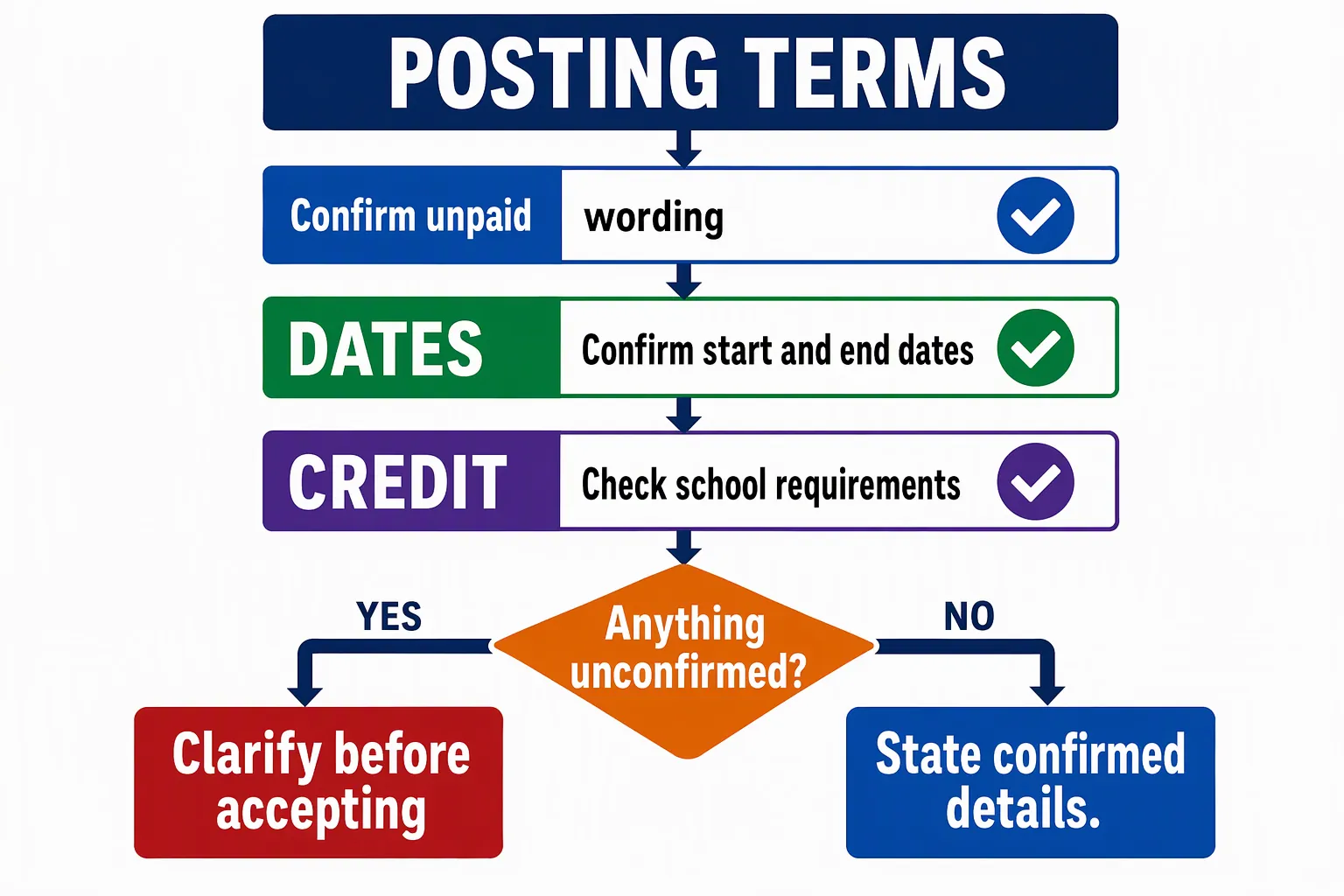
Structural approach for an unpaid internship letter
Keep the letter focused on the posting and the practical details that matter for this placement. A useful cover letter structure guide can help with paragraph order, but keep the unpaid-internship details explicit when they apply to you.
Use a concise letter unless the employer asks for another format or separate answers. Do not use the letter to negotiate terms you have not discussed or imply that an unpaid arrangement has been reviewed by your school or a regulator.
- 01
Name the placement and your reason for applying
Use the posted [Job Title] and [Company Name]. Give a specific reason this placement interests you, such as a stated project, learning opportunity, or type of work. Avoid relying on “I want experience” alone: say what you hope to learn and why it fits your current studies or direction.
- 02
Connect one relevant example to the work
Choose a class assignment, student activity, volunteer task, or other real example that relates to a responsibility in the posting. Explain what you did, the skill you used, and how it could help you contribute. If you do not have a direct example, be clear about the connection rather than presenting it as equivalent professional experience.
- 03
State availability and credit accurately
Give your confirmed start and end dates if you know them. If you still need to check your academic calendar, state that plainly and give a realistic date for confirming. Explain whether credit is required, optional, or unconfirmed, and mention school paperwork only if it applies to your situation.
- 04
Clarify terms before making commitments
If the posting leaves the schedule, duties, supervision, or school coordination unclear, ask a concise question through the appropriate application channel. Do not promise that unpaid work meets legal requirements or assume a host's interest settles that issue. Check school requirements with your school and applicable legal questions against current official guidance for your jurisdiction.
Unpaid internship cover letter example
Preview a fictional example that makes a summer schedule, learning goal, and academic-credit status clear without claiming that credit determines whether an unpaid placement is lawful.
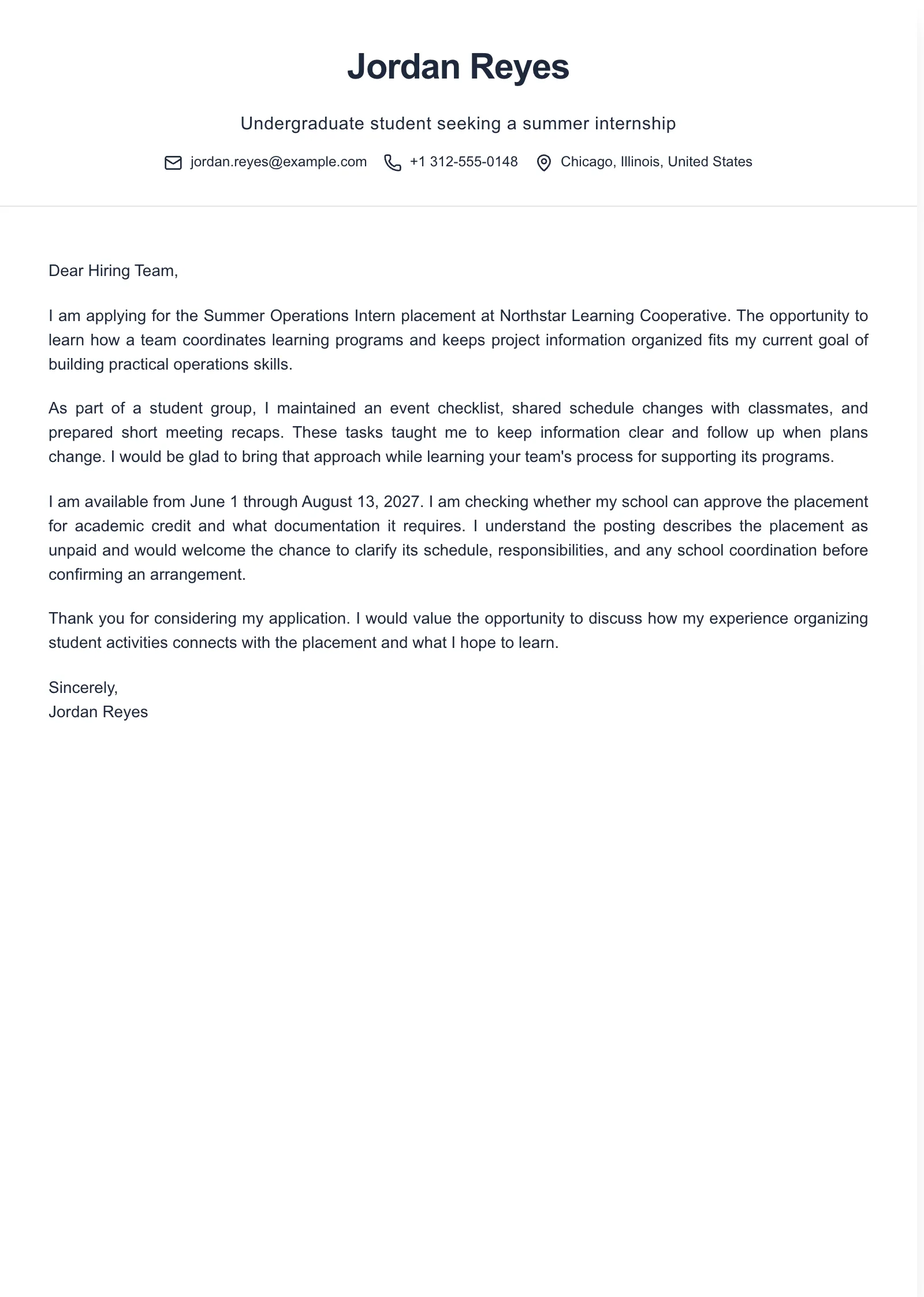
Example paragraphs
“I am applying for the [Job Title] placement at [Company Name] because its work on [specific project or activity from the posting] connects with my goal of learning [specific skill or process]. In [course, project, or activity], I [factual task], and I would value the chance to build on that experience.”
“For [class project, campus activity, or volunteer task], I [specific action] using [relevant skill or tool]. The experience taught me [specific lesson], which I could apply while supporting [responsibility named in the posting] at [Company Name].”
“I am available from [confirmed start date] through [confirmed end date]. [Academic credit is required, optional, or still being confirmed], and [briefly describe any school documentation or timing question that applies]. I would be glad to clarify these details before confirming the placement.”
Adapt each paragraph to a real detail from the posting and your own record. Keep factual placeholders specific enough to check. If you do not know a date or school requirement yet, say that it is unconfirmed instead of guessing.
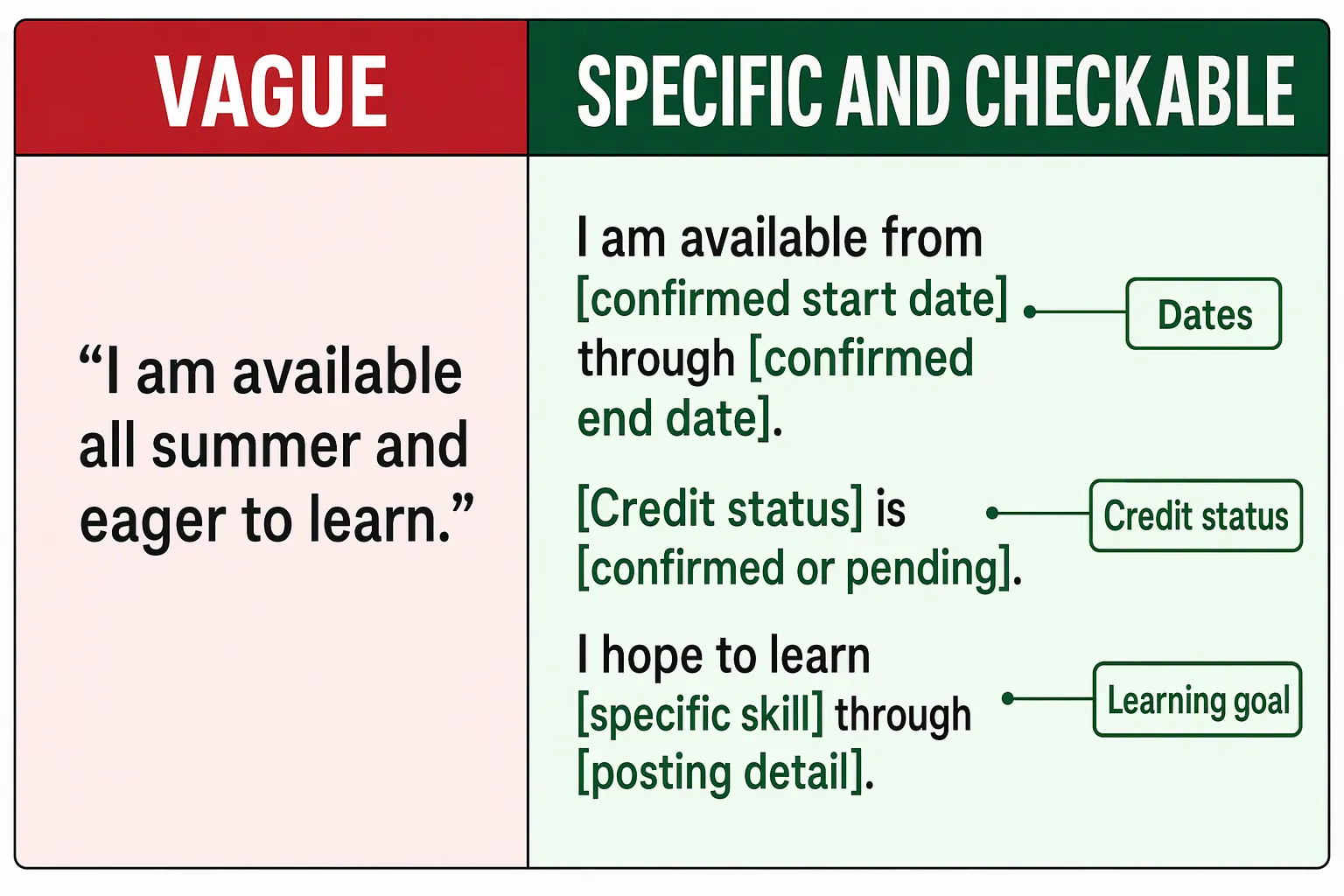
Scenario-specific mistakes in an unpaid internship letter
Treating academic credit as proof of legality
- What goes wrong
- Saying a placement is lawful because your school offers credit makes a legal conclusion that credit alone does not establish.
- Better approach
- Describe your credit status accurately, then check the applicable official guidance and school requirements separately.
Leaving availability vague
- What goes wrong
- Saying you are available “this summer” does not show whether your dates match the placement.
- Better approach
- Give confirmed start and end dates, or state what you still need to confirm and when you expect to know.
Calling every school activity professional experience
- What goes wrong
- Presenting a class assignment as a job can mislead the reader about your work history.
- Better approach
- Label coursework, volunteering, and student activities honestly, then explain the relevant task or skill.
Promising terms you have not checked
- What goes wrong
- Agreeing to a schedule, duties, or unpaid conditions before understanding them can create avoidable confusion.
- Better approach
- Ask focused questions about unclear terms and check any school or jurisdiction-specific requirements before accepting.
Frequently asked questions
- Should I say that I am willing to work without pay?
- You can acknowledge that the posting describes the placement as unpaid, but do not treat that description as proof that the arrangement is lawful. Rules depend on the jurisdiction and circumstances. For a US for-profit employer, consult current Department of Labor guidance and, when needed, an appropriate official adviser.
- Should I mention academic credit?
- Yes, if credit affects the placement or you need the host to complete school documentation. Be precise: say whether credit is required, optional, or still being confirmed. Do not imply that credit alone makes an unpaid placement lawful.
- What dates should I include for a summer internship?
- Give the earliest date you can start and the last date you can stay, or state when you will confirm them. Check your school calendar and any required placement dates first. Do not promise availability you have not verified.
- What if I have little work experience?
- Use a relevant class project, campus activity, volunteer commitment, or personal project to show how you approach a task. Explain what you did and what you learned. Do not present coursework as paid work or claim results you cannot support.

Put this career change approach into practice
Choose sample data or build your own cover letter, then personalize it before you download.