
Introduction
A cover letter for a university staff position should connect your experience to the work the posting describes. Staff roles may support student services, administration, operations, or other campus functions. Do not assume a non-faculty application calls for research or teaching materials unless the posting asks for them.
Your evidence may come from a campus role or from another setting where you handled a relevant service or process. Name the people or work supported, the action you took, and the result you can verify. A general cover letter structure guide explains the basic parts; this page focuses on making those parts specific to university staff work.
What to address directly
Explaining the setting of your experience
- Hiring manager concern
- A posting may identify campus services, systems, or processes that matter for the position. If you have not worked at a university, avoid making another setting sound like a campus role just to appear familiar with that environment.
- What your letter should prove
- If you have relevant campus experience, name the unit or service and what you handled. If you do not, describe a comparable process from another setting, such as coordinating appointments or routing requests. State where the work took place, then explain the specific skill or process that connects to the listed duty.
Making administrative work concrete
- Hiring manager concern
- Coordination, recordkeeping, and follow-through can sound like a list of routine tasks when the letter does not show how you handled the work.
- What your letter should prove
- Choose one real workflow and describe what came in, how you organized or routed it, and how you checked whether it was resolved. Include accurate scale or outcomes only when you can explain how you know they are true. A clear handoff or follow-up step can make your contribution understandable without adding an invented metric.
Connecting service to the advertised position
- Hiring manager concern
- A general claim that you enjoy helping people does not show how your experience relates to the particular office or service in the posting.
- What your letter should prove
- Identify who the role serves and what work the posting says must be coordinated, tracked, or communicated. Connect one example to that responsibility, such as handling inquiries or maintaining a dependable process. Do not assume that every university office serves the same audience or follows the same procedures.
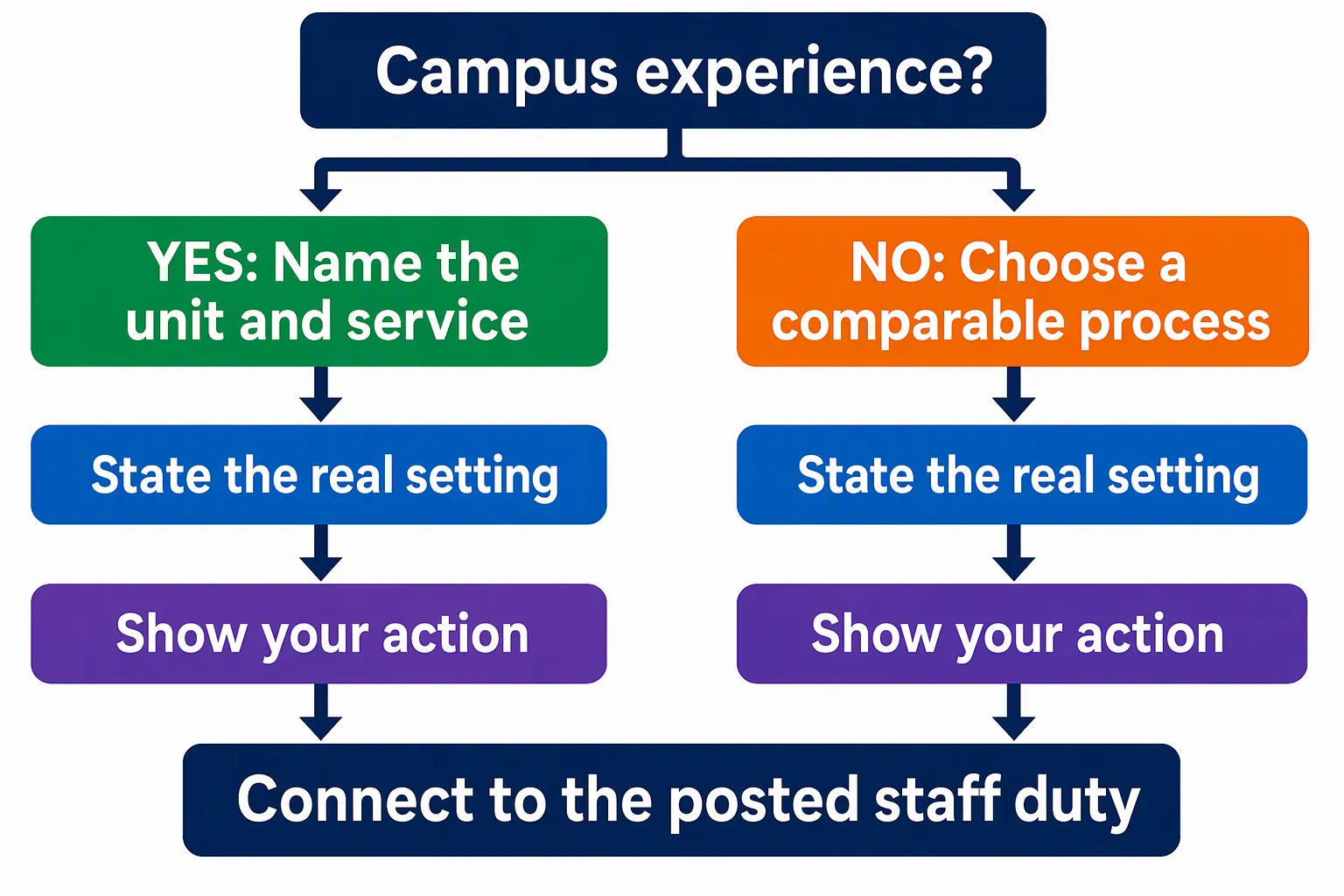
Structural approach for a university staff cover letter
Build the letter around the staff responsibilities in the posting, not a general story about university life. Choose evidence that shows service, coordination, accuracy, or another listed requirement. This guide to opening a cover letter can help you choose a focused first point; use the rest of the letter to substantiate it.
- 01
Identify the work unit and its needs
Read the posting for the office or service the role supports, its audiences, and its recurring tasks. Note the required qualifications and application instructions. Use the institution's name and advertised job title accurately; do not substitute a broader or more senior title.
- 02
Select one relevant process example
Choose a real example that demonstrates a key responsibility, such as coordinating requests, keeping records current, or supporting a service. Campus experience can be relevant when it matches a listed duty, but experience from another setting may also show a useful process. Keep the setting clear so the reader can judge the connection.
- 03
Explain your contribution and its effect
Describe the action you personally took and how it helped the work proceed. For example, show how you organized a handoff, checked information, or followed up on an unresolved request. Use a number or outcome only when it is accurate and you can explain its basis.
- 04
Close on the role's actual priorities
Briefly connect your evidence to a responsibility in the posting and state what you would bring to that work. Keep the tone professional and direct. If the employer requests a separate response to selection criteria or supporting documents, prepare them separately and follow the stated instructions.
University Staff Position Cover Letter Example
This fictional example connects transferable program operations experience to a university staff role without presenting the application as a faculty letter.
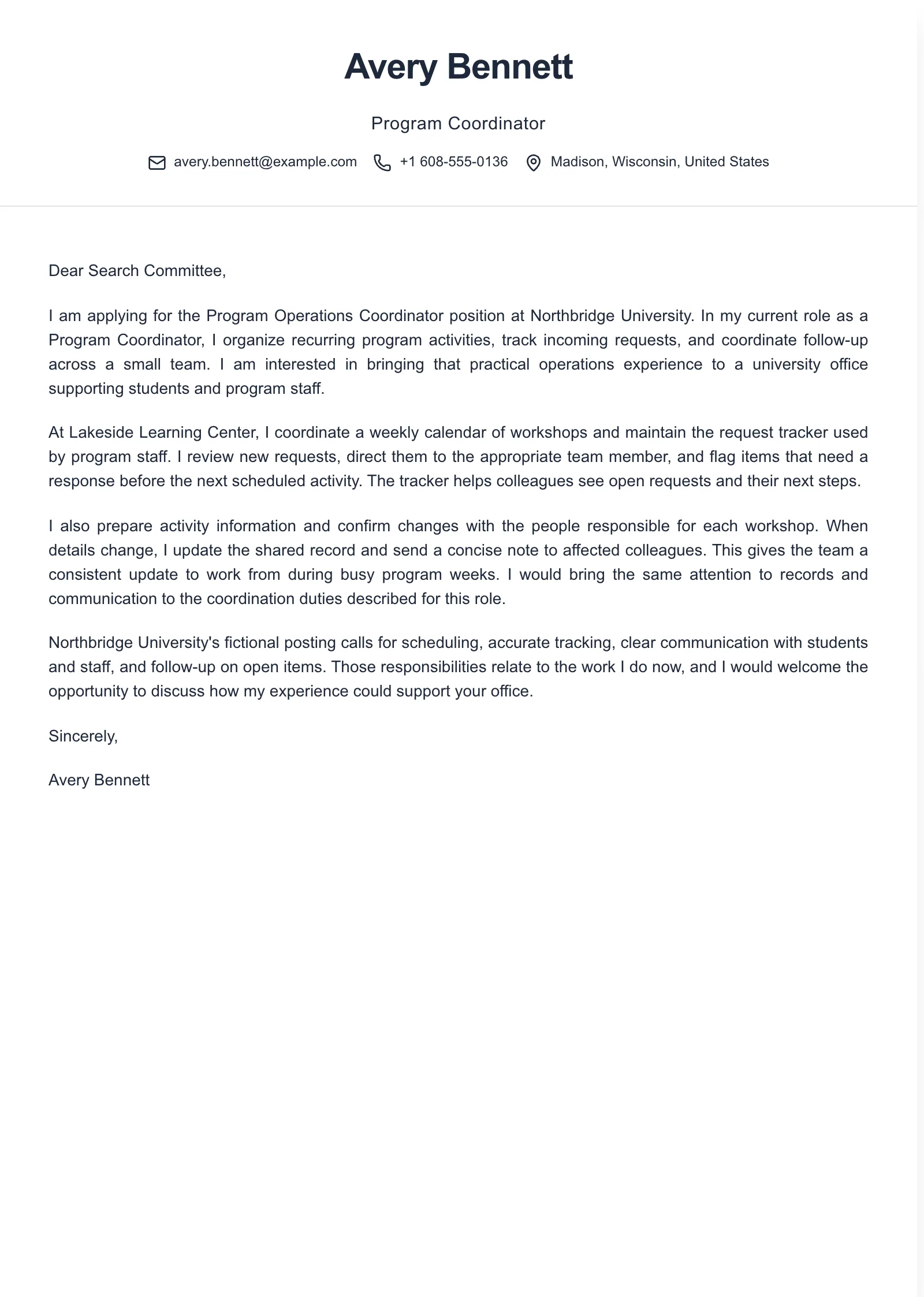
Example paragraphs
“In my role supporting [campus office or service], I coordinated [specific process] for [audience or team]. I used [tool or method] to keep requests visible and followed up when [factual issue] needed attention. That experience would help me contribute to the [specific responsibility] in the [Job Title] role at [Institution Name].”
“At [organization or setting], I managed [type of request or record] across [teams or groups]. I created or maintained [specific tracking method], which helped [verifiable result or benefit]. Although this work was outside a university, the process relates to [specific duty] in the [Job Title] position at [Institution Name].”
“When [specific situation] affected [audience or process], I [action you personally took] and coordinated with [relevant people or team]. As a result, [factual outcome]. I would bring the same approach to [named duty from the posting] as a [Job Title] at [Institution Name].”
Treat these as paragraph models, not complete letters. Replace each bracket with a true detail and remove any claim you cannot support. Use the institution's actual name and check that each paragraph relates to a duty in the posting.
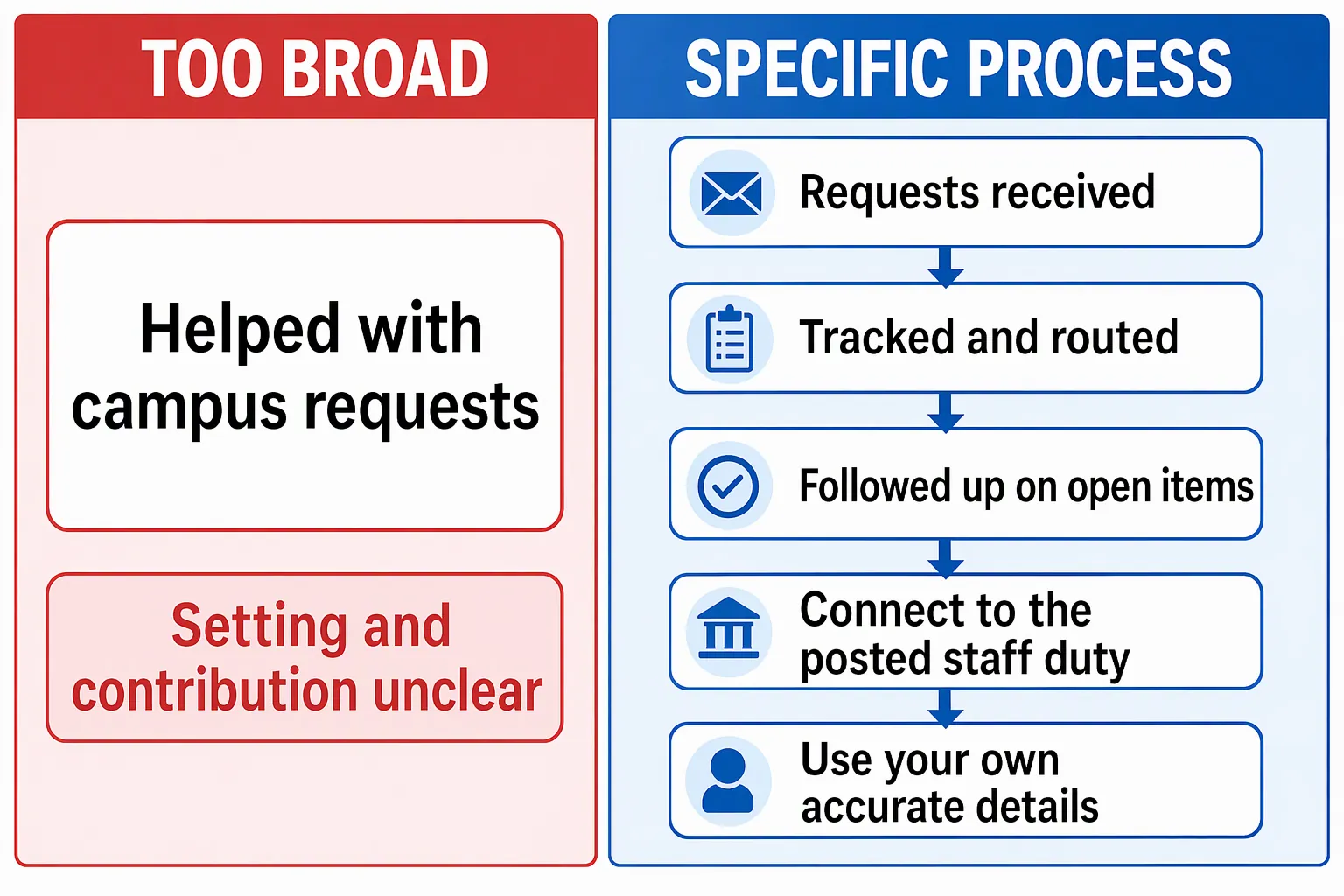
Common mistakes in university staff cover letters
Writing as if the role were faculty
- What goes wrong
- A letter focused on research interests, publications, or teaching can distract from an administrative or student-services position when the posting does not ask for those qualifications.
- Better approach
- Lead with the duties and requirements of the staff role. Include academic work only when it provides relevant evidence or is specifically requested.
Using campus language without evidence
- What goes wrong
- Terms such as student-centered or campus-ready make broad claims but do not show what you have done or where you did it.
- Better approach
- Name a real audience, process, and action. If the experience was outside higher education, state that context and explain the transferable part.
Listing tasks without showing how work moved
- What goes wrong
- A string of duties can leave the reader unsure how you handled coordination, accuracy, or follow-through.
- Better approach
- Choose one relevant workflow and describe your part in it, including a specific check, handoff, or outcome when you can verify one.
Making assumptions about the institution
- What goes wrong
- Claiming that you understand the university's culture or service needs without evidence can make the letter sound generic or presumptuous.
- Better approach
- Refer to the office, service, or responsibility named in the posting. Use public information only when it helps explain a specific, credible reason for applying.
Frequently asked questions
- Should a university staff cover letter discuss teaching?
- Discuss teaching only if it is relevant to the staff position or requested in the posting. For a non-faculty role, focus on the listed responsibilities, such as service coordination, records, events, or administrative processes. Do not imply that you held teaching duties you did not have.
- How can I show campus experience if I have never worked at a university?
- Use a truthful example from another setting that demonstrates a relevant process. Explain who you supported, what you coordinated or tracked, and what happened. Then connect that experience to a specific duty in the university posting without presenting the other setting as campus experience.
- Should I address every qualification in the posting?
- Prioritize the required qualifications that are most relevant to the role and support them with direct evidence. If the employer requests separate selection-criteria responses or another document, follow those instructions rather than trying to fit every response into the letter.
- How long should a university staff cover letter be?
- Use enough space to connect your strongest relevant experience to the posting, while keeping the letter focused. Follow any length or format instructions from the employer. A staff application does not automatically call for an academic research or teaching statement.

Put this career change approach into practice
Choose sample data or build your own cover letter, then personalize it before you download.