
Introduction
A UK cover letter, sometimes called a covering letter, explains why you are applying and gives focused evidence that connects your experience to the role. This page covers the practical task of preparing that letter for a UK application: checking the advert, choosing evidence, using the employer’s document wording, and selecting a suitable greeting and sign-off.
There is no single format every UK employer requires. Read the advert and application form first, then write a concise letter that adds useful context rather than repeating your CV or resume. The UK National Careers Service advises tailoring a covering letter to the role and following the employer’s instructions.
What to address directly
Pair the greeting and sign-off
- Hiring manager concern
- It can be unclear which sign-off to use when you do not have a named contact, especially if you have seen different examples.
- What your letter should prove
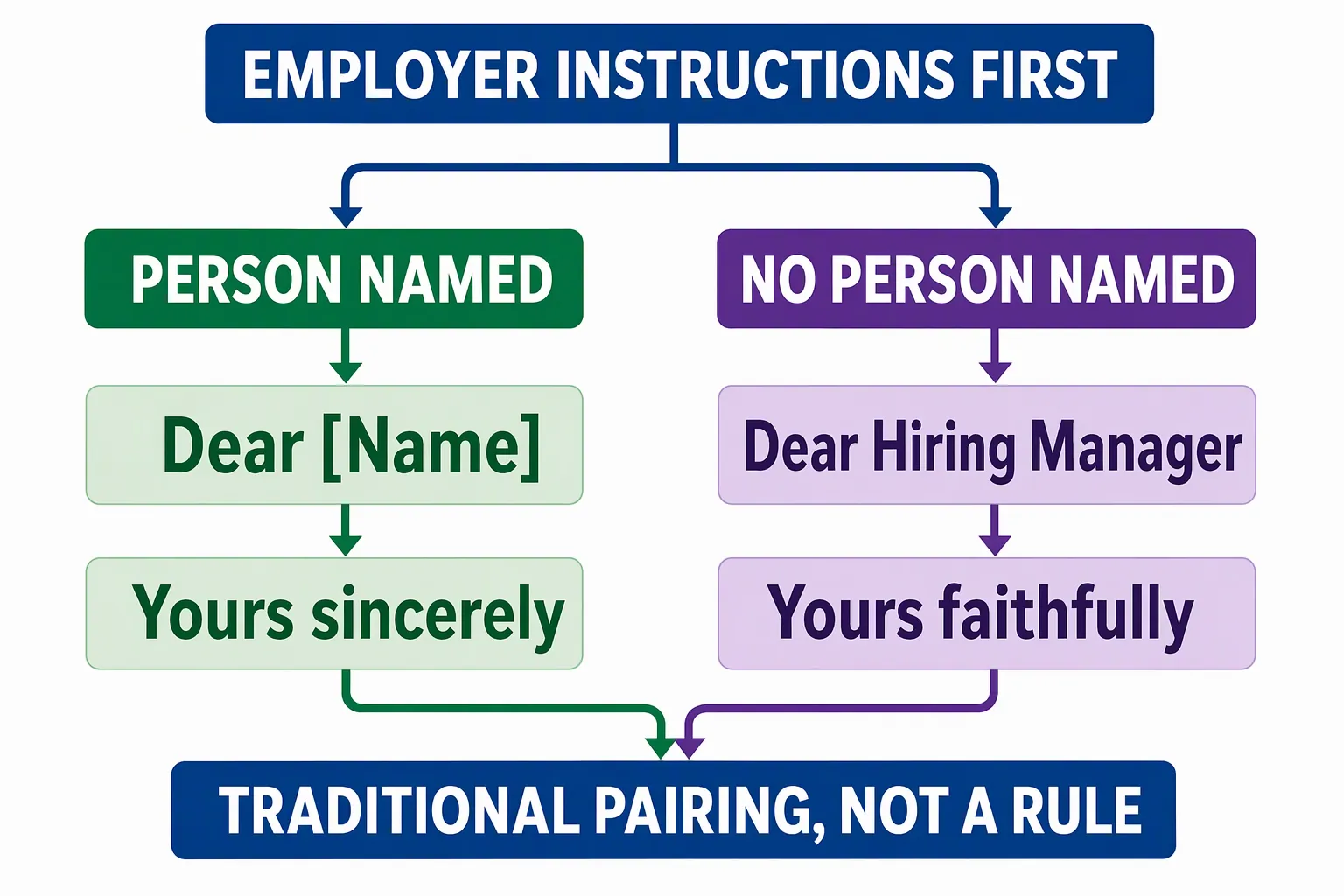
- Use a recipient’s name only when you have verified it. A traditional UK pairing is Dear [Name] with Yours sincerely, and a greeting without a person’s name, such as Dear Hiring Manager, with Yours faithfully. Treat this as a convention, not a legal requirement, and follow any different instructions from the employer.
Use the employer’s document wording
- Hiring manager concern
- Applicants may be unsure whether to call the accompanying career-history document a CV or a resume, or whether the letter should replace another requested document.
- What your letter should prove
- Check the advert and application form rather than assuming one label applies everywhere. Use CV or resume according to the employer’s wording. If the instructions request both a cover letter and another document, provide each in the stated format; do not treat the letter as a substitute.
Keep it concise without imposing a page rule
- Hiring manager concern
- Advice to keep a letter short can sound like a strict length requirement, even when the employer asks for additional information.
- What your letter should prove
- For many standard applications, one page is a useful editorial target, not a universal UK requirement. Remove repeated CV details before cutting relevant evidence. If the employer requests a separate supporting statement or other information, follow those instructions and provide enough detail to answer the request.
Structural approach: build a concise UK application letter
A practical format is your contact details, the date, a greeting, a short opening, one or two evidence-focused paragraphs, and a courteous close. Add postal addresses only when the employer or application method requests them. The cover letter structure guide explains the purpose of each paragraph; use it alongside the UK-specific checks on this page.
Before drafting, identify the exact role title, employer name, requested documents, and any named contact. Then choose evidence that supports the requirements in the advert. Do not add details simply to make the letter look more formal, and do not assume a general cover letter format overrides the employer’s stated process.
- 01
Check the application instructions
Record the role title and employer name exactly as written. Note the requested file or submission format, whether the advert names a contact, and whether it asks for a separate response or statement. Use the employer’s terminology for documents and follow any instructions about length or content.
- 02
Choose a verified greeting
Use a person’s name only if you can verify it from the advert or a reliable employer source. If no person is named, Dear Hiring Manager is a clear option. For more on addressing an unknown recipient, see how to address a cover letter without a name.
- 03
Select relevant, truthful evidence
Choose one or two examples from your actual work, study, volunteering, or other experience. Explain what you did and how it relates to a requirement in the advert. Keep details consistent with your CV or resume, and use only outcomes you can accurately describe.
- 04
Close and review the letter
Briefly state your interest in discussing the application and thank the reader. Where practical, match the sign-off to the greeting: Yours sincerely after a named greeting, and Yours faithfully when no person is named. Before sending, check the role title, employer name, spelling, requested documents, and any separate response the employer requires.
UK cover letter example
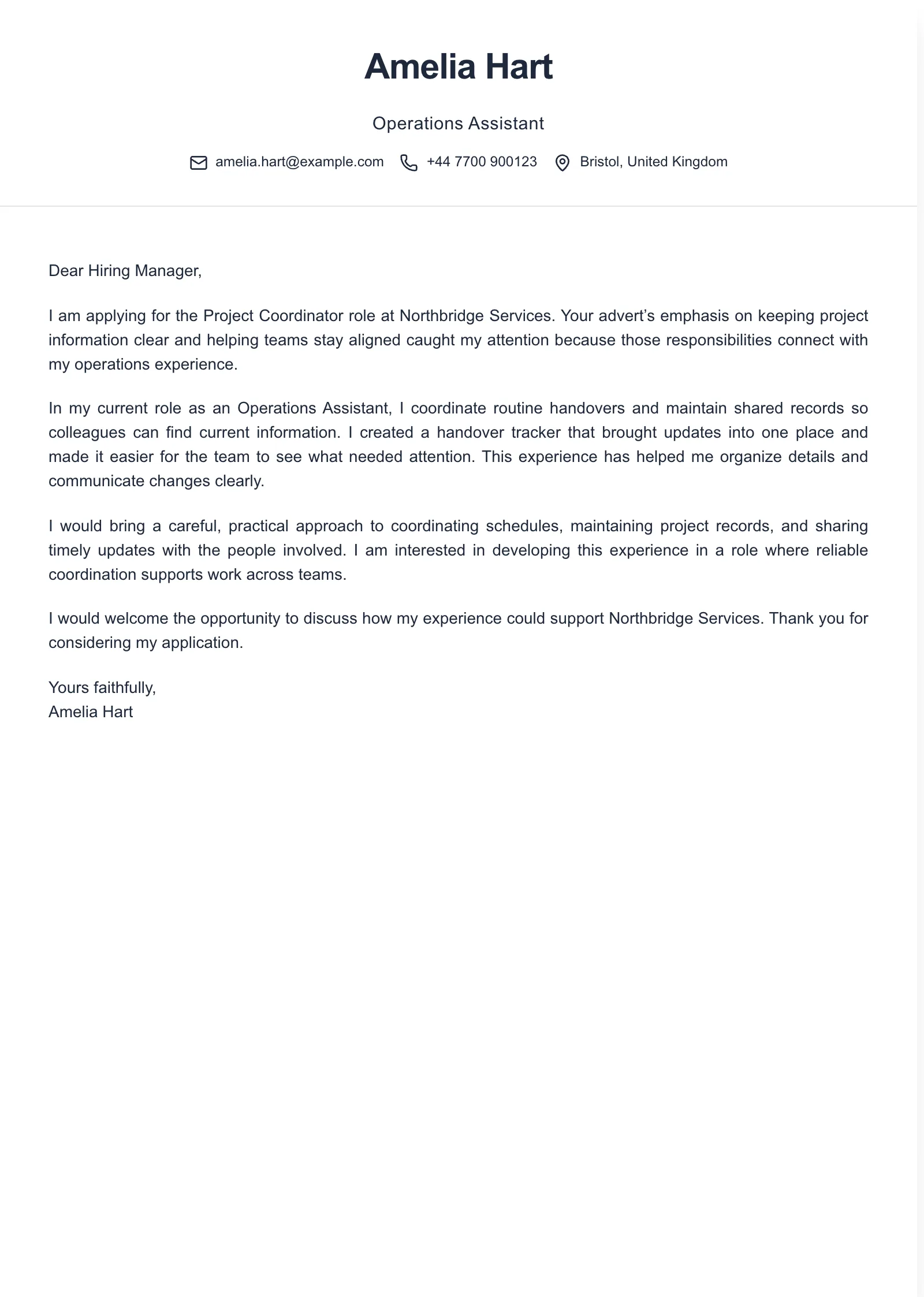
A fictional example showing a tailored opening, relevant evidence, and a traditional UK sign-off.
Example paragraphs
“I am applying for [Job Title] at [Company Name]. The advert’s focus on [specific detail from the advert] interests me because [accurate reason connected to the role or organization].”
“In my [role, study, project, or other experience], I [relevant action] while working with [relevant people, process, or information]. This developed my experience in [relevant skill or task], which relates to the [specific requirement] in your advert.”
“I would welcome the opportunity to discuss how my experience with [relevant task or skill] could support [Company Name] in the [Job Title] role. Thank you for considering my application.”
Replace every bracketed detail with accurate information that matches the advert and your experience. A result does not need a number: describe a real task, contribution, or outcome you can explain. Keep the letter consistent with your CV or resume. These are paragraph examples, not a complete letter; choose a greeting and sign-off that fit the recipient and employer instructions.
Common mistakes in a UK cover letter
Mismatching a traditional sign-off
- What goes wrong
- A named greeting followed by Yours faithfully, or a greeting without a person’s name followed by Yours sincerely, does not follow the traditional UK pairing.
- Better approach
- Use Yours sincerely after a named greeting and Yours faithfully when no person is named, unless the employer gives different instructions.
Treating one page as a mandatory limit
- What goes wrong
- Cutting relevant evidence solely to meet an assumed page rule can make it harder to understand why your experience fits the role.
- Better approach
- Keep a standard application letter concise, using one page as a practical target rather than a fixed rule. Follow any length or supporting-statement instructions in the advert.
Ignoring the employer’s CV or resume wording
- What goes wrong
- Using a different document label from the application instructions can create avoidable confusion about what you are submitting.
- Better approach
- Use the term stated in the advert or application form. Check that the requested document is included in the required format.
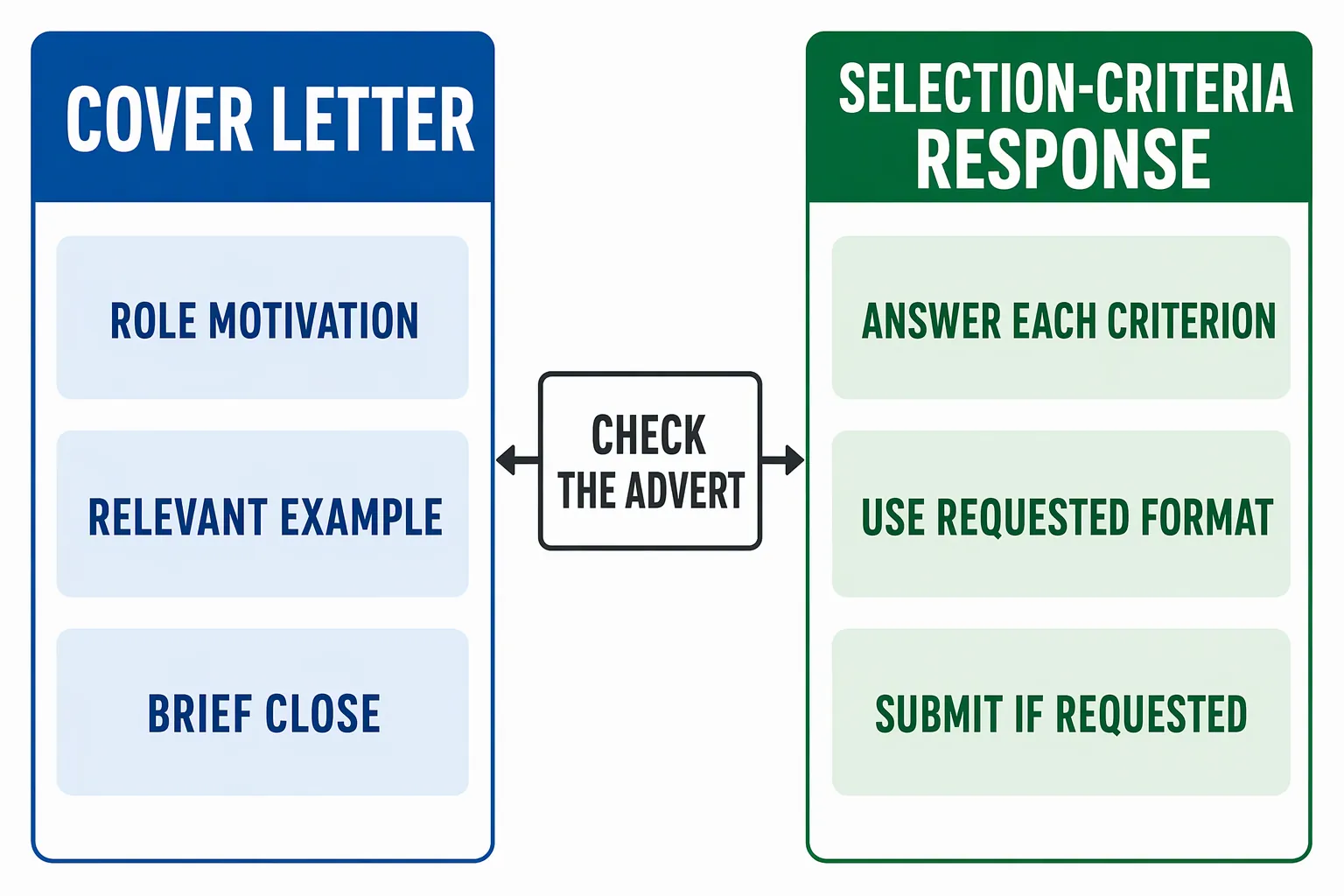
Replacing a requested separate response with the letter
- What goes wrong
- A general letter may not answer each criterion or question when the employer requests a separate response.
- Better approach
- Submit each requested document. Answer criteria in the requested place and format, using accurate evidence for each response.
Frequently asked questions
- Should a UK cover letter be one page?
- One page is a practical target for many standard applications, not a UK-wide rule. Follow the employer’s instructions and use enough space to make your relevant evidence clear.
- Should I write Dear Hiring Manager or Dear Sir or Madam?
- Use a person’s name when you can verify it. If you cannot, Dear Hiring Manager is a clear, neutral option. Follow any salutation instructions in the advert or application form.
- Should I call it a CV or a resume in the UK?
- Use the document label in the advert or application form. If it asks for a CV, call it a CV; if it asks for a resume, follow that wording.
- What if the advert asks for a separate selection-criteria response?
- Provide the requested response as well as a cover letter if both are required. Answer each criterion in the requested format rather than assuming the letter replaces it.

Put this career change approach into practice
Choose sample data or build your own cover letter, then personalize it before you download.