
Introduction
A cover letter for a training program should explain why you want this particular learning opportunity and how you can take part responsibly. Training may be offered by an employer, a school, or another provider, so the program description matters more than the label. Some programs also include a work placement. If yours does, follow its instructions for both the learning and placement parts.
You do not need to claim expertise you hope to gain from the program. Instead, connect a real starting point, such as a course, task, or personal project, to something the program says it teaches. Then describe your readiness to participate in terms you can support, rather than making broad promises.
What to address directly
Motivation that could fit any program
- Hiring manager concern
- Saying only that you are eager to learn does not show why you chose this program.
- What your letter should prove
- Identify one feature named in the program description, such as a learning topic, activity, or format. Explain how it connects to a goal you can put into your own words. Do not claim a particular outcome unless the program itself says it offers one.
Commitment without checking the details
- Hiring manager concern
- A promise to attend or complete everything is not useful if you have not checked the schedule or participation expectations.
- What your letter should prove
- Look for the requirements the program actually states. Check them against your availability, and address only the relevant details in your letter. If something is missing or unclear, ask the program contact instead of guessing.
Unclear or overstated starting experience
- Hiring manager concern
- Applicants can overstate what they know or describe themselves only by what they have not learned yet.
- What your letter should prove
- State your current level plainly, then give one accurate example of something related that you have tried. Say what you want structured training to help you develop, without treating a small amount of exposure as mastery.
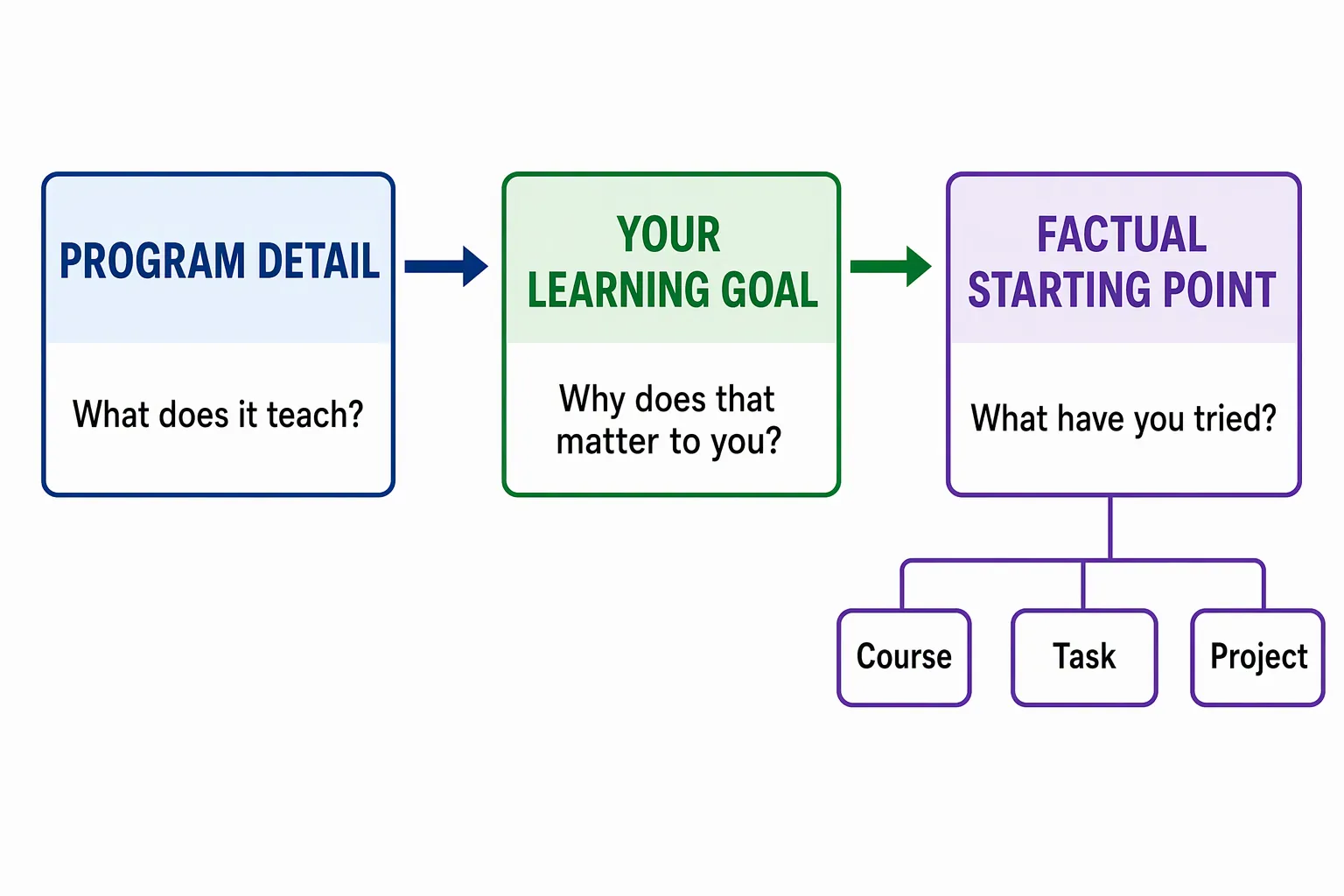
Structural approach: connect your goal to the program
Keep the letter focused on this application. A useful sequence is to name the learning goal, give a truthful starting point, explain the fit with the program, and address any relevant participation details. For a broader paragraph-by-paragraph framework, see cover letter structure.
First check whether the application is for a course, an employer-run training program, or a program that combines instruction with a placement. Use the description's own terms. Your letter is for the task requested, not a substitute for any separate form, selection-criteria response, or placement application.
- 01
Name the program and your learning goal
Identify the program and state what you want to learn or be better able to do. Make the goal specific enough to connect to something in the description. Avoid promising a result the program does not guarantee.
- 02
Give one truthful starting point
Choose a relevant course, task, personal project, or responsibility. Say what you actually did and why it relates to your goal. If you are new to the subject, say so briefly; do not present introductory exposure as professional expertise.
- 03
Explain the fit in both directions
Connect a stated part of the program to your learning goal. Then explain what you would bring as a participant, such as preparation or experience following through on a learning task, only if it is true of you. Do not assume a program's teaching quality, results, or content beyond what it describes.
- 04
Address participation and close
If the program names dates, attendance, preparation, or other participation requirements, address the relevant point accurately. State availability only after checking it. Close by expressing interest in discussing your application, without implying that selection or a later opportunity is guaranteed.
Training program cover letter example
A fictional example for a structured learning program. Notice how it connects a learning goal to a real starting point without claiming expertise the applicant hopes to develop.
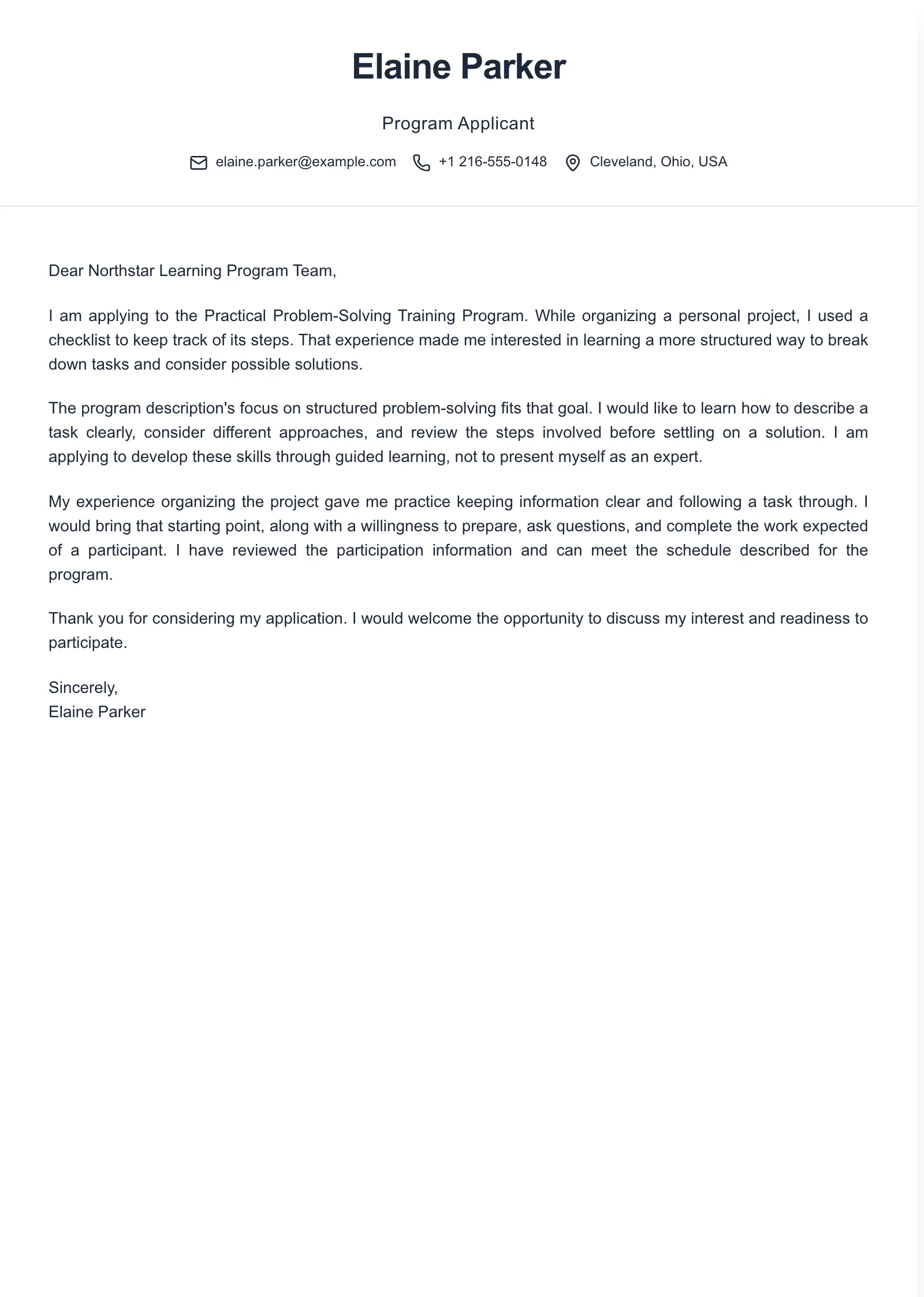
Example paragraphs
“I am applying to the [Program Name] because its focus on [specific topic or activity] connects to my goal of [learning goal]. I became interested in this area while [brief, accurate example].”
“In [course, task, or project], I practiced [related skill] by [factual action]. That experience helped me identify what I can already do and what I want structured training to help me develop.”
“The program description states [participation requirement]. I have checked that detail against my commitments and [accurate statement about availability or preparation].”
Replace each bracket with a detail you can support and tailor it to the program's instructions. If you cannot confirm your schedule or another requirement, check before making a promise.
Common mistakes in training program letters
Using a generic reason
- What goes wrong
- A broad wish to grow or learn gives no specific reason for choosing this program.
- Better approach
- Refer to one real feature in the description and connect it to a learning goal that matters to you.
Treating the application only as a job pitch
- What goes wrong
- Focusing on what you can deliver as an employee can miss that the application is for structured learning.
- Better approach
- Keep your contribution relevant to participation. If the program also includes a work placement, address that part separately and follow its instructions.
Inflating experience to appear ready
- What goes wrong
- A claim of mastery can conflict with your reason for applying and may be hard to support.
- Better approach
- Describe your actual starting point, give a factual example, and name the skill or knowledge you want to develop.
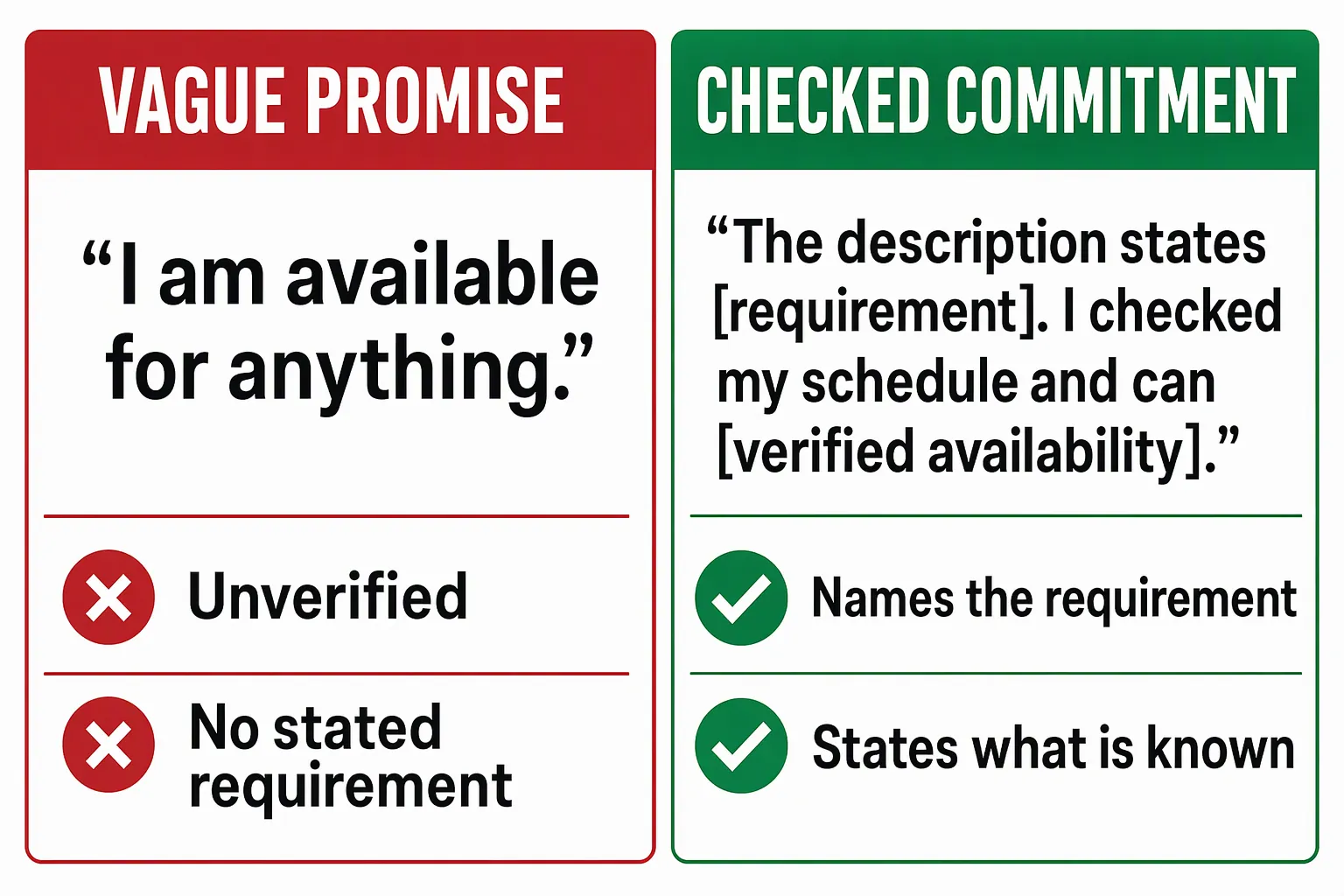
Promising availability before checking
- What goes wrong
- An unverified promise about attendance or completion can create a mismatch with the program's stated requirements.
- Better approach
- Check the schedule and requirements against your commitments. State only what you know you can meet, and ask for clarification when needed.
Frequently asked questions
- How is a training program cover letter different from an internship cover letter?
- The labels can overlap: some internships include structured instruction, and some training programs include a work placement. For this application, follow the program description. Explain why you want the training and how you can participate; if there is also a placement, address its instructions separately.
- Should I mention that I lack experience in the subject?
- If your starting level is relevant, describe it accurately and briefly. Then give a real example of related coursework, practice, or a project, and explain what you want to learn. Do not present beginner-level exposure as professional expertise.
- What if the program has a set schedule or attendance requirement?
- Check the program information and your own commitments first. Address any stated schedule or attendance requirement directly, but promise only what you have verified you can meet. Ask the program contact if an important detail is unclear.
- Can I reuse the same letter for several programs?
- You can reuse a basic structure, but tailor the reasons and evidence to each application. Name the program, connect a specific feature to your learning goal, and check that your statements about participation match that program's instructions.

Put this career change approach into practice
Choose sample data or build your own cover letter, then personalize it before you download.