
Introduction
When applying to another school, show more than a general interest in teaching. Explain why this particular school is a sensible next step and what relevant practice you could bring from your current school. Choose details you can support, such as a teaching approach, a way of collaborating, or a responsibility that connects to the destination school's stated needs.
This guide focuses on a move from one school to another, whether the schools are in different districts or share an employer. The application process may overlap with an internal hiring process when both schools belong to the same organization. In either case, make the destination school's needs and your relevant experience clear, and follow the employer's instructions.
What to address directly
Why this school, rather than any school
- Hiring manager concern
- A vague reason for moving can make your application sound interchangeable with one for another school.
- What your letter should prove
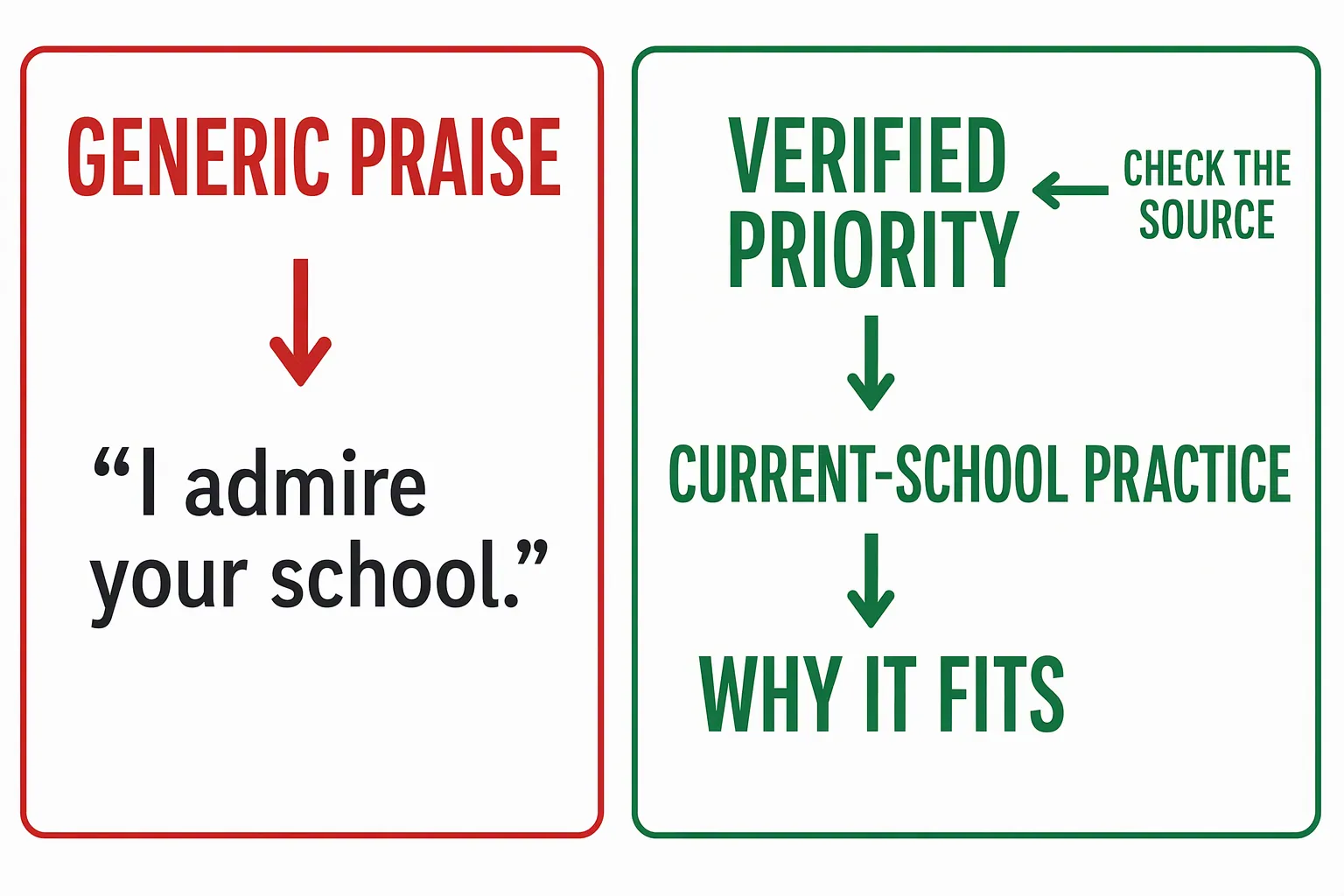
- Select one or two verifiable details from the posting or official school information, such as a stated learning priority or approach to family communication. Explain why a detail matters to your next step and how it connects to your work. Avoid praise that could be pasted into any application.
What carries over from your current school
- Hiring manager concern
- Your experience can be relevant without being an exact match, but a list of duties leaves the reader to make the connection.
- What your letter should prove
- Choose one practice or responsibility that relates to the destination school's stated needs. Briefly describe what you did and the context, then explain how that experience could be useful in the new setting. Keep the claim specific to your own work; do not present a school-wide result as your individual achievement.
References and a respectful transition
- Hiring manager concern
- A school-to-school move can involve current colleagues and students, so reference details and transition language need care.
- What your letter should prove
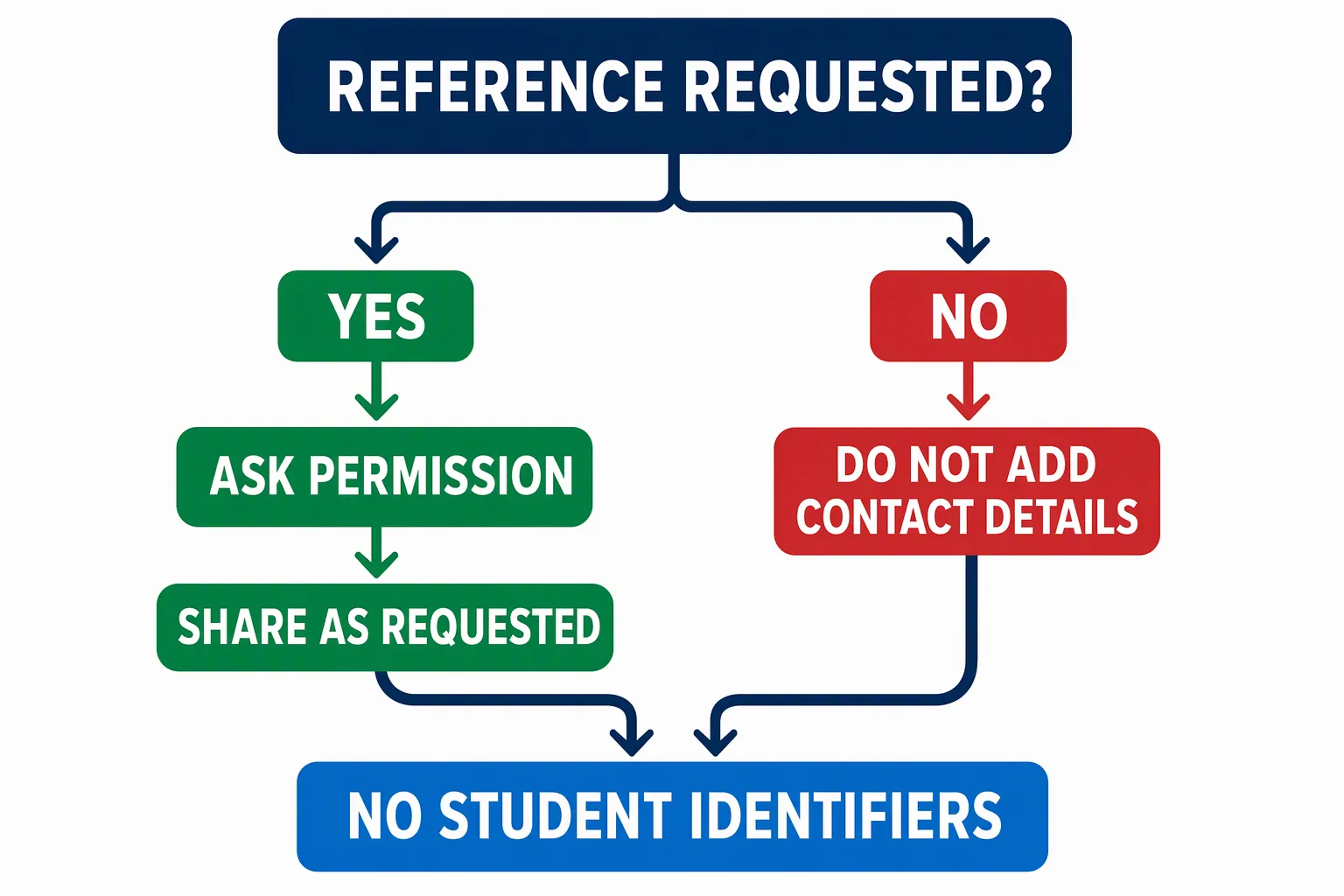
- Ask a potential reference before sharing their name or contact information. If references are requested, provide them where the application asks rather than filling the letter with contact details. Keep any transition statement brief and general, and do not include private student information or criticize your current school.
Structural approach for a teacher changing schools
Keep the letter focused on the destination school, relevant evidence from your current school, and a professional transition. The cover letter structure guide explains the general purpose of each section; the choices below apply that structure to a school-to-school application. Check the posting first, because an employer may request separate responses or documents.
- 01
Identify the destination school's need
Read the posting and any official school information available to you. Choose a specific priority that genuinely connects to your experience. Do not claim familiarity with a program, community, or school culture based only on an assumption.
- 02
Connect one current-school practice
Choose a relevant example from your work, such as adapting instruction, collaborating with colleagues, or communicating with families. State what you did and the context. Include an outcome only when you can describe it accurately and appropriately.
- 03
Make the connection explicit
Explain how the practice relates to the destination school's stated need. Be clear about what you could bring and what you would need to learn in the new setting. Do not imply that two schools or student communities are identical.
- 04
Handle references and next steps discreetly
Name a reference only if the person has agreed and the detail helps the application. Otherwise, follow the instructions for submitting references. Close by expressing interest in discussing your fit, and keep your language respectful toward your current school.
Fictional teacher transfer cover letter example
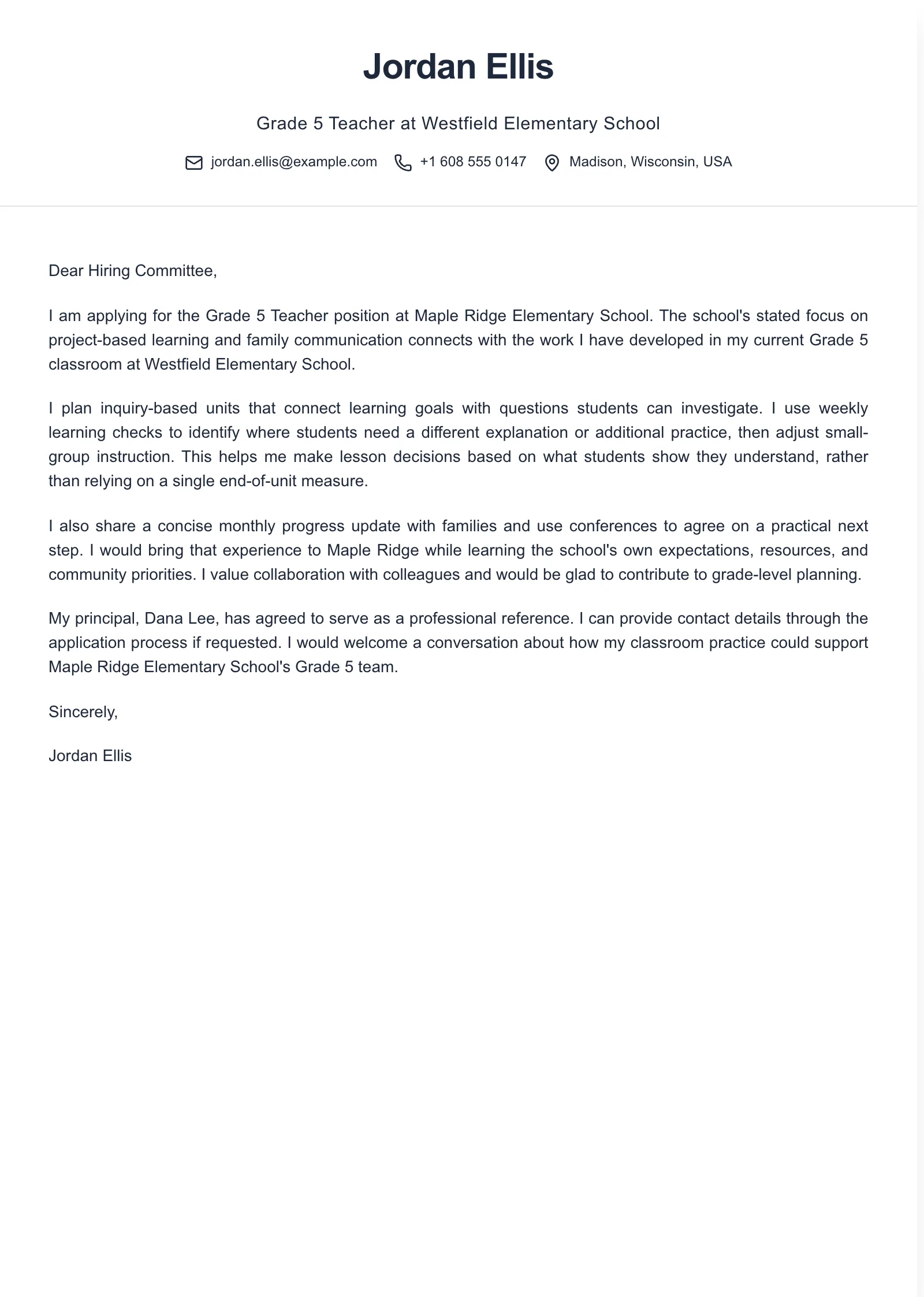
Preview a fictional school-to-school application with a specific reason for applying, relevant current-school evidence, and a considerate reference note.
Example paragraphs
“I am applying for [Role] at [School Name] because [verified school priority] connects with my experience in [relevant practice]. In my current school, I [brief, accurate example]. I would welcome the opportunity to bring that experience to [specific need at the destination school].”
“In my current role, I [specific action or responsibility] in [accurate context]. That experience relates to [School Name]'s stated need for [specific need] because [clear connection]. I would also take time to learn the school's own routines and community.”
“With their permission, [Reference Name], my [professional relationship], can speak to my work in [relevant area]. I can provide their contact details through the requested process and would be glad to discuss how I could support a smooth transition from my current school.”
Treat these as adaptable paragraphs, not a complete letter. Replace each bracket with an accurate detail and remove any sentence that does not fit your situation. A school name alone is not a meaningful reason for applying. Do not share student names, records, or other private information to make an example more convincing.
Common mistakes in a teacher transfer letter
Using the same school praise everywhere
- What goes wrong
- Broad statements about caring communities or strong values do not show why this destination school fits you.
- Better approach
- Choose a detail you verified in the posting or official school information, then explain how it connects to your work. If you cannot make a specific connection, do not pretend that you can.
Criticizing the current school
- What goes wrong
- Complaints about leadership, colleagues, families, or students can distract from your qualifications and make the move sound defined by conflict.
- Better approach
- If a reason for leaving is relevant, explain it briefly and neutrally. Use the available space to show what you could contribute at the destination school.
Claiming results without clear evidence
- What goes wrong
- An unsupported improvement claim, or taking credit for a school's collective work, can make relevant experience harder to trust.
- Better approach
- Describe your own actions and the context. Include a result only if you can explain its basis, and leave out student-identifying information.
Sharing a reference before asking
- What goes wrong
- Listing a current colleague without checking can put them in an unexpected position and may disclose your search before you intend it to.
- Better approach
- Ask first, share only relevant professional contact details, and follow the application's reference instructions. Keep the letter focused if no reference is requested.
Frequently asked questions
- Should I tell my current principal that I am applying elsewhere?
- Consider your relationship, workplace policies, and the timing of your search. If you want to name your principal as a reference, ask privately before sharing their details. You do not need to explain personal circumstances in the letter; focus on the new school's fit and the contribution you could make.
- Should I include references in the cover letter?
- Use the letter to explain your relevant experience and evidence, not to list contact details unless the application asks you to do so. Follow the requested process, and ask each person before sharing their information. Do not include student-identifying details in examples.
- How is a teacher transfer letter different from an internal-position letter?
- This guide focuses on applying to another school, whether or not it is in a different district. If both schools share an employer, the application may also follow an internal hiring process. Explain why the destination school fits and connect your experience to its needs, while following the employer's instructions.
- Should I explain why I am leaving my current school?
- Only include a brief explanation if it is relevant to the move or requested. Keep it professional and factual. Do not criticize colleagues or students, and do not let the reason for leaving take the place of evidence about what you could contribute at the new school.

Put this career change approach into practice
Choose sample data or build your own cover letter, then personalize it before you download.