
Introduction
A T-format cover letter pairs selected requirements from a job advertisement with relevant evidence from your experience in two columns. The layout makes the comparison visible: each row connects what the posting asks for with something you can substantiate. It is a format choice, not a separate application purpose or a substitute for documents the employer requests.
Consider it when the posting names several distinct qualifications that you can match with clear examples. If the employer asks for separate responses to selection criteria, provide them as instructed rather than assuming a table replaces them. The usual parts of a cover letter structure still matter: explain your interest, make the matches readable, and close with a relevant next step.
What to address directly
Will the table make the match clear?
- Hiring manager concern
- Two columns help only when each row connects one real requirement to evidence that directly supports it. A list of skills beside unrelated achievements can suggest a match without showing one.
- What your letter should prove
- Choose distinct needs from the posting and pair each with a specific action, context, or result. If your evidence is related but not an exact match, explain the connection instead of presenting it as identical experience.
Will the table work in the format I need to submit?
- Hiring manager concern
- A table may wrap awkwardly on a narrow screen or lose alignment when copied into an application field. Dense rows can also make the comparison harder to scan.
- What your letter should prove
- Use concise cells and clear column headings, then review the actual file or pasted text before submitting. If the columns do not hold together, turn the same matches into short, labeled plain-text pairs.
Does the table answer every requested item?
- Hiring manager concern
- A posting or application may request separate answers, criteria statements, or a particular document structure. Combining them in a letter could leave a requested response incomplete.
- What your letter should prove
- Read the posting and application instructions before choosing this layout. Use the table for the letter only when it fits the request, and keep required responses in the specified place.
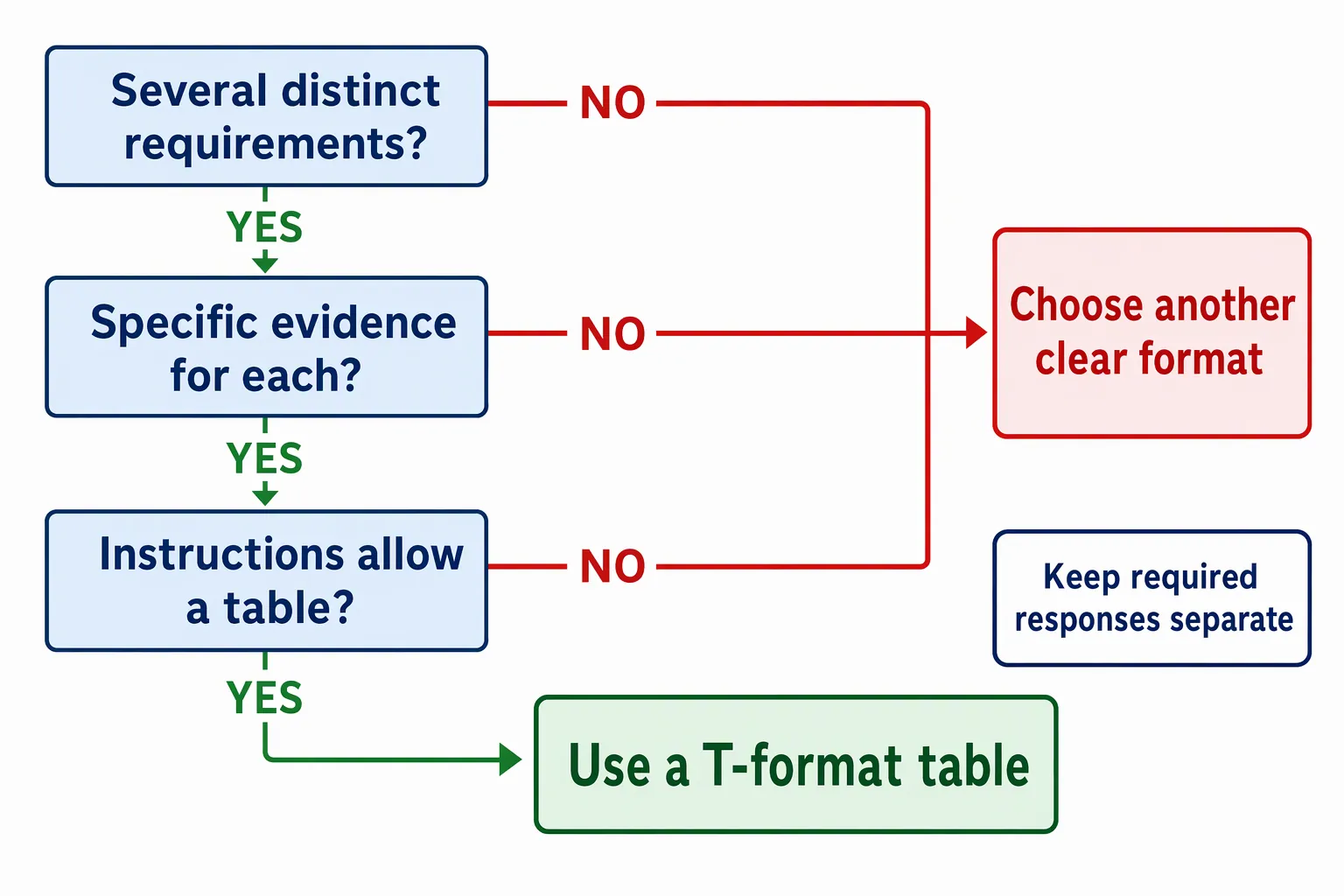
Structural approach: Build one clear match per row
Treat the table as a comparison, not a place to repeat the entire job advertisement. Choose distinct requirements that matter to the role, then identify the strongest truthful evidence you have for each. A careful read of the job description can help you distinguish a concrete need from repeated or less relevant wording.
Put a brief introduction before the table and a concise closing after it. Name the role and give a specific reason for your interest in the opening. After the table, connect the evidence to the opportunity and invite further discussion without assuming what the employer will do next.
Here is an illustrative filled table using general workplace tasks. Replace the wording with requirements from your posting and work you actually completed. These are example statements, not claims about your background.
| Requirement in the posting | Matching experience |
|---|---|
| Coordinate work across groups | I kept a shared action log, confirmed owners, and followed up on handoffs between teams. |
| Maintain accurate records | I reviewed incoming requests, corrected missing information, and kept the shared register current. |
| Work to agreed deadlines | I divided a delivery into milestones, raised a delay early, and completed the agreed handoff. |
- 01
Select requirements you can address
Review the posting and choose a manageable set of important, distinct requirements. Prefer a concrete skill, responsibility, or qualification over a broad phrase such as “excellent professional.” Do not copy every bullet. If you lack direct experience for an essential qualification, decide whether you can show related evidence accurately.
- 02
Find verifiable evidence for each one
For each requirement, note what you did, the context, and a result or useful detail. Relevant evidence may come from work, study, volunteering, or another setting. Use numbers only when you can verify them. Do not invent metrics or describe a related task as a responsibility you did not hold.
- 03
Draft and check the two columns
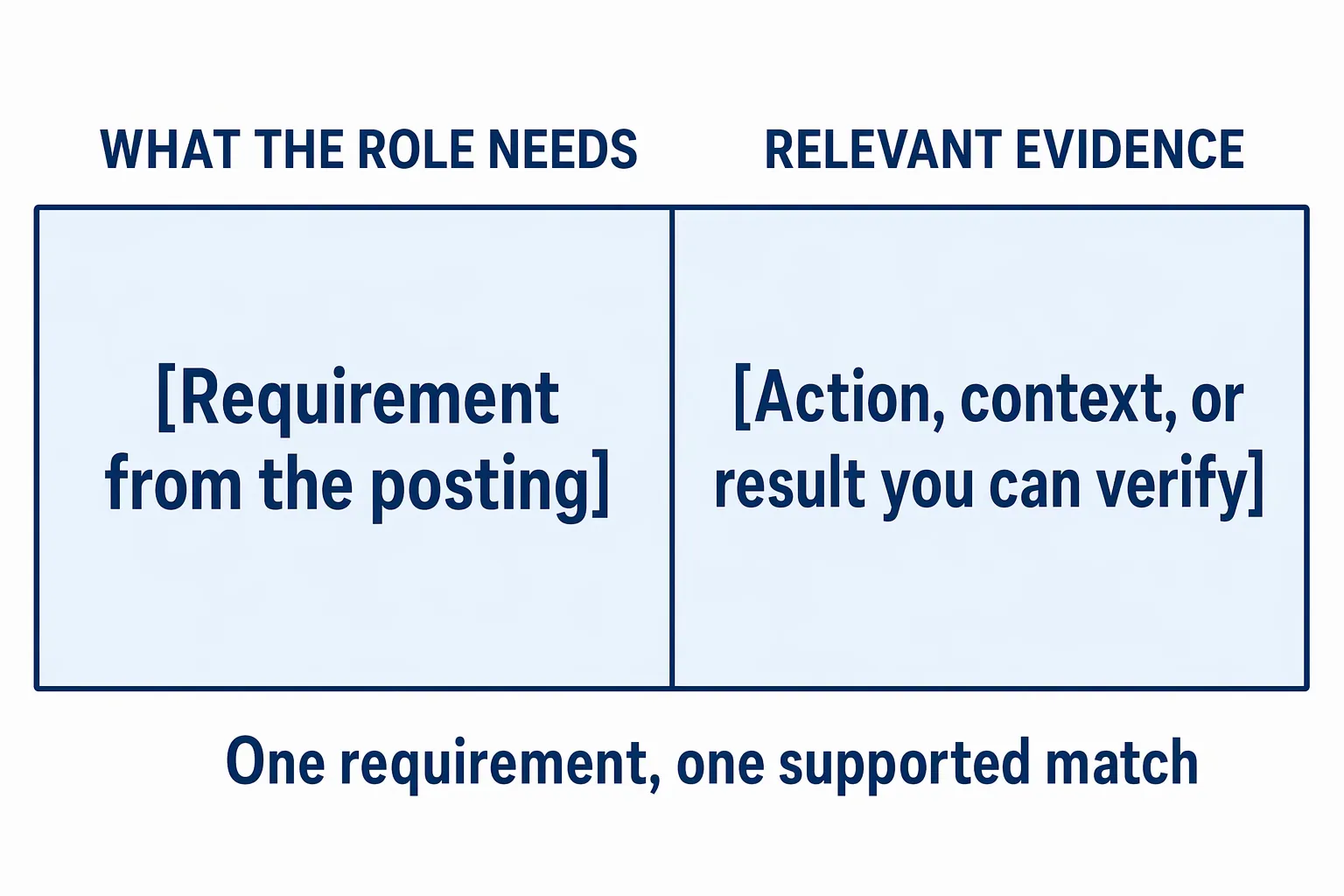
Use direct headings such as “What the role needs” and “Relevant evidence.” Match one requirement with one supporting example in each row. A placeholder match could read “[requirement from the posting]” beside “[action, context, or result you can verify].” If two rows rely on the same evidence, find a more distinct example or combine requirements that genuinely belong together.
- 04
Add context and review the submitted format
Introduce the role and your interest before the table; after it, connect the matches to the opportunity. Check that the headings explain the columns, each row stays together, and the table is readable in the file or field you plan to submit. If it becomes cramped or loses alignment, keep the same matches but present them as labeled plain-text pairs.
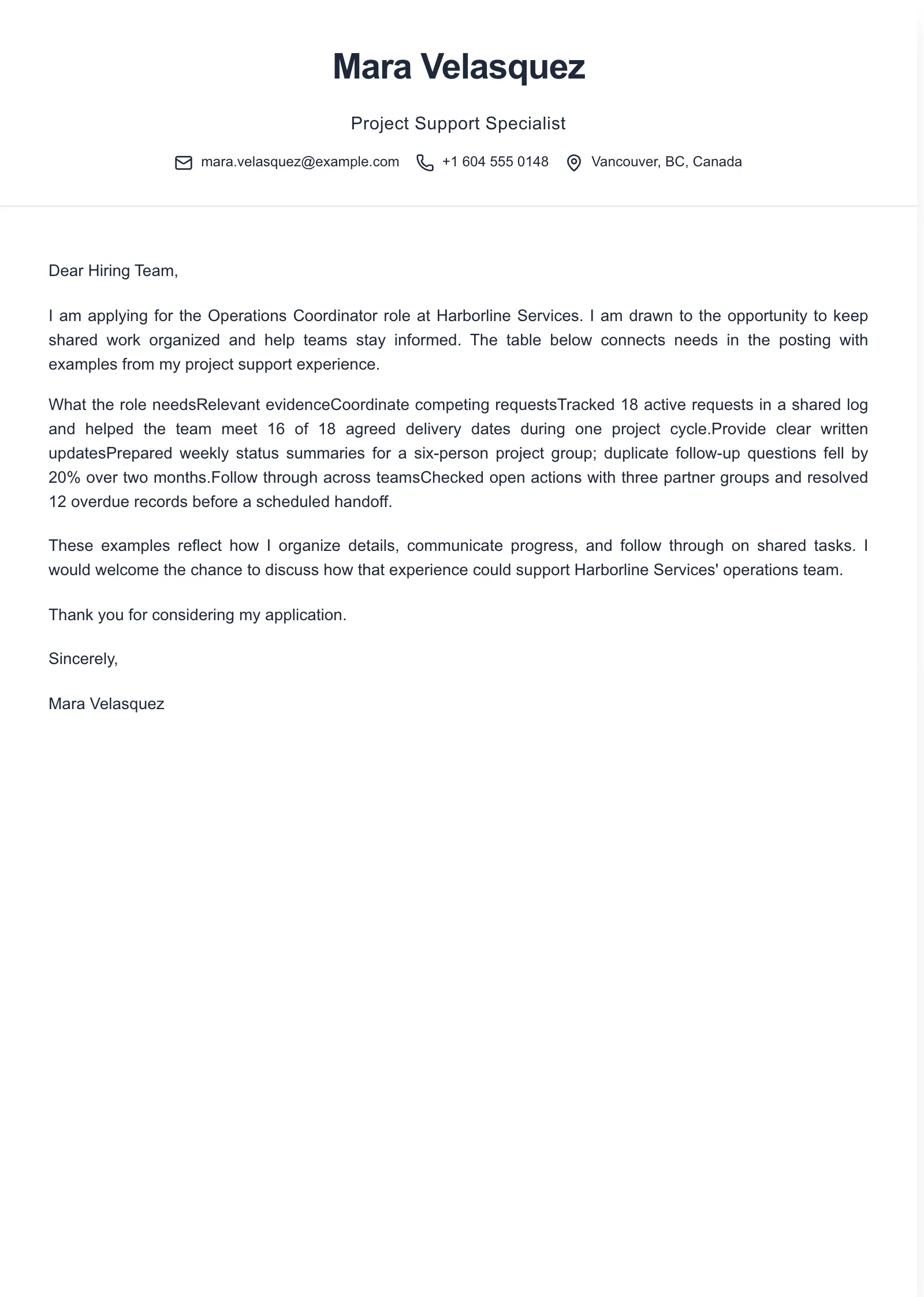
T-Format Cover Letter Example
A fictional example shows a two-column match between an Operations Coordinator posting and specific, verifiable experience.
Example paragraphs
“I am applying for [Job Title] at [Company Name] because [specific reason connected to the work or organization]. Your posting emphasizes [important requirement], which connects with my experience in [brief factual context].”
“The matches below focus on requirements that appear central to the role. They draw on my experience in [relevant setting] and show how I have used [relevant skill or approach] to contribute to [verifiable result or outcome].”
“I would welcome the opportunity to discuss how my experience with [relevant area] could support [Company Name]'s work on [specific priority]. Thank you for considering my application for [Job Title].”
Adapt these paragraphs to the posting and keep the evidence table separate from the prose. Replace each bracket with a fact you can explain. If your experience is related rather than direct, state the connection clearly and do not imply otherwise.
Scenario-specific mistakes in a T-format cover letter
Matching keywords instead of meaning
- What goes wrong
- Repeating a phrase from the advertisement in one column does not show that your experience supports it.
- Better approach
- Use the requirement's meaning, then pair it with an action or result that demonstrates the connection.
Making a claim broader than the evidence
- What goes wrong
- A narrow task may not support a broad claim of expertise, ownership, or direct experience.
- Better approach
- Describe your actual role, scope, and contribution. Explain a transferable connection without presenting it as an exact match.
Overloading the table
- What goes wrong
- Long paragraphs in cells bury the comparison and make it harder to scan each requirement against its evidence.
- Better approach
- Keep each cell focused on one idea. Move essential context into the surrounding paragraphs or choose a clearer example.
Ignoring the requested application format
- What goes wrong
- A table may not answer a separate required question or stay aligned in the field where you submit it.
- Better approach
- Follow the posting's instructions first. Review the submitted format and convert the matches to labeled plain text if needed.
Frequently asked questions
- What is a T-format cover letter?
- It is a cover letter that pairs selected job requirements with relevant evidence in two columns. An introduction and closing explain the purpose of the comparison.
- How many requirements should I include?
- Choose a manageable set of important, distinct requirements that you can support with specific evidence. There is no universal number; follow the employer's instructions and keep the table easy to scan.
- Can I use a T-format cover letter for every application?
- It may fit a posting with several clear requirements to match. Use another format if the employer requests a different response, the application field will not preserve the table, or the table makes your evidence harder to understand.
- What if I cannot show evidence for one requirement?
- Do not claim a match you cannot support. You can explain a related strength truthfully, describe a relevant learning step, or leave the requirement out if it is not essential to address.

Put this career change approach into practice
Choose sample data or build your own cover letter, then personalize it before you download.