
Introduction
A stay-at-home parent cover letter should explain the transition without asking the employer to evaluate parenting as if it were a corporate job. You can state that you took a planned break for full-time caregiving, protect your family's privacy, and move directly to the professional evidence that supports your application. The strongest case combines relevant achievements from before the break with an honest account of current preparation.
People often search for a “stay at home mom cover letter,” but there is no special format reserved for mothers or parents. The standard still applies: identify the role, match evidence to the employer's priorities, give useful context, and close clearly. What changes is the bridge between your earlier experience and your readiness now.
What to address directly
How should the caregiving period be described?
- Hiring manager concern
- The candidate may fear that direct wording will create bias or that limited wording will appear evasive.
- What your letter should prove
- Use one neutral sentence such as taking a planned career break for full-time caregiving. Share no family detail beyond what you choose.
What professional evidence is still relevant?
- Hiring manager concern
- Time away can make candidates discount achievements that still demonstrate useful judgment and skills.
- What your letter should prove
- Select earlier results that map to current responsibilities and explain the connection rather than apologizing for their date.
What changed during the break?
- Hiring manager concern
- The employer may wonder whether tools, practices, availability, or expectations are current.
- What your letter should prove
- Name completed refresh work and current readiness. Be exact about the depth of courses, projects, volunteer roles, or freelance work.
Are logistics settled?
- Hiring manager concern
- Candidates sometimes feel pressured to discuss childcare arrangements or family schedules.
- What your letter should prove
- State availability only as you would for any candidate. You do not need to explain childcare arrangements, marital status, or another person's schedule.
Structural approach for a stay-at-home parent cover letter
Open with the [Job Title] and the professional background most relevant to it. If you previously worked in operations, design, finance, support, education, or another field, name that identity and its connection to the posting. Introduce the caregiving break in one sentence, either late in the opening or at the start of the second paragraph.
Build the middle around evidence. Use one achievement from prior employment that demonstrates a central requirement. Add recent evidence when you have it, such as a completed course, renewed certification, volunteer project, committee responsibility, freelance task, or portfolio piece. Do not create business language around everyday parenting. If caregiving itself developed a relevant insight, state it modestly and support the application mainly with verifiable professional or project evidence.
Close by explaining why [Company Name] and the role fit your intended return. Focus on the work, not on whether the employer is “family friendly” unless a specific published policy is genuinely part of your decision. For broader guidance on timing and disclosure, see how to explain an employment gap.
- 01
Lead professionally
Name the target role and the background that best supports your fit.
- 02
Explain without oversharing
Give brief caregiving context, then move to prior and recent evidence.
- 03
Confirm readiness
Show preparation, connect to this employer, and close on contribution.
Use this template after a parenting career break
Give caregiving context its proper proportion and keep professional evidence at the center.
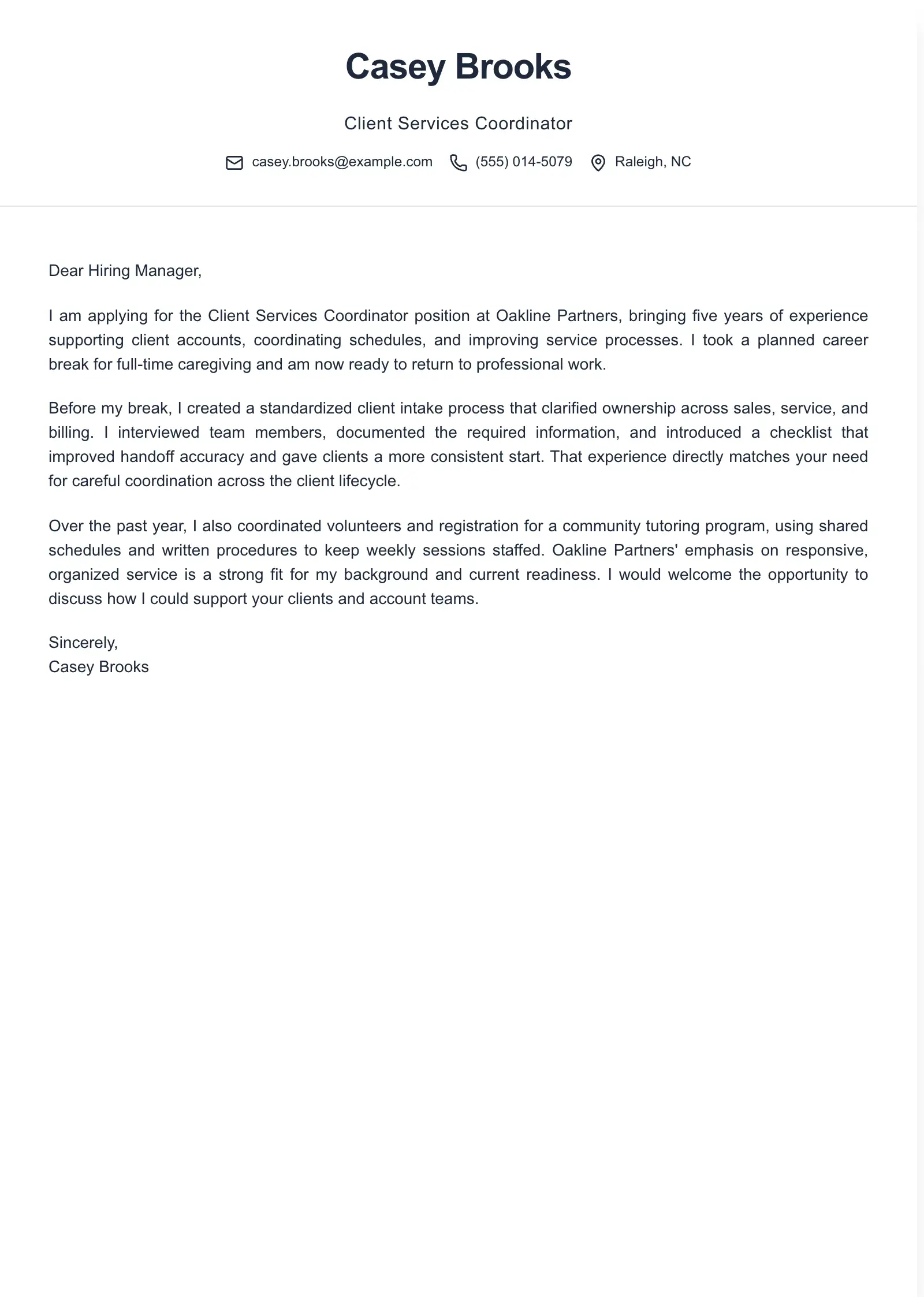
Example paragraphs
“I am applying for the [Job Title] position at [Company Name], bringing [Number] years of experience in [Field or Function]. I took a planned career break for full-time caregiving and am now ready to return. My background in [Relevant Capability], including [Brief Achievement], aligns closely with your need for [Requirement].”
“Before my career break, I managed [Relevant Responsibility] at [Organization]. When [Situation], I [Action], worked with [Stakeholders], and achieved [Verified Result]. That experience required [Capability], the same skill your posting connects to [Current Team Priority].”
“Over the past [Time Period], I prepared for my return by completing [Course, Certification, Project, or Volunteer Assignment]. I applied [Tool or Method] to [Concrete Output] and used feedback from [Source] to improve [Aspect]. This work has refreshed my knowledge of [Relevant Area] and confirmed my readiness to contribute in a structured professional role.”
Choose language that you would be comfortable discussing in an interview. The letter should remain true whether the reviewer calls the period a career break, caregiving leave, or time as a stay-at-home parent. Consistency is more important than finding a perfect label.
Common mistakes in a stay-at-home parent cover letter
Turning parenting into a corporate title
- What goes wrong
- Labels such as household CEO can sound evasive and make it harder for the employer to understand your actual work history.
- Better approach
- Describe full-time caregiving honestly and reserve professional titles for roles in which you actually held them.
Sharing family logistics
- What goes wrong
- Childcare plans, children's ages, and a partner's schedule are private and do not establish ability to perform the job.
- Better approach
- State relevant availability in the same concise way any applicant would, without explaining household arrangements.
Apologizing for the choice
- What goes wrong
- Defensive wording suggests that the break requires forgiveness and pulls attention away from qualifications.
- Better approach
- Give calm context, then focus on matched evidence and current readiness.
Ignoring changes in the field
- What goes wrong
- Relying only on older experience may leave a reasonable question about current tools or practices unanswered.
- Better approach
- Show specific recent preparation or acknowledge the learning area with a realistic plan and related foundation.
Frequently asked questions
- How do I explain being a stay-at-home parent in a cover letter?
- Use a direct, neutral sentence stating that you took a planned break for full-time caregiving and are now ready to return. Then focus on prior achievements, relevant activity during the break, and the employer’s current needs.
- Should I use the phrase stay-at-home mom?
- Use the wording that feels accurate to you. Stay-at-home parent or full-time caregiver can keep the language broadly professional, while stay-at-home mom is also valid when it reflects how you identify and the search language you used.
- Can parenting skills go in a cover letter?
- Mention capabilities only when they clearly relate to the job and you can provide credible context. Avoid presenting ordinary family responsibilities as corporate achievements. Prior employment, projects, volunteering, and current training usually provide stronger evidence.
- What if I did no paid work during the break?
- That is not something you need to disguise. Describe the break accurately, use relevant achievements from before it, and show current readiness through research, refreshed skills, or completed preparation when available.

Put this career change approach into practice
Choose sample data or build your own cover letter, then personalize it before you download.