
Introduction
A cover letter for a startup company should make your way of working visible. Show what you took responsibility for, how you made a decision when details were unsettled, and what useful result followed. Describe your own contribution accurately, including where you worked with other people.
Start with the advertised job and a specific reason you chose this company. Then give a relevant example rather than relying on claims about being adaptable or fast-paced. A concise, direct letter may suit this task, but there is no universal startup style. Searches for an introduction letter to a new company can also mean introducing a business or service; this guide is for applying to a startup job. For general letter components, see cover letter structure.
What to address directly
Show ownership without claiming you did everything
- Hiring manager concern
- A startup job posting may describe several responsibilities. Broad claims such as wearing many hats do not show which work you actually owned.
- What your letter should prove
- Name your responsibility, the decision or action you took, and what changed. If others contributed, say so. Clear boundaries make your account more credible than overstating your scope.
Explain your judgment when details change
- Hiring manager concern
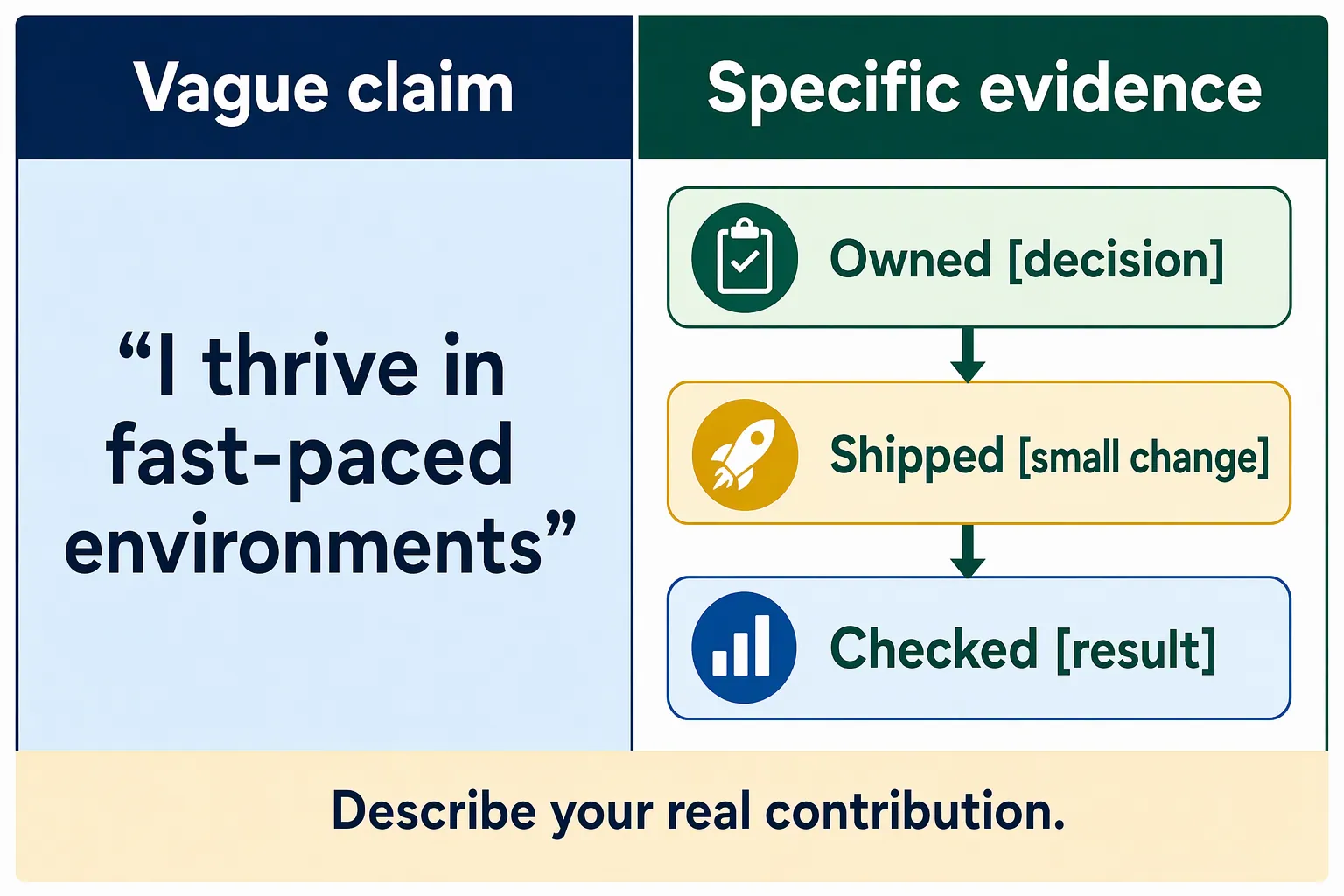
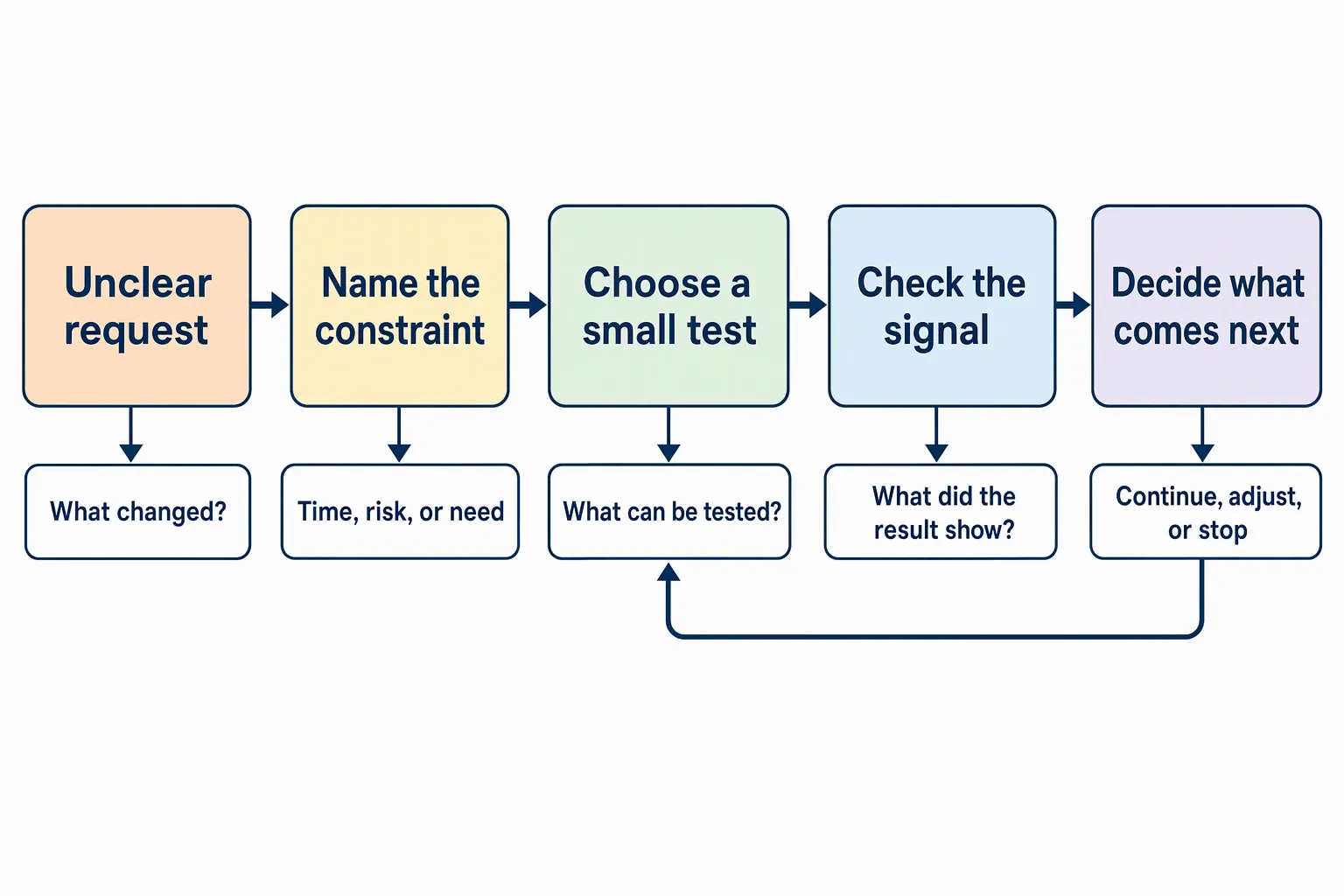
- Saying you thrive in ambiguity does not explain how you respond when a request is unclear, a constraint changes, or priorities compete.
- What your letter should prove
- Give the reader the relevant constraint, how you decided what to do next, and how you checked the result. Make clear what you knew, what you still needed to learn, and when you sought input.
Connect delivery speed to useful evidence
- Hiring manager concern
- A fast result is not automatically a good one. A claim about moving quickly leaves the reader unable to judge what you prioritized or whether the work helped.
- What your letter should prove
- Describe the smallest useful action you took, how you reviewed or tested it, and what happened next. Use a measured result only if you can support it; a concrete observed change or lesson can also show what you delivered.
Give a specific reason for this company
- Hiring manager concern
- Generic praise for innovation or a fast-paced culture could apply to many employers and may be based on assumptions about the team.
- What your letter should prove
- Choose a detail you can verify in the job posting or the company's public information. Connect it to the work you want to do and relevant evidence you can offer. Do not guess about funding, team size, work conditions, or internal culture.
Structural approach: four moves for a startup job letter
Use four compact moves: connect to a verified company or role detail, show relevant experience, explain one decision you made under a real constraint, and close with the contribution you would like to discuss. Keep each move tied to the advertised job rather than making claims about startup life in general.
Before drafting, check the posting for its priorities and application instructions. The cover letter opening examples can help you make the first sentence specific. For this scenario, anchor it in a detail you can verify and avoid guessing about the company's internal conditions.
- 01
Choose one verified point of connection
Select a product, customer need, stated goal, or responsibility mentioned in the posting or public company information. Explain why it connects to your interest or experience. Do not repeat a slogan without explaining its relevance.
- 02
Define the work you can contribute
Link one or two needs in the posting to relevant skills or experience. Be precise about what you handled and what you did with others. Do not imply that everyone at a startup must do every kind of work.
- 03
Tell one ownership story
Briefly state the problem or constraint, your decision, the action you took, and the outcome or learning. If there is no reliable metric, describe a concrete observed change instead of inventing a number.
- 04
Close on a useful next contribution
State the relevant contribution you would bring and invite a conversation. Keep the tone confident and respectful. Avoid promising to transform the company before you understand its needs.
Startup cover letter example
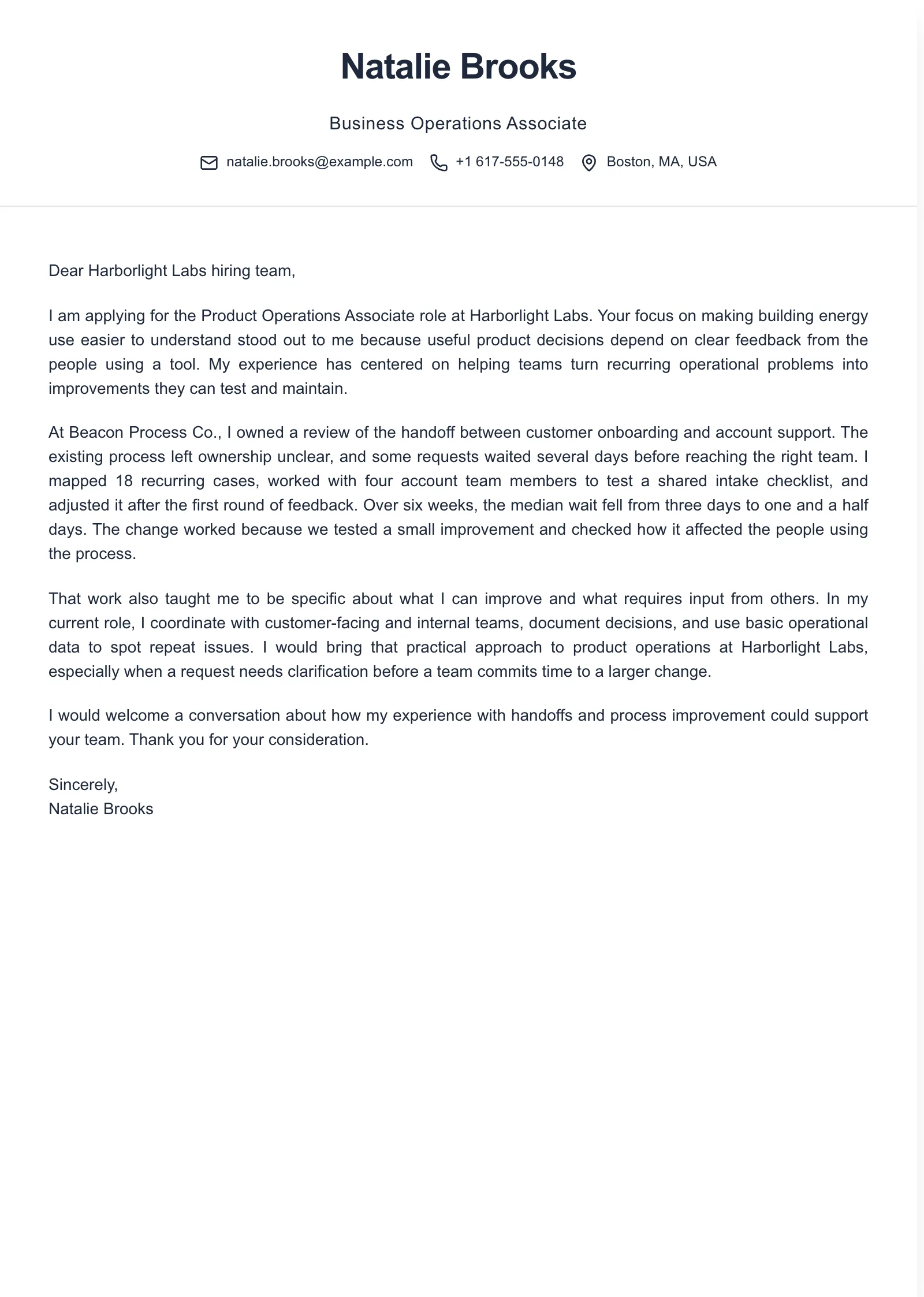
This fictional example connects a stated company need to specific ownership, a measured result, and a practical contribution.
Example paragraphs
“I am applying for [Job Title] at [Company Name] because your work on [specific product, customer need, or stated goal] connects with my experience in [relevant area]. In [project or responsibility], I [relevant action], which strengthened my interest in contributing to this work.”
“When [specific constraint or need] changed during [project or responsibility], I took responsibility for [part you owned]. I [specific decision and action] with [relevant collaborators], resulting in [factual outcome or observed change].”
“To address [team or customer need], I first tested [small, useful change] rather than [larger untested approach]. After [factual check or feedback], I [next action], helping [team or customer] achieve [factual result]. I would bring that approach to [relevant responsibility] at [Company Name].”
Use these as adaptable paragraphs, not a full letter. Replace every bracket with a truthful detail and remove any claim you cannot support. Describe your own contribution accurately, including important collaboration. An outcome can be a resolved handoff, a tested process, or a useful lesson, not only a numerical metric.
Common mistakes in startup cover letters
Using startup buzzwords instead of evidence
- What goes wrong
- Calling yourself an owner, builder, or fast mover does not tell the reader what you did.
- Better approach
- Describe a decision, an action you took, and the outcome or learning. Let the example show the quality you want to communicate.
Claiming ownership you did not have
- What goes wrong
- Saying you managed every part of a project can make your account hard to trust, especially when other people contributed.
- Better approach
- State your actual responsibility and mention important collaboration. Clear ownership of one part is stronger than overstating your role.
Treating speed as a substitute for judgment
- What goes wrong
- A claim that you delivered quickly leaves out how you chose the work or checked its effect.
- Better approach
- Show what you prioritized, how you reviewed or tested it, and what you learned. Do not claim a result your example cannot support.
Assuming what the company is like
- What goes wrong
- Describing a team as informal, rapidly growing, or resource-constrained without reliable evidence can make your reason for applying sound presumptuous.
- Better approach
- Base your motivation on details in the posting or other public information. Connect those facts to your interest without guessing about internal conditions.
Frequently asked questions
- Should a startup cover letter be less formal?
- A direct, conversational tone can work, but stay professional and follow the employer's instructions. Choose a greeting and sign-off that suit the application.
- How long should a cover letter for a startup company be?
- Keep it concise enough that your reason for applying and strongest example are easy to find. Any general length target is guidance, not a universal rule; follow the employer's instructions.
- What if I have never worked at a startup?
- Use a truthful example from another job, study, volunteering, or a project that shows responsibility, a decision under changing conditions, or useful delivery. Do not imply the experience came from a startup.
- Is an introduction letter to a company the same as a startup job cover letter?
- People may use introduction-letter wording for different purposes. This guide focuses on applying to an advertised startup job. If you mean introducing a new business or service, that is a different task and needs a different message.

Put this career change approach into practice
Choose sample data or build your own cover letter, then personalize it before you download.