
Introduction
For a second job, focus on why you want this position and when you can reliably work it. The reader should be able to understand how the hours fit around your main job without having to guess.
Mention your first job when it explains a schedule boundary or helps show how you manage a regular commitment. Keep it brief. You do not need to apologize for having another job; explain what hours you can commit to and why those hours are realistic.
Before writing, compare the posting's schedule with your actual work hours, travel time, and recurring responsibilities. If the position requires hours you cannot commit to, do not imply otherwise to make the application sound stronger.
What to address directly
Will my main job make my availability unclear?
- Hiring manager concern
- If you do not connect the schedules, it may be unclear which hours you can offer, especially when the posting names particular shifts or asks about flexibility.
- What your letter should prove
- State your main-job hours only as much as needed to explain the fit. Then name the specific hours you can commit to for this role. If your schedule can change, describe what you know about that process rather than promising permanent availability.
Can I manage both schedules reliably?
- Hiring manager concern
- A weekly plan may be difficult to sustain if it leaves out travel time, shift handoffs, or recurring commitments.
- What your letter should prove
- Build a realistic schedule before applying. Include time between jobs and identify recurring commitments. In the letter, support your availability with a factual example of planning, punctuality, or following through on a regular responsibility.
How much should I explain about my first job?
- Hiring manager concern
- Too much detail can distract from the position you want; too little can leave a schedule boundary unexplained.
- What your letter should prove
- Include only the details that help explain your schedule or fit. You can state your hours without naming your current employer or sharing private information. Keep job titles and working arrangements accurate.
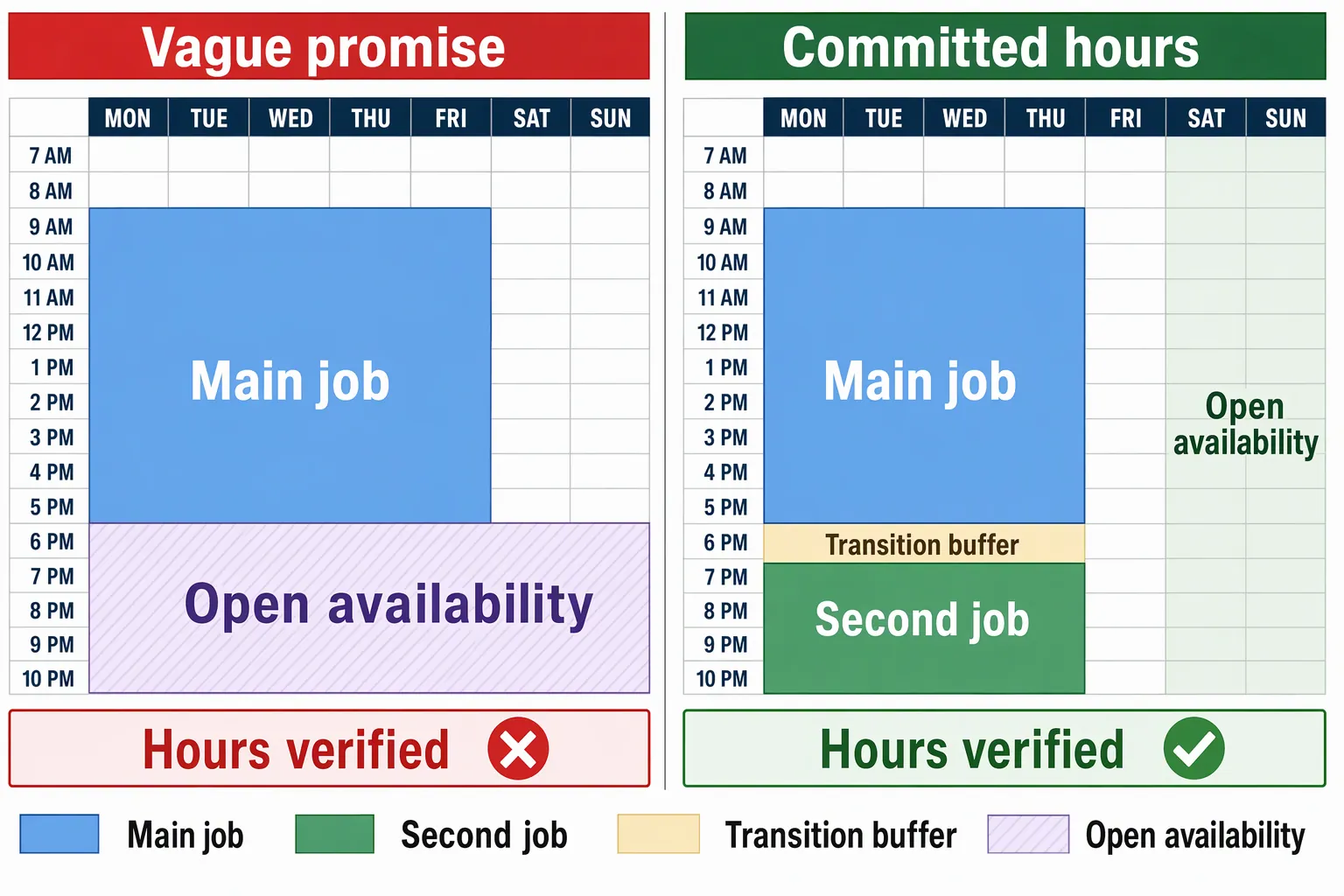
Structural approach for a second job cover letter
Keep the letter focused on this opening, not on your general need for more work. The cover letter structure guide explains the purpose of each paragraph; for a second job, make the schedule fit clear alongside your relevant contribution.
A useful order is to name the position and your interest, explain your availability in relation to your main job, give one concrete example that supports your reliability, and close by restating the hours you can commit to. Use details from the posting, and leave out schedule claims you cannot stand behind.
- 01
Identify the actual schedule need
Read the posting for stated shifts, days, and any requested flexibility. Separate requirements from preferences when the posting makes that distinction. If the schedule is unclear, do not guess; say what hours you can offer and be ready to clarify them.
- 02
Map your true availability
Write down your main-job hours, travel or handoff time, and recurring commitments before choosing the windows to offer. Make sure the hours are sustainable, not just possible once. Include notice or schedule variability if it affects what you can promise.
- 03
Explain the fit in one short passage
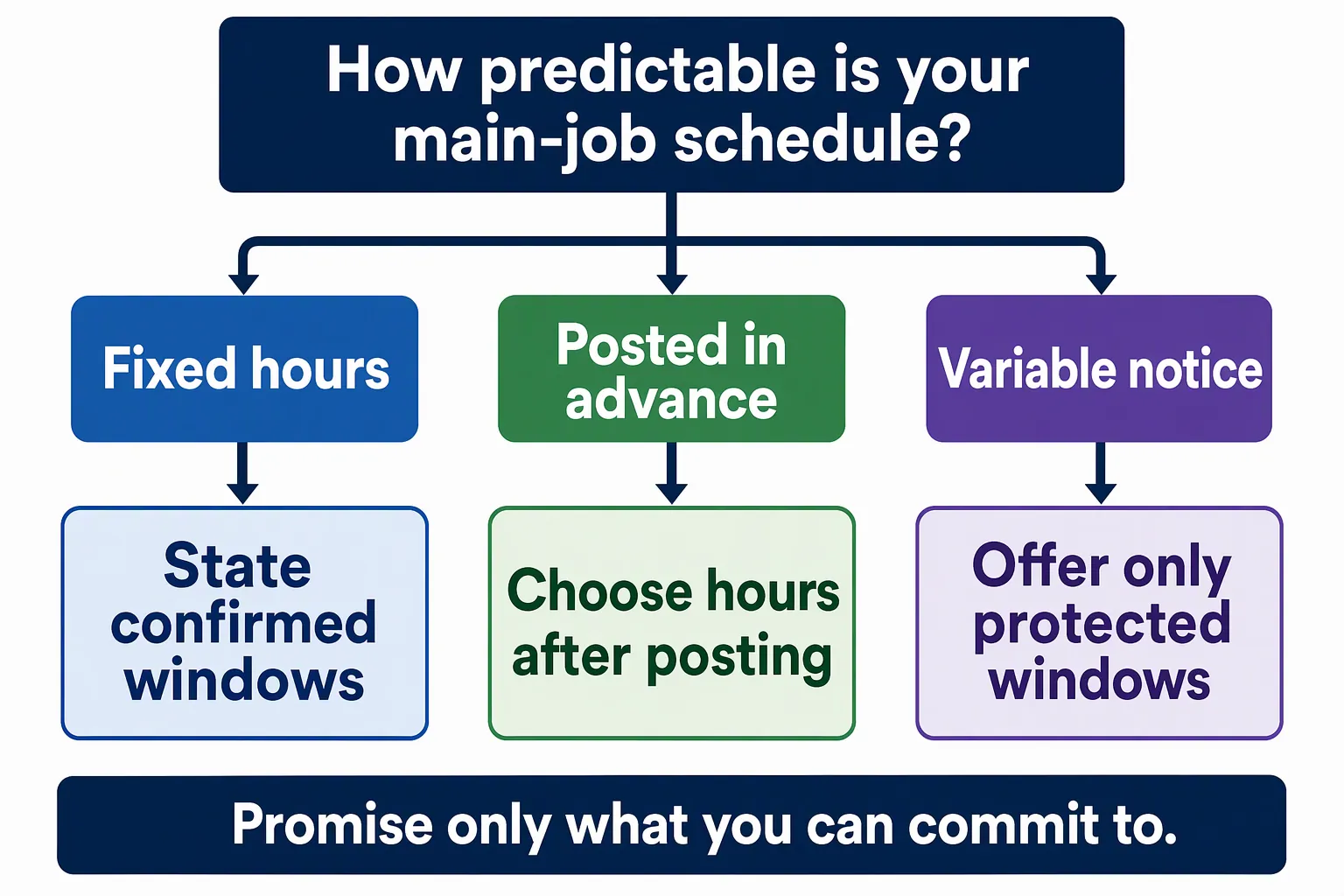
Mention your main job only when it helps the reader understand your schedule. Name the days and hours you can work in this role. If your main schedule changes, describe when it is set or how much advance notice you receive only if you know that information.
- 04
Support your promise with a relevant example
Choose a true example of meeting a regular commitment, coordinating schedules, or completing work on time. Explain what you did and why it relates to this position. Do not claim that two jobs can never conflict; show how you planned for the hours you are offering.
Second job cover letter example
This fictional example shows how a letter can name a current job, state specific availability, and support it with a relevant reliability detail. Its sample schedule is illustrative, not a recommendation for every applicant.
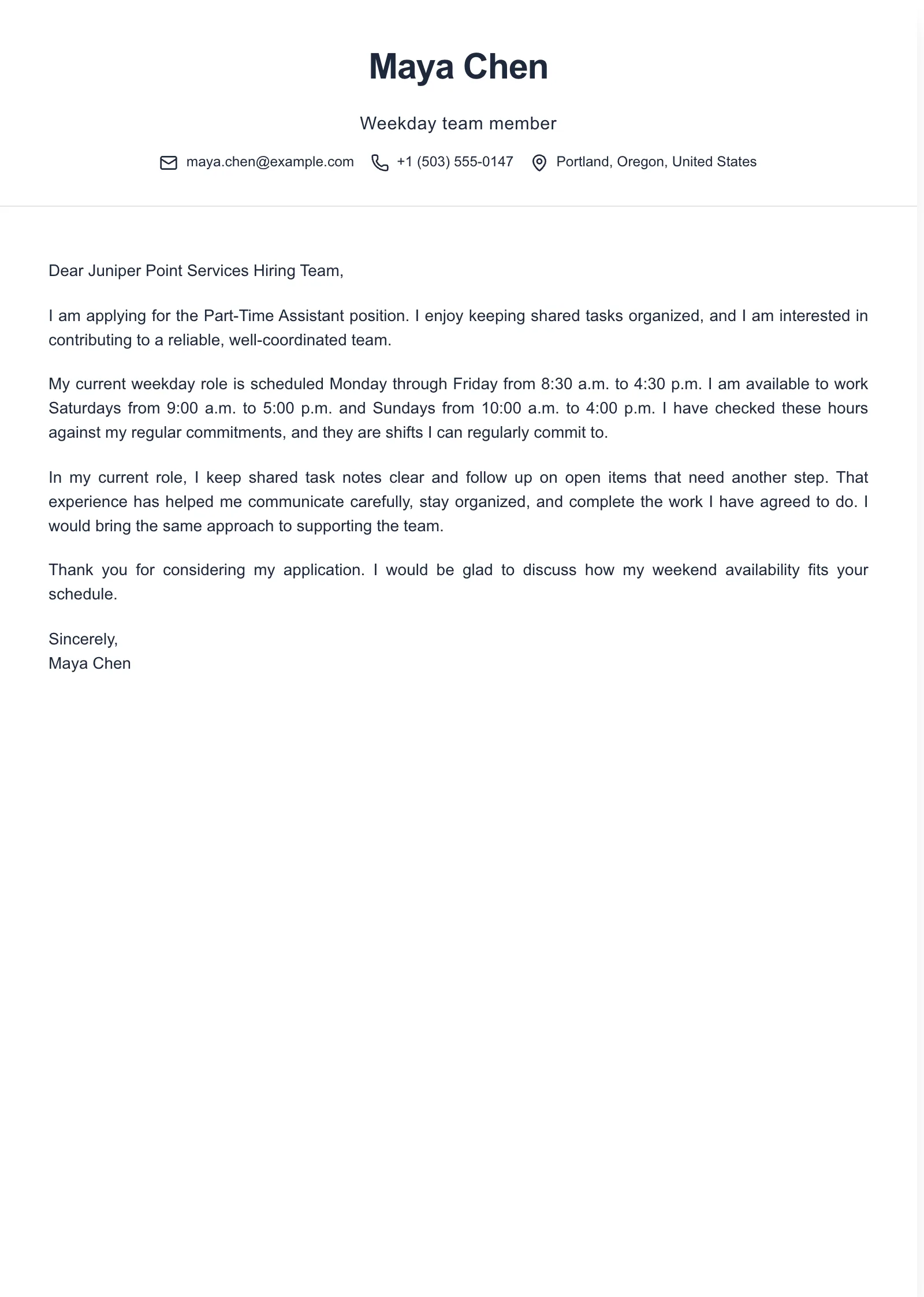
Example paragraphs
“I am applying for the [Job Title] position at [Company Name]. My current role is scheduled for [confirmed main-job days and hours], which leaves me available for [specific days and hours] with [realistic travel or handoff buffer]. I can commit to those recurring shifts.”
“In my current role, I [specific action that shows dependable planning], including [factual example]. For the [Job Title] opening at [Company Name], I can work [confirmed available hours], and I know [accurate information about when my main schedule changes].”
“I am interested in bringing [relevant skill or experience] to the [Job Title] role at [Company Name]. I can reliably work [specific days and hours], and I would be glad to discuss how those hours align with the position's schedule.”
Use only schedule details you have checked, and replace every bracket with a fact you can explain. If your main-job hours are fixed, name the available windows. If they vary, explain what you know about when the schedule is set and offer only the hours you can reasonably protect. Choose a reliability example that is true and relevant; a specific example of consistent planning is more useful than a broad claim that you are always available.
Common mistakes when applying for a second job
Claiming open availability without checking
- What goes wrong
- A broad promise may conflict with your main job, travel time, or regular commitments, making your stated availability inaccurate.
- Better approach
- Offer the specific days and hours you can reliably work. If availability depends on advance notice, describe that accurately.
Treating the first job as an apology
- What goes wrong
- Over-explaining why you have another job can shift attention from the position and the contribution you can make.
- Better approach
- Mention your current work briefly when it clarifies your schedule or provides relevant experience. Then return to what you can contribute.
Ignoring time between shifts
- What goes wrong
- Listing available hours without accounting for travel or a handoff can make a proposed schedule impractical.
- Better approach
- Plan the full transition between commitments first. State only the work windows that remain realistic after that check.
Promising that conflicts will never happen
- What goes wrong
- An absolute guarantee may be misleading when either schedule can change.
- Better approach
- Describe the planning steps and confirmed availability you can support. Be candid about known limits instead of making guarantees.
Frequently asked questions
- Should I mention my first job in a cover letter for a second job?
- Mention it briefly if it helps explain when you are available or how you can avoid a schedule conflict. You do not need to give unrelated details about your main job. Keep the description accurate and focused on the hours you can commit to.
- Should I say I have open availability?
- Only if that is true for the hours the employer may need. It is clearer to name the days and times you can reliably work, and to explain any real limits or notice you need for schedule changes.
- Do I need to explain why I want a second job?
- You can focus on why this position interests you and what you can contribute. Personal financial details are not needed unless you choose to share them and they help explain your interest.
- Should I tell my main employer that I am applying for a second job?
- This guide cannot determine what applies to every work arrangement. Review any applicable workplace policy or agreement, and do not assume that disclosure is either required or unnecessary. If you cannot determine what applies, ask an appropriate adviser.

Put this career change approach into practice
Choose sample data or build your own cover letter, then personalize it before you download.