
Introduction
A school leaver cover letter should connect what you have done at school or in part-time work to the actual vacancy. You do not need a long work history. One relevant subject, responsibility, or task can give an employer a clearer reason to consider you than a list of qualities such as “hard-working.”
For a UK application, first check whether the employer asks for a cover letter, a short application statement, or answers to separate selection criteria. Follow the requested format. The National Careers Service has general covering letter guidance; here, the focus is how to use school and work evidence specifically and truthfully.
This page focuses on the school-to-work transition and how to present GCSEs, A-levels, and genuine experience. It overlaps with advice for applicants without experience, but you do not need to have paid work experience to use the approach.
What to address directly
“I have little or no paid experience.”
- Hiring manager concern
- A short work history can make it hard to decide what evidence belongs in the letter.
- What your letter should prove
- Choose one example that shows an action relevant to the vacancy. It might be helping customers during a part-time shift, keeping track of materials for a school event, or completing a project to a deadline. Say what you personally did and connect it to a duty in the advert. Identify school or volunteer activities as such, not as paid jobs.
“I am not sure my grades are relevant.”
- Hiring manager concern
- Listing subjects and results without a connection to the vacancy can take up space without helping the employer understand your fit.
- What your letter should prove
- Mention a qualification when the advert asks for it or when a subject supports a specific requirement. State results accurately and label predicted grades as predicted. If grades are not central to the role, use a concrete example of how you worked, learned, or handled a task.
“I do not know what to say about this employer.”
- Hiring manager concern
- Broad statements about being enthusiastic or flexible do not show why you chose this particular vacancy.
- What your letter should prove
- Use a detail from the advert or the employer's public information to explain your interest. Then link one of your real examples to a duty or requirement in that advert. Do not claim personal knowledge or a connection you do not have.
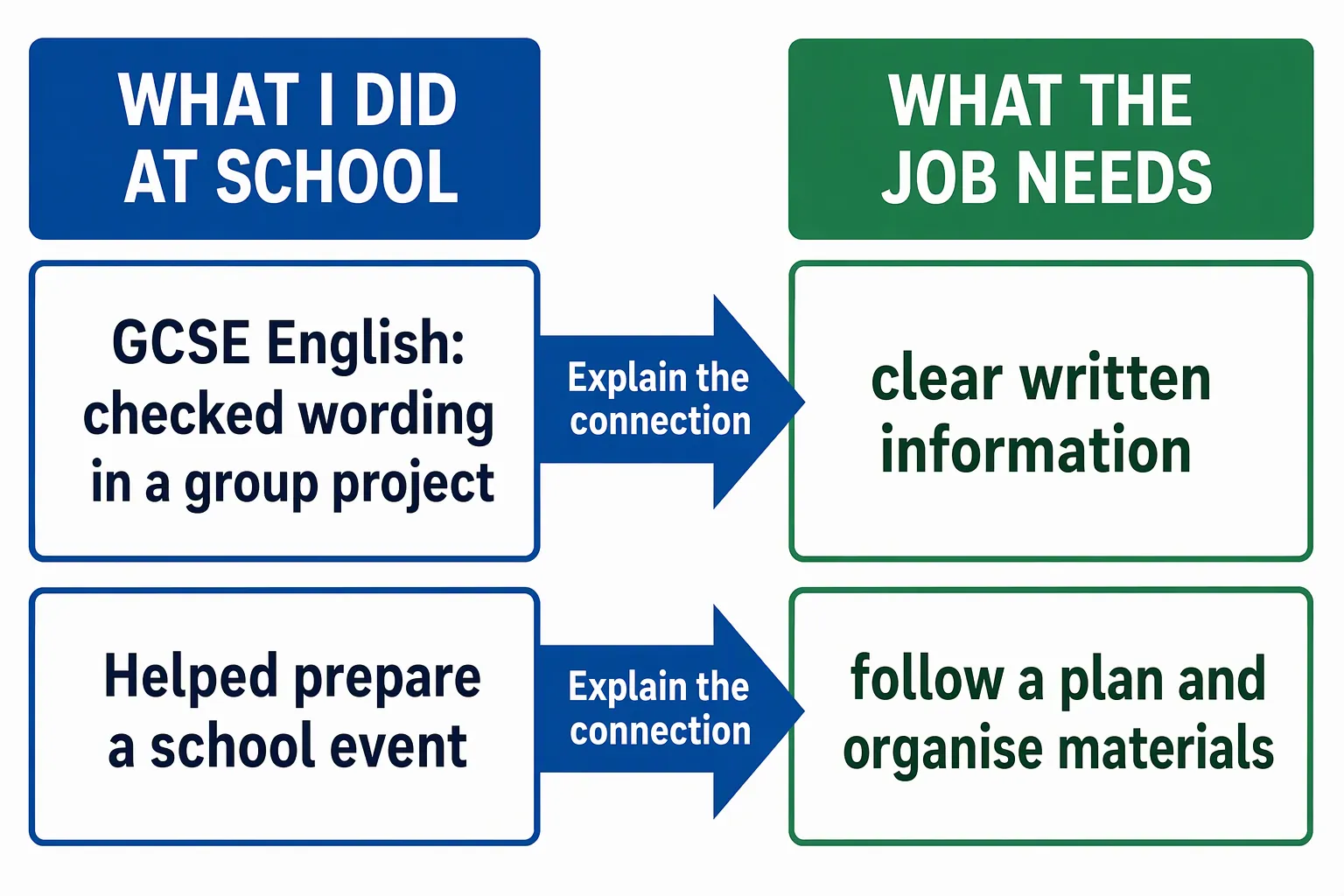
Structural approach for a UK school leaver
Keep the letter focused on the vacancy, not your whole school history. The cover letter structure guide explains the general parts; for this scenario, the key decision is which school, volunteering, or work example belongs in the middle. Include a qualification when it helps address the employer's stated need.
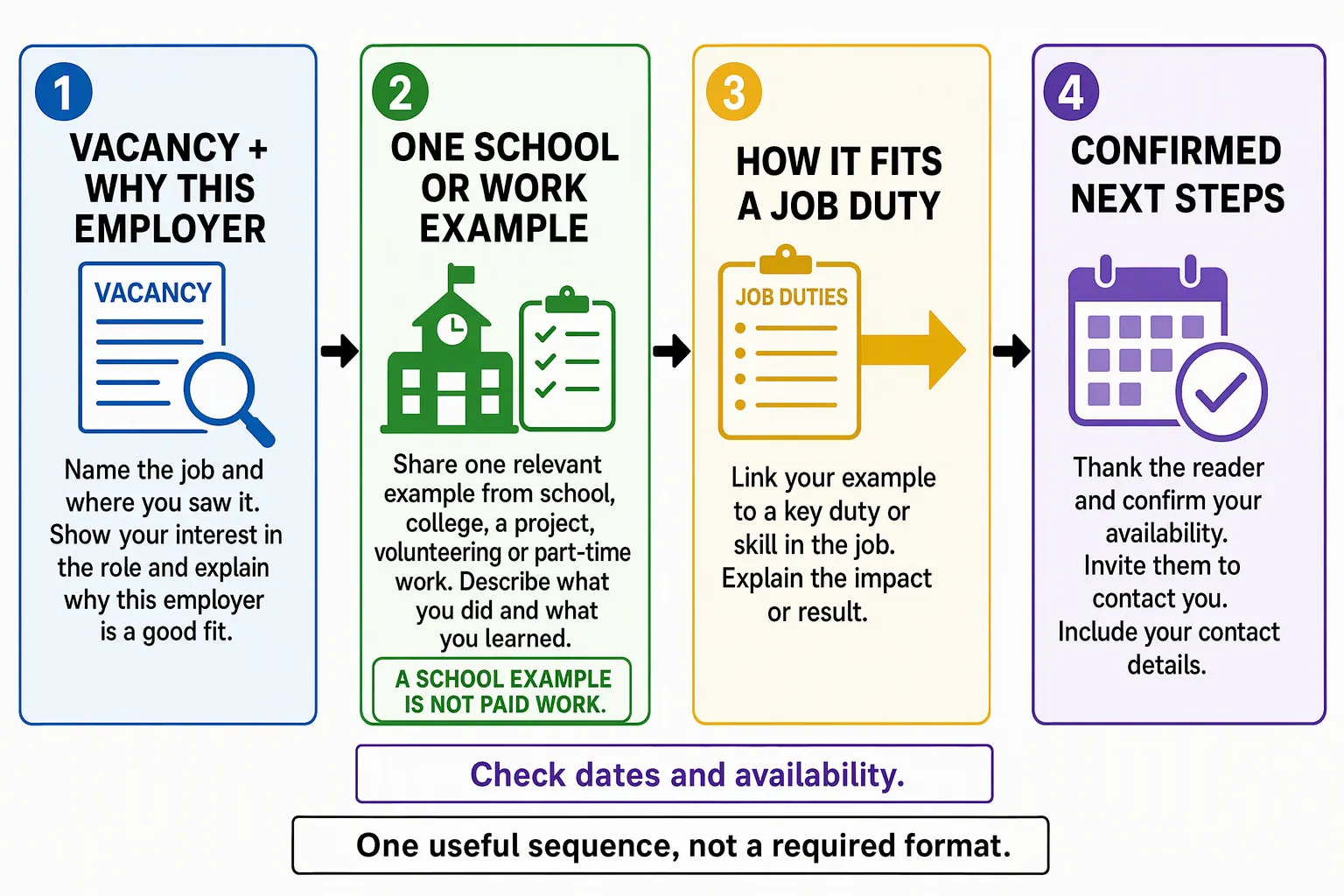
A useful sequence is to name the vacancy, give a genuine reason for choosing this employer, connect one relevant example to a job duty, and close with accurate practical information. This is a way to organise your points, not a required format. You do not need to apologise for being new to work. Show what you can already contribute and what you are ready to learn.
- 01
Name the actual vacancy
Use the job title and employer name from the advert. Add one genuine reason this particular work appeals to you, such as a duty, product, service, or stated way of working. Avoid a reason that could apply to any employer, or an unsupported claim about what the employer is like.
- 02
Choose one piece of relevant evidence
Match a requirement to a real example. A GCSE subject may support a stated need for written accuracy; a school event may show that you followed a plan; part-time work may show customer contact. Name the task and your action. Include A-level study only when it is relevant, and distinguish achieved grades from predicted results.
- 03
Explain how the example fits the job
Do not leave the employer to work out why an activity matters. If you helped with a school event, explain what you handled, such as organising materials or answering questions, and connect that action to a duty in the advert. Keep the claim within what you actually did; an activity is evidence, not proof that you have already done the job.
- 04
Close with confirmed details
Thank the reader and say you would welcome an interview. Mention a start date or availability only when you know it is accurate. If you are still of compulsory school age, check current official guidance for your age and local area before promising particular work patterns. Follow any application-form instructions rather than repeating every qualification in the letter.
School leaver cover letter example
This fictional example connects recent education and genuine part-time experience to a specific vacancy.
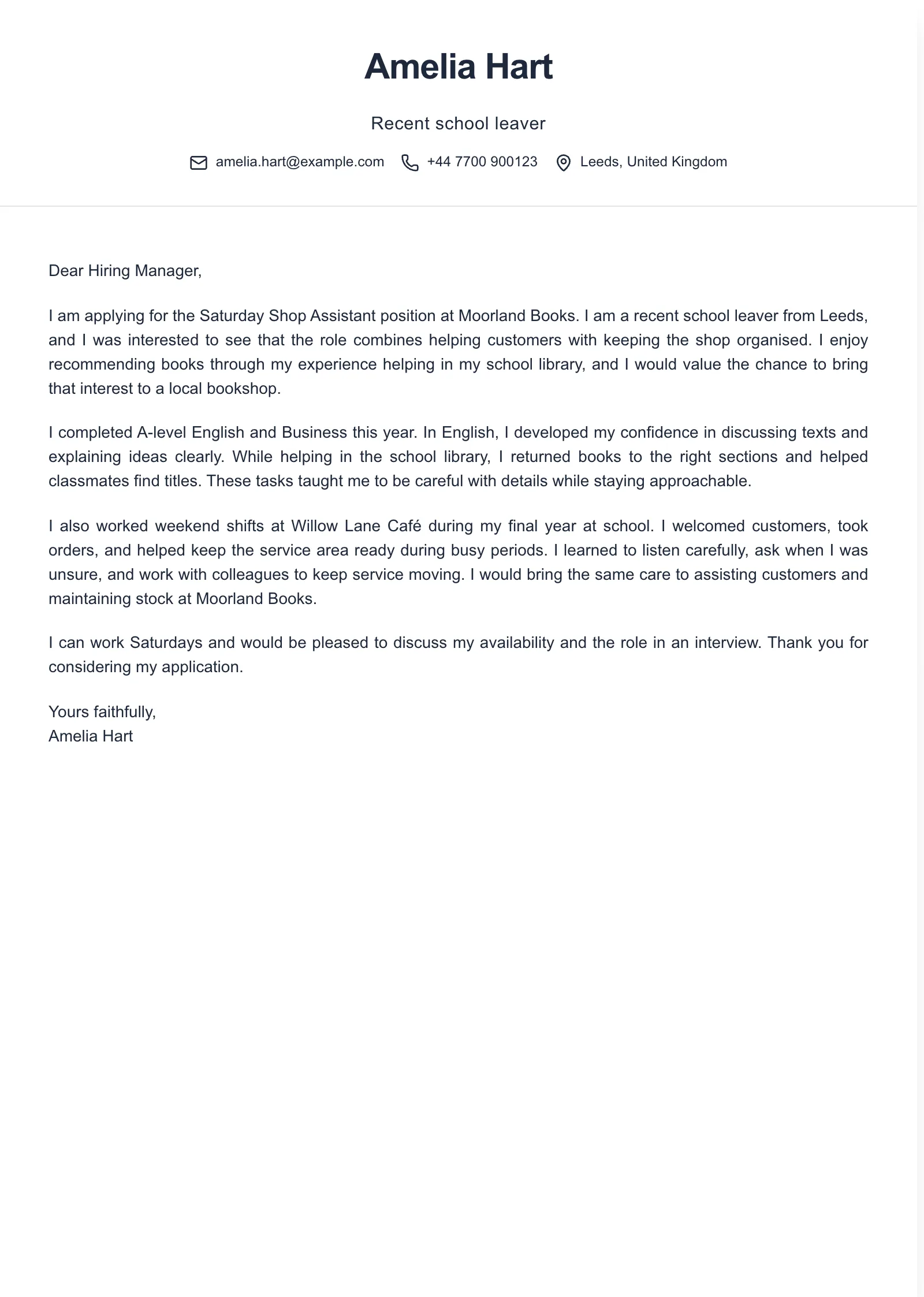
Example paragraphs
“I am applying for the [Job Title] position at [Company Name]. I am interested because [specific detail from the advert or employer information], and I would like to contribute my experience of [relevant task or activity].”
“My [GCSE subject and achieved or predicted grade] has helped me practise [relevant skill], which I used when [specific school task or project]. This would help me with [duty named in the advert] at [Company Name].”
“In my part-time role at [Company Name] / during [school activity], I [specific action] when [brief factual situation]. I learned to [relevant action or skill], which I could bring to the [Job Title] role at [Company Name].”
These are adaptable paragraphs, not a complete letter. Replace each bracket with an accurate detail, and use only the school or work option that applies to you. Do not invent grades, duties, results, or knowledge of an employer. Describe what you did rather than claiming experience you do not have.
Common mistakes in a school leaver cover letter
Listing grades without a reason
- What goes wrong
- A long list of GCSEs or A-levels can distract from the vacancy and repeat information better placed in an application form.
- Better approach
- Mention subjects or results that answer a stated requirement or support a relevant point. Label predicted grades accurately.
Presenting an activity as a job
- What goes wrong
- Describing a school project or one-off event as formal employment can mislead an employer about your experience.
- Better approach
- Name it as a project, volunteering, or a school activity. Describe your own task without inflating your title or responsibility.
Promising availability you cannot confirm
- What goes wrong
- Saying you can work any shift or start immediately may not reflect your commitments or the rules that apply to you.
- Better approach
- State only confirmed dates and availability. If you are still of compulsory school age, check current official guidance for your age and local area before committing to work patterns.
Sending the same letter to every employer
- What goes wrong
- A generic letter does not show that you understand this vacancy or why your example fits it.
- Better approach
- For each application, update the job title, employer-specific reason, and link between your evidence and the advertised duties. Keep the underlying facts consistent with your CV and application form.
Frequently asked questions
- Should I include GCSEs in a school leaver cover letter?
- Mention a subject or grade when the advert asks for it or when it supports a relevant point. Label predicted results as predicted, and follow the employer's instructions about where to list full qualifications.
- Can I write a school leaver cover letter without paid work experience?
- Yes. Choose a specific example from school, volunteering, a club, a project, or another responsibility. Explain what you did and how it relates to the vacancy. Do not describe unpaid experience as paid employment.
- How do I explain when I can start or work?
- Give dates and availability you can confirm. If you are still of compulsory school age, child employment rules can vary by age and local bylaws. Rules for young workers who have reached the end of compulsory school age differ. Check current official guidance for your circumstances before committing to work patterns.
- Is a school leaver cover letter different from a no-experience cover letter?
- The intents overlap: a school leaver may also have no paid experience. This guide focuses on connecting recent education, such as GCSEs or A-levels, and the move from school to work with a particular vacancy. A no-experience guide can address applicants at other career stages too.

Put this career change approach into practice
Choose sample data or build your own cover letter, then personalize it before you download.