
Introduction
A return-to-work cover letter should connect three points: the professional value you built before the break, the readiness you have now, and the contribution the employer needs next. The break provides context, but it is not the central qualification. A strong letter neither hides the transition nor lets it consume the application.
Returning candidates often underestimate older achievements or overstate informal activity during the break. Neither is necessary. Relevant experience still counts, particularly when the underlying work remains important. Recent learning can show currency, but it should be described at its real level. The employer needs a clear, credible picture of how you would step into [Job Title] now.
What to address directly
Why return now?
- Hiring manager concern
- The reviewer may want to know whether the timing is deliberate and whether the candidate is available for the role's expectations.
- What your letter should prove
- Give a concise forward-looking statement that you are ready to return and explain why this type of work is the right direction.
Is previous experience still relevant?
- Hiring manager concern
- Achievements from before a break may appear distant if their connection to current responsibilities is not explained.
- What your letter should prove
- Choose durable capabilities and results, then link them explicitly to current requirements in the posting.
Are skills and knowledge current?
- Hiring manager concern
- Tools, regulations, processes, or customer expectations may have changed during time away.
- What your letter should prove
- Show completed refresh work and name what you practiced, produced, or learned. Do not claim that a short course equals recent professional depth.
Will the person adjust to the workplace?
- Hiring manager concern
- A reviewer may question pace, collaboration, or confidence after an extended absence.
- What your letter should prove
- Use evidence of recent commitments, structured learning, projects, or prior adaptability to show follow-through and realistic readiness.
Structural approach for a return-to-work cover letter
Start with the role and the most relevant professional identity you can support. “Operations specialist with six years of experience” is more useful than “person returning after a break.” Mention the transition in the opening or early in the second paragraph when it will otherwise be obvious.
Next, select one meaningful achievement from your prior work. Explain the problem, your action, and the result, then connect the underlying skill to the current posting. Follow it with recent evidence of currency. That might be a completed course, project, license renewal, volunteer assignment, freelance engagement, or sustained practice. If you have no formal recent activity, focus honestly on transferable experience and what you have done to understand current expectations.
Close with a specific reason for [Company Name] and a contribution you are ready to make. Availability details belong in the letter only when the posting requests them or they clarify a practical issue. If the break is also visible on your resume, use the employment-gap guidance to keep both documents consistent.
- 01
Reclaim your professional value
Lead with relevant experience and the target role, not the absence from work.
- 02
Bridge past and present
Connect a prior achievement with recent evidence that your readiness is current.
- 03
Look forward
Explain why this employer fits and what you are equipped to contribute now.
Use this template for a return to work
Balance prior achievements, current preparation, and a confident forward-looking close.
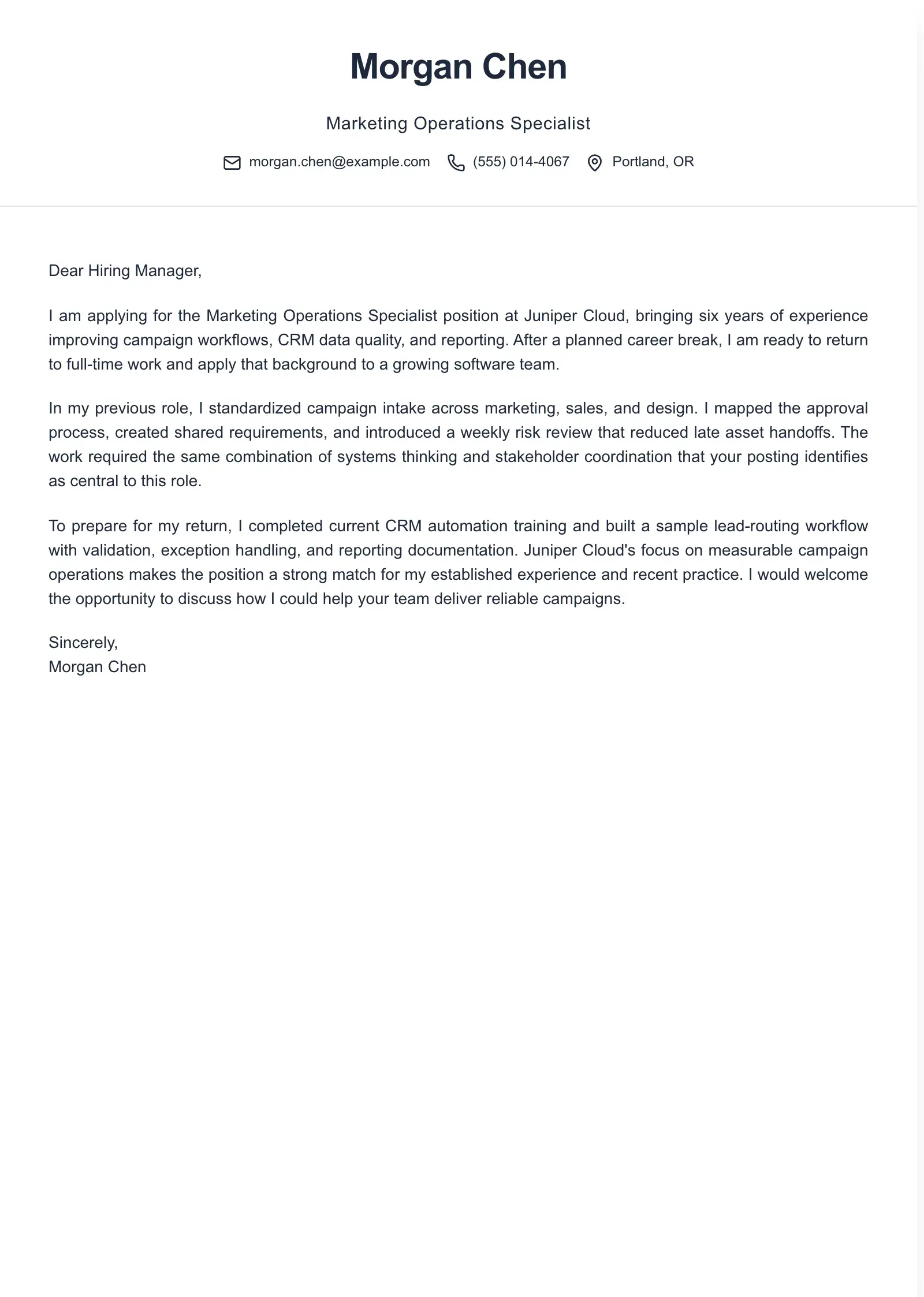
Example paragraphs
“I am applying for the [Job Title] position at [Company Name], bringing [Number] years of prior experience in [Relevant Field]. After a planned career break for [Broad Reason, if you choose to state it], I am ready to return to work and apply my background in [Capability] to your need for [Specific Requirement].”
“In my previous role at [Organization], I was responsible for [Relevant Scope]. When [Situation], I [Action] and delivered [Verified Result]. The tools may have evolved, but the work required [Durable Capability], which remains central to your team's responsibility for [Current Priority].”
“To prepare for my return, I completed [Course, Project, Renewal, or Practice] focused on [Relevant Area]. I used [Current Tool or Method] to [Concrete Output] and incorporated feedback from [Credible Source]. I would welcome the opportunity to combine this current preparation with my established experience in [Field].”
You can adapt these excerpts without copying their claims. Use your actual timeline, completed preparation, and defensible outcomes. A measured explanation communicates more confidence than exaggerated language about being completely up to speed.
Common mistakes in a return-to-work cover letter
Making the break your identity
- What goes wrong
- Opening and closing around the absence can obscure years of relevant experience and current capability.
- Better approach
- Use the break as brief context, then organize the letter around professional evidence and contribution.
Dismissing older achievements
- What goes wrong
- Assuming that all prior work is outdated removes valuable proof of judgment, delivery, and collaboration.
- Better approach
- Choose achievements with durable relevance and explain how they map to today's responsibilities.
Overclaiming recent learning
- What goes wrong
- A short course does not automatically establish the depth gained through sustained professional practice.
- Better approach
- Describe exactly what you completed and applied, while presenting it as evidence of currency and initiative.
Providing unnecessary personal detail
- What goes wrong
- A long explanation of family, health, or financial circumstances can shift attention away from fit and disclose more than intended.
- Better approach
- Use broad truthful context and keep private information private.
Frequently asked questions
- How do I say I am returning to work in a cover letter?
- State the return directly and briefly, then connect your prior experience and recent preparation to the role. A sentence explaining that you took a planned break and are ready to return is usually enough.
- Should I explain why I left the workforce?
- Give broad context when it helps explain your timeline, but you do not owe the employer private details. Keep the explanation consistent with your resume and application, then focus on qualifications and present availability.
- How can I show that my skills are current?
- Cite recent, completed evidence such as coursework, projects, contract work, volunteering, professional association activity, or hands-on practice. Explain what you did and how it relates to the employer’s tools or responsibilities.
- Can I use achievements from before my career break?
- Yes. Relevant achievements remain useful when you explain the underlying capability and connect it to the current role. Pair older evidence with a recent sign of readiness when the field or its tools have changed.

Put this career change approach into practice
Choose sample data or build your own cover letter, then personalize it before you download.