
Introduction
A research position cover letter should connect the work in the posting to evidence from your own research experience. That evidence might be a method you used, a tool you handled, a project you supported, or a research output with a clearly stated status. The aim is to explain your fit, not to repeat your CV or imply that your contribution was larger than it was.
Research roles can focus on lab methods, interviews, records, data handling, literature review, or other tasks. Read the actual posting before choosing what to highlight. The cover letter structure guide explains the general purpose of each part; this page focuses on making research methods, outputs, and group fit specific and credible.
Before drafting, separate the position's stated requirements from its preferences. For each relevant point, note one example from your own work and exactly what you did. This helps you choose evidence that matches the role without turning a skills list into an unsupported claim.
What to address directly
Methods and tools
- Hiring manager concern
- A technique listed without context does not show whether you used it, observed it, studied it, or supported someone else using it. That uncertainty can make your fit difficult to assess.
- What your letter should prove
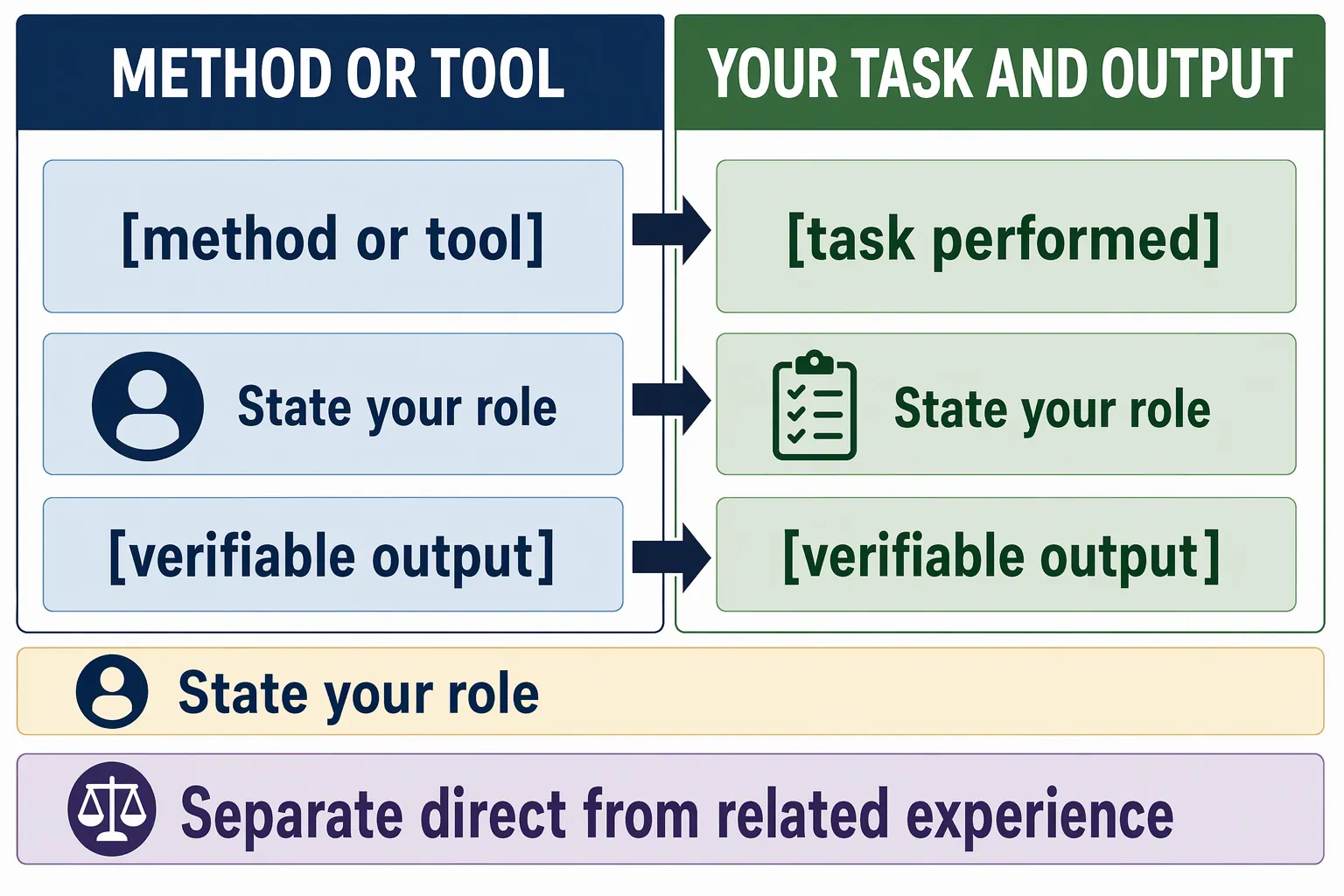
- Name the method or tool, the task you performed, and your responsibility. Distinguish direct experience from related experience or a method you are ready to learn. If your role was supervised or collaborative, describe that scope rather than implying independent ownership.
Research group fit
- Hiring manager concern
- A letter that could be sent to any lab or research group does not explain why this particular position interests you. Broad praise is not evidence of a meaningful connection.
- What your letter should prove
- Use a research question, project, or approach described in the posting or a reliable group source. Then connect it to something you have done or a relevant skill you can contribute. Avoid claiming knowledge of private plans or work that the source does not describe.
Publications and other outputs
- Hiring manager concern
- Applicants may have different kinds of research outputs, and those outputs can have different statuses. Calling a draft published or apologizing for having no publication can distract from relevant evidence.
- What your letter should prove
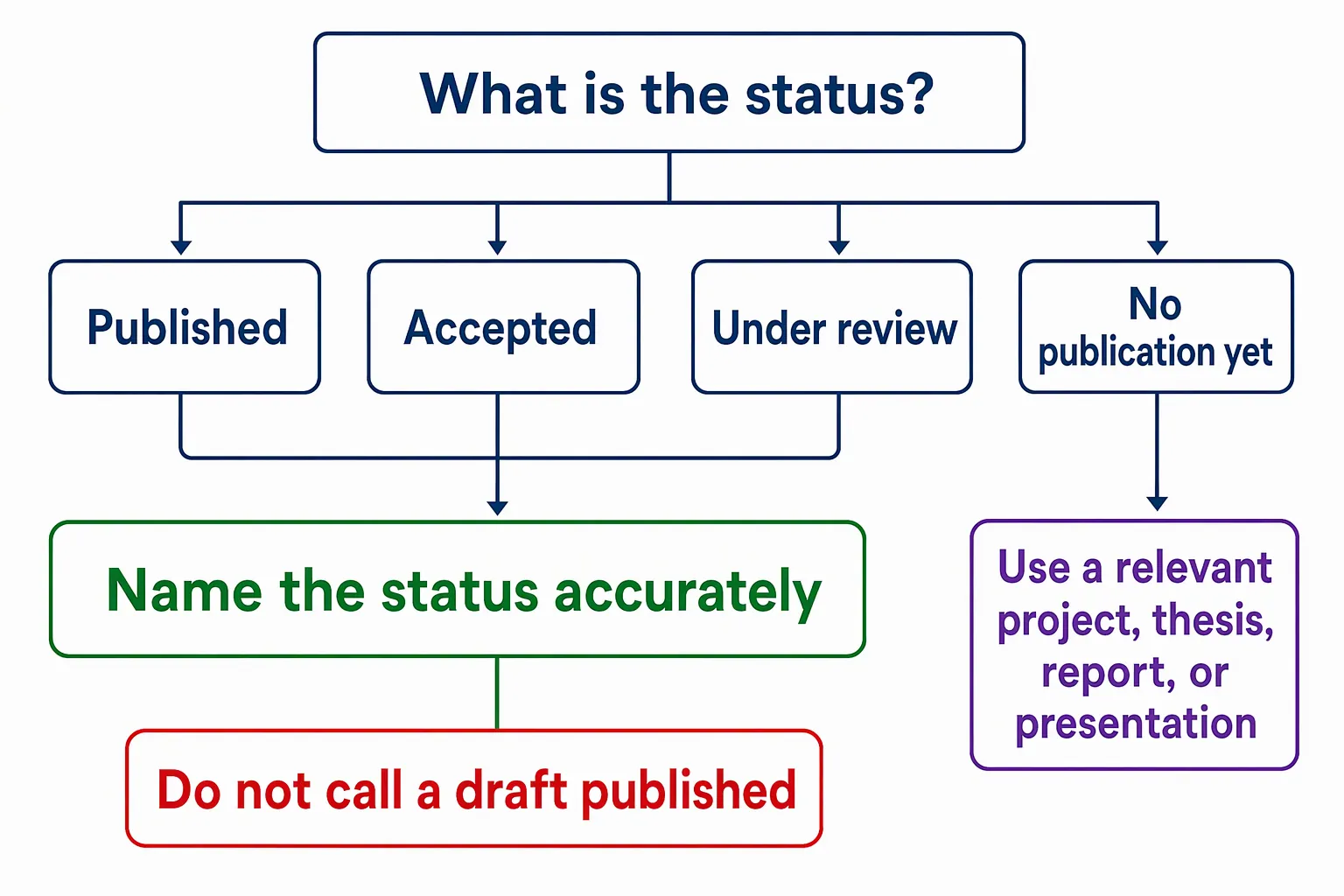
- If you mention an output, state its status accurately and describe your contribution. If you have no publication, choose another relevant item, such as a thesis, presentation, report, or project. Include it only if it helps show your fit and you can explain your work.
Structural approach
Build the letter around a short chain of evidence: why this research interests you, what relevant work you have done, and how that experience relates to the tasks in the posting. There is no need to force every detail into a fixed paragraph count. Follow any application instructions and choose only the points that make your case clear.
For each point you plan to make, write down the evidence, your role, and the output or learning that followed. Keep those elements distinct. For example, a team result is not automatically an individual achievement, and familiarity with a method is not the same as having performed it.
- 01
Identify the research question
Find the question, project, or purpose that makes this position distinct. Use a detail from the posting or a reliable group source to explain your interest. These cover letter opening examples can help with the opening, but adapt the wording to the research rather than copying a general formula.
- 02
Match methods to your experience
Select one or two methods or tools that matter to the role. For each, state the task, your contribution, and the setting. If your experience is adjacent rather than direct, name the difference and explain the relevant skill you can transfer.
- 03
Choose evidence you can explain
Use a project, thesis, publication, presentation, or other output that supports your fit. State publication status accurately, identify your own contribution, and follow any project or employer instructions about sharing details. A specific task and output are more informative than a technique listed without context.
- 04
Connect evidence to the role
Explain how your evidence relates to a responsibility in the posting. Close by stating your interest in discussing the position. Keep any claims about experience, training, availability, or eligibility accurate, and do not promise qualifications or permissions you do not have.
Research position cover letter example
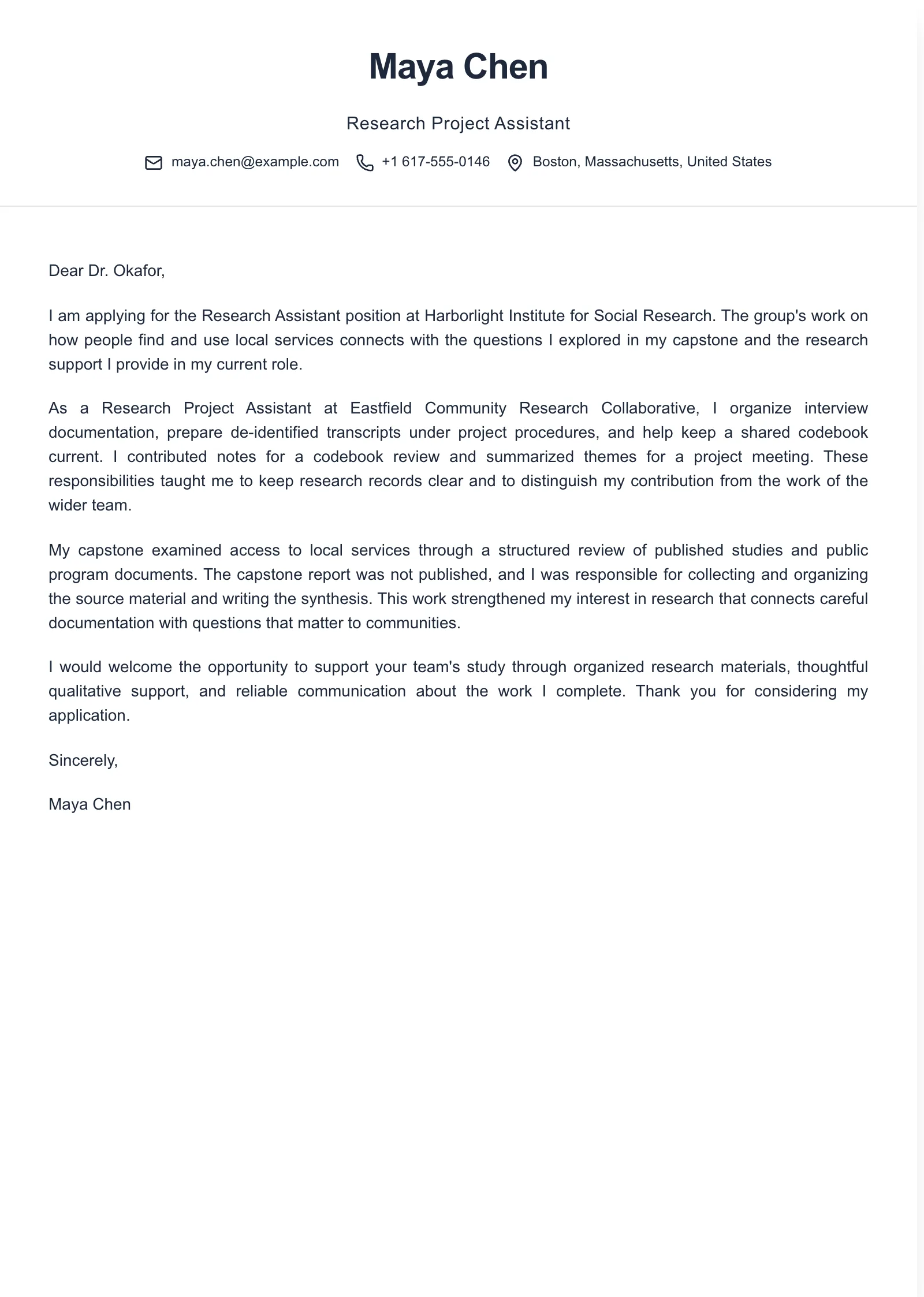
This fictional example connects research support experience to a group's stated focus and describes the candidate's project and output status precisely.
Example paragraphs
“I am applying for [Job Title] at [Organization or Institution] because [specific research question or project detail] connects with my experience in [method or research task]. In [project or setting], I [verifiable contribution], which relates to [responsibility stated in the posting].”
“For [project or study], I used [method or tool] to [specific task]. My responsibility was [factual contribution], and the work produced [verifiable output]. I have not used [requested method or tool] directly, but my experience with [related method or task] gives me a relevant foundation to build on.”
“My [research output, with accurate status] examined [topic or question], and I contributed [specific role]. This work gave me practice with [relevant research task] and produced [verifiable finding or completed output] that connects to [requirement in the posting].”
Use these as separate paragraph options, not as a complete letter. Choose the options that match the posting, replace each bracket with a fact you can explain, and remove claims that do not fit your experience. Keep the group connection specific while distinguishing your work from the wider team's.
Common mistakes in a research position cover letter
Listing methods without showing your role
- What goes wrong
- A string of techniques can leave readers unsure whether you used them, observed them, or only studied them.
- Better approach
- For each relevant method, state the task and your level of responsibility. Use a related example when you do not have direct experience.
Using generic praise for a group
- What goes wrong
- Calling a lab impressive or innovative does not explain why its research is relevant to you.
- Better approach
- Refer to a stated question, project, or approach and connect it to evidence from your own experience.
Misstating output status
- What goes wrong
- A draft, an item under review, an accepted work, and a published work are not interchangeable descriptions.
- Better approach
- Use the status that matches the record and clarify your contribution. If you have no publication, feature another relevant research output instead.
Inflating team or training work
- What goes wrong
- Describing a supervised or shared task as independent leadership can misstate what you did. Claiming training or access you do not have can also create confusion.
- Better approach
- Use precise verbs for your part, name collaboration where relevant, and distinguish completed training from a willingness to learn.
Frequently asked questions
- Do I need publications to apply for a research position?
- Not necessarily. Follow the posting's stated requirements. If you have no publications, show relevant work you can discuss accurately, such as a thesis, class or independent project, literature review, dataset, presentation, or research support task. Do not imply that a draft or work under review has been published.
- How should I describe a method or tool I have not used?
- Do not present it as hands-on experience. Name a related method or tool you have used, explain the task you completed, and state what you are prepared to learn. If the posting makes the method essential, address the gap plainly rather than suggesting an equivalence you cannot support.
- What if my research experience comes from coursework?
- You can describe coursework when it involved relevant research tasks. Identify the project or setting, your own contribution, the method or tool you used, and the resulting work. Keep the scope clear so readers can distinguish a class project from paid, independent, or published research.
- Should I name a specific lab or research group?
- When the posting names a group, connect your interest to a specific research question, approach, or stated project. Explain how your actual experience relates. Avoid generic praise and do not assume the group works on a topic that is not described in a reliable source.

Put this career change approach into practice
Choose sample data or build your own cover letter, then personalize it before you download.