
Introduction
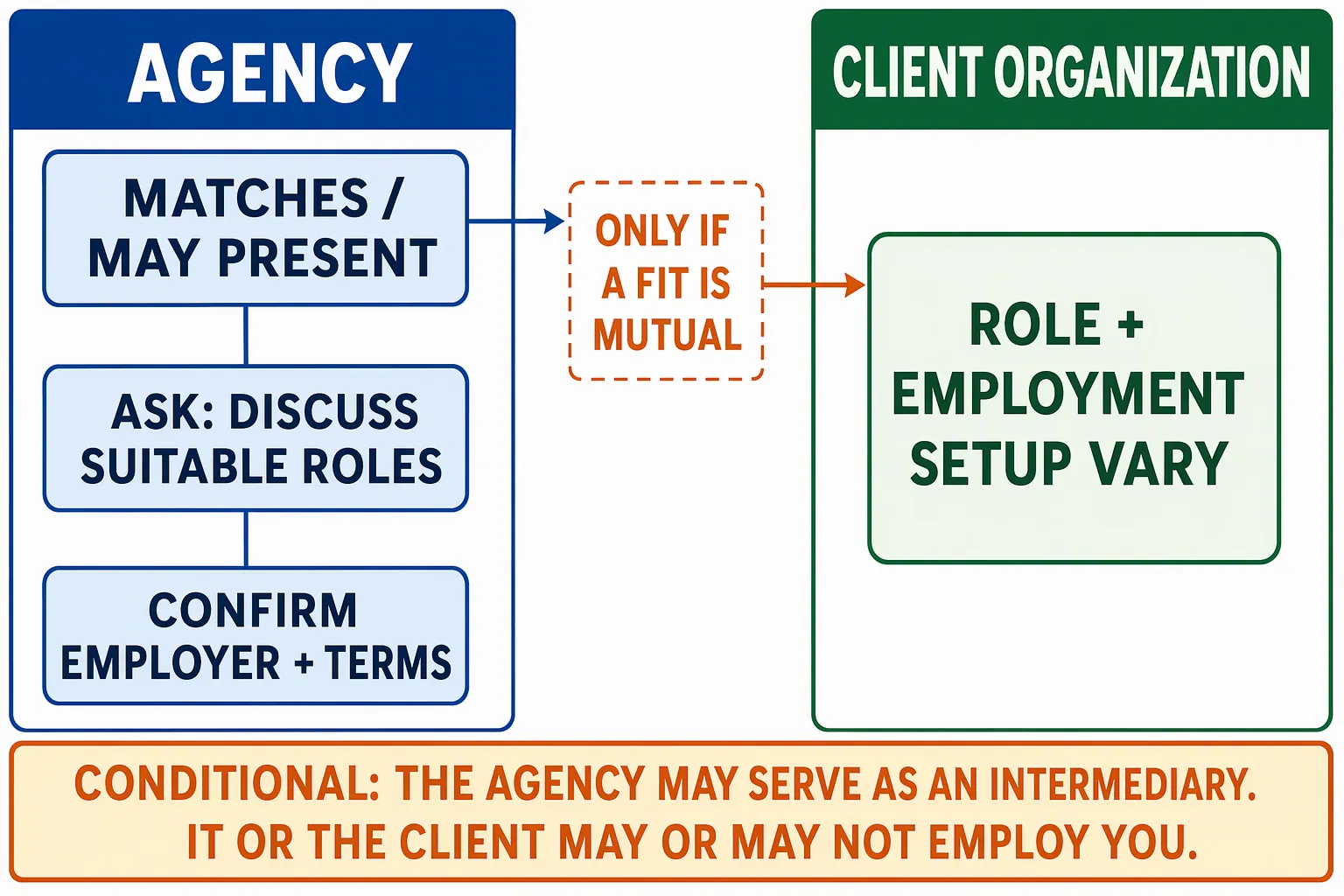
A cover letter to a recruitment or staffing agency is a placement request. You are asking the agency to assess your fit and, where appropriate, discuss possible matches or present you for a client opening. The agency, client organization, and employer may not be the same party, and temporary arrangements can vary. Confirm who would employ you and what terms apply before accepting an assignment.
The task differs from contacting one employer directly, even though labels for these letters can overlap. Focus on your recipient and what you want them to do: help identify suitable roles, or consider you for a named opening. For context on overlapping letter names, see cover letter, motivation letter, or letter of interest.
What to address directly
The agency is not necessarily the client or employer
- Hiring manager concern
- A letter written as if the recruiter is hiring you directly can obscure whether you want a placement, a conversation about an opening, or a job with the agency itself.
- What your letter should prove
- Address the recruiter and state the action you want. If you are discussing a temporary assignment, confirm the employer and terms with the agency rather than assuming who employs you.
A broad search is hard to match
- Hiring manager concern
- Listing unrelated job titles, industries, or levels leaves the recruiter guessing about your direction and strongest evidence.
- What your letter should prove
- Choose one main role family and, at most, one adjacent option supported by the same evidence. Specify a workable location or commute area and the work arrangements you will consider. If you have separate search priorities, identify the primary one.
Practical details are missing
- Hiring manager concern
- The agency may need more information to discuss a match if your availability, location, schedule, or pay expectations are unclear.
- What your letter should prove
- State your actual start date or notice period, relevant schedule preferences, and on-site, hybrid, or remote preferences. If useful, include a pay range with currency and hourly or annual basis. These are details for discussing a match, not promises about what an agency or client will offer.
Structural approach: make your placement request easy to assess
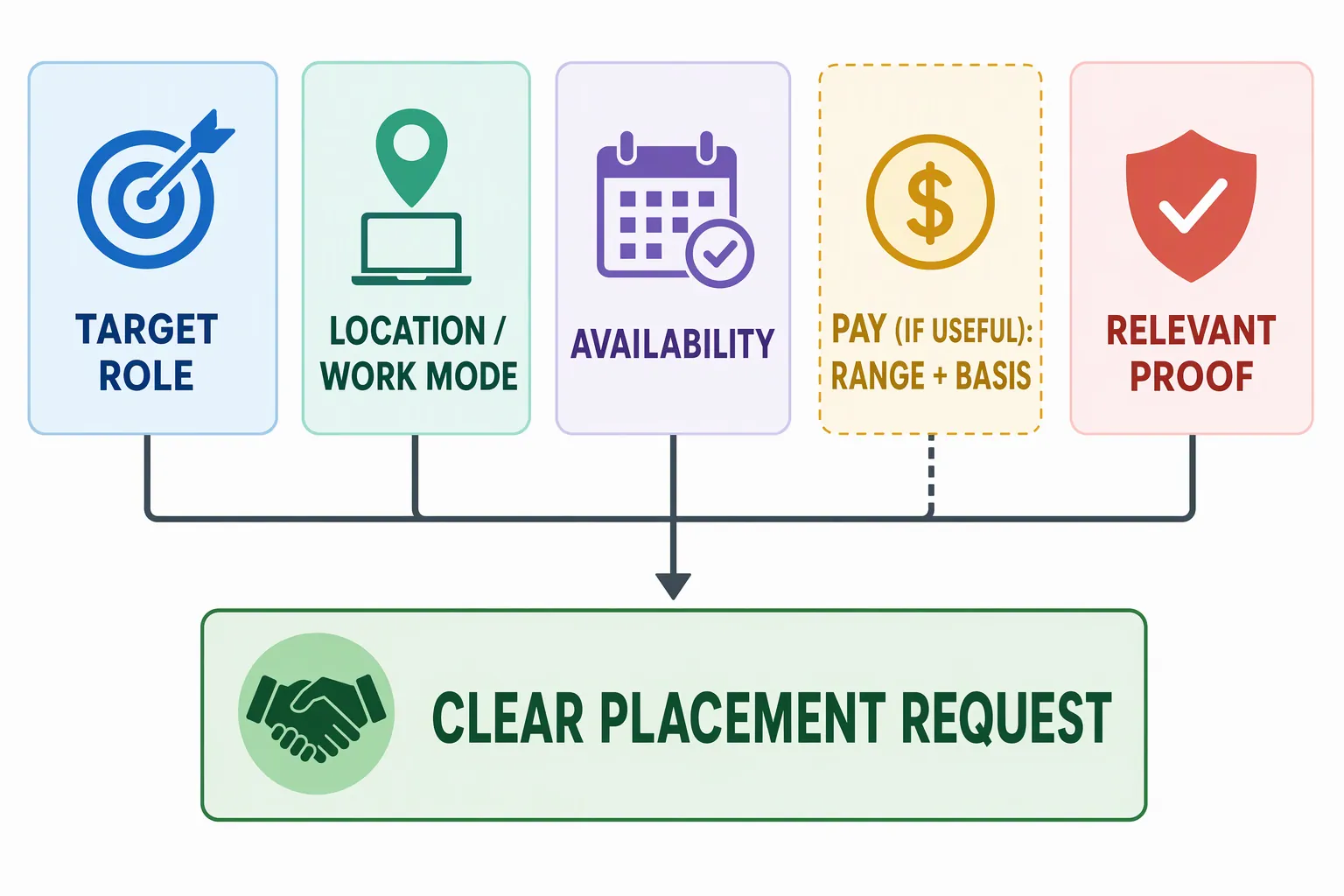
Organize the letter around three things an agency can use: the work you want, evidence that supports the match, and practical conditions. A general cover letter structure can help organize the page, but adapt the request for an intermediary. Open by naming your target roles rather than suggesting the agency has already hired you.
For a named listing, use its stated duties to choose relevant evidence. Without a listed vacancy, describe the roles you want and why your experience fits, then invite a conversation about suitable opportunities. Use the agency's stated contact method and follow any instructions about forms or documents.
- 01
Set a clear target
Name one main role family and the level or type of work you are seeking. Add a closely related option only if your experience supports it. Give a workable location, commute area, or remote preference, and state any important limits.
- 02
Give evidence the agency can relay
Choose one or two facts that connect your actual experience to duties in the target work. Say what you did and what it supported or achieved. Use results you can verify; do not claim skills or metrics just because they appear in a listing.
- 03
State availability and relevant terms
Give your real start date or notice period and relevant schedule preferences. Include pay expectations if they will help the discussion; specify the currency and whether the range is hourly or annual. If pay depends on the role, say what you need to understand before settling on a range.
- 04
Ask for a useful next step
Invite the recruiter to discuss suitable openings or a named role. If you want to know more before your profile is presented to a client, say so and ask how the agency handles that process. Practices vary, so describe only contact or actions that have actually taken place.
Recruitment agency cover letter example
A fictional example showing how to share target roles, location, availability, pay expectations, and relevant evidence with an agency.
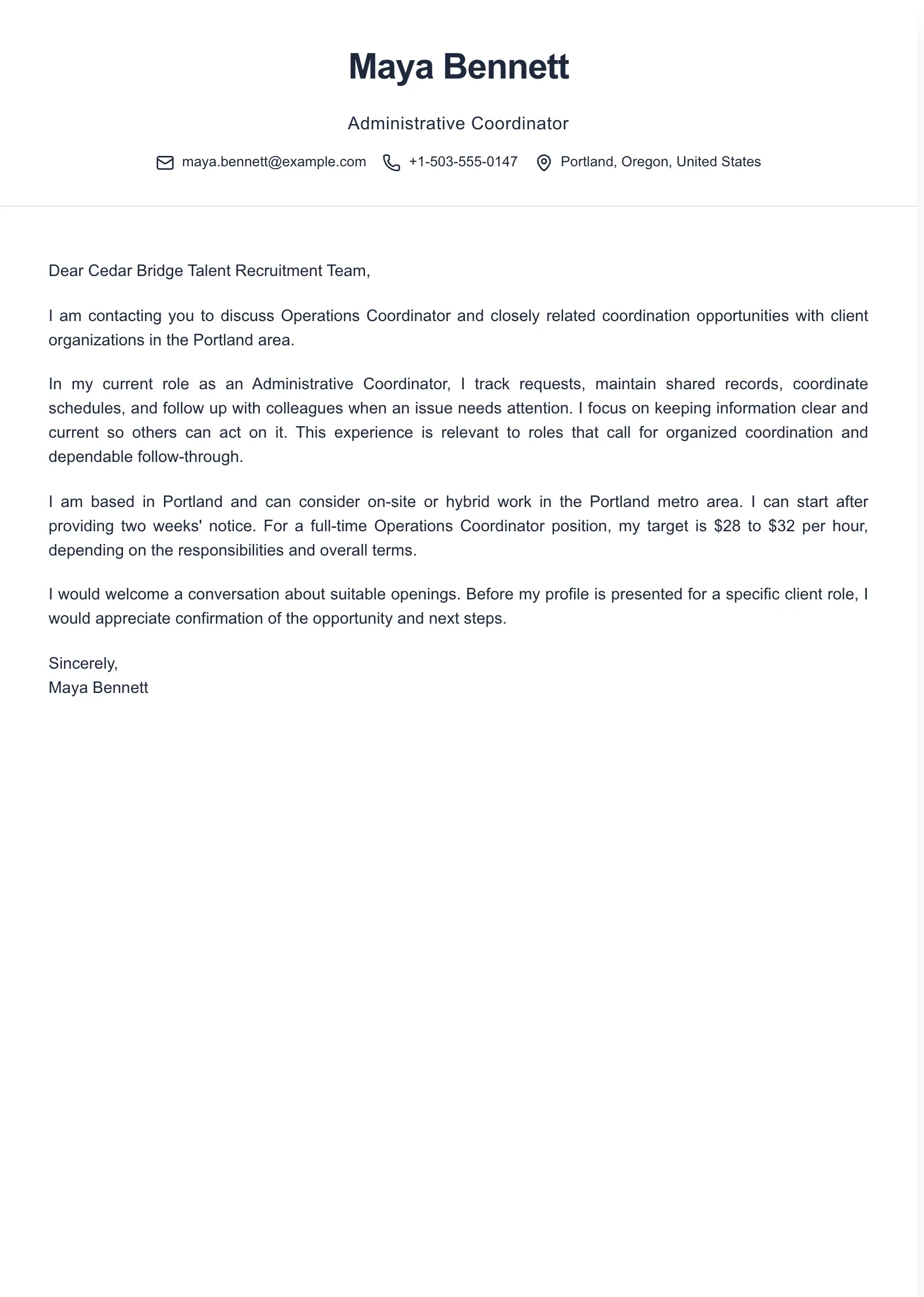
Example paragraphs
“I am seeking [target role family] opportunities in [location or realistic commute area]. My primary focus is [role family], with interest in [closely related role] when the work includes [shared duties supported by your experience].”
“In my current or most relevant role as [accurate job title], I [specific action you performed] for [team, customer, or process], using [relevant skill] to [verifiable result or responsibility]. This experience relates to [specific duty] in [target role or named listing].”
“I can start [accurate date or notice period] and am available for [days, shifts, or schedule]. I am considering [work arrangement] in [location], with a target of [currency and amount per hour or year], depending on the responsibilities and overall terms.”
Use these paragraphs as prompts, not claims to copy. Without a named client or vacancy, describe the employers or roles you are seeking rather than inserting a company name. Keep job titles, duties, availability, and results accurate, and remove anything you cannot support.
Scenario-specific mistakes to avoid
Writing as if the agency is the client employer
- What goes wrong
- A letter that says you are eager to join the agency in a client role can confuse a placement request with a direct application.
- Better approach
- Address the recruiter and ask to discuss suitable placements or a named opening. For a temporary assignment, confirm the employment arrangement separately.
Listing every job you might consider
- What goes wrong
- An unfocused list can hide where your experience is strongest and make your location or level preferences difficult to understand.
- Better approach
- Lead with your primary role family. Add only a genuinely related alternative, and make clear what evidence connects you to it.
Leaving availability, location, or pay basis vague
- What goes wrong
- Phrases such as “available anytime” or “salary negotiable” may not answer practical questions needed to discuss an opening.
- Better approach
- Give your actual notice period, schedule, and workable location. If stating pay, include currency and whether the figure is hourly or annual. If you need role details first, say so.
Claiming a referral or permission that does not exist
- What goes wrong
- Saying an agency has submitted you, or that a client expects your application, misrepresents what has happened.
- Better approach
- Describe only contact and actions that have taken place. If you want to discuss a role before your profile is shared, ask the agency how it handles client presentations.
Frequently asked questions
- Should I address the recruiter or the client company?
- Address the recruiter or agency contact when the agency is your recipient. Name a client organization only when the agency or a listing identifies it and you have a specific reason to tailor your interest. Do not imply that you have been referred or submitted when that has not happened.
- Should I include my salary expectations?
- Include them if they will help clarify a potential match. Give a considered range with its currency and basis, such as hourly or annual, and note relevant conditions. If you need to understand the role first, say you are open to discussing pay once its responsibilities and arrangement are clear. Do not present a guess as a firm requirement.
- What if I am open to several types of roles?
- Name one main role family and, if useful, one closely related option. Explain the shared duties or skills that make both a genuine fit. A long list of unrelated job titles gives the recruiter less guidance about what to match.
- How do I write to an agency when there is no advertised opening?
- Say that you are seeking placement in specified roles and locations, and provide the evidence and practical details that help the agency assess fit. Do not write as though you are applying for a vacancy that does not exist. Follow the agency's stated contact method and instructions.

Put this career change approach into practice
Choose sample data or build your own cover letter, then personalize it before you download.