
Introduction
Applying again to a company can feel awkward, especially if you interviewed or received a rejection. Your cover letter does not need to defend the earlier application. It should give the reader a short, useful bridge from that earlier contact to this opening.
A focused letter names the earlier application in one line, states what has changed, and connects that change to a current need in the posting. New evidence might be a completed project, a skill you have since used, a credential, or a clearer example of relevant work. Be accurate about what is new, and do not assume that previous contact guarantees special consideration.
What to address directly
Whether to mention the earlier application
- Hiring manager concern
- Leaving out a recent interview or application may make your renewed interest seem unexplained. Describing every step of the earlier process can also distract from the current opening.
- What your letter should prove
- Use one neutral sentence to identify the earlier role or conversation. Include timing only if you can verify it. Then move on. You do not have to repeat a rejection, explain how you felt about it, or ask the employer to reconsider the earlier decision.
What counts as a meaningful change
- Hiring manager concern
- A claim that you remain interested does not show what is different about this application. But a new activity is not automatically relevant to the current job.
- What your letter should prove
- Choose one or two verifiable updates and explain their connection to the current posting. A completed project can show a skill in use; a credential can document completed learning; a new responsibility can provide a relevant example. Do not describe work in progress as complete or inflate an update's importance.
Whether the company or opening has changed
- Hiring manager concern
- A new posting at the same company may have different responsibilities, requirements, or application instructions. A repost may also refer to the same opening rather than invite another application.
- What your letter should prove
- Read the current posting and any earlier correspondence before writing. Make your case for the role as it is described now, not for what you assume the company remembers. Follow any reapplication instructions. The letter itself cannot tell you whether the employer will accept another application.
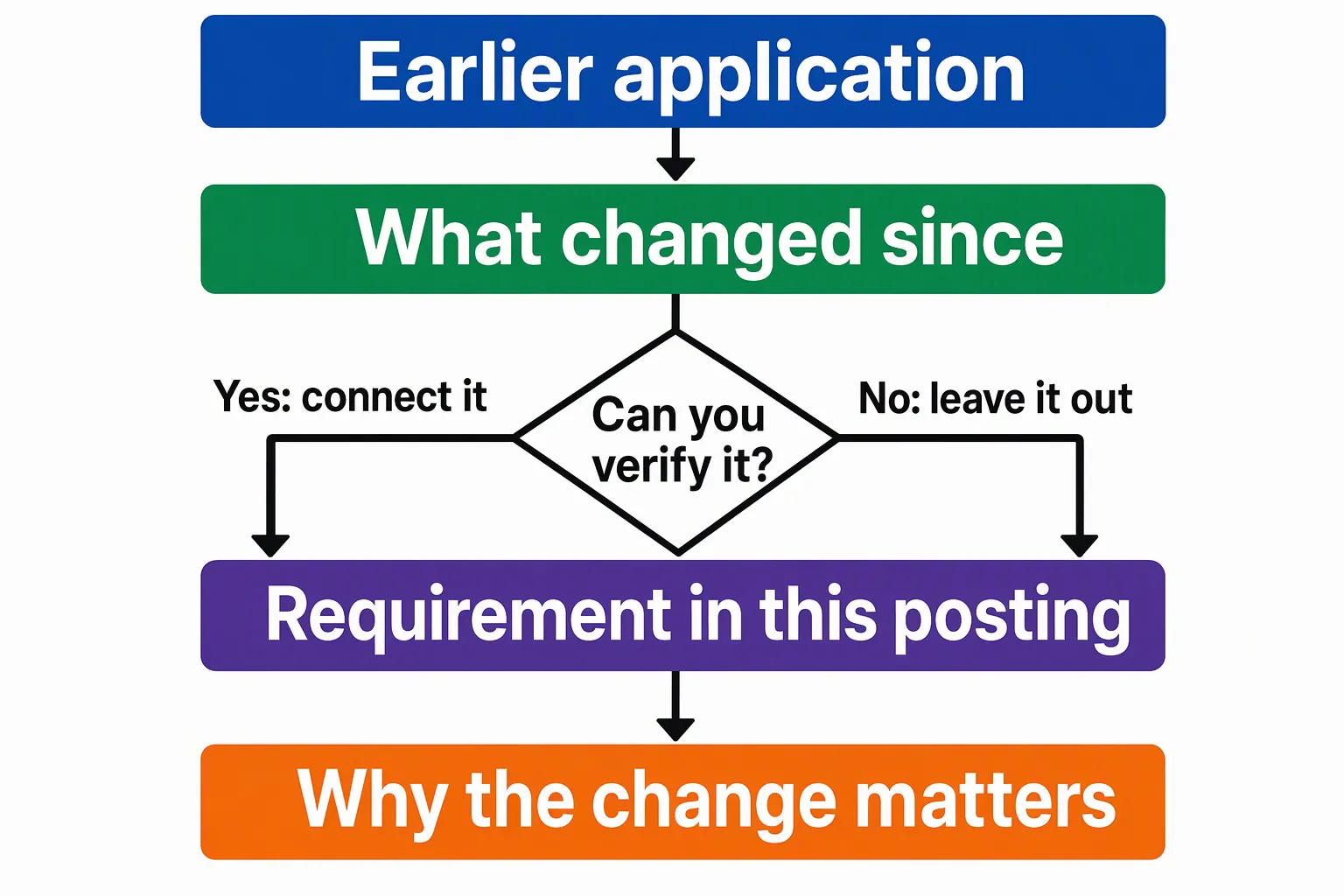
Structural approach: connect the earlier application to new evidence
Keep the letter focused on this application, not on continuing a private conversation. The earlier contact supplies context; the current role and your updated evidence explain why you are applying now. For help arranging the parts of a letter, see cover letter structure.
Use the four steps below to build a concise explanation. Keep each part only if it helps the reader understand why your application is relevant to this opening.
- 01
Identify the current opening
Name [Job Title] and [Company Name]. Include a posting reference or team name only when it is accurate and useful. Make clear that you are applying to the current opening, not asking the company to reopen an earlier decision.
- 02
Acknowledge the earlier application once
Briefly identify your previous application, interview, or conversation. Use a date or role only if you can verify it. Avoid an apologetic tone, a long account of the outcome, or an assumption that the recipient remembers you.
- 03
Show what has changed
Choose a recent, factual update, such as [new skill], [completed project], [credential], or [new responsibility]. Say what you did and what it demonstrates. Do not overstate its scale or claim a result you cannot support.
- 04
Connect the update to this posting
Point to a specific duty or requirement in the current posting and explain how your new evidence relates. Close by expressing interest in discussing your fit for this opening. Follow the employer's instructions about any separate follow-up.
Fictional reapplying cover letter example
This fictional example acknowledges an earlier application, names a genuine update, and connects it to a current opening without revisiting the rejection.
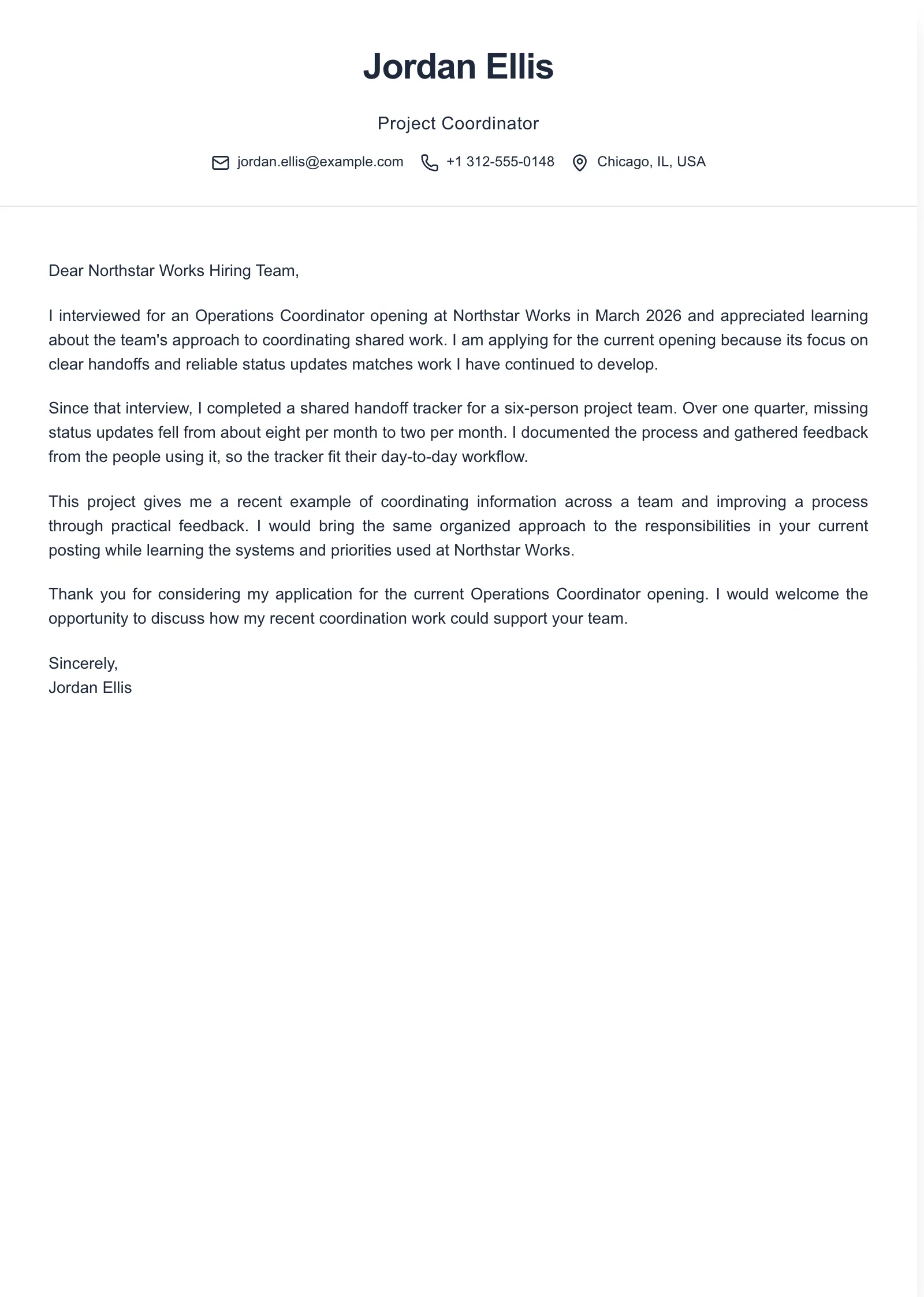
Example paragraphs
“I interviewed for a role with [Company Name] in [month/year] and appreciated learning about the team's priorities. I am applying for the current [Job Title] opening because [specific current responsibility] matches the work I want to take on.”
“Since my earlier application to [Company Name], I completed [specific project], where I used [new skill] to achieve [verifiable result]. That experience relates to [specific duty] in the current [Job Title] posting.”
“After applying for [Job Title] at [Company Name], I completed [credential or course] in [month/year]. I have since applied [specific learning] in [factual example], which relates to the posting's need for [specific requirement].”
Adapt one paragraph to your actual history; these are alternatives, not a script to combine. Replace every bracket with a fact you can explain, and leave out any update that does not support this opening. For more ways to make the first lines specific, see cover letter opening examples.
Scenario-specific mistakes when reapplying
Rehashing the rejection
- What goes wrong
- A long explanation of why you were not selected shifts attention from the current opening to a past decision.
- Better approach
- Acknowledge the earlier application briefly, then use the space for current evidence and its relevance.
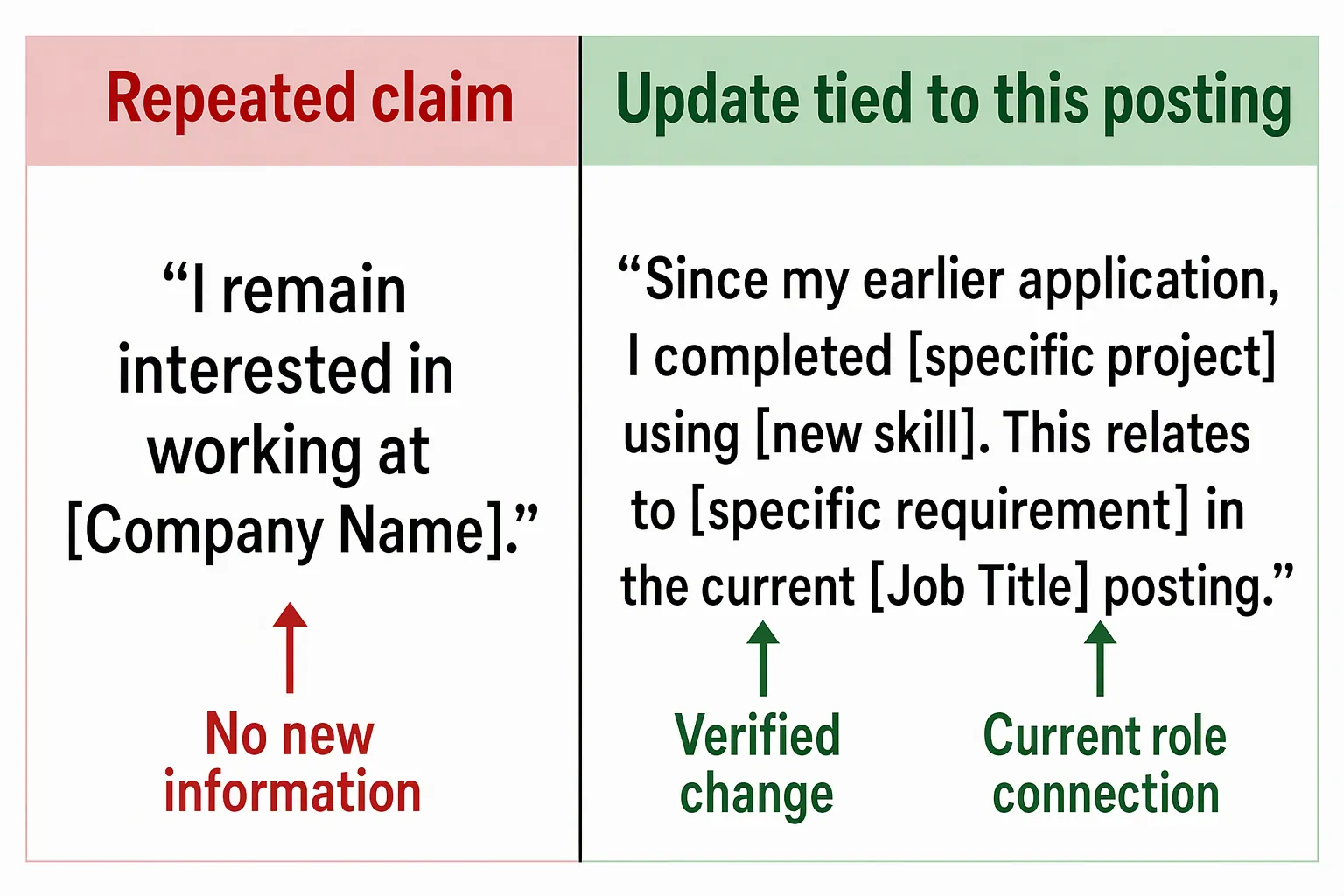
Repeating the old application with new dates
- What goes wrong
- Changing the role title while reusing the same claims does not show why this application is relevant now.
- Better approach
- Compare your earlier materials with the current posting. Add a genuine update or a more relevant example, and explain the connection.
Apologizing for applying again
- What goes wrong
- An apology can make a direct application sound like an intrusion, even when the employer has not asked you to avoid reapplying.
- Better approach
- Use a calm, direct tone. Follow any stated reapplication instructions instead of assuming another application is automatically welcome or unwelcome.
Assuming the company remembers you
- What goes wrong
- The person reading your application may not have handled the earlier one or may not recall its details.
- Better approach
- Give enough context to identify the earlier contact. Explain the current role, your new evidence, and the link between them so the application makes sense on its own.
Frequently asked questions
- Should I mention that I applied to the company before?
- A brief, factual reference can help explain the connection. Mention the role or approximate date if useful and accurate, then move to what has changed and why it matters for the current opening. You do not need to retell the earlier process.
- Should I address a rejection in my cover letter?
- You can acknowledge the earlier application without repeating the rejection or arguing with the decision. Focus on the current posting and relevant new evidence. Follow any instructions the employer gave you about reapplying.
- What if nothing has changed since I applied?
- Do not invent progress. Check whether the current role, your relevant evidence, or the employer's instructions differ from the earlier application. If you have no new relevant information and the posting appears unchanged, consider whether another application is appropriate before sending one.
- How long should I wait before reapplying?
- This guide cannot recommend one interval for every employer or posting. Check any instructions you received and whether the opening is genuinely new or still active. Avoid sending repeated applications for the same opening unless the employer invites you to do so.

Put this career change approach into practice
Choose sample data or build your own cover letter, then personalize it before you download.