
Introduction
A postdoc cover letter should explain why your research experience fits a particular principal investigator's group and what you could contribute or explore next. Make the connection between your work and the group's research easy to follow instead of retelling your full CV.
For an advertised position, address the opportunity and its stated instructions. If you are writing before an opening is posted, adapt the message into a concise, respectful email. This page focuses on the same postdoc-specific task in both cases: show research fit with accurate evidence, and frame any possible next direction as open for discussion.
What to address directly
Fit with this PI's research
- Hiring manager concern
- Sharing a broad subject area with a group does not by itself show how your experience connects to its work.
- What your letter should prove
- Choose a specific, relevant question, approach, or finding from the group's public work. Connect it to a question you have worked on and explain the overlap. Make the connection precise without claiming that the group has a need or priority you cannot verify.
Evidence you can contribute
- Hiring manager concern
- A long list of methods or publications can leave the reader unsure what you personally did and why it matters to this opportunity.
- What your letter should prove
- Select one or two relevant examples. State your contribution, the method or reasoning involved, and an outcome you can describe accurately. Distinguish work you led from work you supported, and keep the account consistent with your CV and other application materials.
A credible next direction
- Hiring manager concern
- A proposed project may seem disconnected from the group's research or sound more settled than it is.
- What your letter should prove
- Raise one focused question that follows from the group's work and your preparation. Explain why your experience could give you a starting point, while leaving the scope and approach open for discussion with the PI and team. Do not invent results, access to resources, or agreement from the group.
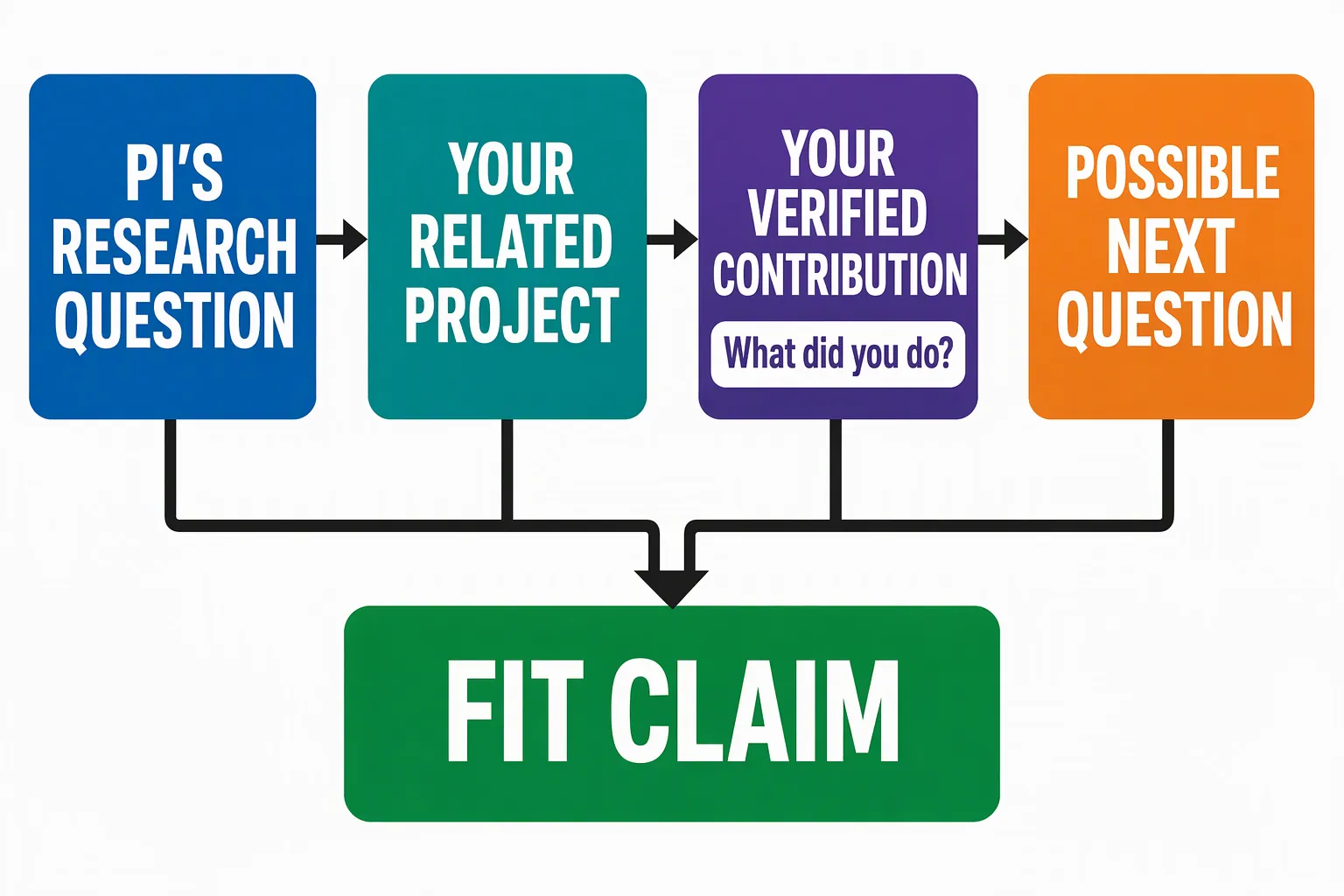
Structural approach: connect your research to a next step
Give each paragraph a clear job: identify the opportunity and research fit, support the fit with your own evidence, then describe a relevant direction or contribution. The cover letter structure guide explains the general paragraph roles; here, make the connection between your research and the PI's work the center of the letter. Keep detail that belongs in a CV, publication list, or research statement out unless it directly supports that connection.
Before drafting, compare the position description with a specific, relevant piece of the group's public work. Separate requirements stated in the posting from your own interpretation of what may be useful. Use claims you can support from your research and from information the PI or institution has made public.
- 01
Identify the opportunity's research focus
Note the research question, preparation, and responsibilities explicitly stated in the posting. Mark your interpretation separately. If there is no advertisement, identify why you are contacting this PI and check the group's public information rather than assuming it is hiring.
- 02
Select evidence that shows your contribution
Choose a project that demonstrates relevant research reasoning or methods. Explain your role and the result, limitation, or learning that matters to the target work. A clear account of one contribution is more useful than an unconnected inventory of techniques.
- 03
Connect your preparation to a possible direction
Raise a question that follows from the group's work and your experience. Name a method only when you can explain its relevance and your actual level of experience. Present the direction as a starting point for conversation, not as a promised result or a plan imposed on the PI.
- 04
Adapt the format to how you are contacting the PI
For an advertised position, address the application and follow its instructions. For pre-contact, write a concise email with a clear subject, a specific reason for contacting that PI, a brief research connection, and a polite question about possible discussion. Attach a full letter only when requested or appropriate to the stated process.
Postdoc cover letter example
A fictional example connecting an applicant's research, a PI's group, and a possible next direction.
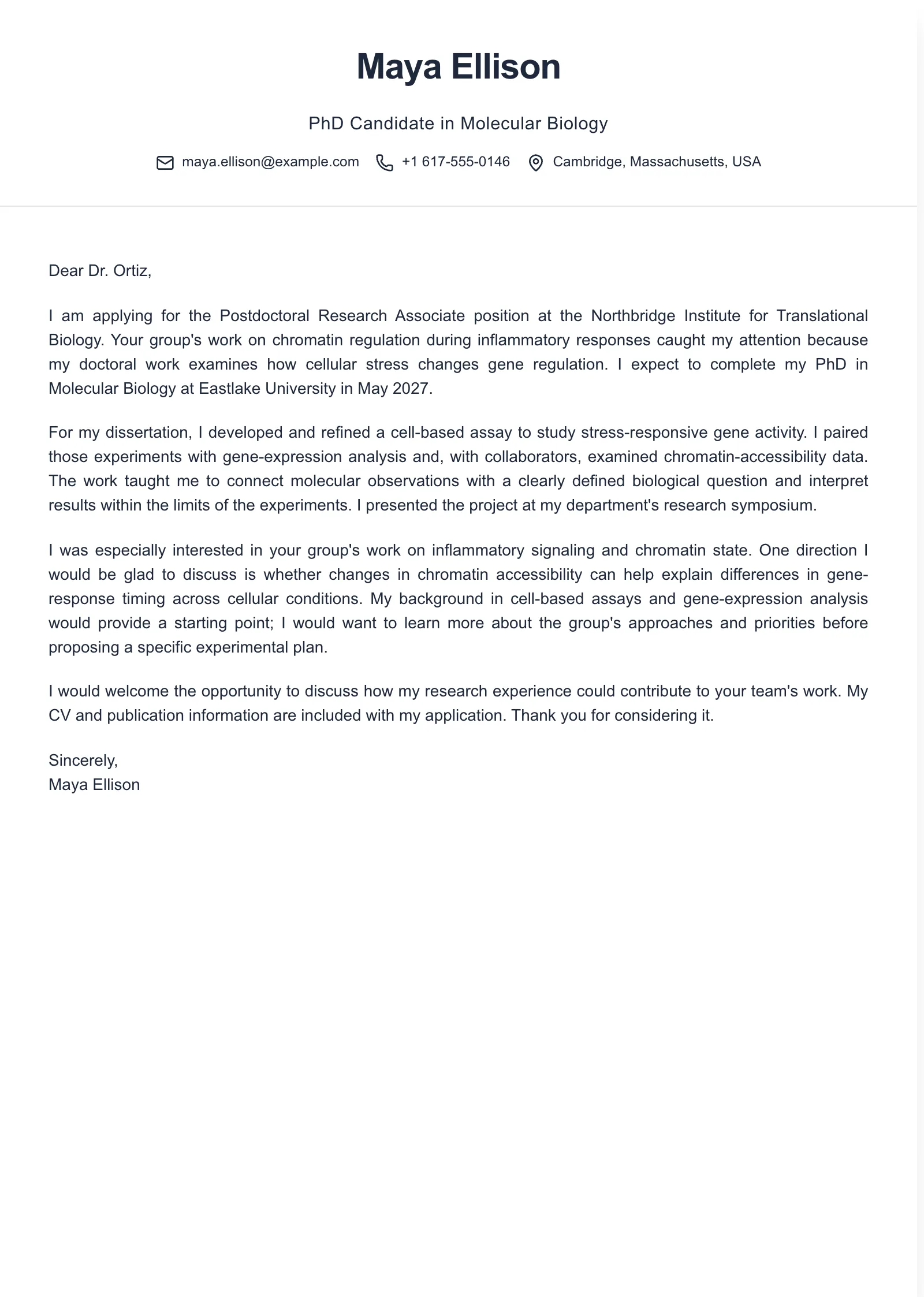
Example paragraphs
“I am applying for the [Position Title] opening at [Institution or Lab] because your group's work on [specific research question] connects with my experience investigating [related question]. In my [research project], I [specific contribution] using [method], which helped establish [verifiable finding or outcome].”
“Building on your group's work on [public research theme], I would be interested in discussing whether [testable next question] could clarify [specific uncertainty]. My experience with [relevant method or analytical skill] would give me a starting point, while [method, expertise, or resource to learn or discuss] would need to be explored with the group.”
“Subject: Postdoctoral research fit: [research topic]. I am writing to ask whether you might be open to discussing a possible postdoctoral opportunity in your group at [Institution or Lab]. Your work on [specific public research] connects with my research on [your topic], where I [accurate contribution and outcome]. If relevant, I would welcome a brief conversation about whether my experience in [method or skill] could support your team's work.”
Replace every bracketed detail with a verifiable fact and remove any sentence that does not strengthen the connection to this PI's work. The pre-contact version is an email, not a formal application; follow the lab's contact instructions and do not assume that sending it submits an application. For a focused first sentence, see cover letter opening examples.
Scenario-specific mistakes in a postdoc cover letter
Listing methods without explaining their use
- What goes wrong
- A list does not show which methods you used, your role, or why the experience matters to this PI's work.
- Better approach
- Choose relevant methods and connect each to a contribution or research question. Describe a method you have not used as something you would need to learn, not as existing experience.
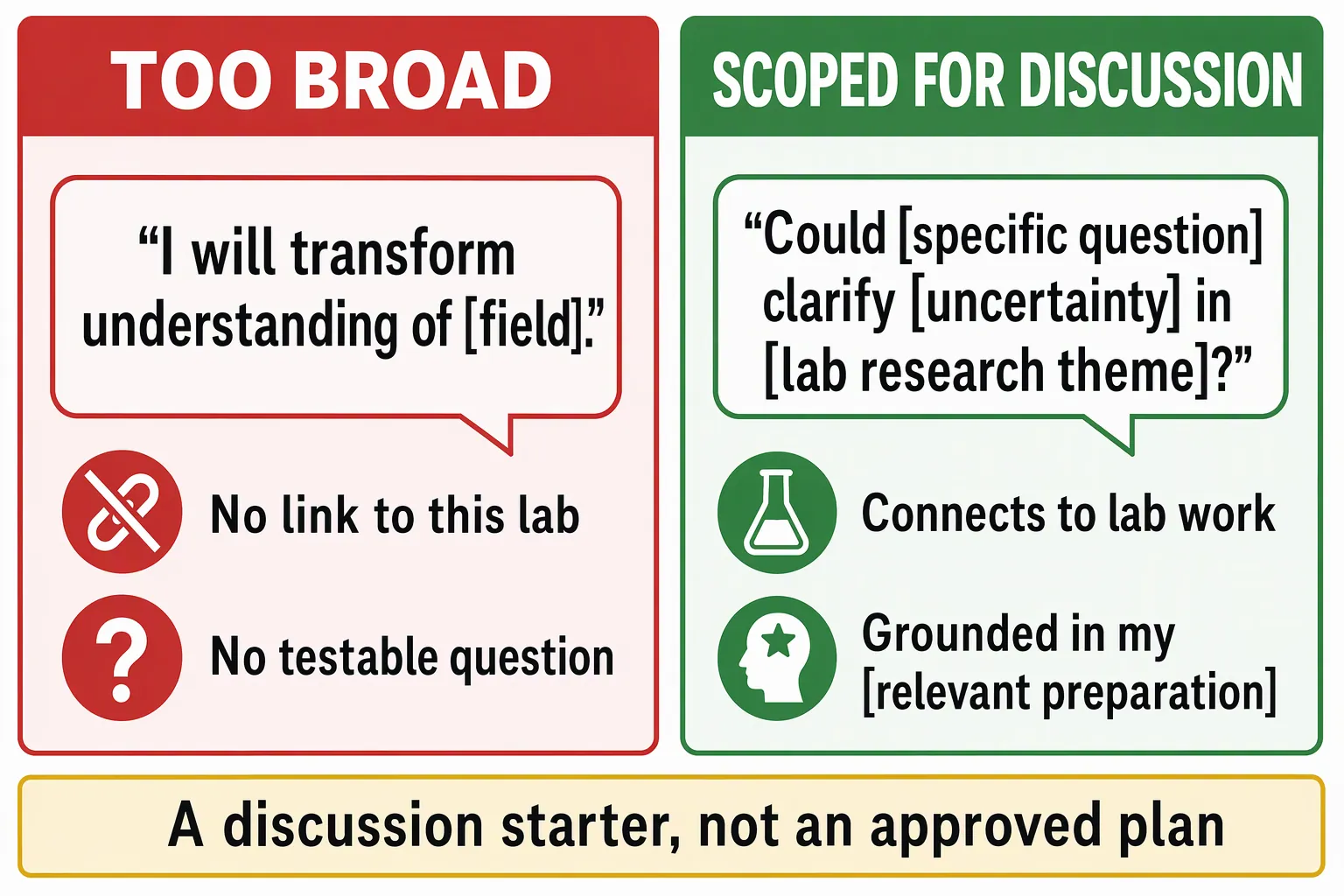
Making the proposed direction too broad
- What goes wrong
- A sweeping idea can seem detached from the group's work or too vague to discuss.
- Better approach
- Describe one focused question that follows from a specific research theme. Treat it as a discussion starter and leave room for the PI and team to shape its scope.
Overstating your contribution or evidence
- What goes wrong
- Taking credit for collaborative work or presenting preliminary results as established findings can undermine the accuracy of your application.
- Better approach
- State your role plainly and describe results only as strongly as your research supports. Check that the account agrees with your CV, publications, and other application materials.
Sending a formal letter as a cold email
- What goes wrong
- A formal application letter may be too long for pre-contact or may assume an advertised opening that does not exist.
- Better approach
- Adapt the message into a concise email with a specific research connection and a clear, low-pressure question. Follow the PI's stated contact preferences and do not imply that the PI has agreed to supervise you.
Frequently asked questions
- How is a postdoc cover letter different from a general research cover letter?
- Focus on the fit among your research, the specific PI or group's work, and the advertised postdoc opportunity. Support that connection with accurate examples and, when useful, a discussion-stage research direction. Follow the documents and instructions in the posting or from the institution.
- Should I describe a proposed project?
- You can briefly raise a research direction if it follows from the group's work and the opportunity. Present it as a question or starting point for discussion, not as an agreed plan or a claim that the PI has approved it.
- Can I contact a PI before applying?
- If you choose to make contact, send a focused email explaining the specific research connection and asking whether a conversation about a possible opportunity would be welcome. Follow the lab or institution's contact instructions. Do not assume an email replaces a formal application.
- What if I have not used the lab's exact techniques?
- Name the methods you have used accurately, then explain which relevant research question or underlying skill transfers. Do not imply experience you do not have. Describe a learning goal only when it is relevant to the opportunity.

Put this career change approach into practice
Choose sample data or build your own cover letter, then personalize it before you download.