
Introduction
A PhD-to-industry cover letter should help an employer understand how your doctoral work relates to the role. Connect a need in the posting to work you actually did: a project you advanced, a method or tool you used, or a finding you communicated.
This topic can overlap with career-change advice. Here, the focus is on translating research for an industry reader, not explaining every reason for changing direction. Keep your degree and titles accurate, and give role-relevant evidence more space than academic context. For help connecting experience to a target role, see how to map transferable skills.
What to address directly
Will my research sound too academic?
- Hiring manager concern
- A dissertation topic, literature review, or list of publications can take up space without showing how your work relates to the role.
- What your letter should prove
- Choose a relevant project and explain its purpose, your actions, and the useful outcome. Keep specialist terms when they clarify your method or fit, and explain unfamiliar ones for a reader outside your field.
How do I show practical evidence?
- Hiring manager concern
- Research can sound detached from delivery when a letter names theories or methods but leaves out constraints, tools, collaborators, or decisions.
- What your letter should prove
- Describe how the work moved forward: what you organized, analyzed, communicated, or handed off. Use accurate examples from research or other experience, and distinguish your contribution from the team's.
Do I need to explain why I am leaving academia?
- Hiring manager concern
- A long defense of the move can make the letter focus on what you are leaving rather than the employer's needs.
- What your letter should prove
- Give a brief, forward-looking reason if it helps connect your experience to this role. Then show relevant evidence. You do not have to apologize for your degree or imply that academic work was a mistake.
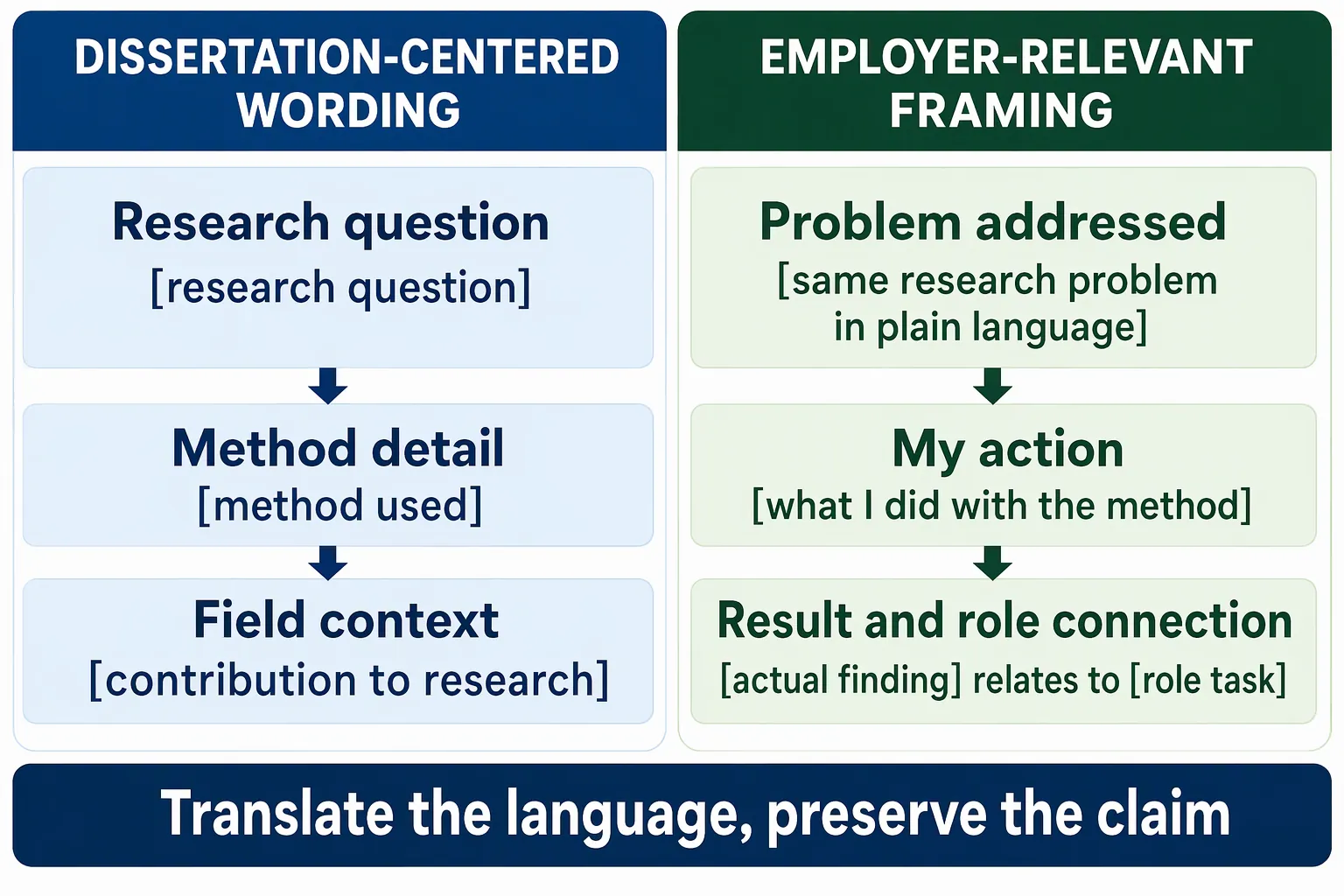
Structural approach: turn doctoral work into an industry case
Use a concise industry structure, not a compressed academic research statement. Open with the role and a relevant reason for applying; use the body for one or two pieces of evidence; close by naming a contribution you would be ready to discuss. The cover letter structure guide explains the general order. The choices below help you make the evidence specific to a PhD-to-industry application.
A focused industry version can aim for one page when the employer's instructions and your relevant evidence make that practical. Select a project or two and connect them to the role. An academic letter may need more space when a posting requests research, teaching, or service statements. These are different writing needs, not universal page limits; follow the instructions.
- 01
Start with the employer's need
Choose a responsibility or problem from the posting that genuinely matches your experience. Name the [Job Title] and [Company Name], then make the connection clear in the opening. Lead with your dissertation topic only if it quickly explains that fit.
- 02
Translate one research project
Describe the question or challenge in language a nonacademic reader can follow. Say what you did, which relevant methods or tools you used, and what resulted: a finding, decision, resource, or next step. Keep the claim proportionate to your contribution.
- 03
Show how you work with others
Give a concrete example of explaining findings, coordinating with collaborators, working within a project constraint, or handing off useful work. Identify your own part and how it relates to the role instead of presenting a team's result as yours.
- 04
Edit for the target reader
Cut literature-review context, publication lists, and details already clear from your CV unless they support this application. Keep your degree and titles accurate, explain academic shorthand, and check that each paragraph connects your experience to the employer's stated need.
PhD to industry cover letter example
Preview a fictional example of a doctoral researcher connecting research experience to an industry role.
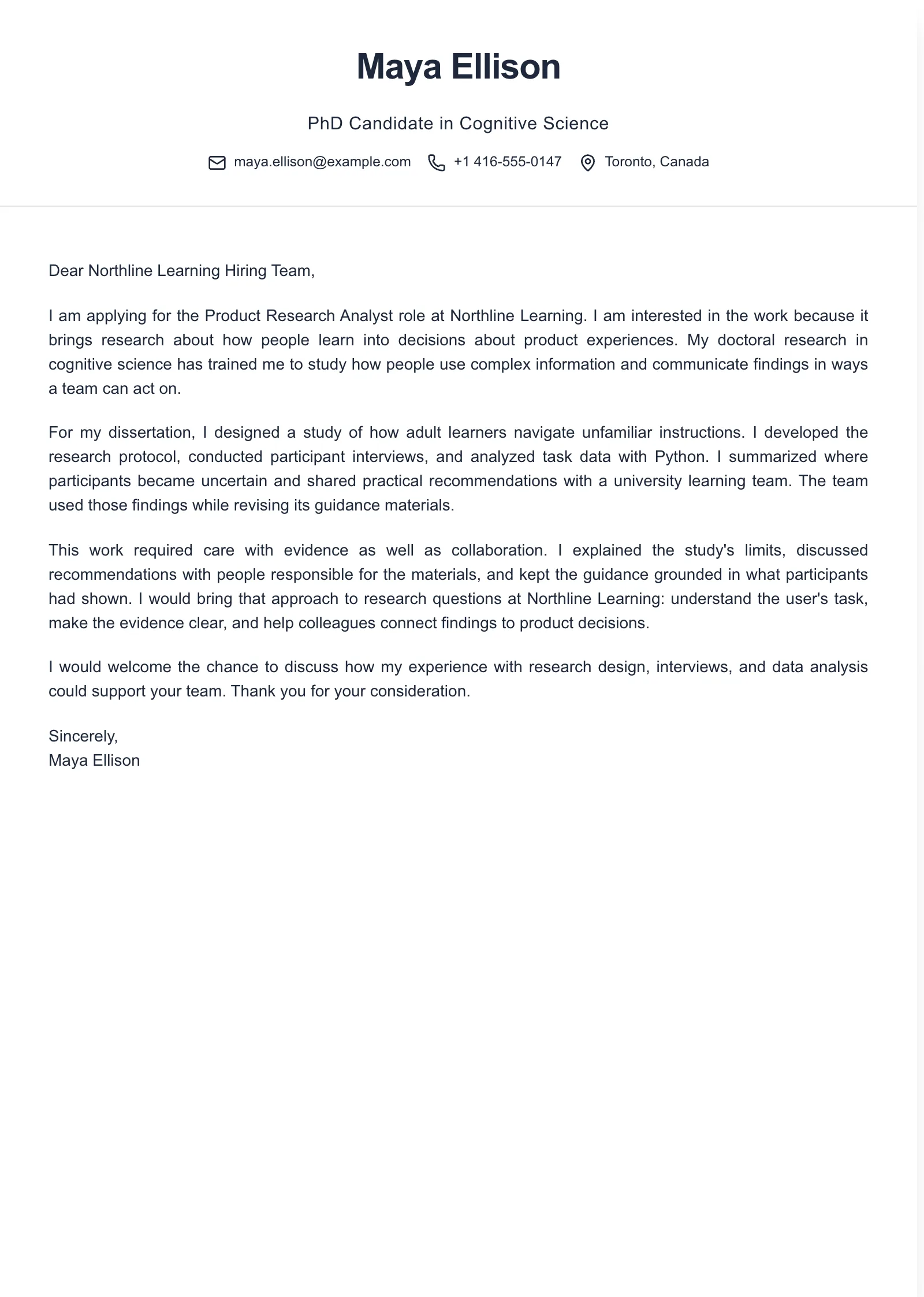
Example paragraphs
“The [Job Title] role at [Company Name] calls for [specific team need]. In my doctoral work on [research question], I [relevant action using a method or tool] to produce [verified finding, decision, or resource]. I am interested in applying that approach to [responsibility from the posting].”
“For [project or collaboration], I worked with [relevant collaborators] to address [specific constraint or problem]. I used [tool or method] to [your action], then shared [deliverable or finding] so the team could [factual next step or decision]. This relates to [requirement for the Job Title] because [specific connection].”
“I would welcome a conversation about how my experience with [relevant method, tool, or kind of collaboration] could support [Company Name]'s work on [specific priority]. I can also discuss how I would approach [responsibility from the posting], based on my experience with [factual example].”
Replace every bracket with a detail you can support. Make your contribution and the outcome clear without claiming a team's result as your own or implying commercial experience you do not have. These are adaptable paragraphs, not a complete letter. Pair your strongest evidence with the employer's stated need, and remove sentences that only repeat your CV.
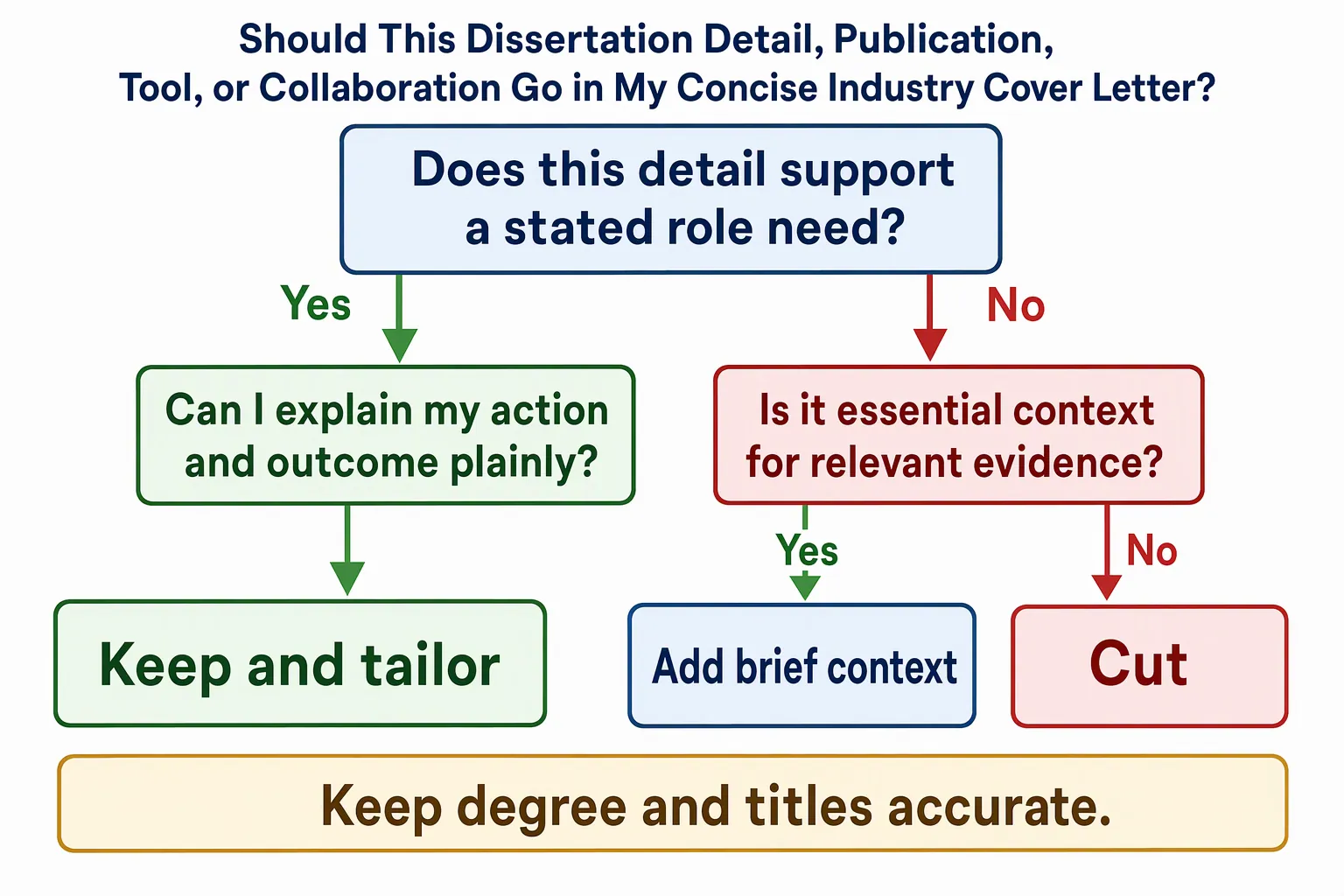
Common mistakes to avoid in a PhD-to-industry letter
Summarizing the whole dissertation
- What goes wrong
- A long account of your research question and literature can bury the part that matters to this role.
- Better approach
- Select a relevant project and explain its purpose, your contribution, and a useful outcome in plain language.
Using academic shorthand without context
- What goes wrong
- An unfamiliar method name or specialist term may leave a reader unsure what you can do.
- Better approach
- Name the method when useful, then briefly explain how you used it and what it helped you learn, produce, or decide.
Claiming experience you do not have
- What goes wrong
- Presenting university research as commercial delivery can make your transition less credible.
- Better approach
- Keep the setting and your titles accurate. Explain which parts of the work transfer and where your experience differs.
Keeping the academic letter's full scope
- What goes wrong
- A detailed research narrative, publication record, or discussion of academic plans may distract from the industry role's needs.
- Better approach
- Use a focused industry version. Retain academic details only when they support a stated requirement, and follow the employer's requested format.
Frequently asked questions
- Should I mention my PhD in an industry cover letter?
- Mention it when it helps explain relevant expertise or experience. State your degree or current doctoral status accurately, then connect your work to the role. You do not need to make the degree the main point if other evidence better shows your fit.
- Should an industry cover letter be one page?
- A focused industry version can aim for one page when the employer's instructions and your relevant evidence make that practical. An academic letter may need more space when a posting requests research, teaching, or service statements. Follow the employer's instructions; neither length is a universal rule.
- Does this guide cover PhD admissions or academic job applications?
- No. This guide is for doctoral researchers applying to industry roles and focuses on translating research experience into role-relevant evidence. PhD admission letters and academic applications have different purposes and should follow the program or employer's instructions.
- Is this different from a career-change cover letter?
- The topics can overlap. This page focuses on a specific task: translating doctoral research, tools, and collaboration for an industry reader. Use broader career-change guidance when the main challenge is explaining a different kind of transition.

Put this career change approach into practice
Choose sample data or build your own cover letter, then personalize it before you download.