
Introduction
A cover letter for a student job should help an employer understand when you can work and what relevant habits or experience you bring. Clear, realistic availability is more useful than a broad promise to be flexible.
This guide focuses on balancing work with classes and other academic commitments. A general part-time letter may discuss hours; here, you will connect work windows to your actual schedule and choose evidence from school or other responsibilities. Employers set their own scheduling needs, so do not assume a campus or local job will fit your timetable.
Build each paragraph around a stated job need and a true detail. For a general overview of paragraph roles, see our guide to cover letter structure.
What to address directly
Availability an employer can assess
- Hiring manager concern
- Classes, labs, and other commitments can affect when you are able to work. Saying only “I am flexible” does not show which shifts you can reliably accept.
- What your letter should prove
- Name the recurring time windows you can commit to, if you have confirmed them. Mention a known schedule change only when it affects the work period. Check fixed commitments and travel time before offering hours, and do not promise shifts you have not confirmed you can keep.
Reliability alongside study
- Hiring manager concern
- An employer may need to know whether you can keep agreed shifts during busy academic periods. Promising that school will never affect your work is difficult to support and may not reflect your commitments.
- What your letter should prove
- Give a real example of how you plan ahead or follow through, from school, volunteering, a club, or another responsibility. If your timetable is not final, say what you know and avoid presenting uncertain hours as confirmed.
Relevant evidence without a long work history
- Hiring manager concern
- If you have limited paid experience, it may be hard to decide what to include. General claims such as “hardworking” do not show what you have done.
- What your letter should prove
- Choose one brief example that demonstrates an action relevant to the posting, such as coordinating a shared deadline or keeping information organized. State your contribution and the result only when you can support them. Work authorization depends on individual circumstances and jurisdiction. Check the relevant official authority and your institution; U.S. international students can confirm their exact status and dates with their designated school official and current USCIS guidance.
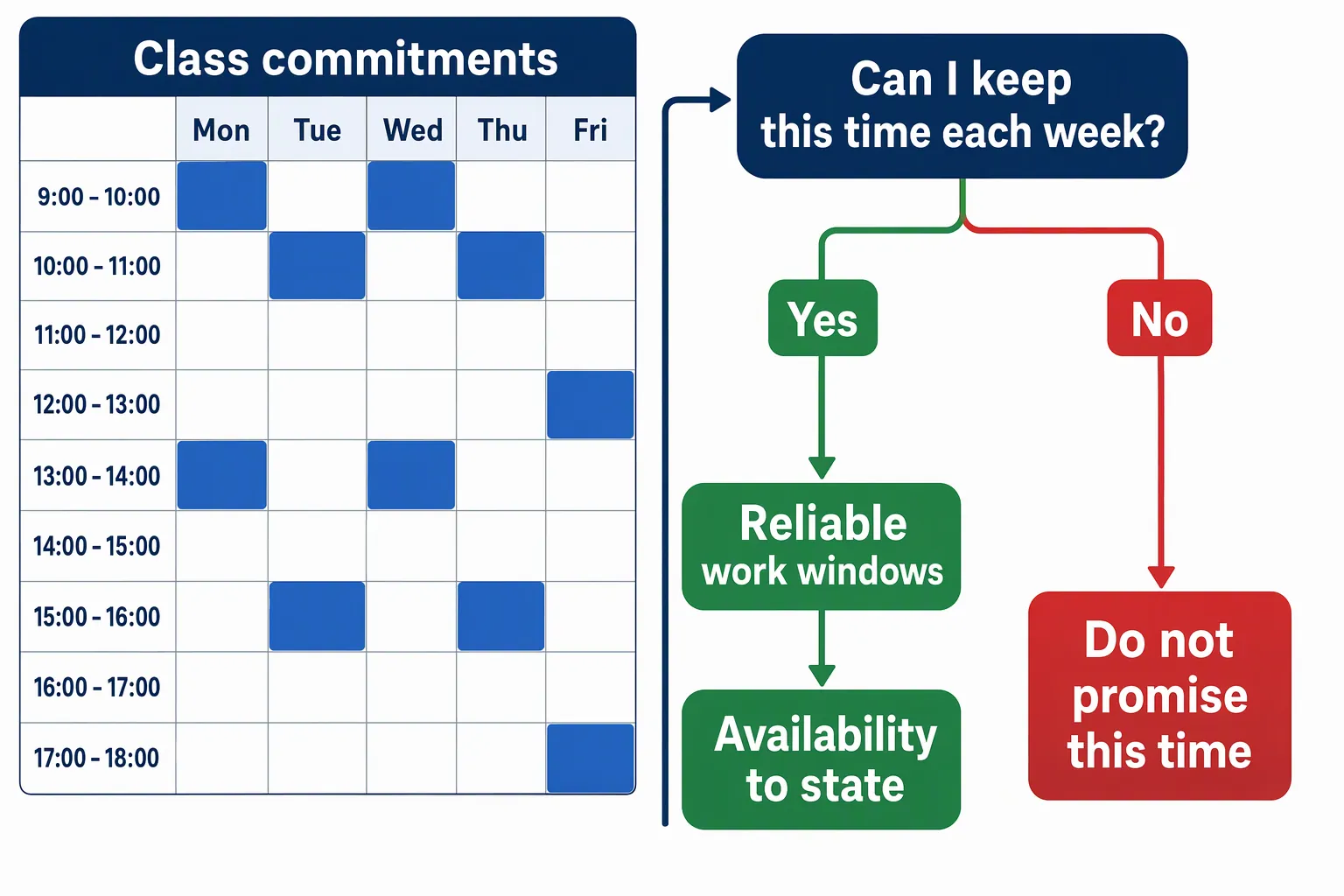
Structural approach for a student job letter
Keep the letter focused on the employer's stated needs, your workable hours, and relevant evidence. A useful sequence is to identify the role, explain your availability, give one example, and close with a practical next step. Include school details only when they help the employer assess your fit.
- 01
Identify the role and your reason for applying
Name [Job Title] and [Company Name]. Give one specific reason for applying, such as a responsibility in the posting that connects to an experience you can describe. Show that you have read what this job involves.
- 02
State the work windows you can keep
Share the days or time ranges you can currently commit to. If your timetable is not final, explain that briefly and say when you expect to confirm it. Do not include a full weekly class list unless the application requests one.
- 03
Connect one example to the work
Choose an example from school, volunteering, a club, or paid work that demonstrates a useful action. Explain your part and a supportable result. Present it as transferable experience, not as equivalent to paid work if it was not.
- 04
Close with a practical next step
Confirm your interest and invite a conversation about the role or schedule. If the employer requests separate availability details, selection criteria, or other documents, provide them in the requested format rather than relying on the letter to replace them.
Student Job Cover Letter Example
Preview a fictional example that connects a student's work windows and school-based evidence to a part-time role.
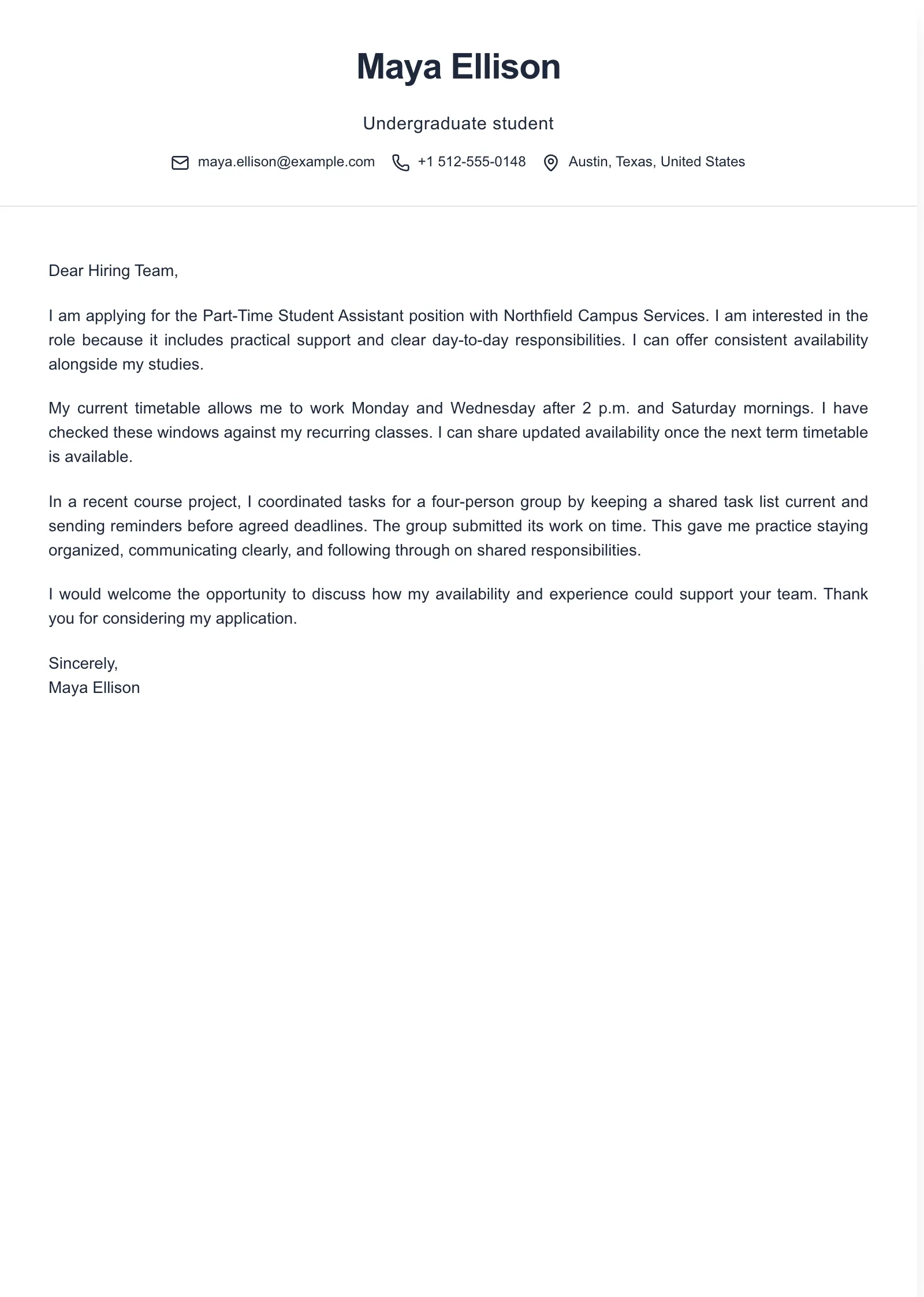
Example paragraphs
“I am applying for the [Job Title] position at [Company Name]. The posting's focus on [specific responsibility] interests me because I have practiced [relevant action] through [true school, volunteer, or work example].”
“My current class schedule allows me to work [days and time windows you can reliably commit to]. I expect to confirm any changes by [accurate date or event], and I understand the role requires [schedule detail stated in the posting].”
“For [specific school, club, volunteer, or work task], I [action you personally took], which led to [verifiable outcome]. This helped me practice [relevant skill], which I could use when [task connected to the Job Title] at [Company Name].”
These are adaptable paragraphs, not a complete letter. Replace each bracket with a true detail. Do not invent a result or schedule; if something is not confirmed, say only what you know.
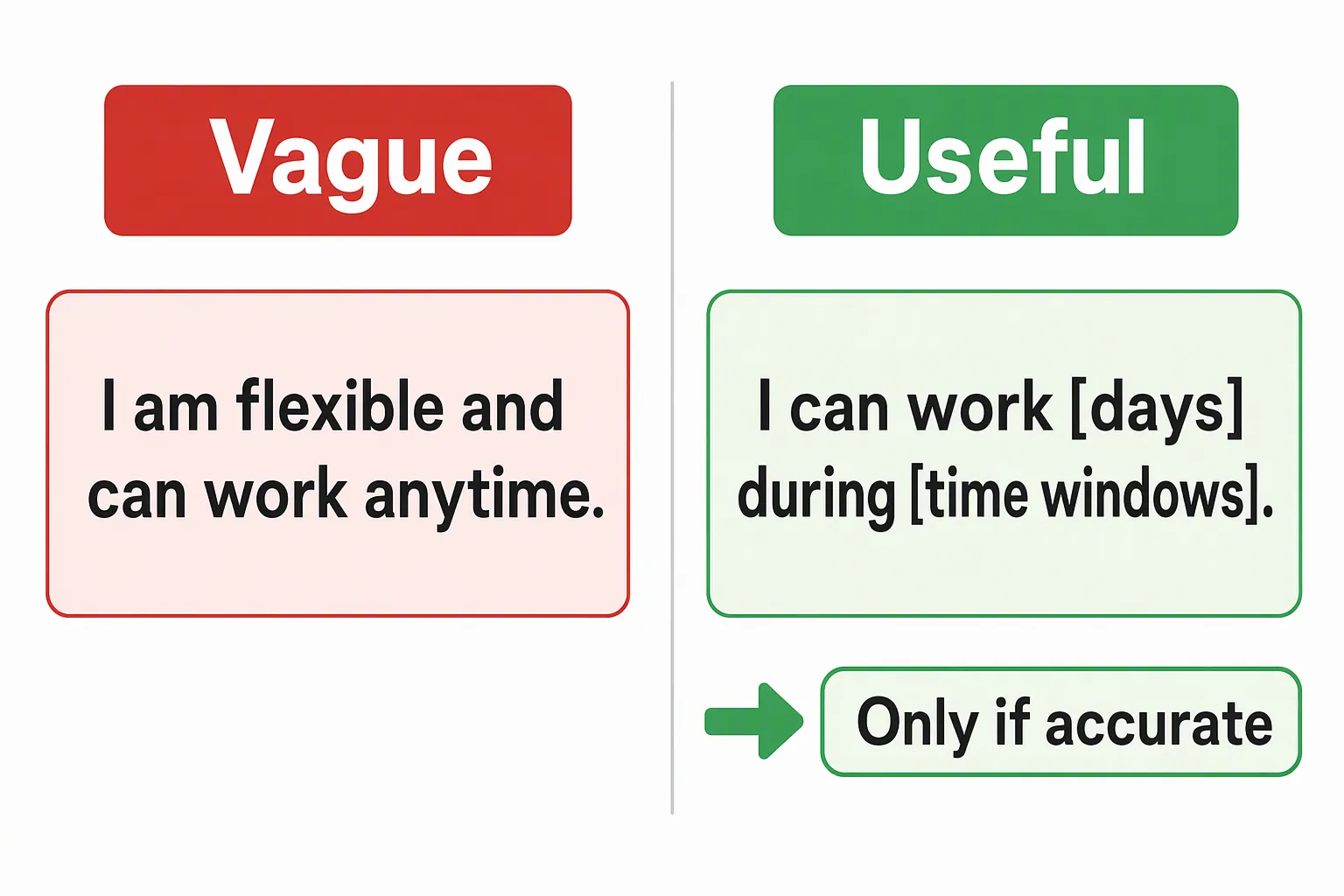
Common mistakes in a student job cover letter
Promising unlimited flexibility
- What goes wrong
- A claim such as “I can work any time” may conflict with classes or other fixed commitments and does not tell the employer which hours you can reliably offer.
- Better approach
- List the time windows you can keep. Be candid about known limits and update your availability when your timetable is confirmed.
Listing school activities without your contribution
- What goes wrong
- Naming a course, club, or project alone does not show what you did or why it is relevant to the job.
- Better approach
- Describe one action you took and a factual result. Connect it to a responsibility in the posting without overstating its scope.
Assuming the job will work around classes
- What goes wrong
- A part-time or campus role may still have specific coverage needs. An unverified assumption about scheduling can lead to a mismatch.
- Better approach
- Compare the posting's schedule with your actual commitments. Ask about unclear requirements through the appropriate application or contact channel, and do not claim hours you cannot keep.
Explaining your entire academic timetable
- What goes wrong
- A class-by-class account can distract from your available work hours and the evidence that supports your application.
- Better approach
- Share only the recurring availability and known schedule changes relevant to the job. Leave unrelated academic and personal details out.
Frequently asked questions
- Should I include my class schedule in a student job cover letter?
- Give the days or time windows that help the employer assess your availability; a full list of classes is usually unnecessary unless requested. Be accurate about recurring commitments, and mention a change during exams or academic breaks only when you know it will affect your availability.
- How can I write a student job cover letter with little work experience?
- Use a specific example from school, volunteering, a club, or another responsibility to show a relevant action, such as meeting a deadline or organizing shared tasks. State what you actually did and connect it to a need in the posting.
- Should I mention that I am a student?
- Mention it when it helps explain your availability or the context of a relevant example. Keep the focus on how you meet the role's stated needs rather than assuming the employer will adjust the job around your studies.
- Do student workers need to explain work authorization in the letter?
- Follow the application instructions and answer any work-authorization questions accurately. Whether you are authorized to work depends on your jurisdiction and individual status, not student status alone. Check current official guidance and, when relevant, your institution. U.S. international students should confirm their exact status and dates with their designated school official and current USCIS guidance.

Put this career change approach into practice
Choose sample data or build your own cover letter, then personalize it before you download.