
Introduction
A letter of interest is a note to an organization when you have a genuine reason to explore possible future work but have not found a matching advertised role. It is not a response to a vacancy. Say that plainly so the reader does not mistake your message for an application to a job that may not exist.
A cover letter often accompanies an application for an identified opening. Letter of interest and speculative application can describe overlapping kinds of outreach, and there is no universal boundary between those labels. This page focuses on the usable task: writing a no-posting note that explains your interest without implying a vacancy. See how cover letters, motivation letters, and letters of interest are used for more context.
What to address directly
No advertised role
- Hiring manager concern
- The reader may not know whether you are applying for a job, asking about future work, or requesting a conversation.
- What your letter should prove
- State early that you did not find a current posting that matches your interest. Name the kind of work you hope to explore, but do not describe it as an opening or imply that the organization has an unadvertised position.
A specific reason for this organization
- Hiring manager concern
- Without a job posting to guide you, general praise can make the note sound interchangeable with messages sent to many organizations.
- What your letter should prove
- Refer to one verifiable detail, such as a public project, stated priority, or service. Connect that detail to a real part of your background. Do not treat public information as evidence that the organization is hiring.
A reasonable request
- Hiring manager concern
- A request for a job, referral, and meeting all at once can put pressure on someone who has not invited applications.
- What your letter should prove
- Choose one possible next step, such as a brief conversation or guidance on the appropriate application channel. Make it easy to decline or redirect the request, and do not treat a polite response as evidence that a role is available.
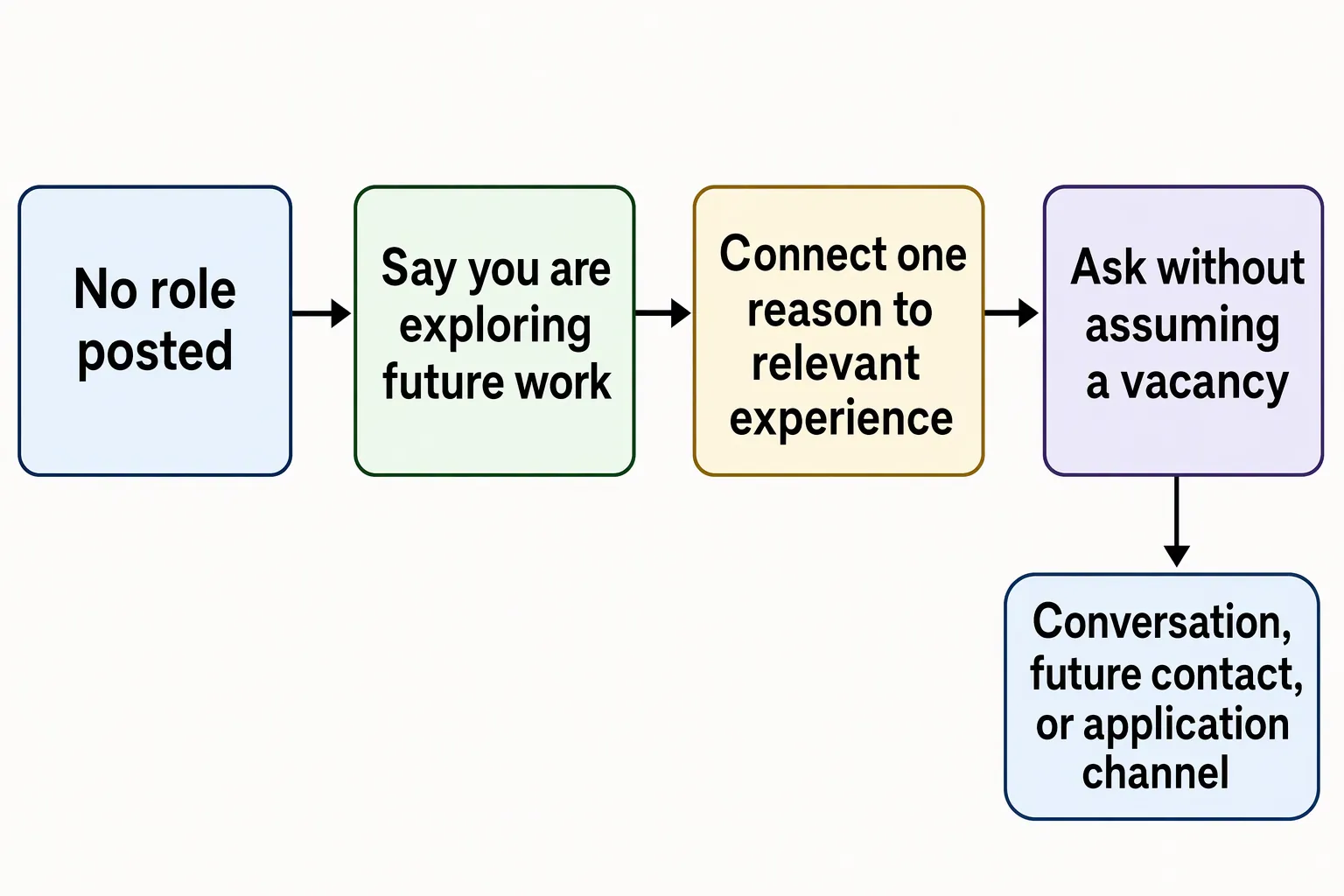
Structural approach for a no-vacancy note
Keep the note focused on why you are writing, why this organization is relevant to you, and what you are asking for. Since there is no job description to respond to, connect a specific reason for contact with a few relevant facts about your experience instead of trying to match unstated requirements.
Before sending, check the organization’s own careers or contact information for instructions about unsolicited inquiries. Follow any stated process. For email, use a clear subject line such as “Interest in future [Job Title] opportunities.” Address the message to a named contact only when you have confirmed the person’s name and role; otherwise, use a neutral greeting. The cover letter structure guide provides broader context, while these steps focus on what changes when no job is advertised.
- 01
Name the purpose
Open with the type of work you hope to explore and the organization you are contacting. State that you are not responding to a current posting. This helps the reader understand that you are not referring to an application or vacancy they may not recognize.
- 02
Show why this organization
Use one accurate detail from information the organization has shared publicly. Explain what interests you about that work, service, or direction. Avoid broad claims of admiration unless you can name what you followed and how it relates to your interest.
- 03
Connect your experience
Choose one or two relevant facts, such as a responsibility you handled, a skill you used, or a result you can explain. State how that experience could be useful for the kind of work you named. Do not invent a vacancy or inflate an outcome to make the connection seem stronger.
- 04
Make one low-pressure request
Ask one clear question, such as whether a brief conversation would be appropriate. Offer to share a resume or other relevant document only if useful and appropriate to the stated channel. End with a courteous sign-off and your contact details.
Letter of interest example
This fictional example asks about future project coordination work without treating an unadvertised role as open.
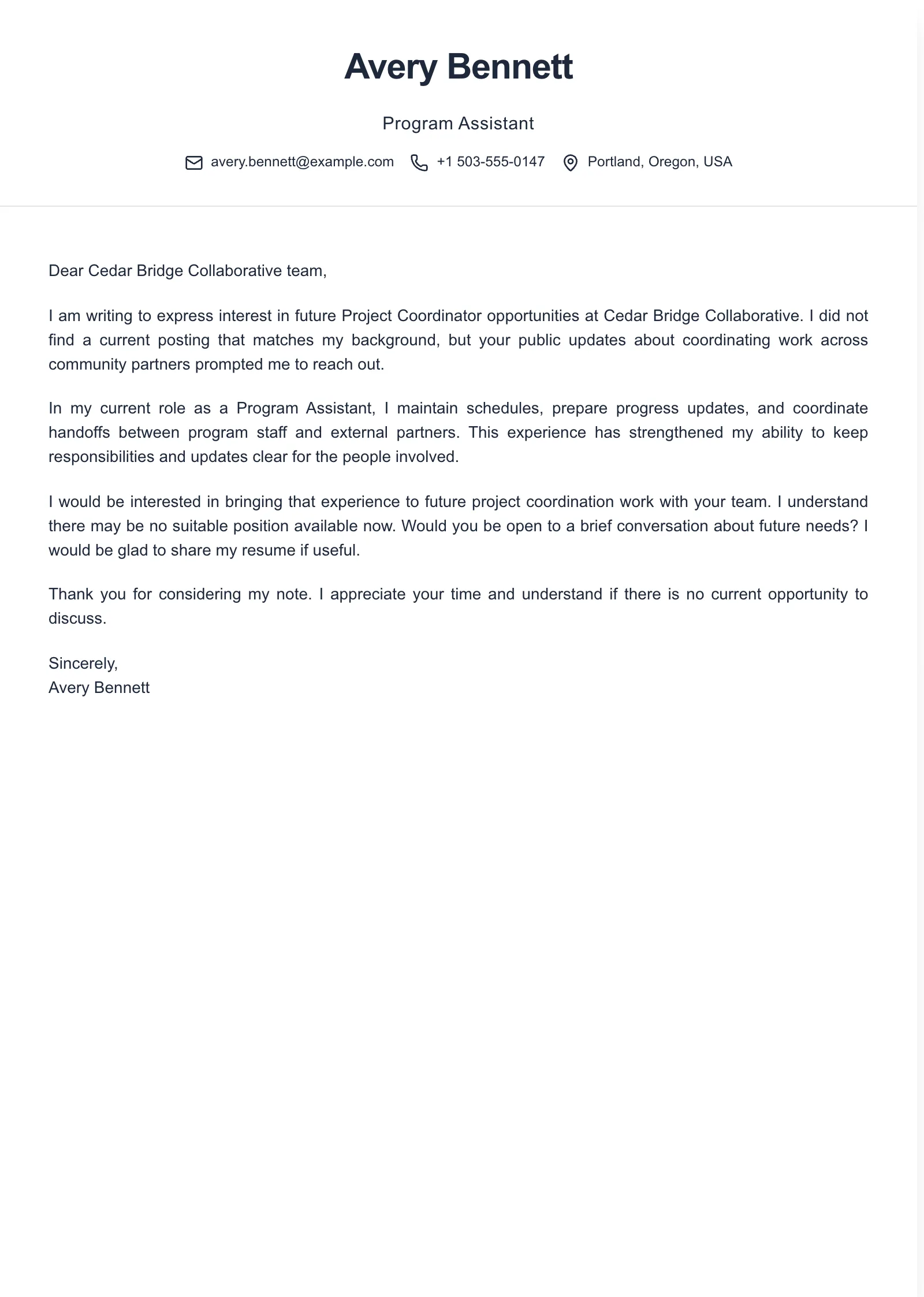
Example paragraphs
“I am writing to express interest in future [Job Title] opportunities at [Company Name]. I did not find a current posting that matches, but [specific public project or stated priority] caught my attention because [factual connection to your interests or experience].”
“In my current work, I [specific responsibility] and use [relevant skill] to [verifiable result or outcome]. That experience could be useful for [type of work] at [Company Name], particularly if future [Job Title] needs involve [specific, evidence-based connection].”
“Would you be open to a brief conversation about [type of work] at [Company Name]? I understand there may be no suitable role available now, and I would be glad to share [relevant document or work sample] if useful.”
Replace each bracketed detail with information you can verify. A public project is a reason for contact, not proof that the organization is hiring. Keep the request modest, and remove any sentence that suggests a position exists unless the organization has confirmed one.
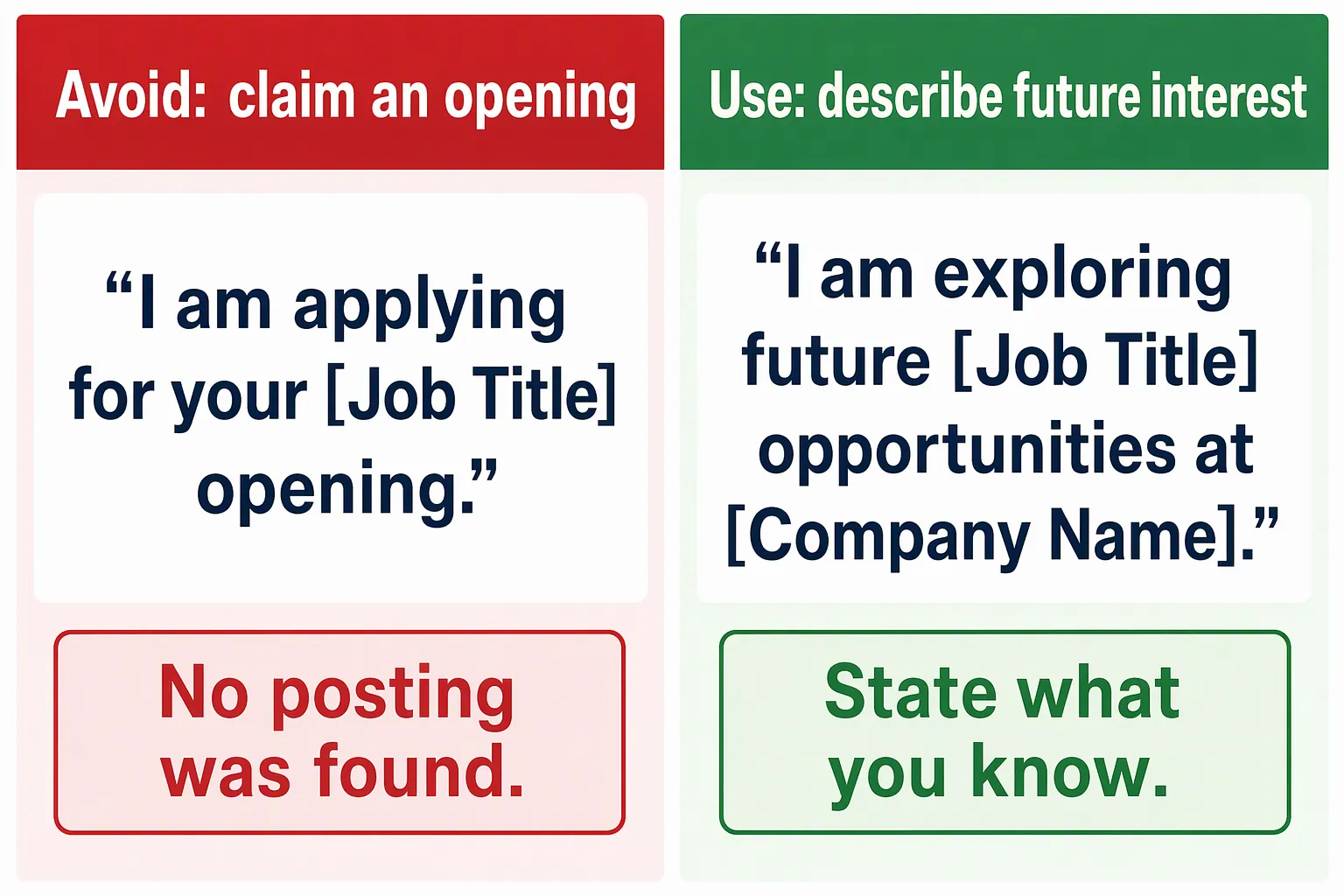
Common mistakes in a letter of interest
Writing as if a vacancy exists
- What goes wrong
- Calling the note an application for an open [Job Title] can confuse the reader when there is no posting.
- Better approach
- Say that you are exploring future opportunities and that you did not find a matching current posting.
Sending the same praise to every organization
- What goes wrong
- Generic claims do not show why you chose to contact this organization or how your experience relates.
- Better approach
- Use one accurate, organization-specific detail and explain its connection to your work or interests.
Asking for too much at once
- What goes wrong
- A long list of requests for a job, referral, meeting, and feedback makes an unsolicited note harder to answer.
- Better approach
- Choose one possible next step and make clear that you understand there may be no suitable role or conversation available.
Relying on the document label
- What goes wrong
- Letter of interest, speculative application, and letter of intent do not have a universally fixed meaning across settings.
- Better approach
- Describe the purpose in plain language and follow the recipient’s instructions. Do not use a label to imply an application, commitment, or vacancy.
Frequently asked questions
- Is a letter of interest different from a speculative application?
- There is no dependable universal distinction: the terms can describe similar outreach when no vacancy is posted. This guide uses letter of interest for the written note and focuses on how to express interest without implying that a role is open.
- Is a letter of interest the same as a letter of intent?
- Not necessarily. Letter of intent can mean different things in different settings. If an organization requests one, follow its instructions and do not assume it means a job-search letter of interest.
- Should I send a letter when no job is advertised?
- Consider it when you have a specific, verifiable reason to contact the organization and can identify an appropriate contact channel. Ask about one possible next step without assuming there is a vacancy or that you will receive a reply.
- Should I attach my resume?
- Attach it only when the organization invites documents or its instructions make an attachment appropriate. If the channel or instructions are unclear, keep the initial note focused and offer to share your resume if useful.

Put this career change approach into practice
Choose sample data or build your own cover letter, then personalize it before you download.