
Introduction
A cover letter for a leadership development program should show what you have done with responsibility and what you want to learn next. A formal management title is not the only possible evidence. A specific example of organizing work, helping a group reach a decision, or taking ownership of a problem can show how you act when others depend on you.
Connect one real experience to one development goal, then explain why a feature named in the program description could help you build that skill. Programs may request a cover letter, motivation letter, or statement; those labels can overlap, so follow the actual instructions rather than assuming the title alone sets different requirements. For more context, see cover letter, motivation letter, or letter of interest. The focus here is the usable task in a program application: evidence of your actions and a specific reason to pursue this development opportunity.
What to address directly
You have led without a formal title
- Hiring manager concern
- You may have coordinated a project, supported a group decision, or stepped in when a task stalled, but never held a position called “leader.”
- What your letter should prove
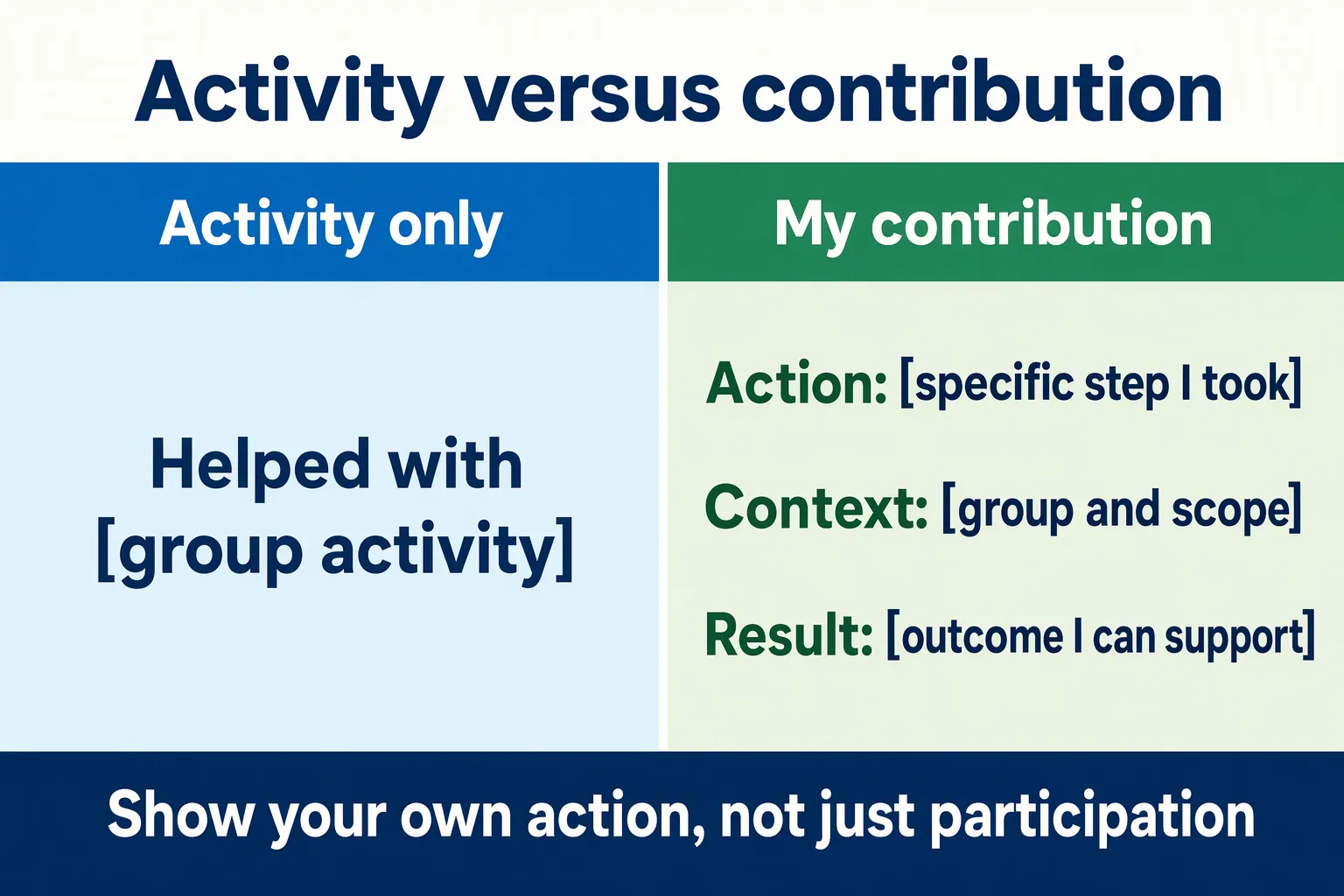
- Describe the responsibility you actually took. Identify the people or work involved, your action, and what changed. Do not upgrade a contribution into a management role; a precise example is more useful than an impressive-sounding title.
Your strongest example was shared
- Hiring manager concern
- Leadership often happens in a group, so claiming the whole outcome can make your example less credible and hide how you worked with others.
- What your letter should prove
- Give the team context briefly, then isolate your contribution: what you noticed, proposed, organized, or followed through on. Credit collaborators where appropriate and report only results you can support.
Your goals sound broad
- Hiring manager concern
- Saying you want to “grow as a leader” does not tell the reader what you need to practice or why this particular program fits.
- What your letter should prove
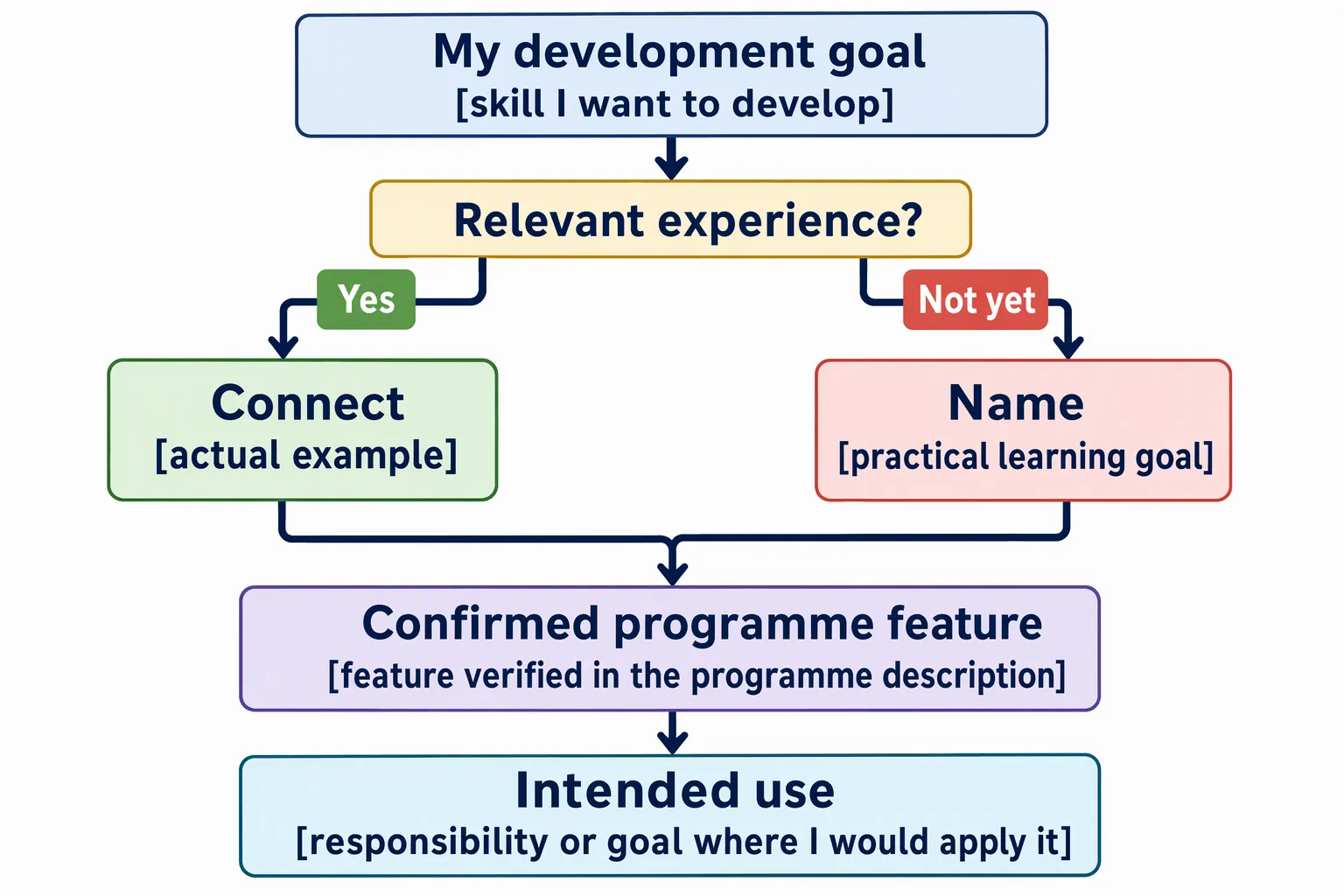
- Choose a specific next skill, such as giving clearer feedback or guiding a decision with competing views. Connect it to a program feature only if that feature appears in the published description, and explain where you would apply the learning.
Structural approach: connect an action to a learning goal
Build the letter around one main leadership example and one next-step goal. This keeps your evidence from becoming a list of unrelated activities and gives the selection reader a clear reason to consider your application.
A useful sequence is: show why the program fits; describe a real moment of responsibility; reflect on what the moment taught you; then name what you want to practice and where you hope to use it. The cover letter structure guide explains the general paragraph roles. Apply them to the program’s actual prompt and selection criteria.
- 01
Choose a program outcome
Read the program description and application questions. Pick one stated outcome, selection criterion, or learning feature that genuinely matters to you. Do not assume every program offers mentoring, rotations, or a particular curriculum; use only details you can verify.
- 02
Select one leadership moment
Choose an instance that makes your contribution visible. State the setting and challenge, then explain the action you took. A formal role can be relevant, but responsibility in a project, community activity, study group, or workplace task can also provide evidence.
- 03
Explain what the moment taught you
Go beyond the result. Name what you learned about your approach, what was difficult, or what you would improve next time. Keep the reflection connected to the example rather than making a sweeping claim about your personality.
- 04
Link development to future use
Name one skill or behavior you want to strengthen and a factual context where you hope to apply it. Explain how a verified program feature could help you practice. A clear development goal shows direction without promising outcomes the program has not guaranteed.
Leadership program cover letter example
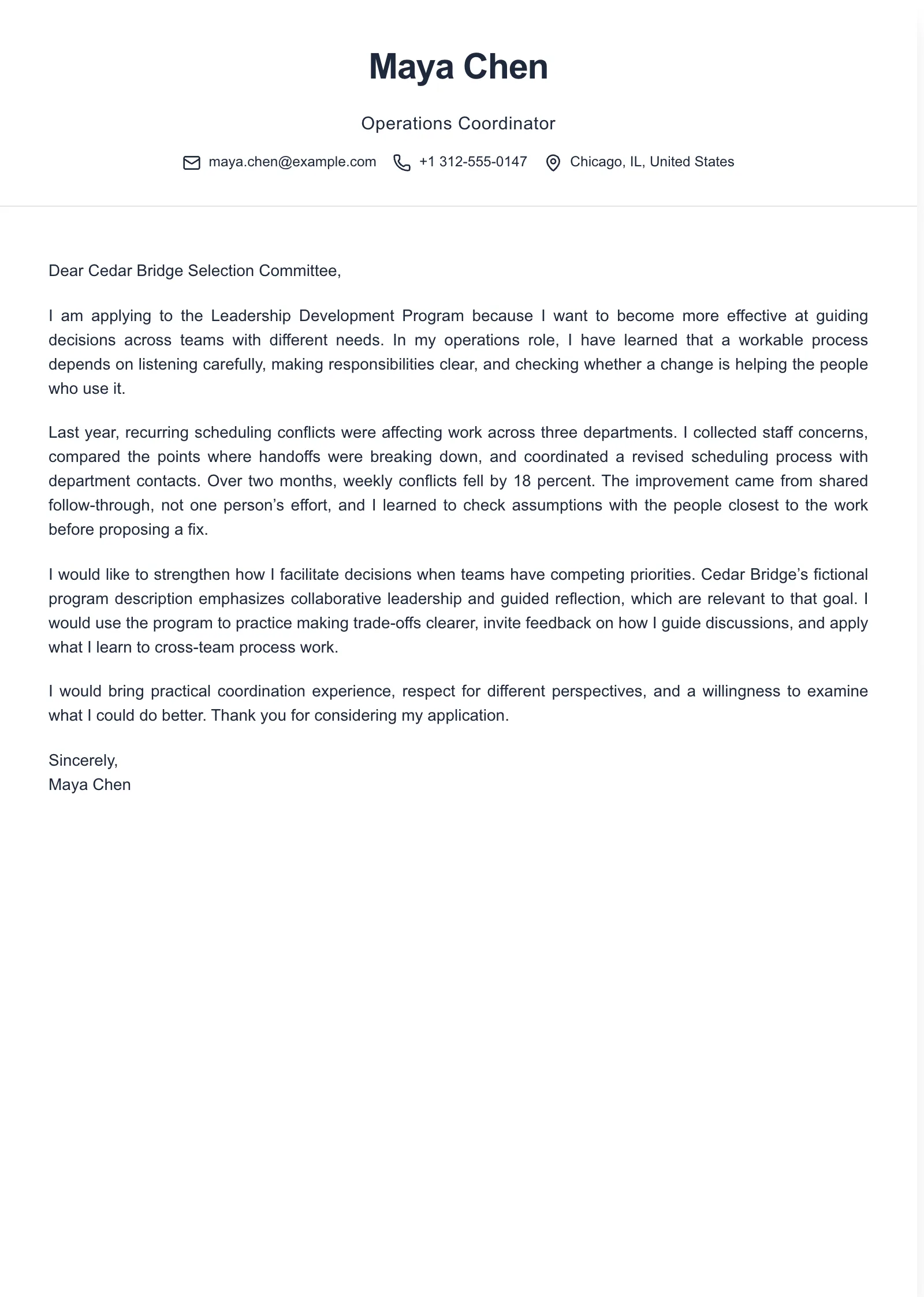
Explore a fictional example of an applicant connecting a team contribution to a specific leadership development goal. The template preview shows how that reasoning can fit into a complete cover letter.
Example paragraphs
“I am applying to [Program Name] because its [verified program feature] would help me build on my experience coordinating [project or group]. When [factual challenge] put [shared task] at risk, I [specific action], which helped the group achieve [verifiable result]. I now want to practice [specific leadership skill] in a setting with [verified opportunity for practice or feedback].”
“As [accurate role or participant], I worked with [team or group] to address [factual challenge]. I was responsible for [specific contribution], while [collaborators’ contribution] helped us reach [verifiable outcome]. The experience taught me [specific lesson], and I would bring that learning mindset to [Program Name].”
“My next development goal is to strengthen [specific behavior or skill], especially when [factual situation]. The [verified feature from the program description] interests me because it could let me practice [specific action] and seek feedback on [observable behavior]. I hope to apply that learning in [factual future context].”
Treat these as adaptable paragraphs, not complete letters. Replace every bracket with a detail you can support, and check that any named program feature appears in the program description. For shared work, separate your own action from the group’s result. For a development goal, name a behavior someone could observe rather than a broad personal quality.
Common mistakes in a leadership program cover letter
Using a title as the only proof
- What goes wrong
- Listing a position such as team lead or club officer without showing what you did leaves the reader to guess how you handled responsibility.
- Better approach
- Add one action and its context. If you had no formal title, describe the responsibility you took without relabeling your role.
Taking sole credit for group work
- What goes wrong
- Presenting a shared result as your individual achievement can overstate your contribution and obscure how you worked with others.
- Better approach
- Distinguish your action from the team’s work. Attribute the outcome accurately, and keep any numbers or results factual.
Praising the program without a reason
- What goes wrong
- Calling a program excellent or prestigious does not explain why its specific learning focus suits your next step.
- Better approach
- Name a verified program feature, connect it to one development goal, and explain where you hope to use the skill.
Claiming skills you have not demonstrated
- What goes wrong
- Calling yourself an exceptional leader or promising future impact without supporting details weakens the connection between your record and your goal.
- Better approach
- Use a concrete example for what you have done. Frame the next skill as a development goal, and avoid promising an outcome beyond your control.
Frequently asked questions
- Do I need a formal leadership title to apply?
- Not necessarily. Follow the program’s stated criteria, then use a factual example of taking responsibility, coordinating people or work, or helping a group make progress. Make your role clear without presenting yourself as the sole owner of a team result.
- What if I have little leadership experience?
- Choose a small, specific instance where you took initiative or helped a group move forward. Explain what you did and what you learned. If you do not yet have a strong example, state the leadership skill you want to practice and why the program is a relevant next step.
- How should I explain what I want to learn?
- Name one skill or behavior, explain why developing it matters to your next step, and connect it to a feature the program actually offers. Avoid broad goals such as becoming a better leader without saying what you want to do differently.
- Is this the same as a recent-graduate cover letter?
- There can be overlap: either letter may draw on education, projects, or early work. Use this guide for the specific task of connecting a leadership example to a development goal and the program’s instructions. Follow the program’s requested document type and selection criteria.

Put this career change approach into practice
Choose sample data or build your own cover letter, then personalize it before you download.