
Introduction
A career fair cover letter connects your application to a real meeting. You might hand it over at the event or send it afterward through the application route the employer provides. Its purpose is to identify the conversation, name the role you are applying for, and point to relevant evidence from your experience.
Before writing, note the fair or event, the company, the role, and any topic you genuinely discussed. Use the representative's name only if you recorded or confirmed it. If you missed the name, you can still write a clear follow-up without guessing.
What to address directly
You may not have a recruiter's name
- Hiring manager concern
- A short conversation can end before you exchange names, or you may remember only the company's booth. Guessing a name risks addressing the letter incorrectly.
- What your letter should prove
- Use a neutral greeting such as “Dear Hiring Team,” and identify the event and company. Add a discussion detail only if you remember it accurately. For more guidance on the greeting, see how to address a cover letter without a name.
A fair conversation may not count as an application
- Hiring manager concern
- A representative may discuss a role without collecting documents or making a decision. A friendly exchange does not necessarily mean you have been referred or have completed the employer's application process.
- What your letter should prove
- Describe what happened without overstating it. Check the posting and follow any application instructions you received. A letter can help explain the connection, but it cannot replace steps required by the employer.
You may remember only part of the conversation
- Hiring manager concern
- Several short conversations can blur together. A vague reference gives the employer little help placing your application, while an invented detail can misrepresent the meeting.
- What your letter should prove
- Use notes you made at the time, such as the role you asked about or a point the representative explained. If you remember only the event and booth, say so plainly and focus the rest of the letter on the role and your relevant experience.
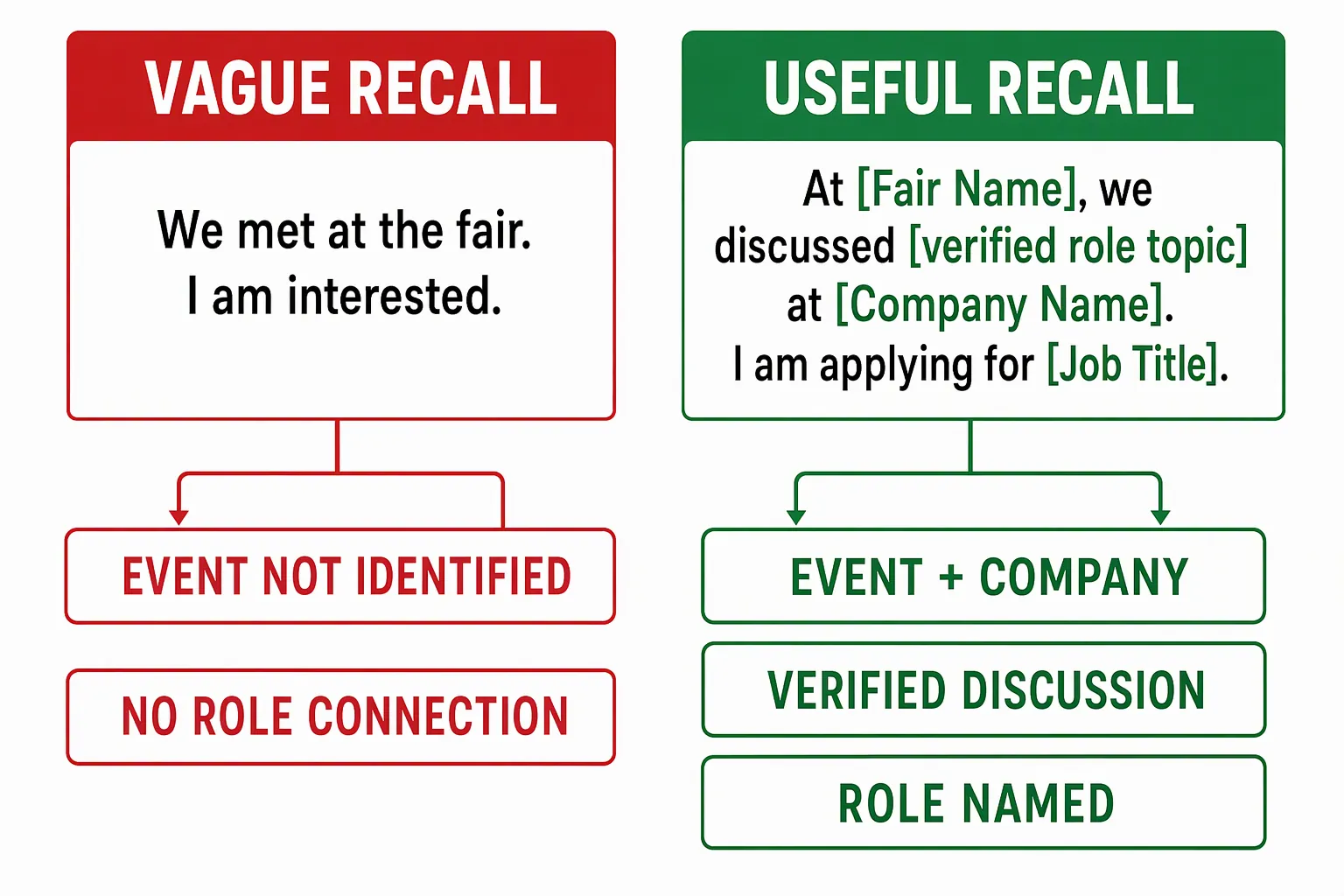
Structural approach: connect the fair conversation to the application
Think of the letter as a bridge between the meeting and the employer's hiring process. Identify where you met, make a truthful reference to the interaction, and then connect your experience to the role. The guidance on specific cover letter openings can help with the first sentence; make the fair detail your own rather than using a generic greeting as the whole opening.
Use four moves: establish where you met, recall a real detail if you have one, connect relevant evidence to the role, and state the next step you are taking. Keep the company and job title consistent with the posting. Your greeting and delivery method depend on what you know and what the employer requested.
- 01
Choose the follow-up route
At the fair, ask whether the representative accepts a printed letter or prefers an online application. After the event, use the contact or application route they gave you. Do not assume that handing over a document completes a formal application.
- 02
Identify the meeting accurately
Name the fair and company. Include the representative's name only if you recorded or confirmed it. Add one real detail, such as a question you asked or a role feature they described. Do not create a quote or claim a longer conversation than you had.
- 03
Connect evidence to the role
Choose a relevant project, task, result, or skill from your own background. Explain how it relates to a responsibility in the posting or a topic you discussed. Keep the claim factual; a brief conversation is not evidence that the representative endorsed you.
- 04
Make the next step clear
State the role you are applying for and, when useful, that you have followed or will follow the employer's stated process. Offer to provide further information, then add a sign-off and your contact details. Include other materials only if requested or accepted.
Career fair cover letter example
This fictional example shows how a candidate can refer to a career fair conversation, connect relevant experience to a role, and follow the employer's application process.
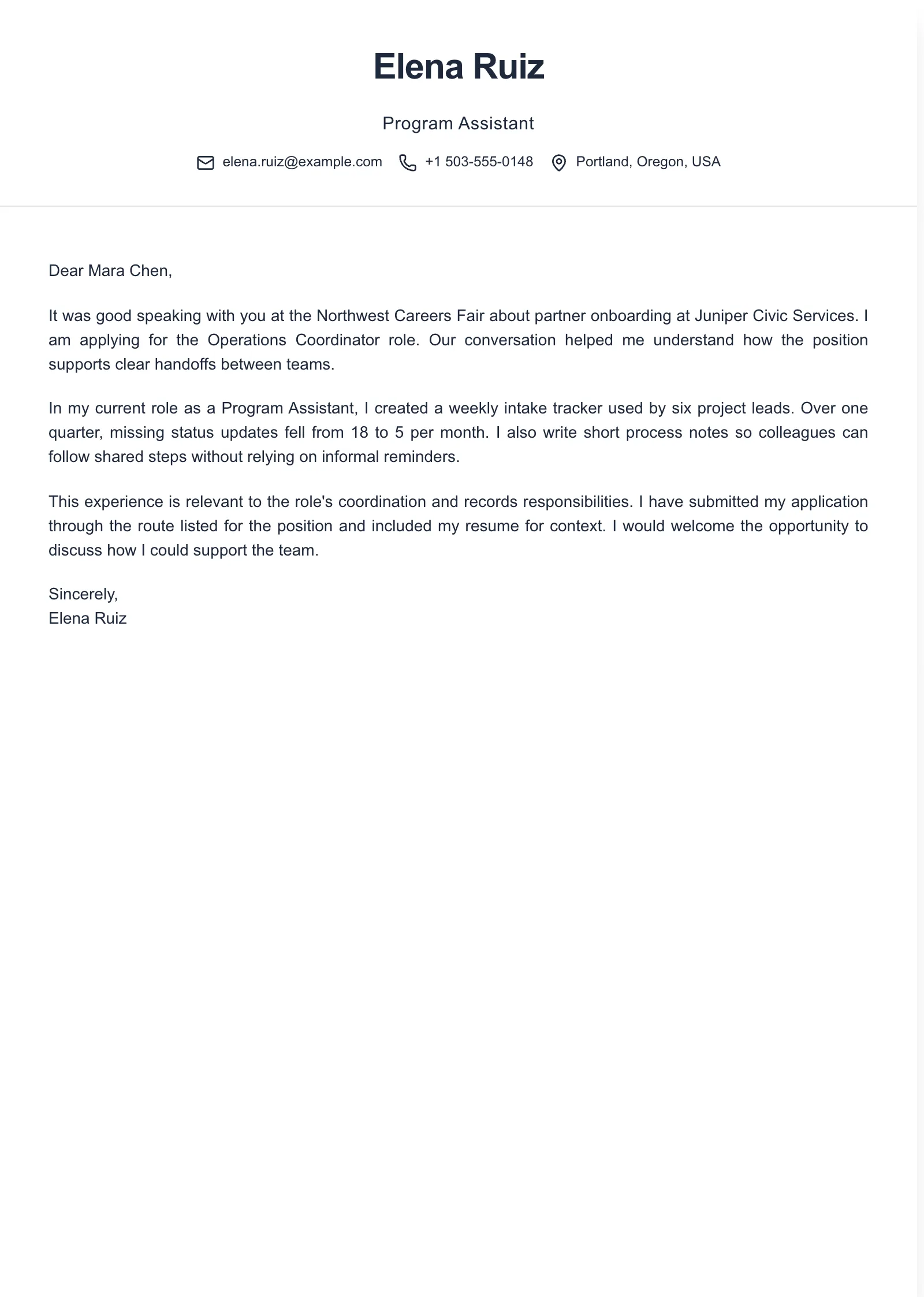
Example paragraphs
“Dear [Person's Name], it was good speaking with you at [Fair Name] about [specific topic you discussed]. I am applying for the [Job Title] role at [Company Name]. Our conversation helped me understand how the position relates to [responsibility from the posting].”
“Dear Hiring Team, I visited the [Company Name] booth at [Fair Name] and am following up about the [Job Title] position. I remember learning about [role detail you can verify], which connects with my experience in [relevant task or skill].”
“Thank you for speaking with me at [Fair Name] about the [Job Title] role at [Company Name]. Since the event, I have submitted my application through [application route]. My experience with [factual example] relates to [relevant responsibility].”
Adapt only details you can verify: the event, name, discussion, role, application route, and your own evidence. These are paragraph examples, not complete letters. Keep the meeting reference brief, do not claim a referral or invitation unless that is what happened, and follow the employer's instructions for submitting materials.
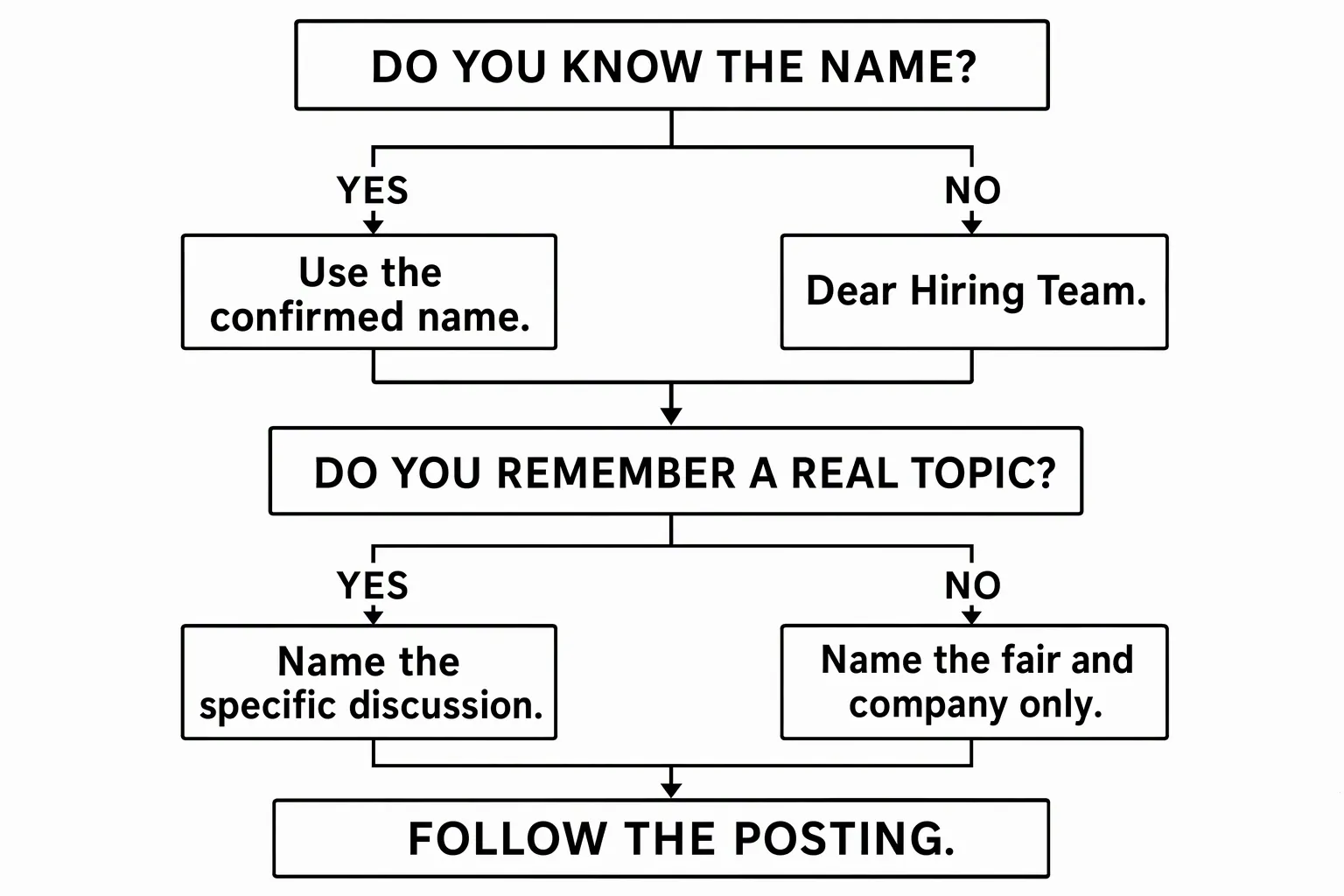
Scenario-specific mistakes in a career fair cover letter
Using the same vague follow-up for every booth
- What goes wrong
- A line such as “It was nice meeting you at the fair” may not help the reader identify the meeting or understand why you are writing.
- Better approach
- Name the event and company, then add one accurate point from the conversation if you remember one. If you do not, do not manufacture a discussion.
Treating a friendly exchange as a promise
- What goes wrong
- Saying a recruiter referred you, invited you to apply, or agreed to interview you can misrepresent a brief conversation.
- Better approach
- Describe the interaction neutrally. Say you spoke about the role or visited the booth only if that is accurate.
Repeating your resume instead of making a connection
- What goes wrong
- Listing past duties alone does not explain why you are following up with this employer or how your experience relates to the role.
- Better approach
- Choose one piece of evidence and connect it to a responsibility in the posting or a topic from the conversation.
Assuming the letter completes the application
- What goes wrong
- A letter handed to a representative may not enter the employer's formal process, and the posting may require a separate submission.
- Better approach
- Check the employer's instructions and complete the stated application steps. Use the letter to provide context, not as a substitute for those steps.
Frequently asked questions
- Should I hand over a career fair cover letter or send it afterward?
- Ask the representative how they prefer to receive application materials, then follow the instructions for the role. If the posting requires an online application, a letter handed over at the fair does not replace that step. Keep a digital version ready to adapt for the stated application route.
- What should I write if I forgot the recruiter's name?
- Do not guess or invent a name. Address the letter to the hiring team or recruiting team, then identify the fair, company, and any conversation detail you genuinely remember. If you remember no conversation, say you visited the company's booth instead.
- How soon should I follow up after a career fair?
- Follow up while the conversation is still clear in your memory, and observe any timeline or application instructions the representative gave you. There is no universal response deadline, and prompt follow-up cannot guarantee a reply.
- Do I need a cover letter if I already gave the recruiter my resume?
- Not always. Check the job posting and ask what materials the employer wants. A brief letter can reconnect your resume to a specific role and conversation, but do not send extra documents if the employer's instructions say not to.

Put this career change approach into practice
Choose sample data or build your own cover letter, then personalize it before you download.