
Introduction
An international student cover letter should connect your studies to the role and make relevant timing or work-authorization details clear. It is not a place to explain your immigration history. Help the employer understand your fit, expected availability, and what you can accurately say about authorization.
This page focuses on applying while you are a student, including how to use project evidence and handle questions about graduation and work authorization. That can overlap with a recent-graduate letter, but the task here is to explain student-related facts without letting them replace your qualifications. Follow the posting first: authorization questions may be asked separately, or may not be requested in the letter.
What to address directly
Work authorization
- Hiring manager concern
- A visa or student status alone does not establish permission for a particular job or schedule. Requirements depend on the country, your circumstances, and timing.
- What your letter should prove
- State only facts you have verified; do not promise eligibility or assume sponsorship is available. For US student employment, check your circumstances and dates with your designated school official and current USCIS student employment guidance. For another country, consult its relevant official authority and your institution.
Graduation and availability
- Hiring manager concern
- An employer may need to assess whether your expected completion date fits the role. An unclear date can make that difficult, while presenting an unconfirmed date as certain can mislead.
- What your letter should prove
- When timing matters, give your expected graduation month and year and describe availability only as specifically as you can support. If a date or authorization timeline is not confirmed, say so rather than guessing.
Projects as relevant evidence
- Hiring manager concern
- A list of classes does not show what you can contribute. Employers need to understand what you personally did and how it relates to the role.
- What your letter should prove
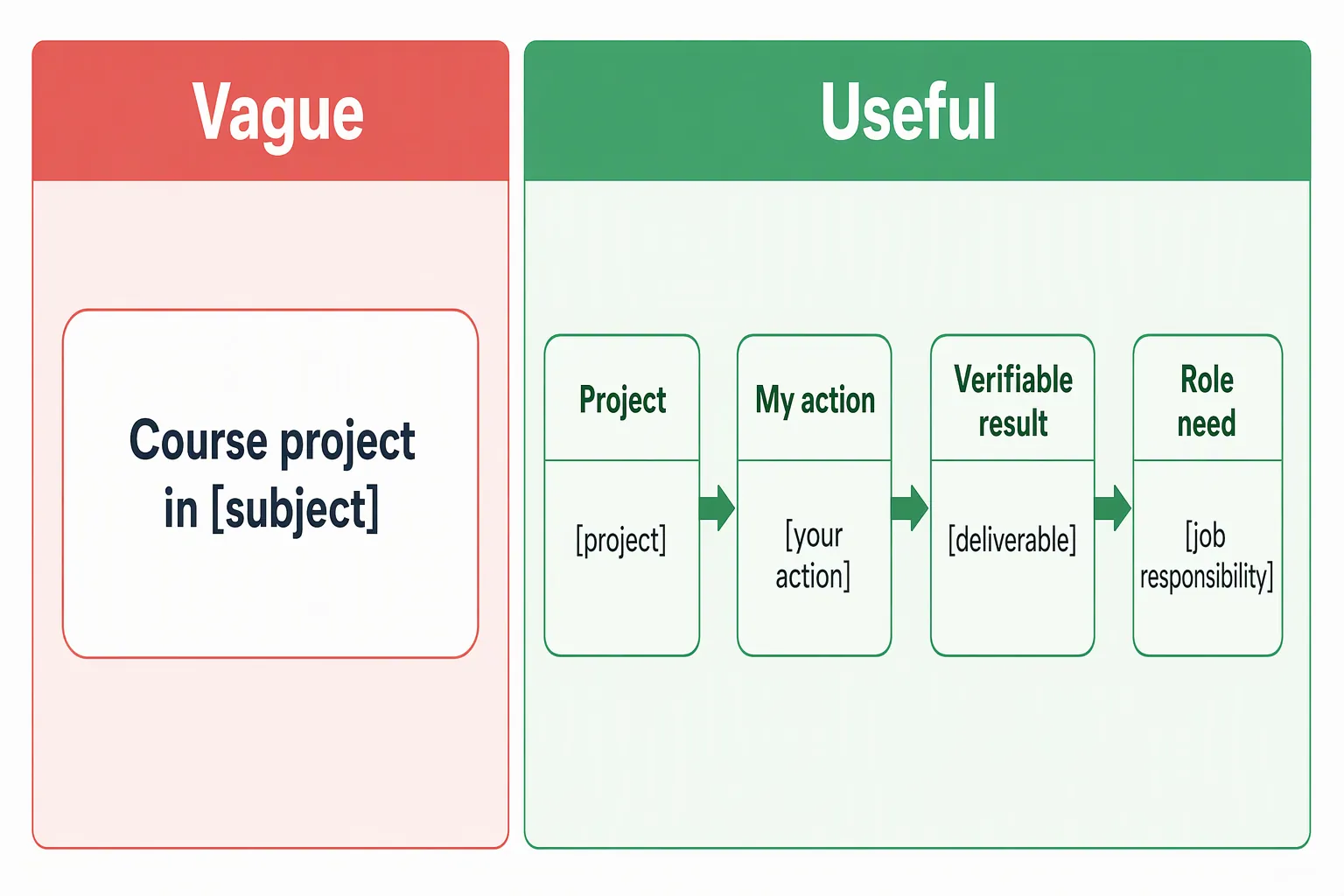
- Choose one relevant project, research task, campus responsibility, or other real experience. Name your contribution, the skill it demonstrates, and the connection to a stated job need. Distinguish your work from a team’s result.
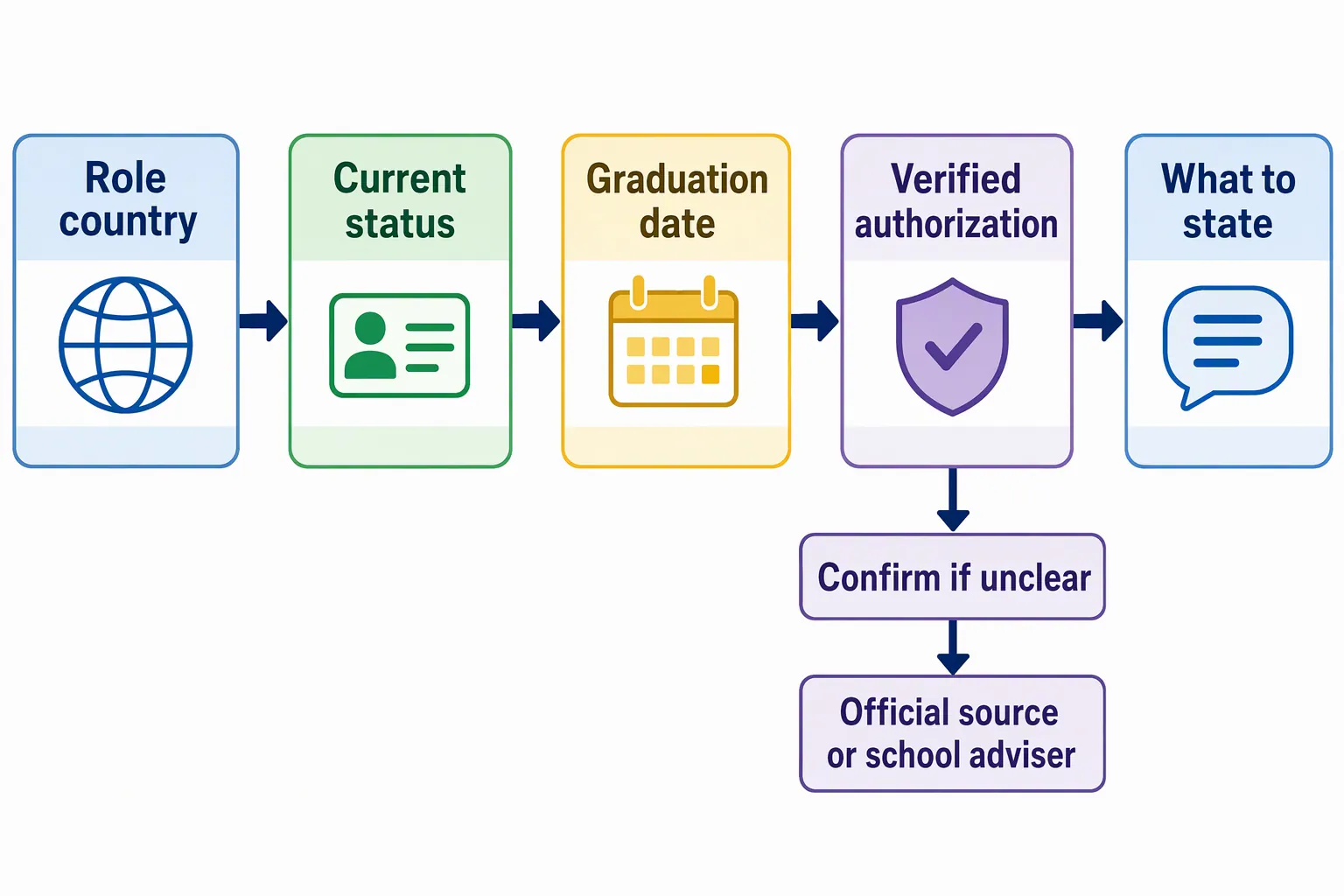
Structural approach: connect study, timing, and role fit
Build the letter around the employer’s needs, not a general explanation of being an international student. The cover letter structure guide explains the general paragraph order; use these steps to apply it to your student experience. Keep legal details limited to facts you have checked.
- 01
Lead with the role and a relevant link
Name the [Job Title] and [Company Name]. Connect one part of the role to your studies, project work, or relevant experience. Lead with fit, not nationality or a broad request for an opportunity.
- 02
Show one piece of student evidence
Describe a relevant project or responsibility through your own actions: the task, the skill or judgment you used, and a result you can support. Do not present coursework as paid employment or claim a team result as solely your own.
- 03
Make timing easy to understand
Include an expected graduation date when it helps answer a question about availability or eligibility. Mention schedule constraints only when relevant. Label a tentative date as expected rather than certain.
- 04
Handle authorization factually
Check the posting and application questions before deciding whether to include an authorization statement. If needed, state only verified facts about your status and relevant timing. Do not infer eligibility, promise future authorization, or assume sponsorship is available.
International student cover letter example
A fictional example connecting a student project to a role, giving an expected graduation date, and avoiding unsupported claims about work authorization.
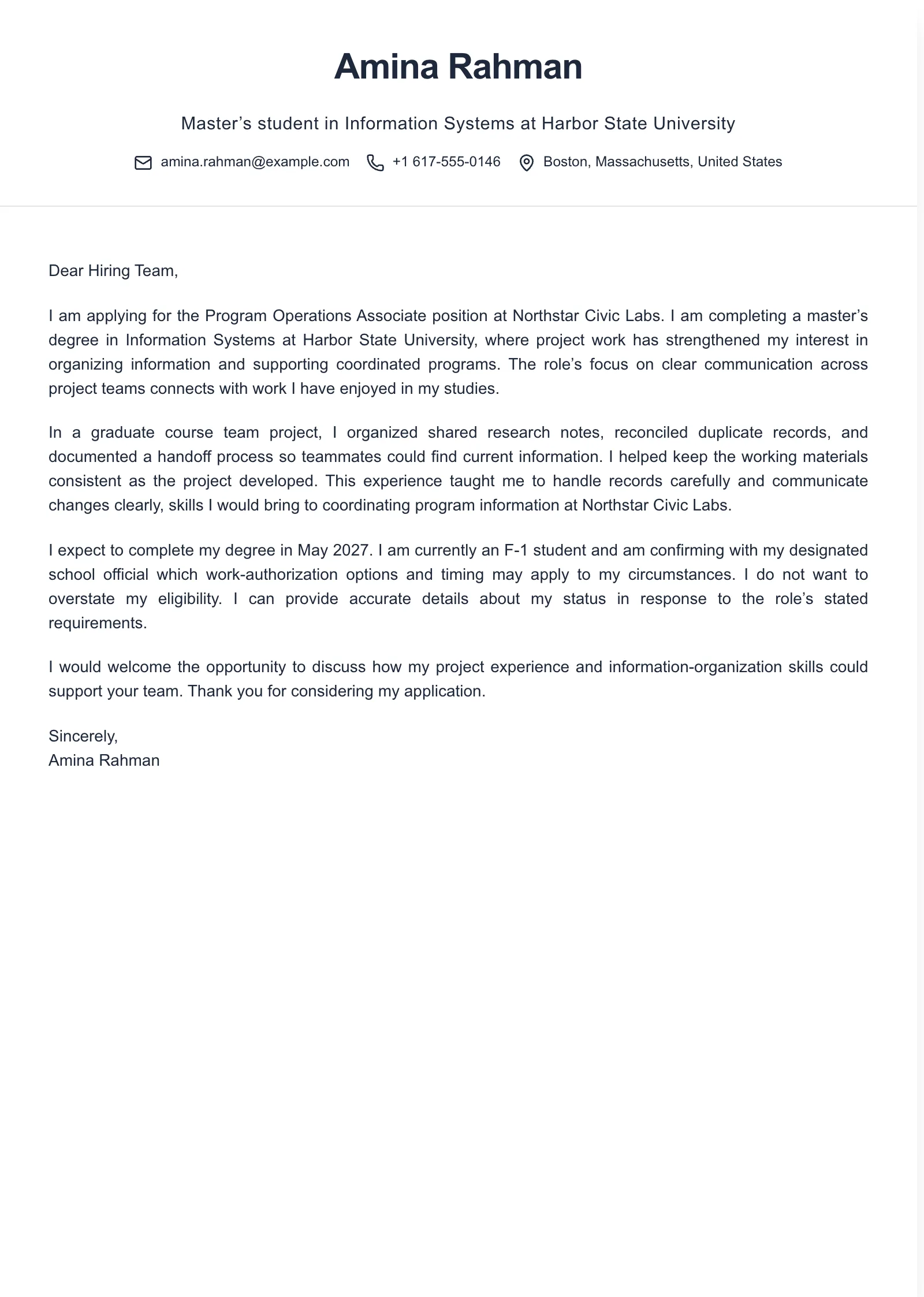
Example paragraphs
“I am applying for the [Job Title] position at [Company Name]. My studies in [field of study] and work on [relevant project] have helped me develop [relevant skill], which I would use to support [specific responsibility from the posting].”
“For [project or course], I [specific action you took] using [relevant method or tool]. The work resulted in [verifiable outcome or deliverable], which relates to [specific need] in the [Job Title] posting.”
“I expect to complete [degree or program] in [month and year]. I am confirming [relevant authorization or timing question] with [appropriate official source or institution] and can provide accurate details about [the employer’s stated requirement].”
Use these as individual paragraphs, not as a complete letter. Replace each bracket with an accurate detail and remove anything that does not apply. Answer direct authorization questions in the designated application field as instructed; do not use a sample paragraph to imply that a status guarantees work permission.
Scenario-specific mistakes
Treating a visa as proof of work permission
- What goes wrong
- Visa status alone does not establish that a particular job, schedule, or start date is authorized.
- Better approach
- Check the applicable official guidance and your circumstances with your institution. State no more than you have confirmed.
Making authorization the whole story
- What goes wrong
- A letter focused mainly on status or sponsorship may not show why your skills fit the role.
- Better approach
- Lead with role fit and relevant evidence. Include authorization details when they answer an employer instruction or a material timing question.
Presenting an expected date as certain
- What goes wrong
- A graduation or availability date may change, so an unqualified promise can give a false impression.
- Better approach
- Label an unconfirmed date as expected, and give a month and year only when you have a reasonable basis for it.
Claiming a team result as your own
- What goes wrong
- Hiding the team context or your individual contribution can overstate your role and make your evidence harder to assess.
- Better approach
- Name the team context, identify what you personally did, and describe only outcomes you can explain.
Frequently asked questions
- Do I need to mention my visa or immigration status in a cover letter?
- Not in every application. Follow the employer’s instructions and answer required eligibility questions accurately. If authorization or timing is relevant, state only what you have verified and leave out unrelated personal details.
- Should I include my expected graduation date?
- Include it when it helps explain your availability or answer a stated eligibility question. Give the expected month and year, and describe the date as expected if it is not confirmed.
- Does being an F-1 student mean I can work after graduation?
- Do not infer work permission or dates from visa status alone. Student employment rules depend on the applicable requirements and your circumstances. Confirm your options and timing with your designated school official and current official guidance before making a claim.
- Should I ask the employer for visa sponsorship in my cover letter?
- First check the job posting and application questions. If sponsorship is relevant, describe your situation accurately without assuming the employer offers sponsorship or that you qualify for a particular authorization. Ask about the role’s requirements when appropriate.

Put this career change approach into practice
Choose sample data or build your own cover letter, then personalize it before you download.