
Introduction
A transfer cover letter for another location asks your current employer to consider moving your work to a different office, site, or branch. Make the request easy to assess: name the destination, explain your reason, suggest a workable timeframe, and describe how you could support continuity. You are asking about a move within the same employer, not introducing yourself to a new organization.
This guide is specifically about a location change, not a move into a different position. Check whether your employer requests a letter, form, or other information, and follow the stated process. Do not assume that your preferred location has an opening or that your current duties, reporting arrangements, or work conditions can transfer unchanged.
What to address directly
Why this location
- Hiring manager concern
- A request can be hard to assess if it only says that you want a change. Sharing too much personal information can also distract from the decision.
- What your letter should prove
- Name the destination and give a concise, truthful reason. If you are relocating, for example, you can say so without sharing private details. Connect the request to your interest in continuing your work, but do not present a personal preference as proof that the employer should approve it.
When the move could happen
- Hiring manager concern
- A date may affect staffing, handoffs, or other arrangements. A fixed date can create confusion if you have not confirmed the process.
- What your letter should prove
- Offer a preferred timeframe only if it is realistic, and say whether you have flexibility. Mention a handoff you could help prepare, if relevant. Treat the date as a request until the employer confirms it; do not imply that approvals or coverage are already arranged.
How work could continue
- Hiring manager concern
- A manager may need to understand what the move could mean for ongoing work and responsibilities. Ignoring those questions can leave the request incomplete.
- What your letter should prove
- Describe relevant experience with the employer's workflows, tools, or internal partners only when it is accurate. Offer a practical transition step, such as documenting open work. Do not promise that the destination follows the same procedures or offers the same duties unless that has been confirmed.
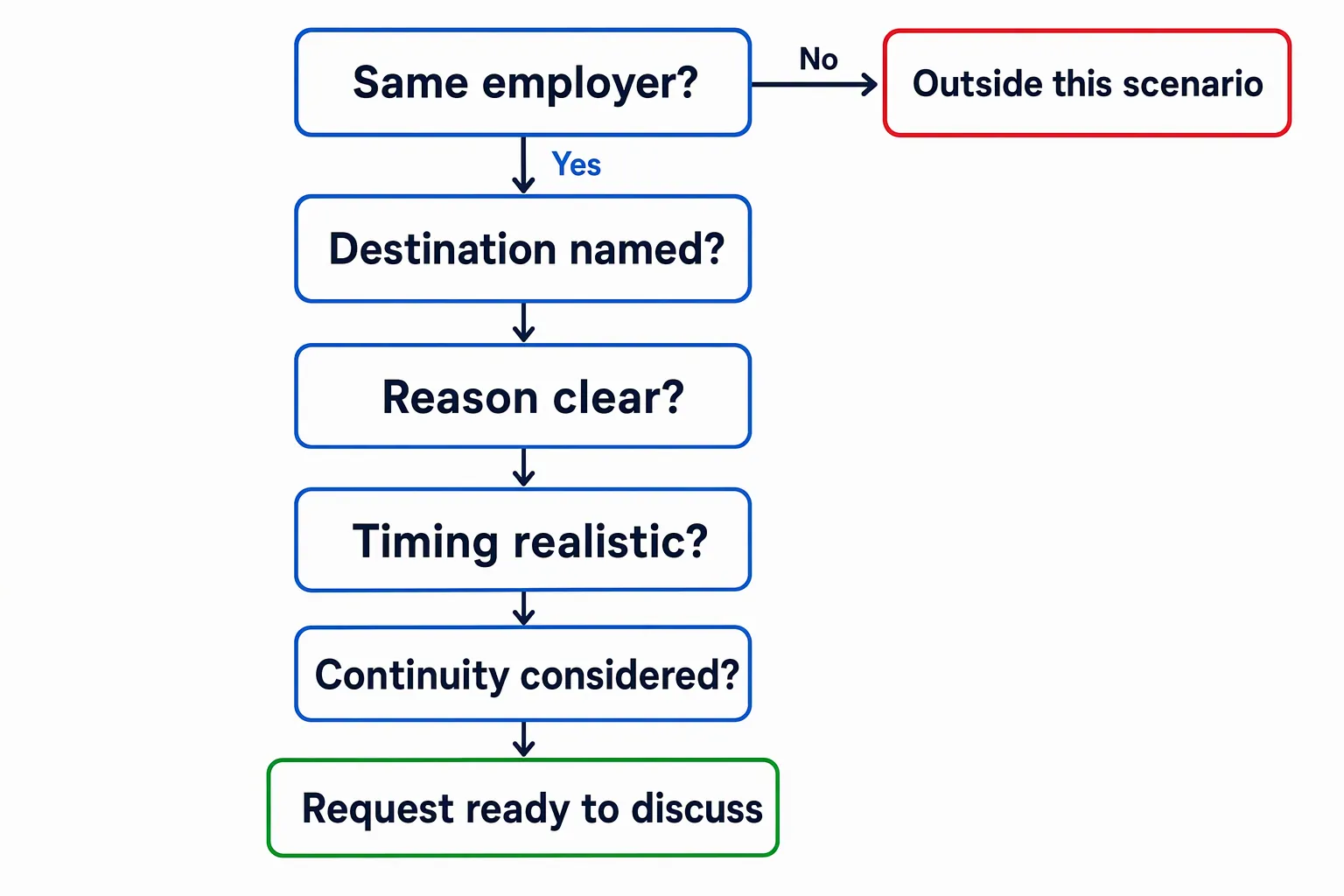
Structural approach for a location transfer
Build the request around the employer's decision: which location you are seeking, why, when, and how ongoing work could be handled. Keep personal context brief and relevant. Then explain what experience you could bring to the destination without treating familiarity with the organization as a guarantee of approval.
The sequence below keeps the request direct while leaving room for your employer's process. For general paragraph order, see this guide to cover letter structure. Adapt that advice to an internal move: the reader may know your work, but still needs a clear request and relevant evidence.
- 01
State the requested move
Name the destination and your current role near the beginning. Say whether you are asking to continue in that role there or to discuss a suitable arrangement. If an internal posting, form, or policy gives instructions, use its terms and follow the stated process.
- 02
Give a concise reason
Explain your reason in a sentence or two, such as a planned move to the area or a practical need to work from that location. Share only what you choose to disclose. Avoid complaints about your current team, claims about what the destination needs, or personal details that do not help the reader assess the request.
- 03
Show what could carry over
Choose a relevant example of work you already handle, such as a recurring process, a cross-location handoff, or using an internal system. Explain how that experience could help you continue contributing. Do not invent performance figures or assume the destination uses the same workflow.
- 04
Propose timing and next steps
Offer a realistic preferred timeframe and note whether you can be flexible. Mention a handoff or documentation plan if it applies. Ask to discuss the process and possible arrangements; do not imply that a receiving contact, opening, or approval has already been secured.
Internal transfer cover letter example
Preview a fictional request to move to another location, with a personal reason, a practical transition offer, and timing left open for discussion.
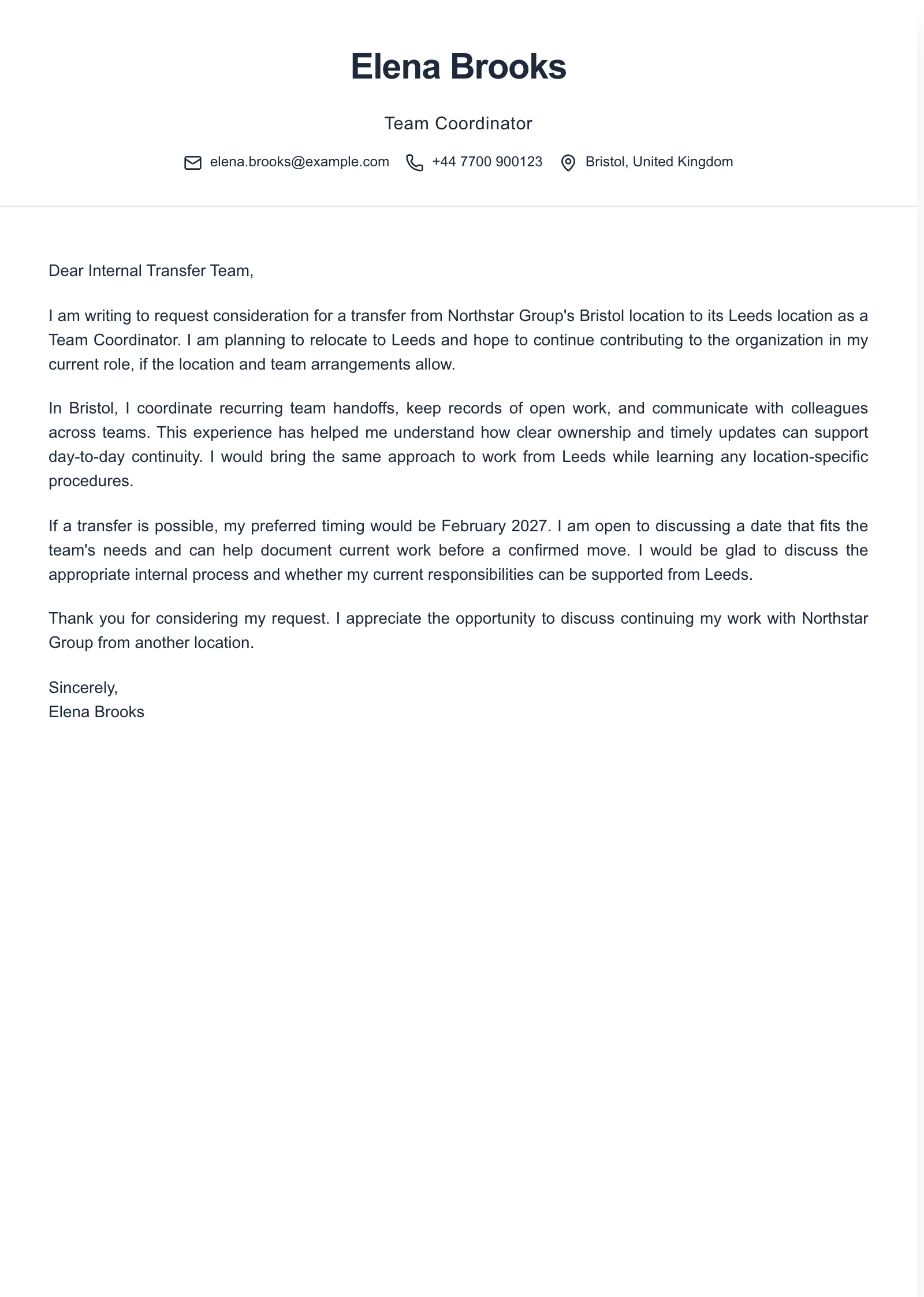
Example paragraphs
“I am requesting a transfer to [Target Location] because [brief, truthful reason]. I would welcome the opportunity to continue contributing to [Company Name] in my current role as [Current Role].”
“In my current work, I handle [relevant responsibility] and coordinate with [team or internal partner]. That experience could help me support [specific work continuity] if a move to [Target Location] is workable.”
“My preferred transfer timing is [date or timeframe], although I can discuss an arrangement that fits the team's needs. If a move is approved, I can help document [open work or handoff detail] before the change.”
Replace each bracketed detail with something accurate, and remove any sentence that does not fit your circumstances. Keep your role title factual. If you need an opening line, state the specific request or reason rather than relying on a generic expression of enthusiasm. See these cover letter opening examples for general opening principles, then make the location request explicit.
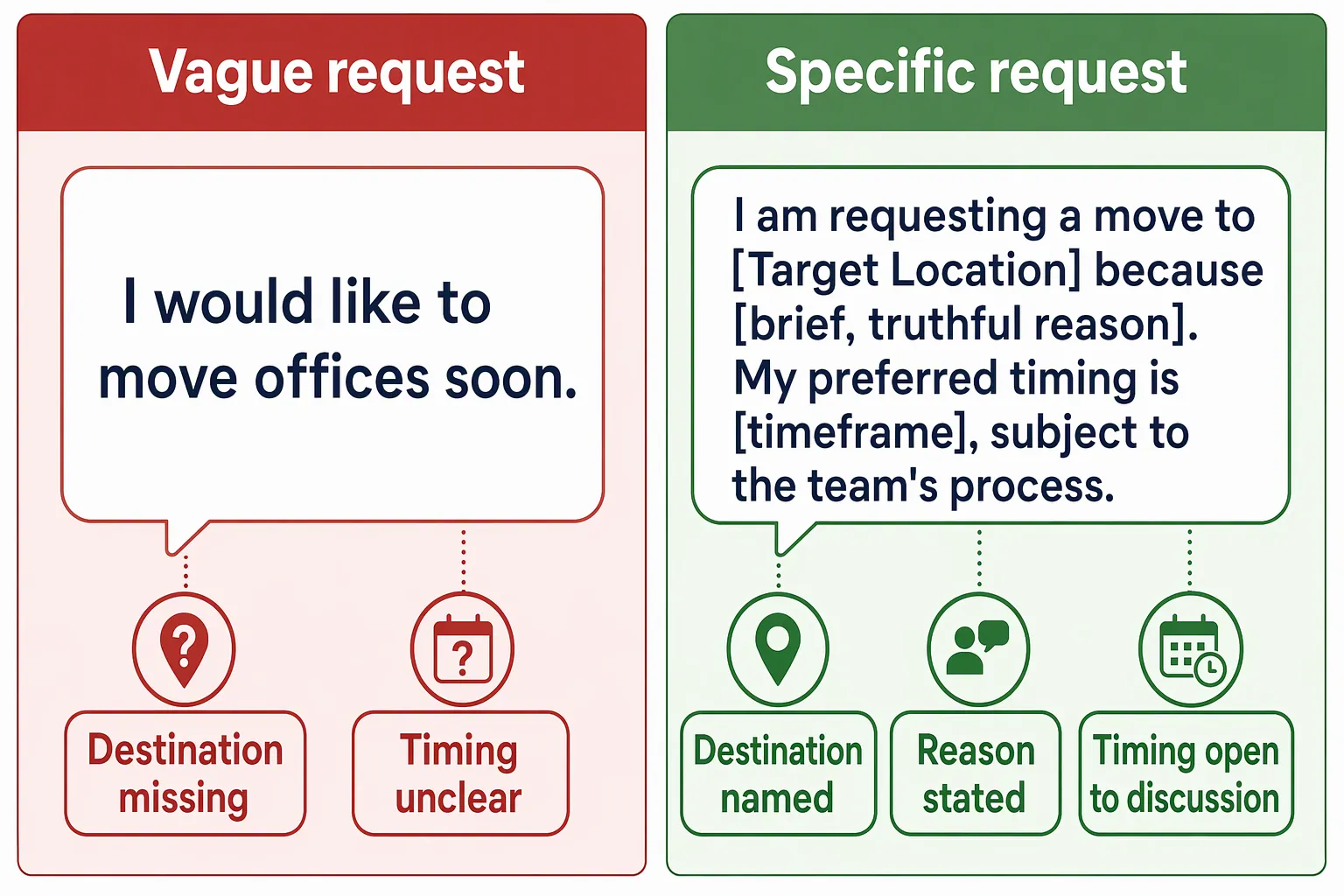
Common mistakes in internal transfer requests
Writing as if applying to a new employer
- What goes wrong
- A long introduction to your background can bury the location request. Generic praise may also sound out of place when the reader already knows the organization.
- Better approach
- State your current role and requested destination near the start. Use the remaining space to explain your reason, timing, and relevant approach to continuity.
Assuming approval or an opening
- What goes wrong
- Writing as if the move is decided, or claiming that the destination needs you, can get ahead of the employer's process.
- Better approach
- Frame the move as a request to discuss a workable arrangement. Mention an opening or confirmed terms only when you have verified them.
Sharing more personal information than needed
- What goes wrong
- A detailed account of private circumstances can distract from the location and timing decision.
- Better approach
- Give a concise, truthful reason at the level of detail you are comfortable sharing. You do not need to turn private information into an argument for approval.
Promising a seamless handoff
- What goes wrong
- The destination may have different duties, reporting relationships, or procedures, and the transfer date may depend on other people.
- Better approach
- Offer specific support within your control, such as documenting open work. Make any timing or transition plan subject to confirmation.
Frequently asked questions
- Should I explain why I want to move locations?
- Yes. Give a clear, truthful reason at the level of detail you are comfortable sharing. Name the destination and explain why the move works for you, without criticizing your current location or implying that a personal reason obligates the employer to approve the request.
- Should I address the letter to my current manager or the receiving location?
- Follow your employer's internal process and any instructions for the transfer request. If no recipient is named, use an appropriate neutral greeting rather than guessing who will make the decision.
- How much notice should I give?
- There is no universal transfer timeline. State a preferred timeframe, note whether you are flexible, and confirm the effective date through your employer's process before making commitments.
- Is this the same as applying for a different internal role?
- This page focuses on requesting a different work location, usually while seeking to continue in your current role. If you are applying for a different internal position, address that role's duties and your fit for them, and follow the employer's application process.

Put this career change approach into practice
Choose sample data or build your own cover letter, then personalize it before you download.