
Introduction
A newcomer cover letter is still a job application: connect your evidence to the advertised role, then clarify any unfamiliar context that affects how a reader understands it. Depending on the posting, that may mean a concise statement of current work authorization, an explanation of an overseas job or degree, and a grounded account of language use.
You do not need to narrate your move or disclose private immigration history just because you are new to the country. Follow the employer's instructions and check relevant local requirements. Conventions vary by employer, occupation, and application channel. This guide does not determine whether a particular status permits employment.
What to address directly
Work authorization: answer the relevant question
- Hiring manager concern
- If an application asks about work eligibility, or your circumstances make it relevant, vague wording may leave the employer without a clear answer. Overexplaining can also add personal detail that the application does not need.
- What your letter should prove
- Use one factual sentence about your current, verified authorization. Add a date or condition only when it is accurate and relevant to the role. Do not assume that a document allowing entry, a pending application, or another status also authorizes work. Confirm the effect of your documents with the appropriate official authority, and do not promise future eligibility or sponsorship.
Overseas roles and degrees: explain without renaming
- Hiring manager concern
- A title or qualification from another country may not map directly to a local term. Replacing the title on your records with a supposedly equivalent local title can misstate your history; leaving unfamiliar terms unexplained may make relevant experience harder to understand.
- What your letter should prove
- Keep your recorded job title, then summarize the responsibilities that matter for this role. Give your degree's official title, institution, and country. If you translate the title for clarity, make clear that it is a translation, not a formal equivalency. Describe an assessment or recognition only if it has actually been completed and you can verify what it covers.
Language ability: connect a level to actual use
- Hiring manager concern
- A broad label such as “good” gives little information about what you can do, while an inflated claim can create an expectation you cannot meet.
- What your letter should prove
- Choose a description you can explain, or give a current test result if it is relevant or requested. Add a specific example, such as writing updates, discussing instructions, or communicating with clients. Mention other languages when they are relevant to the role. Do not treat an accent as evidence of ability or as something you need to apologize for.
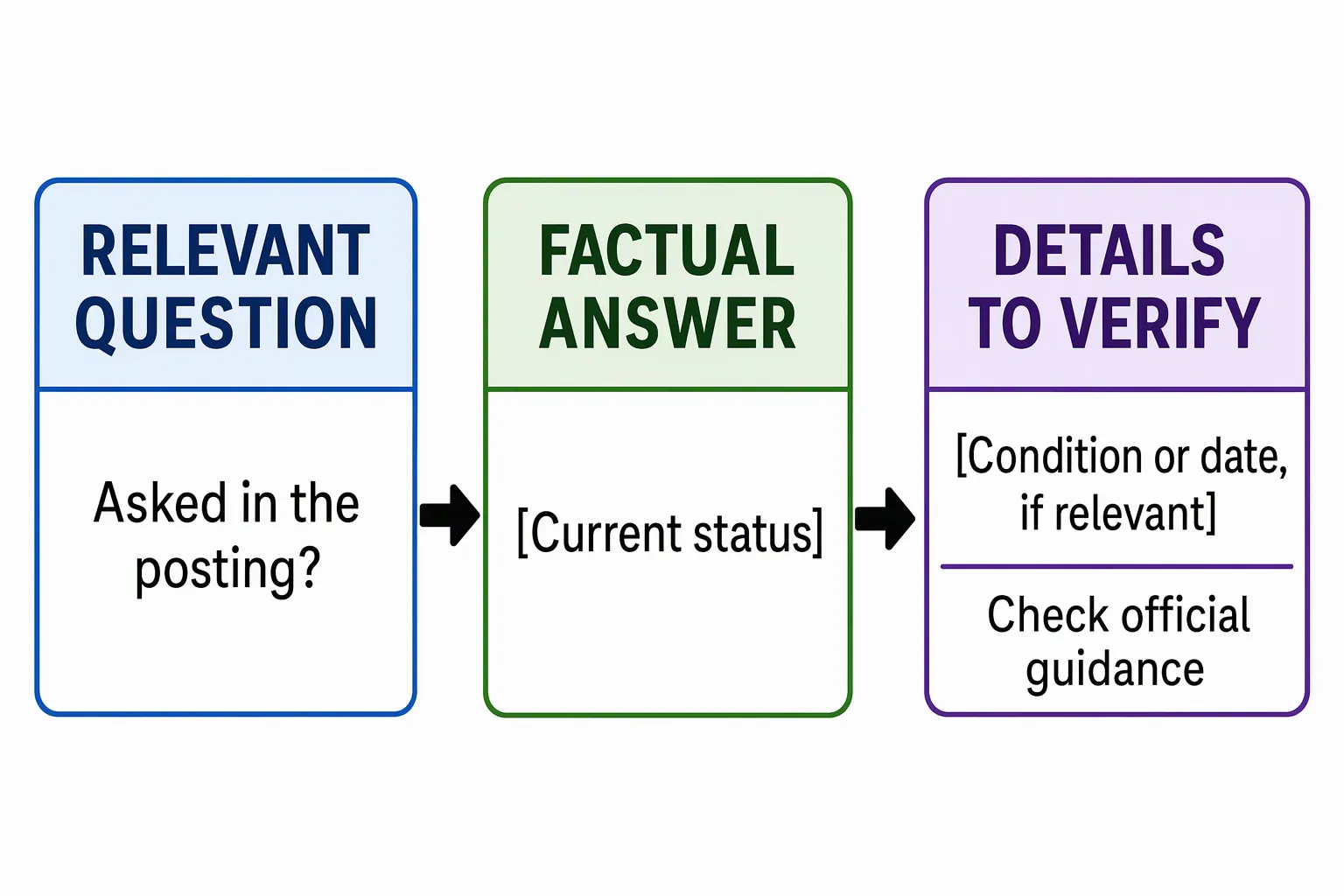
Structural approach for a newcomer cover letter
Use a familiar, job-focused structure and give unfamiliar details only the space they need. A local comparison explains responsibilities; it does not replace the title in your employment history. Similarly, relevant coursework does not by itself establish that a degree has been formally assessed as equivalent. The general cover letter structure guide explains each paragraph's purpose; the steps below adapt that structure to this application.
A statement about authorization should describe your present, verified circumstances, not predict the result of a future application. The work authorization glossary entry explains the term but cannot determine whether a particular person may work. Check the appropriate official source for your country and status. For an application in Canada, Canada Job Bank's application guidance recommends researching the employer and matching your application to the actual job.
- 01
Name the role and your fit
Open with the exact [Job Title] and one reason your experience matches a stated need. Make clear which application the letter supports. Do not begin with a general account of moving countries.
- 02
Clarify authorization only when relevant
If the posting asks about work eligibility or one sentence would resolve a relevant question, state your current, verified status plainly. Add a date or condition only when accurate and relevant. If the employer asks in a separate form, answer there as instructed and avoid repeating unnecessary sensitive detail.
- 03
Make overseas experience understandable
Retain the title shown in your records and describe the responsibilities that relate to the target role. Give a degree's official title and source. Explain relevant study or any completed assessment only as far as the facts support it.
- 04
Show language use and close on fit
Describe your language ability honestly and pair it with a work-related example. Connect one specific part of the posting to your evidence, then close professionally. Leave private migration details out unless the employer has a clear, appropriate reason to request them.
Newcomer cover letter example
A fictional job application showing how to state current work authorization, explain overseas experience, and describe language use without claiming more than the facts support.
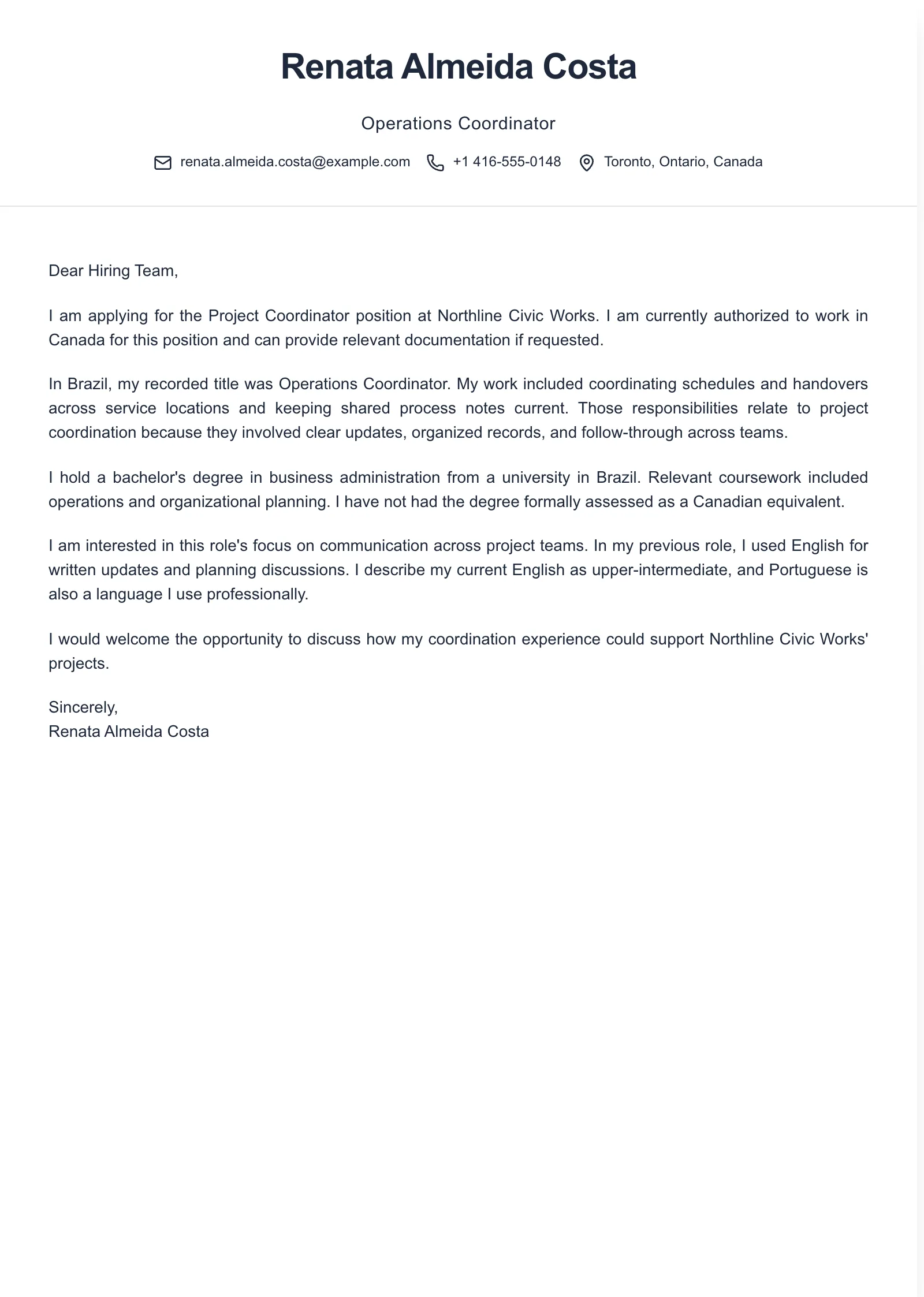
Example paragraphs
“For the [Job Title] opening at [Company Name], my current work authorization for [Country] is [accurate status and relevant condition, if any]. I can provide supporting details through [appropriate application step] if needed.”
“My recorded title was [original job title] at [former employer]; my responsibilities included [relevant duty]. My degree is recorded as [official degree title] from [institution and country], with relevant study in [subject].”
“I use [language] at [honest level or relevant current test result], including [specific speaking or writing task] in [work, study, or community setting]. That experience relates to the [communication need stated in the posting].”
Use these as paragraph patterns, not claims to copy. Replace every bracket with a fact you can explain if asked. Do not imply that a degree has been formally assessed if it has not. If a test result is old or irrelevant, describe your present ability accurately instead.
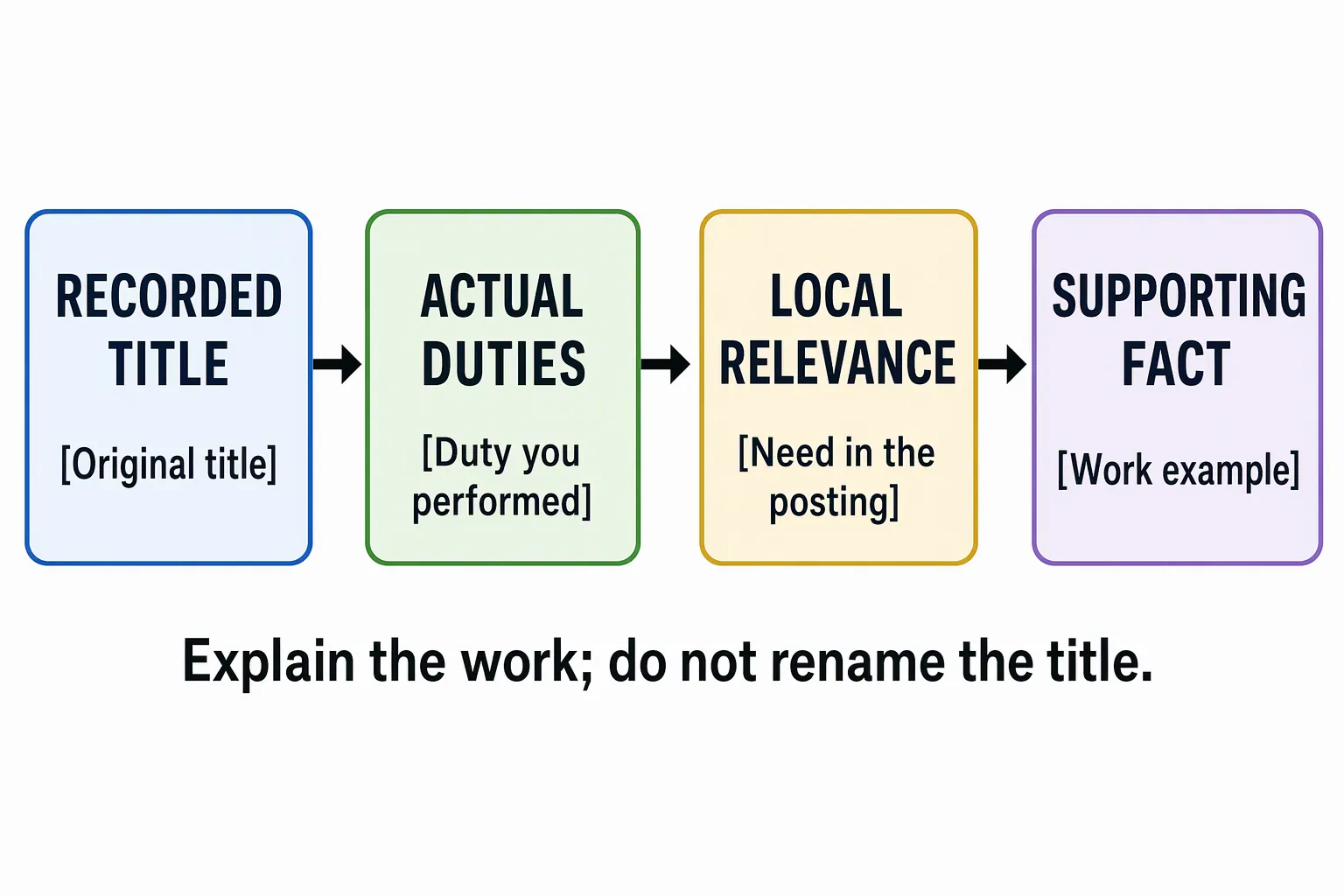
Common mistakes in a newcomer cover letter
Claiming authorization too broadly
- What goes wrong
- A phrase such as “I can work anywhere” may fail to reflect conditions attached to your current status.
- Better approach
- Describe only current authorization you have verified. If you are uncertain about its effect, check with the appropriate official authority instead of interpreting it in the letter.
Replacing an original title with a local one
- What goes wrong
- Changing the title shown in your employment records to make it sound familiar can make your history inaccurate.
- Better approach
- Keep the recorded title and briefly explain the responsibilities that are relevant to the advertised work.
Presenting a degree as formally equivalent
- What goes wrong
- A translated title or similar course content does not, by itself, establish formal recognition in another country.
- Better approach
- Name the degree and institution accurately. Mention assessment or recognition only when it has occurred and you can describe its scope.
Calling yourself fluent without support
- What goes wrong
- A broad label may overstate what you can currently do in work conversations or written communication.
- Better approach
- Choose a level that fits your present ability and give a practical example. If the posting requests a test, state the test and result accurately.
Frequently asked questions
- Should I include my work authorization in a newcomer cover letter?
- Include it when the posting asks or when one accurate sentence would clarify a relevant question. Describe only your current, verified status, and include conditions or dates only when they are accurate and relevant. If you are unsure what your status permits, check current official guidance instead of guessing.
- How do I explain a foreign degree without claiming equivalency?
- Give the degree's official title, institution, and country. You can add relevant study or coursework. Mention a formal assessment or local recognition only if it has actually occurred and you can describe it accurately; assessment requirements vary by purpose and jurisdiction.
- Should I write a cover letter for an immigration officer?
- This guide is for a job application, not an immigration application. If an authority requests a letter or statement, follow its current instructions and provide information relevant to that request. A job cover letter does not replace immigration forms or other required evidence.
- How should I describe my language level?
- Use a level you can explain and pair it with a real example of speaking or writing. If the employer requests a test result, give the test and result accurately and only if it is current and relevant. Do not describe yourself as fluent unless that reflects your present ability.

Put this career change approach into practice
Choose sample data or build your own cover letter, then personalize it before you download.