
Introduction
A hybrid job cover letter should show that you understand the role's mix of in-person and remote work. The practical question is not whether you like hybrid work. It is whether you can meet the schedule the employer described and contribute both when colleagues are together and when work happens remotely.
Use the posting as your reference point. If it names office days, confirm whether you can attend them. If it does not, avoid guessing at a fixed schedule. Then connect one relevant example of independent work or coordination to the role. This page focuses on applications where in-person attendance is part of the posting; a remote role cover letter focuses on a role where regular office attendance is not part of the stated arrangement.
What to address directly
Can you meet the stated office schedule?
- Hiring manager concern
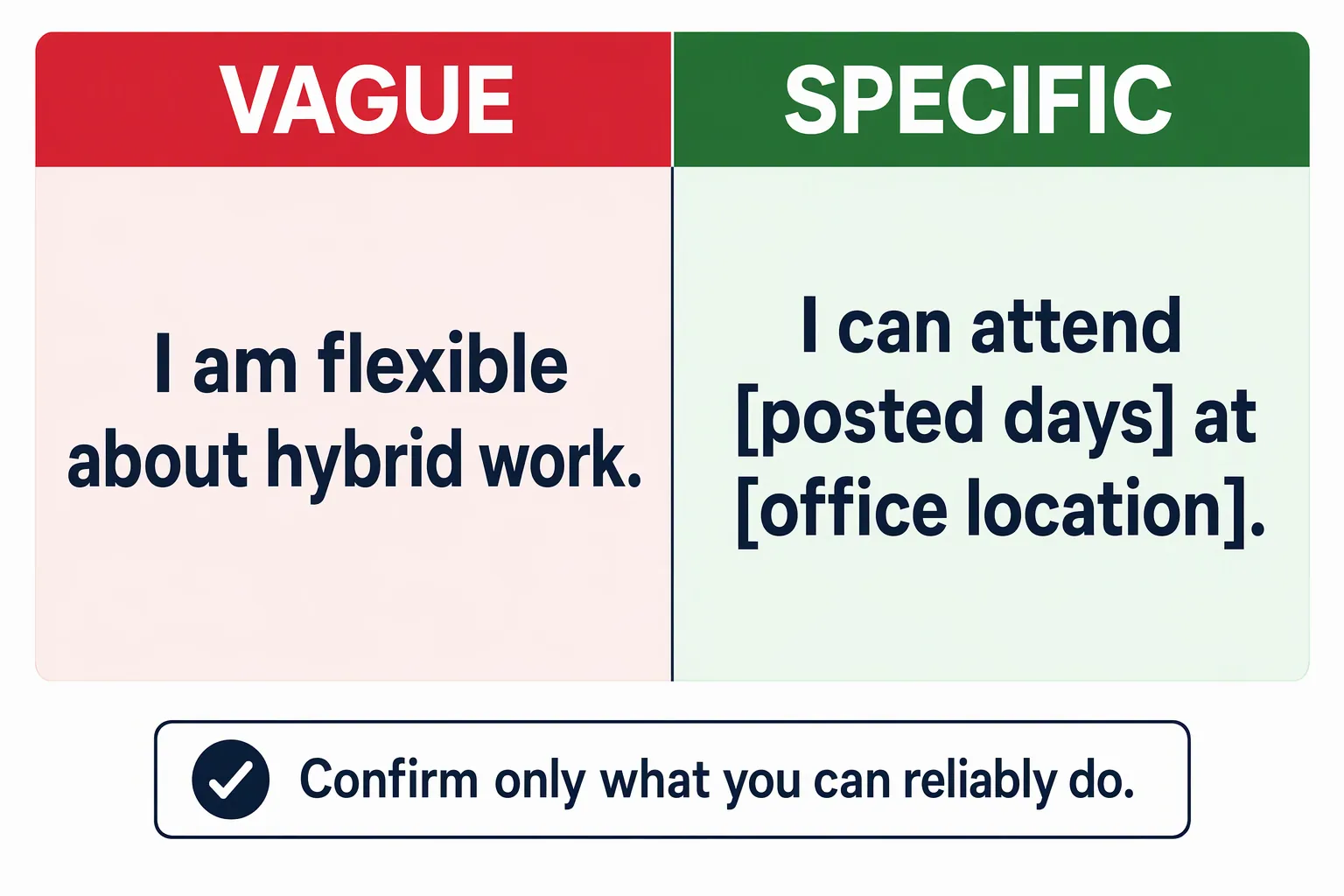
- If the posting identifies required in-person days, a general statement about flexibility may not clarify whether you can attend them. Promising days that do not work for you can also create a mismatch.
- What your letter should prove
- Use the posting's wording and state only what you can reliably do. If the days are listed and suit you, name them briefly. If the schedule is unstated or unclear, do not invent office days or claim unlimited availability.
Can you get to the work location when needed?
- Hiring manager concern
- The office location can matter when a role includes in-person attendance. A long commute explanation may distract from your qualifications, while a brief confirmation can address a practical question when attendance is central to the posting.
- What your letter should prove
- If useful, give a short, accurate confirmation that you can reach the stated location on the required days. Mention a realistic commute arrangement only when it supports that confirmation. Do not claim a move, vehicle, or travel plan that is not settled.
Can you work well in both settings?
- Hiring manager concern
- Availability for office days does not show how you handle focused work, shared tasks, or handoffs across locations. A broad claim that you work well remotely does not explain how that helps with this role.
- What your letter should prove
- Choose a relevant example of how you kept work moving across locations, such as documenting a decision, updating a shared tracker, or preparing a clear handoff. Keep the example factual and connect it to a responsibility in the posting.
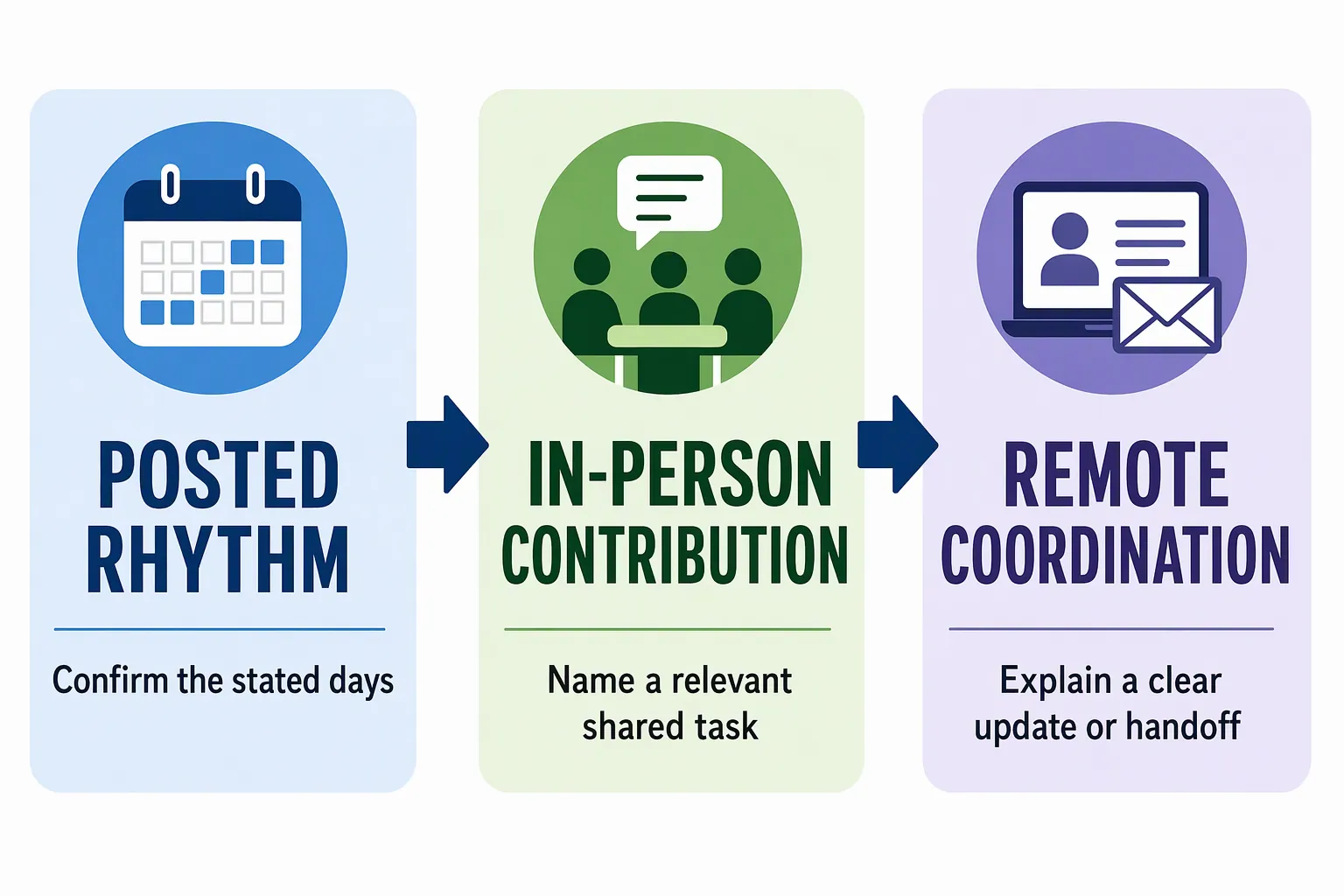
Structural approach: Confirm the schedule, then show how you work
Keep the letter centered on the job, not on a general debate about hybrid work. A useful sequence is to identify the role and its stated work pattern, confirm the attendance you can support, and give evidence that connects your working habits to the job's responsibilities. The cover letter structure guide can help you place these points without letting schedule details crowd out your qualifications.
Treat the commute as a practical detail, not your main argument. The stronger point is how you will contribute across the working week, including how you share progress and coordinate with colleagues who may not be in the same place.
- 01
Read the schedule as written
Find any stated office location, attendance pattern, or in-person requirement. Separate details the employer has confirmed from assumptions you might otherwise make. If the schedule is not specific, keep your letter accurate rather than filling in missing information.
- 02
Check your real availability
Decide which stated days you can reliably attend and whether reaching the location is practical. State that commitment plainly if it fits. If it does not, do not hide the conflict behind a vague claim of flexibility.
- 03
Select evidence for both settings
Choose a work example that demonstrates a useful hybrid habit, such as completing independent tasks, keeping shared records current, or coordinating a handoff. Tie it to a responsibility in the posting rather than listing tools without context.
- 04
Keep logistics brief and verify them
Give schedule or commute details only as needed, then use the remaining space for relevant experience and motivation. Before sending, check every stated day, location, and availability claim against what you can actually commit to.
Hybrid role cover letter example
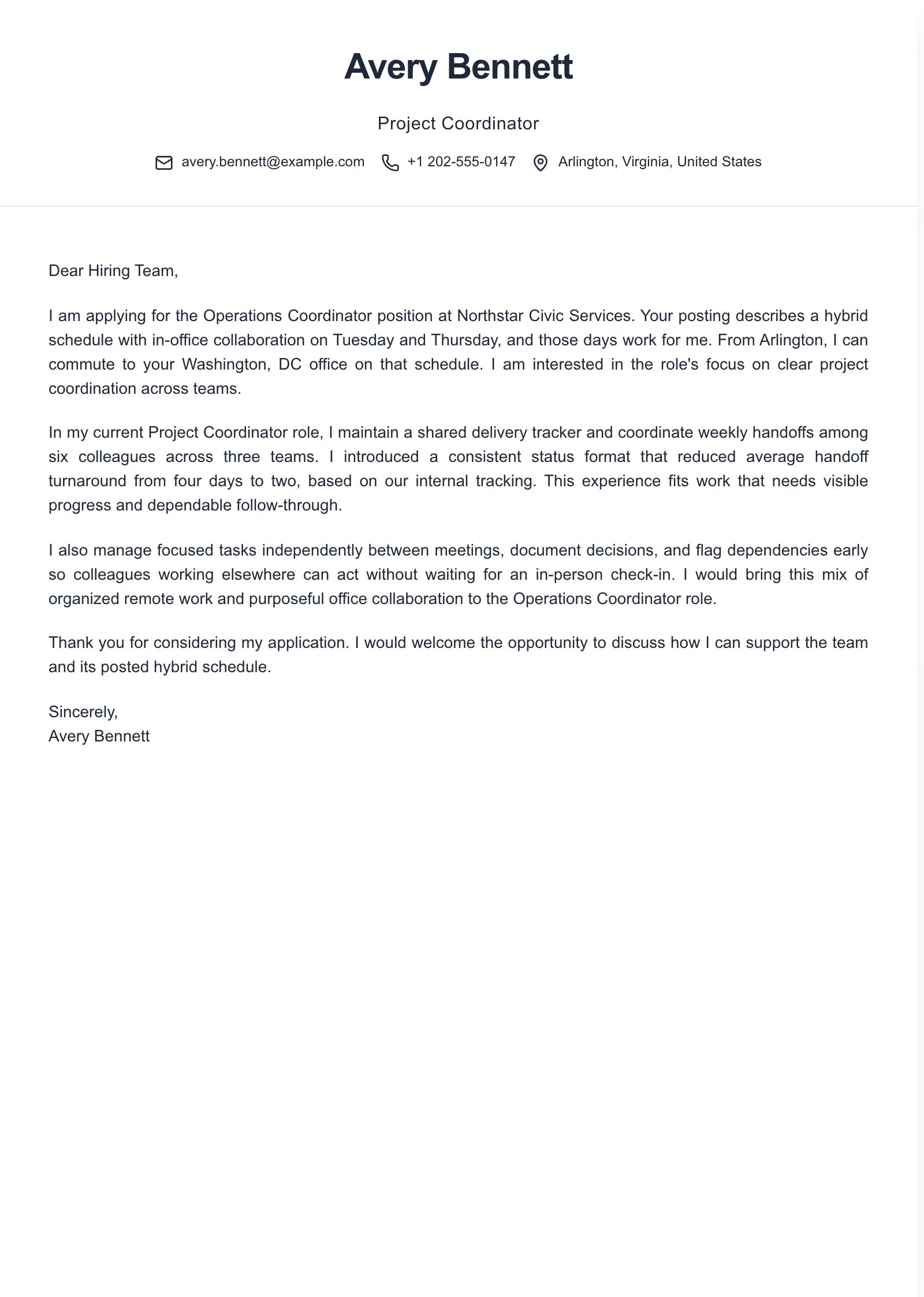
Preview a fictional example that confirms a stated office schedule and connects coordination habits to the role. Adapt the details to your own experience and the schedule in the posting.
Example paragraphs
“I am applying for [Job Title] at [Company Name]. The posting describes [office days or attendance pattern], which I can support from [location or realistic commute arrangement]. I am interested in the role's focus on [specific responsibility from the posting].”
“In [relevant role or project], I used [specific practice or tool] to keep [team or stakeholders] informed about [work or handoff]. This helped [factual result or observable outcome], an approach I could bring to the hybrid work described for [Job Title] at [Company Name].”
“I have managed [relevant task] independently while keeping [colleagues or stakeholders] updated through [specific communication or documentation practice]. At [Company Name], I would apply that experience to [responsibility in the posting] as [Job Title], alongside the in-person collaboration the role requires.”
These are separate paragraph options, not sections to combine into a complete letter. Replace every bracket with a true detail from the posting or your experience. If you cannot confirm the office pattern, do not state one as fact. Use one relevant example of coordination across locations instead of stacking claims about tools or flexibility.
Common mistakes in a hybrid role cover letter
Promising any schedule
- What goes wrong
- Calling yourself fully flexible may obscure a real limit or suggest a commitment the employer did not ask for.
- Better approach
- Confirm the specific attendance pattern you can meet. If the posting leaves the pattern open, describe only the availability you know and avoid making a blanket promise.
Making the commute the whole case
- What goes wrong
- A convenient commute may answer one practical question, but it does not explain why your experience fits the job.
- Better approach
- Keep commute information to a sentence when it is useful. Give more space to a relevant responsibility, a concrete example, and how you work with others across locations.
Treating hybrid as remote
- What goes wrong
- Focusing only on independent work or home-office tools can make the in-person part of the posting seem overlooked.
- Better approach
- Address the stated office commitment as well as remote work. Connect your example to purposeful collaboration, a clear handoff, or another responsibility that reflects the posting.
Claiming collaboration without an example
- What goes wrong
- Statements such as being a strong communicator do not show how you keep work coordinated when colleagues are in different places.
- Better approach
- Name a specific practice and its factual outcome, such as documenting decisions or updating shared progress. Do not invent a result or imply that a particular tool is required unless the posting says so.
Frequently asked questions
- Should I name the days I can work in the office?
- If the posting specifies days and you can reliably attend, naming them makes your availability clear. If the schedule is unclear, do not guess or imply a commitment. State only what you can confirm and seek clarification through an available contact or application channel if the pattern affects your decision.
- What if I do not know how many office days the job requires?
- Use the details the employer has provided and avoid promising availability for an unstated schedule. If you can meet the arrangement as described, say so without inventing a number of days. If the missing detail affects whether you can take the role, ask for clarification before making a specific commitment.
- Is a hybrid role cover letter the same as a remote role cover letter?
- The two situations can overlap, but a hybrid posting indicates some in-person work while the exact schedule may vary. Address the attendance information the employer gives and show how you can contribute across locations. For a role where regular office attendance is not part of the stated arrangement, see the remote role cover letter guide.
- Should I explain my commute in the letter?
- Include a brief, factual note only if it helps confirm that you can attend the stated office days. You do not need to provide a detailed route or personal information. Do not claim a move, vehicle, or travel plan that is not settled.

Put this career change approach into practice
Choose sample data or build your own cover letter, then personalize it before you download.