
Introduction
A graduate scheme cover letter should connect your reasons for applying to this particular programme and show how real experience relates to skills the employer names. Use details from the current advert or the employer's official programme information, not assumptions about what graduate schemes usually include.
The phrase “graduate scheme” describes the vacancy, not a separate kind of letter. This guide focuses on the specific task of explaining fit for a structured early-career programme, including its confirmed features and current application timeline. A recent graduate may also apply for a standard entry-level vacancy; the recent-graduate guide addresses that broader situation.
What to address directly
A scheme name is not a reason by itself
- Hiring manager concern
- Calling a programme exciting or prestigious could apply to almost any employer. It does not show why this scheme's stated work or structure interests you.
- What your letter should prove
- Find one or two details in the current advert or official programme information. Explain what interests you about them and connect that interest to a goal, subject, project, or experience you can honestly describe. If a detail is unclear or unconfirmed, leave it out.
Competency claims need evidence
- Hiring manager concern
- A list such as adaptable, motivated, and a strong communicator does not show what you have actually done. Paid work is not the only possible source of relevant evidence, but any example needs to be specific.
- What your letter should prove
- Choose a short example from employment, study, volunteering, or another relevant activity. State the context briefly, what you did, and a factual result or lesson if you have one. Make your own contribution clear, even when the work was shared.
Programme structures and deadlines vary
- Hiring manager concern
- Assuming every scheme has rotations or the same annual timetable can make a letter inaccurate and an application late.
- What your letter should prove
- Check the current programme details and application instructions for this intake. Mention only confirmed features, and note the stated closing date and any document or submission requirements. If the information is unclear, use the employer's official contact route rather than guessing.
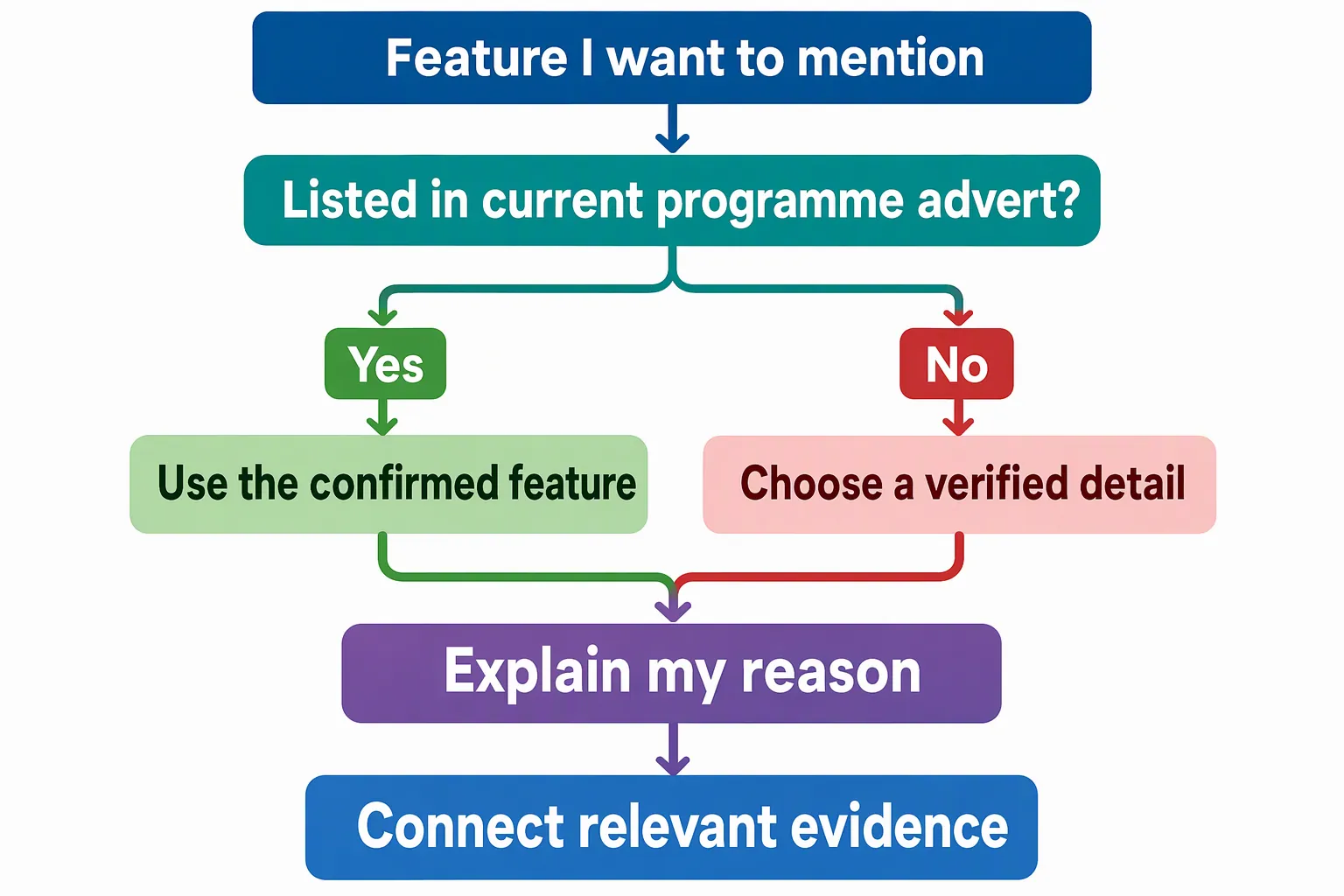
Structural approach: connect programme design to your evidence
Build the letter around why this programme interests you, what relevant evidence you can offer, and what you hope to learn. The cover-letter structure guide explains the general parts of a letter; the programme checks and evidence choices for this scenario are covered here. For a UK application, the National Careers Service's covering-letter guidance offers a useful UK-specific baseline on tailoring and relevant evidence. It does not establish a rule for all European employers or application channels. Follow the current employer instructions first.
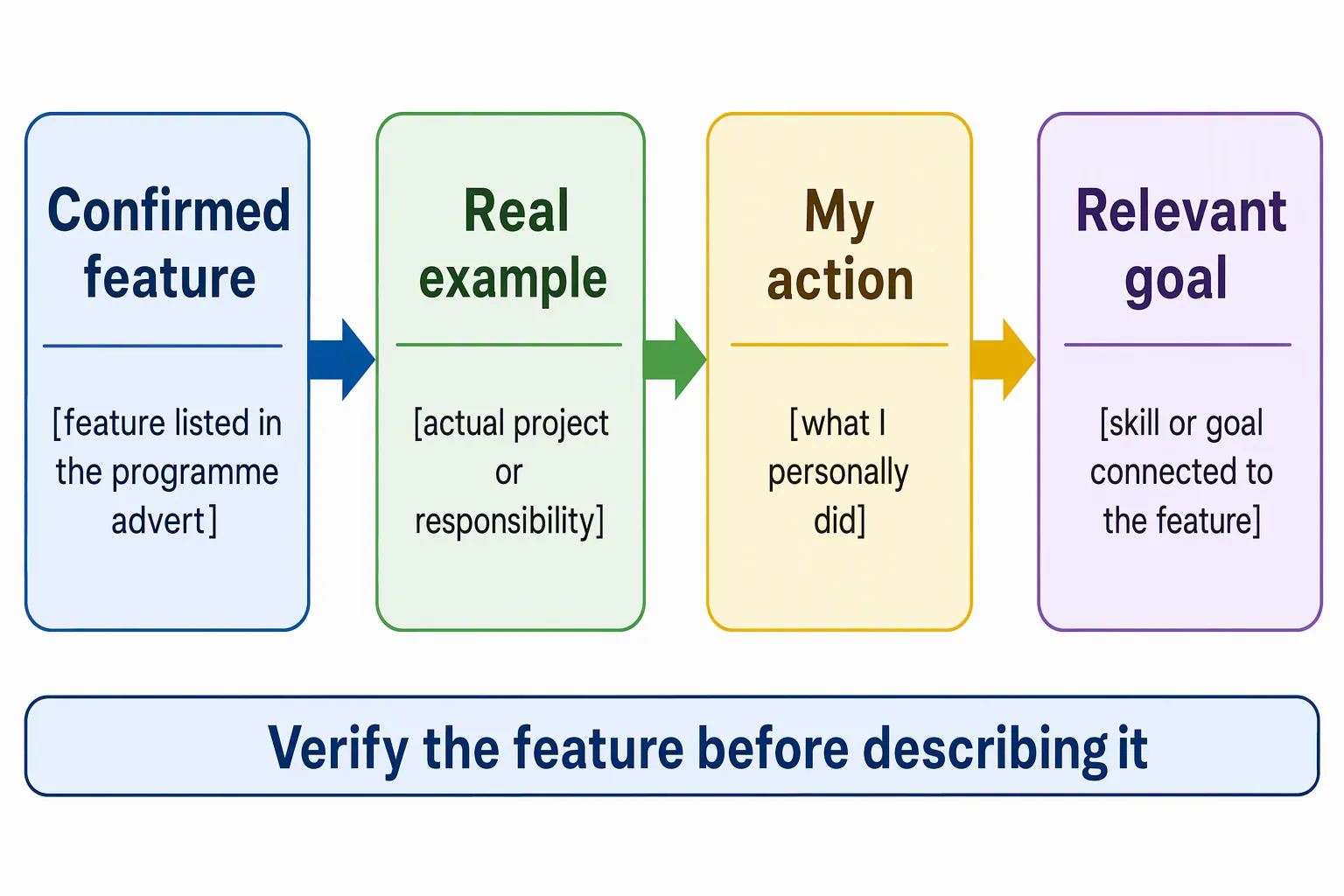
A scheme-specific reason joins a confirmed programme feature to a personal reason. For example, you could explain how a listed learning activity connects to an interest developed through a course project. Then give one action or result from that project. Keep the connection proportionate: an introductory experience is not the same as professional expertise, and interest in a rotation is not evidence that the rotation exists.
Before drafting, record the programme name, current closing date, requested documents, and any stated selection steps. Schemes can differ in structure and application process, so do not copy dates or requirements from a previous intake or another employer. If the employer requests a separate response to selection criteria, provide it as instructed rather than assuming the cover letter replaces it.
- 01
Check the current programme
Read the current advert and official programme information. Note the role, stated competencies, confirmed learning activities or rotations, application deadline, requested documents, and submission instructions. Do not rely on information from another employer or intake.
- 02
Choose a focused reason
Select one or two confirmed details that genuinely matter to you. Explain how they connect to an interest or direction you can describe. If rotations are not mentioned, do not invent them; use another stated feature or the work itself.
- 03
Match a competency to evidence
Choose a real example relevant to a skill named in the advert. Evidence can come from study, work, volunteering, or another activity. State your own action and include a result or lesson only when it is factual and relevant.
- 04
Link your contribution to learning
Show how your example gives you a starting point for the programme, not proof that you have mastered every area. Close with a direct expression of interest, then check the programme name, details, deadline, spelling, and requested documents against the current application.
Graduate Scheme Cover Letter Example
See a fictional example linking confirmed programme features to relevant evidence from an early-career applicant.
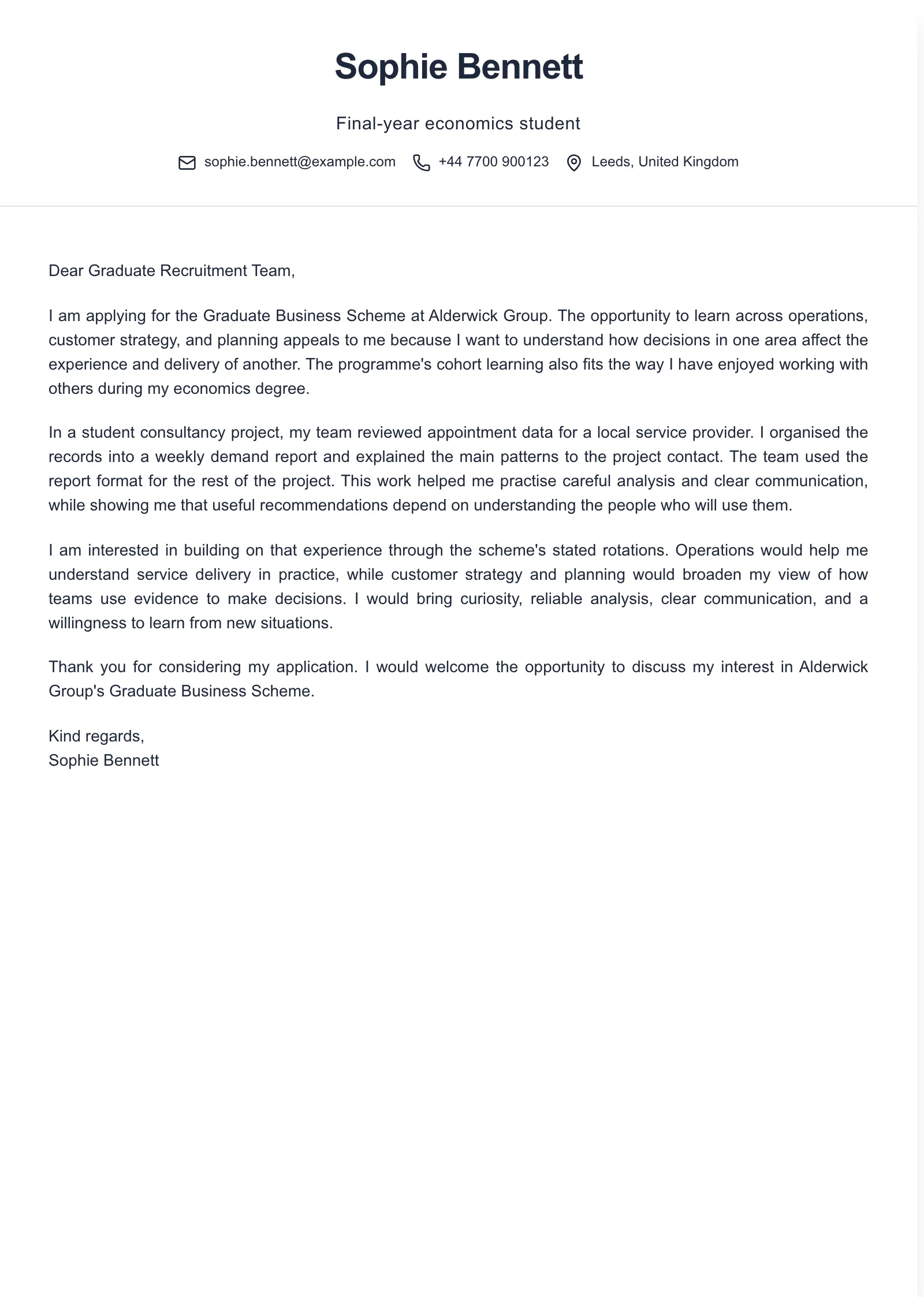
Example paragraphs
“I am applying for [Job Title] at [Company Name] because [confirmed programme feature] connects with my interest in [specific area or learning goal]. During [course, activity, or experience], I became interested in [related topic], and I would value the opportunity to explore it through the programme's stated structure.”
“In [project, role, or activity], I was responsible for [specific action] when [relevant challenge]. I worked with [people or information involved] and [factual result or lesson]. This gives me an example of [competency named in the advert] that I could bring to [Company Name].”
“I am interested in [confirmed rotation, learning activity, or project] because I hope to develop [specific skill or understanding]. My experience with [factual example] has given me a starting point, and I would be keen to build on it while contributing to [Company Name]'s [verified team, service, or programme priority].”
Use these as separate paragraph patterns, not as a complete letter. Replace each bracket with a checked programme detail or a fact from your experience. Remove any sentence that does not fit the current advert.
Scenario-specific mistakes in a graduate scheme cover letter
Using the same motivation for every employer
- What goes wrong
- A broad statement about wanting a challenging career does not explain why this particular programme is a considered choice.
- Better approach
- Name a confirmed feature of this scheme and explain how it connects to an interest or goal you can support.
Treating all schemes as rotational
- What goes wrong
- Some programmes describe rotations and others do not. Assuming a feature that is not advertised can make your explanation of fit inaccurate.
- Better approach
- Check the current programme information. If rotations are not confirmed, focus on another stated element or on the role's responsibilities.
Turning activities into inflated achievements
- What goes wrong
- A team project or course task does not justify claiming another person's responsibility or an outcome you cannot verify.
- Better approach
- State your part plainly. Give a result only if you can support it; otherwise, describe your relevant action or learning without adding numbers.
Repeating the competency list
- What goes wrong
- Restating skills from the advert without an example gives the reader no evidence of how you use them.
- Better approach
- Choose one or two relevant skills and support them with concise evidence. Use the remaining space to explain your fit with the confirmed programme details.
Frequently asked questions
- How is a graduate scheme cover letter different from a recent-graduate cover letter?
- It is the same kind of document. This page focuses on the specific task of explaining your fit for a structured graduate programme, using only features the employer confirms. A recent graduate applying for another kind of vacancy can use the broader recent-graduate guidance.
- What if the scheme does not list rotations?
- Do not assume that it has them. Use another feature the employer confirms, such as stated learning activities or project work, or focus on the role and the employer's stated priorities.
- Do I need work experience to apply?
- Check the programme's current eligibility rules and selection criteria; they vary. If your experience is limited, a relevant project, course activity, volunteering, or other real example may help you show a skill the advert asks for. Describe your contribution accurately.
- When should I submit my application?
- Use the closing date and submission instructions in the current official advert or application system. Do not assume programmes share a deadline or annual timetable. If a closing time or time zone is stated, follow it.

Put this career change approach into practice
Choose sample data or build your own cover letter, then personalize it before you download.