
Introduction
A cover letter for a job in Germany may be called an Anschreiben, while a CV may be called a Lebenslauf. The labels do not establish exactly what a particular employer expects. German official guidance says employers often appreciate individual applications, but it does not set one format for every employer or vacancy. Read the posting and application instructions before adapting a sample. See the official application guidance from Make it in Germany.
Employers may use terms such as cover letter, motivation letter, and letter of interest in overlapping ways. The requested document in the posting matters more than assuming a fixed distinction; this page focuses on an Anschreiben for a job vacancy. See how these document labels can overlap. The aim is to explain your fit, not repeat your CV, and to address salary or availability only when asked and when you can give accurate details.
What to address directly
A formal layout can still sound generic
- Hiring manager concern
- A polished document does not show why you chose this vacancy by itself. Reusing the same letter without connecting your experience to the posting can leave the employer unsure how your application fits the role.
- What your letter should prove
- Identify the vacancy in the subject line and name a relevant responsibility or requirement from the posting. Support your point with a true example from your background. Do not add a claim just to make the letter sound more impressive.
Salary and start date are not automatic fields
- Hiring manager concern
- Applicants may assume every application in Germany needs a salary expectation or a start date. Guessing either detail can create confusion, particularly if the posting does not ask for it or specifies a particular format.
- What your letter should prove
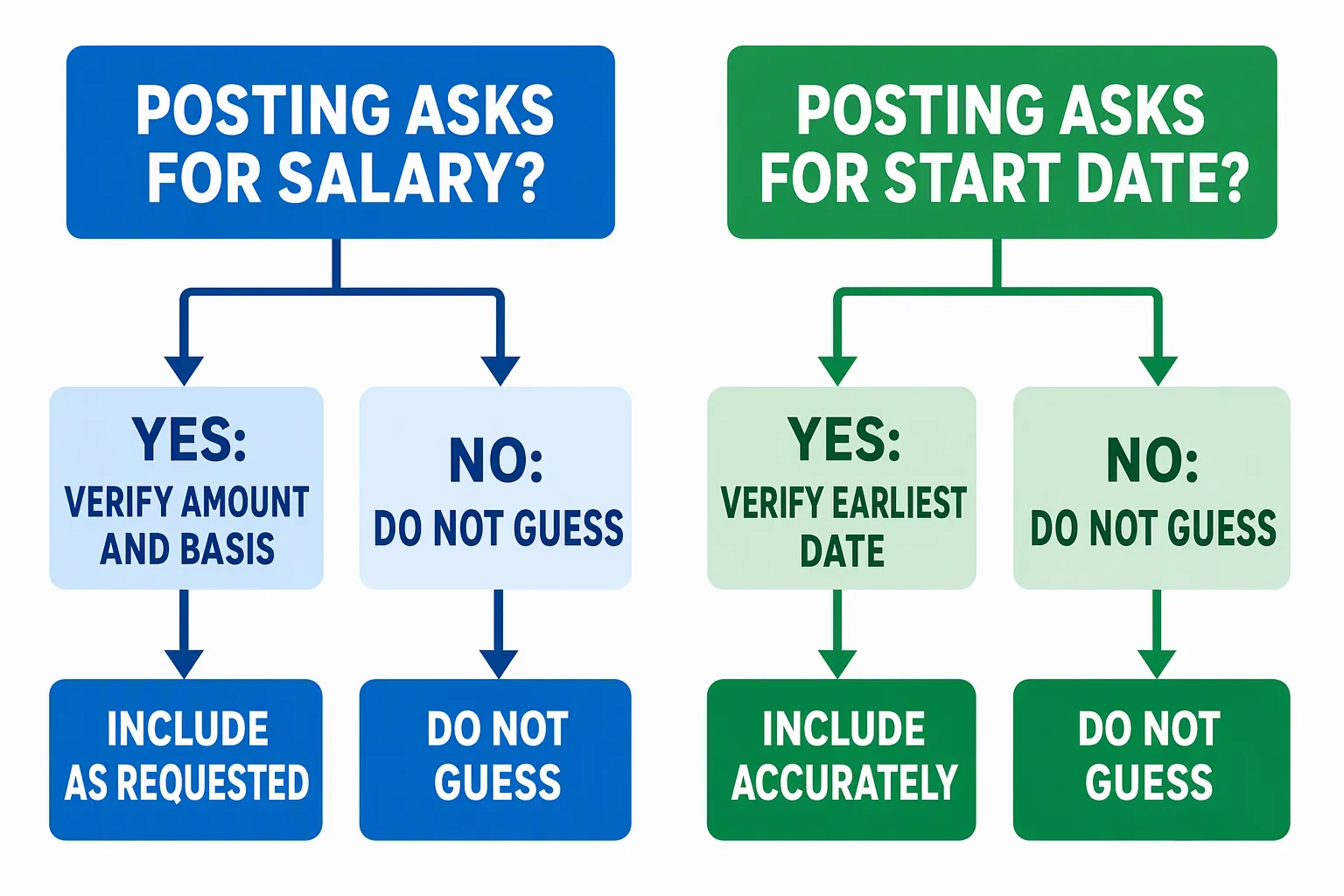
- Check the posting and application questions first. If either detail is requested, give a figure or date you can stand behind and use the requested basis. If it is not requested, there is no need to invent a standard amount or date.
A sample does not set photo or attachment rules
- Hiring manager concern
- Some application examples include a photo or several supporting documents. Seeing those items in a sample does not establish that your employer requires them or that they belong in every application.
- What your letter should prove
- Follow the vacancy's document instructions. Do not add a photo or unrelated personal information just to imitate an example. Include supporting documents when requested or when they substantiate a relevant point and fit the application instructions.
Structural approach: make each application detail earn its place
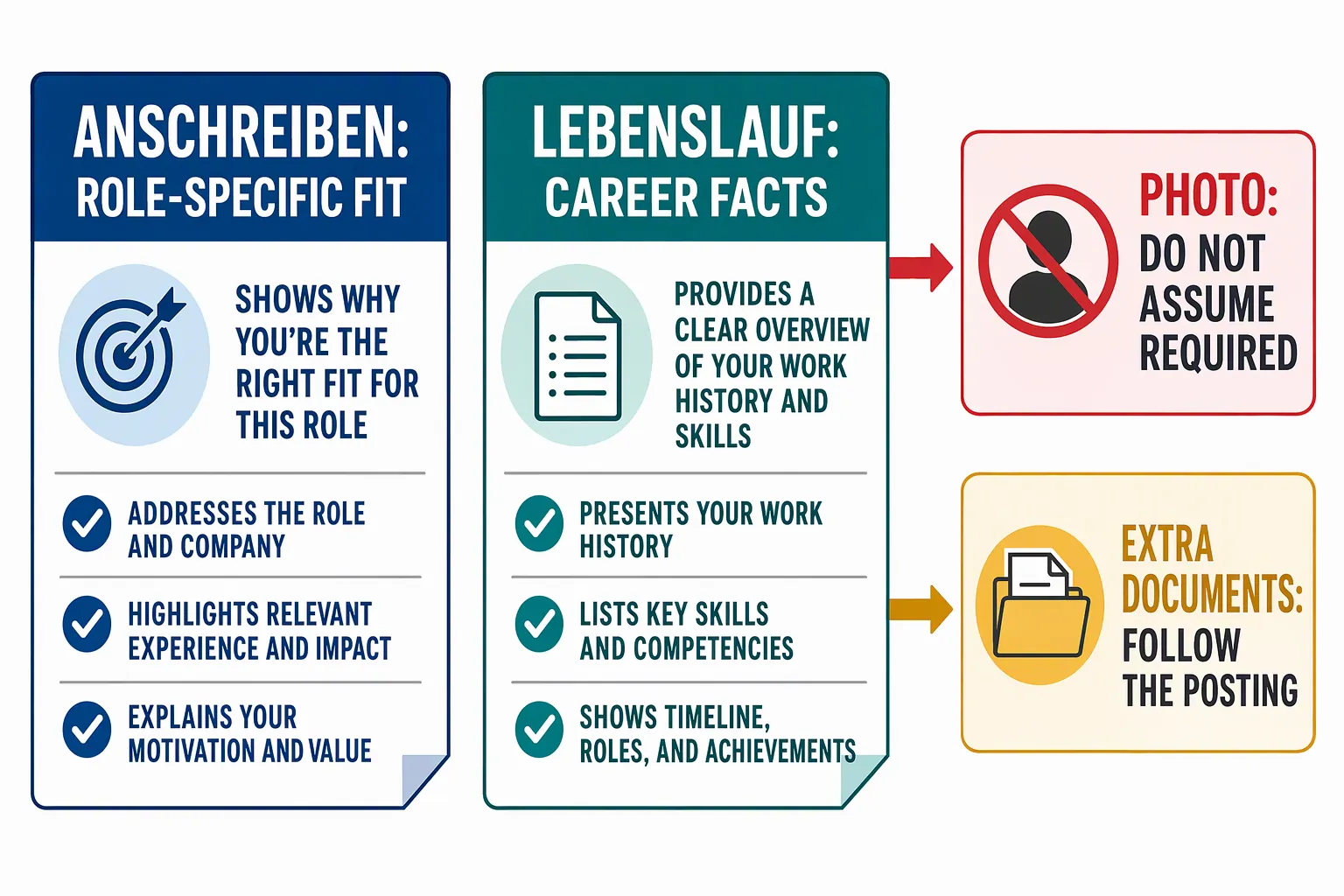
Treat the Anschreiben as a companion to the CV, not a second version of it. A useful sequence is to identify the vacancy, explain your fit with relevant evidence, address practical details the employer requested, and close professionally. For more on the purpose of each paragraph, see this cover letter structure guide.
Keep the letter easy to scan. Use a subject line that identifies the role, and choose a greeting that fits the contact information and instructions provided. If no recipient name is given, this guide to addressing a cover letter without a name offers general options. Put your strongest role-specific reason near the beginning, then explain relevant experience rather than listing every CV entry.
- 01
Read the posting for instructions
Note the exact job title, any reference number, the requested language, documents, and questions about salary or availability. Check whether the employer specifies a greeting or asks you to respond to particular points. Those instructions take priority over a general example.
- 02
Match evidence to the vacancy
Choose a few requirements you can support with real examples. Explain what you did and how it relates to the role; add a result or scope only when you can verify it. Keep job titles, dates, and other career facts consistent with your CV.
- 03
Verify any practical details requested
If asked for a salary expectation, check the basis the employer wants, such as a period or other stated format, and give an amount you can support. If asked for a start date, state the earliest date you can genuinely meet. Do not infer a standard German-wide amount or date.
- 04
Review the complete application
Check the letter and CV for consistent names, dates, titles, and contact details. Review spelling, translated terms, and attachments. Do not treat a photo or any particular extra document as required just because a template includes it; follow the employer's instructions.
English-language German application example
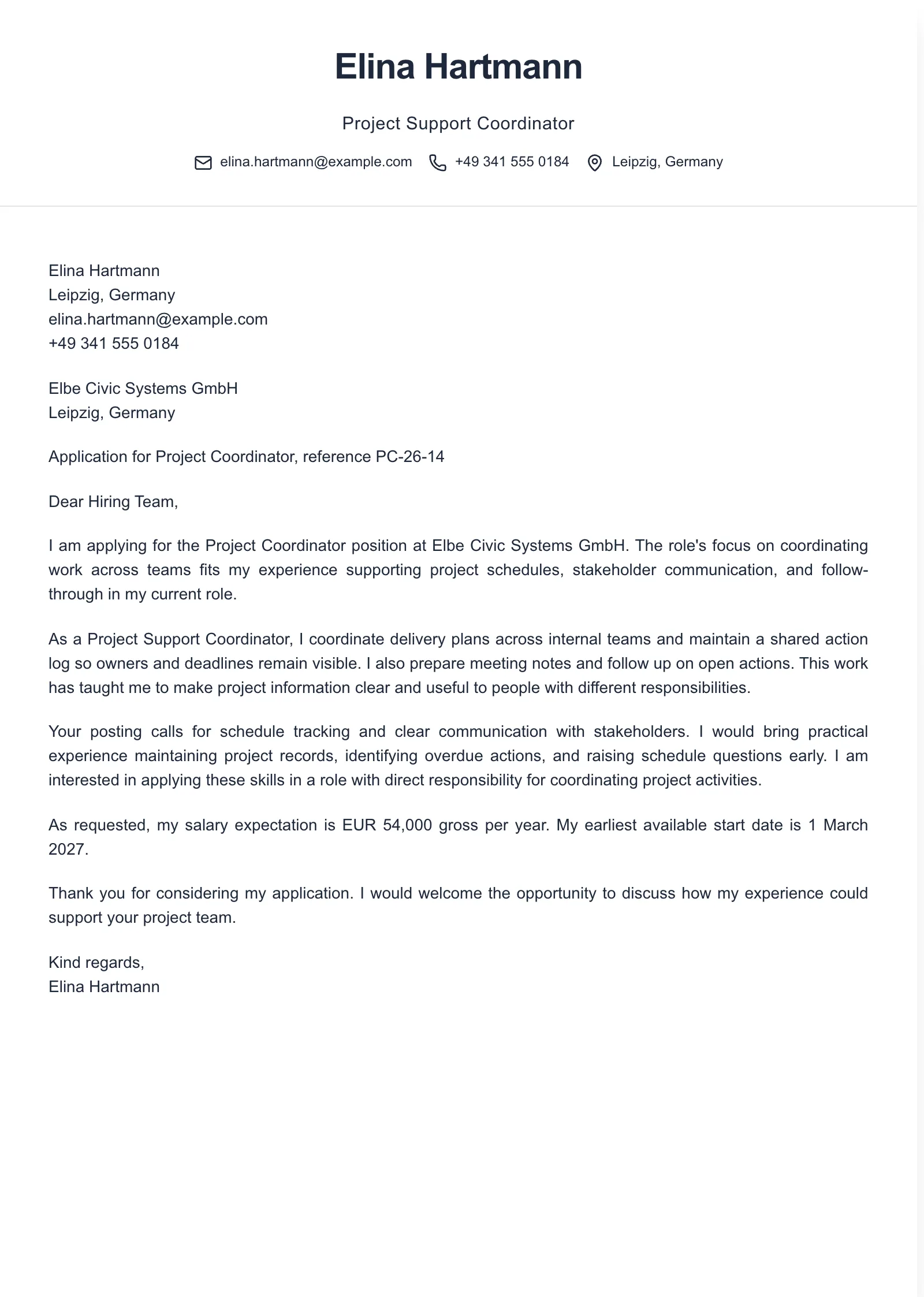
This fictional example responds to a posting that requests salary expectations and earliest availability. Its details are not a national formula.
Example paragraphs
“I am applying for the [Job Title] position at [Company Name] because its focus on [specific responsibility from the posting] matches my experience with [relevant type of work]. In my current or recent role, I [verified action related to that responsibility].”
“Your posting highlights [specific requirement]. In [relevant situation], I [factual action] and [verified result, if available]. That experience is relevant to the [Job Title] role because [brief explanation of the connection].”
“As requested, my salary expectation is [researched amount and requested basis]. My earliest available start date is [accurate date], taking into account [relevant notice or scheduling condition, if applicable].”
These are adaptable paragraphs, not a complete letter. Replace every bracketed item with accurate information and keep the language consistent with the posting. Use the practical-details paragraph only when requested; do not guess an amount or date to imitate a sample.
Scenario-specific mistakes to avoid
Treating one sample as a national rule
- What goes wrong
- A sample may show a particular header, greeting, photo, or salary detail that does not fit your vacancy.
- Better approach
- Use the employer's instructions and your actual application details. Treat examples as options, not rules that apply to every employer in Germany.
Guessing a salary or start date
- What goes wrong
- An unsupported figure or promise can conflict with your expectations, notice period, or actual availability.
- Better approach
- Include the detail when requested, verify it, and follow the requested format. If it is not requested, do not add a guessed amount or date.
Repeating the CV instead of explaining fit
- What goes wrong
- Listing past roles and duties without showing their relevance uses space but does not explain why they matter for this vacancy.
- Better approach
- Choose evidence tied to the posting and explain the connection. Keep job titles and dates consistent with the CV.
Adding a photo or documents by imitation
- What goes wrong
- Copying the extra items in a template can introduce information the employer did not request or distract from relevant qualifications.
- Better approach
- Check the vacancy's instructions for documents. Do not assume a photo is required, and include supporting material only when it is requested or relevant to the application.
Frequently asked questions
- Is a photo required on a German CV?
- Do not assume a photo is required. Follow the vacancy's document instructions, and do not include one simply because it appears in a sample. Avoid adding unrelated personal information.
- Should I include salary expectations in a German cover letter?
- Include a salary expectation when the posting or application asks for it. Give a considered, accurate figure in the requested format. If it is not requested, do not add one just because the application is in Germany.
- Should I write a German cover letter in German?
- Use the language specified in the posting or application instructions. If German documents are requested, submit a carefully reviewed German version. Do not rely on a literal translation if you are unsure it is accurate.
- Do German employers expect a specific cover letter format?
- There is no single format for every employer or role. A clear, tailored letter is a practical starting point, but follow the posting's instructions for the greeting, subject, content, and supporting documents.

Put this career change approach into practice
Choose sample data or build your own cover letter, then personalize it before you download.