
Introduction
A general cover letter is a reusable starting draft, not a letter to send unchanged to every employer. It can save time when applying through a job board or following up after a career fair. Keep the parts that describe relevant experience, then change the details that show which opening or employer you mean.
This guide focuses on adapting a draft to a posted job or a real career-fair conversation. A five-minute editing pass is a practical target, not a guaranteed time or platform rule. If you are contacting an employer without a listed opening or a fair conversation, make that purpose clear instead of implying that you are responding to a specific job.
What to address directly
A saved draft can sound copied
- Hiring manager concern
- A reusable letter can become so broad that it could be sent to any employer. A line such as “I am interested in your company” does not identify the opening or explain what drew you to it.
- What your letter should prove
- Keep a base draft for your background, but change its opening for each application. Name the actual job title and company, then add one accurate detail from the posting or your conversation. If you cannot find a relevant detail, reread the opportunity before sending the letter.
Broad claims do not show relevant evidence
- Hiring manager concern
- A list of strengths such as being organized, hardworking, and collaborative can describe many people. Without a connection to the opportunity, it does not show how your experience applies.
- What your letter should prove
- Choose one need mentioned in the posting or conversation and pair it with an example from your own experience. State what you did and, if you can support it, what changed as a result. A short, relevant proof point is more useful than a long inventory of skills.
The application route may not call for a letter
- Hiring manager concern
- Job boards, employer portals, and career fairs may have different instructions. An extra letter should not replace a required answer or requested document.
- What your letter should prove
- Check the specific instructions before attaching anything. Indeed says applicants may be able to add a cover letter or other documents, so availability depends on the application route. See Indeed's cover letter submission guidance. At a fair, follow the employer's directions for applying or following up.
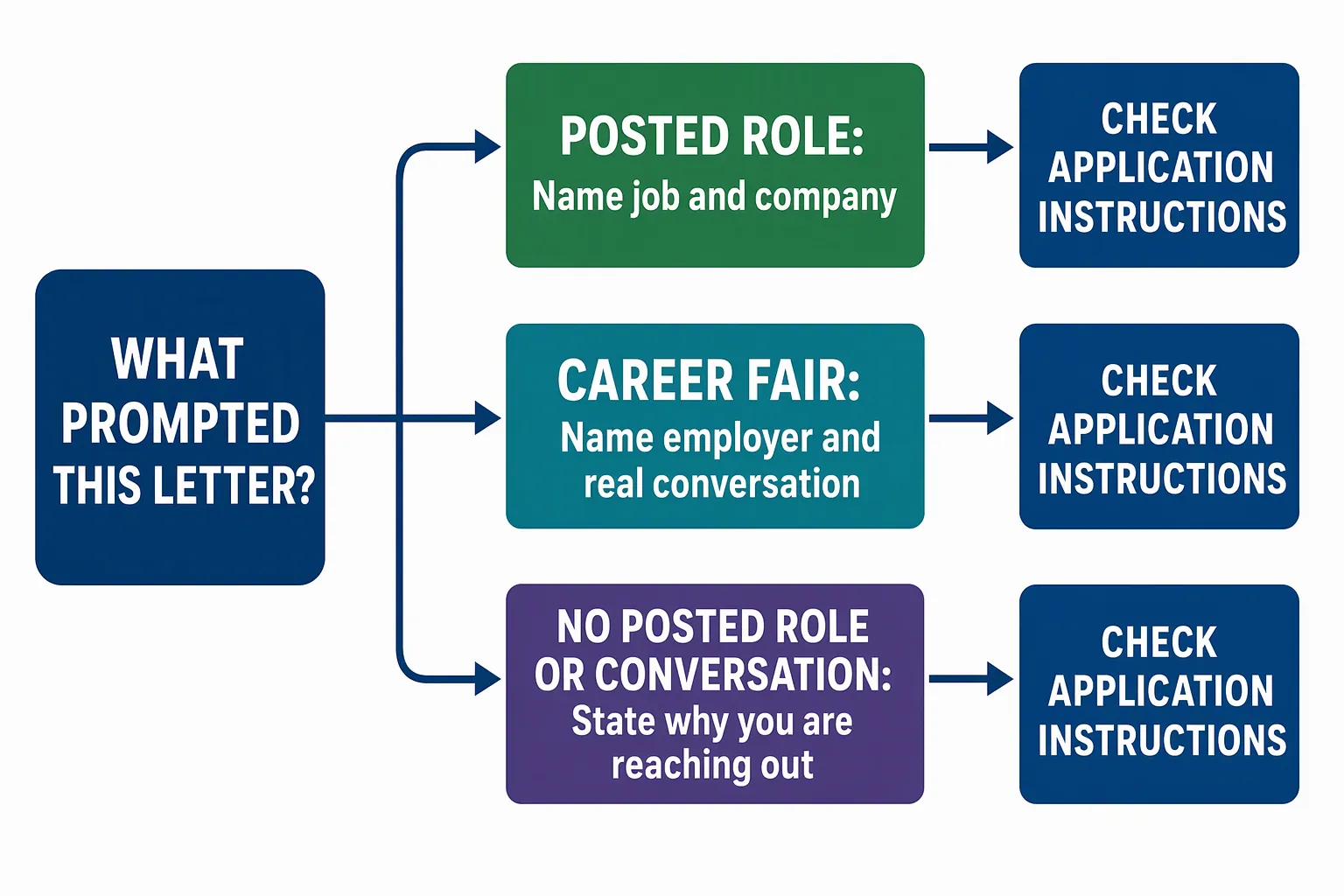
Structural approach: Keep a base draft, then make it specific
Build a short base draft around three points: the role you want, evidence that relates to it, and a clear reason for contacting this employer. In your working copy, make details that need changing easy to spot. Remove every bracketed note before sending. For a paragraph-by-paragraph explanation, see cover letter structure.
Use the opening to identify the opportunity and give a real reason for your interest. In the middle, connect one or two relevant needs to evidence from your experience. In the final paragraph, express interest in discussing the role and follow any requested next step. For help making the first lines specific, see cover letter opening examples. The labels speculative application and letter of interest can overlap; this explanation of related letter terms discusses that terminology. The examples below are paragraph models, not a complete letter.
- 01
Minute 1: Identify the route
For a job-board application, note the exact job title and company from the posting. For a career fair, note the employer and role discussed, if there was one. Check whether a letter is requested and whether the employer gave different instructions.
- 02
Minutes 2 and 3: Choose a relevant need
Find one or two needs in the posting or conversation that you can honestly address. Do not copy a long list of terms. If no specific role was discussed at the fair, describe your interest accurately instead of claiming a match to an opening you have not confirmed.
- 03
Minute 4: Add one proof point
Choose a relevant task, project, or result from your experience. Say what you did and include an outcome only if you can verify it. A smaller, truthful example is more useful than a broad claim you cannot support.
- 04
Minute 5: Review the changes
Update the opening and the details connecting your evidence to this opportunity. Check the company and job title, remove every placeholder, and make sure the letter does not replace an application question or required document. Read it once as if you had not seen your base draft before.
A tailored general cover letter example
Preview a fictional example of a reusable draft adapted to one posted opening, with relevant evidence and a clear reason for applying.
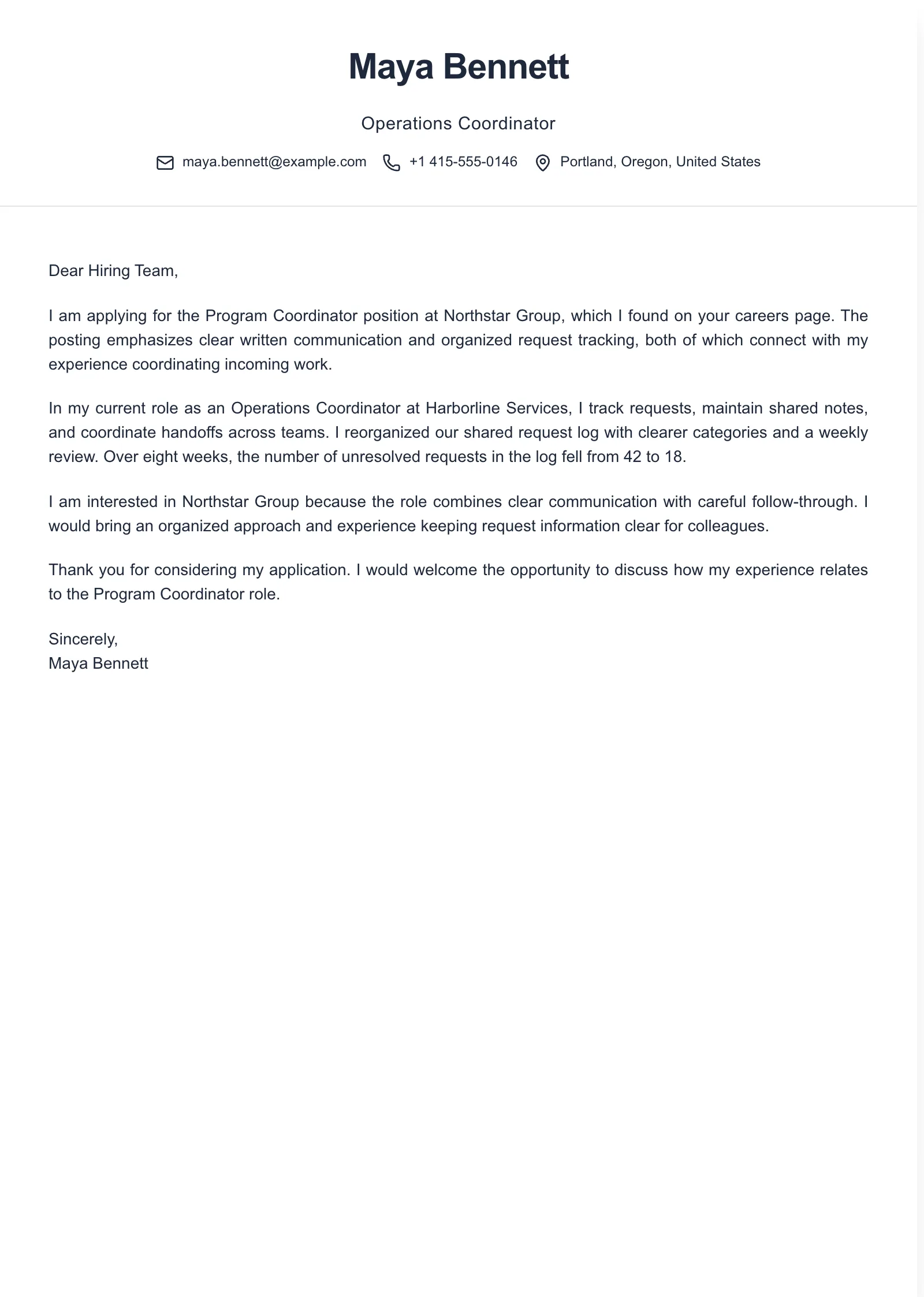
Example paragraphs
“I am applying for [Job Title] at [Company Name] because [specific detail from the posting] connects with my experience in [relevant area]. In [role, project, or other factual context], I [specific action or result that supports this connection].”
“Your posting highlights [specific need]. In [relevant role or project], I [action you took], which led to [verifiable outcome or factual result]. I would bring this experience to the [Job Title] role at [Company Name].”
“After speaking with [Recruiter Name or Team Member] at [Career Fair Name], I am applying for [Job Title] at [Company Name]. Our conversation about [specific topic discussed] strengthened my interest, and my experience with [relevant factual example] relates to that need.”
Use only details you can verify. Replace every bracketed phrase and remove any sentence that does not fit the actual posting or conversation. If you did not speak with a named person at a fair, do not imply that you did. If an application form asks a question your draft also addresses, answer the form as requested rather than assuming the letter covers it.
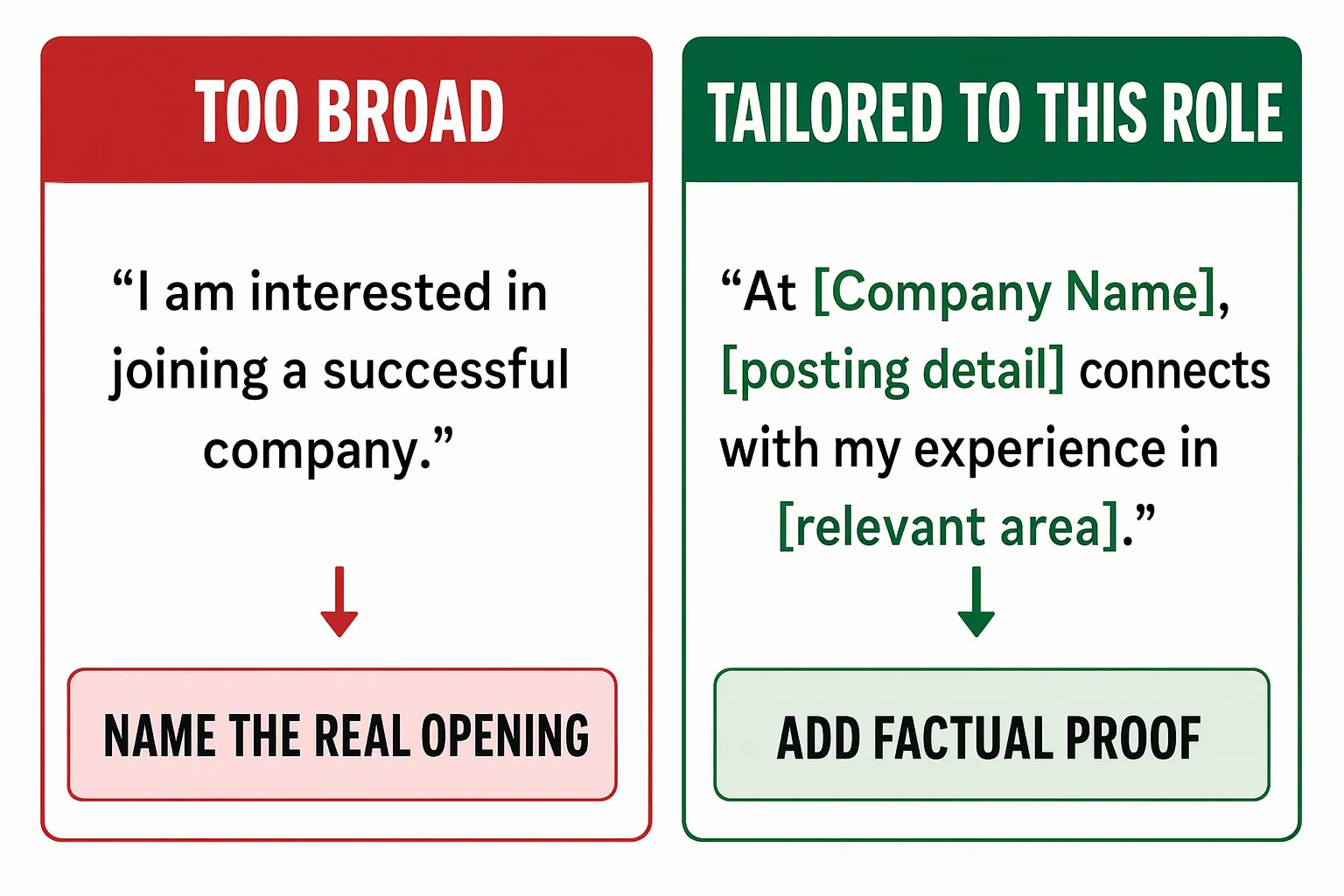
Scenario-specific mistakes with a general cover letter
Sending the base draft unchanged
- What goes wrong
- The letter names no specific role, employer, or reason for applying, so the same text could be used for unrelated opportunities.
- Better approach
- Update the opening for the posting or career-fair conversation. Add an accurate detail that shows which opportunity you mean.
Listing every strength
- What goes wrong
- A crowded list makes it difficult to see which experience relates to this opportunity.
- Better approach
- Choose one or two relevant needs and connect them to a factual example. Leave unrelated strengths for other parts of your application.
Implying a job or conversation that does not exist
- What goes wrong
- Referring to an unconfirmed opening or a career-fair conversation that did not happen makes the purpose of the letter unclear.
- Better approach
- State the actual reason for reaching out. If there is no listed opening or fair conversation, describe that purpose honestly and adapt the letter accordingly.
Attaching a letter without checking instructions
- What goes wrong
- An extra document may distract from required answers or fail to follow the employer's stated application process.
- Better approach
- Check the posting and application route first. Provide each requested document or answer where instructed, and include a letter only when it fits the process.
Frequently asked questions
- Can I use the same general cover letter for several applications?
- Reuse the structure, not the unchanged letter. For each application, update the job title, company name, reason for applying, and evidence that fits the posting. If those details do not change, the draft may not explain why you are applying for that particular opening.
- Should I upload a cover letter to every job board application?
- Follow the instructions for the specific posting and application route. Some routes allow a cover letter or other documents, while others may not. Do not assume every application has a cover-letter field or that an extra document replaces required questions.
- What should I change for a career fair?
- Name the employer and role you discussed, if you discussed one. Use an accurate detail from the conversation to explain your interest. If the employer directs you to apply online, follow that instruction rather than treating a letter as a substitute for the requested application.
- Is a general cover letter the same as a speculative application or a letter of interest?
- General describes a reusable starting draft; it does not define why you are contacting an employer. Speculative application and letter of interest can overlap in use, and neither label reliably means a separate letter format. Make clear whether you are responding to a posted opening, following up after a conversation, or contacting an employer without a listed opening.

Put this career change approach into practice
Choose sample data or build your own cover letter, then personalize it before you download.