
Introduction
Moving from self-employment into a job changes how you describe responsibility. As an owner, you may have set priorities or made final decisions. In an employee role, you may contribute within someone else's goals, processes, and decision-making structure. Your cover letter should make the transition understandable without apologizing for having owned a business.
This topic overlaps with general career-change advice, but the useful task here is specific: translate owner duties into the advertised role's requirements, explain the business's status if the transition needs context, and address whether the employee role fits your plans. For a broader method of translating experience, see this guide to mapping transferable skills; this page applies that method to business ownership.
What to address directly
What did you do that fits this role?
- Hiring manager concern
- A business title can hide the actual work. The reader may not know whether you handled tasks that relate to the advertised responsibilities, or whether other people shared that work.
- What your letter should prove
- Name one or two relevant duties and connect each to a requirement in the posting. Add a specific, supportable result or work practice. Be clear about what you personally did rather than implying that you handled every part of the business.
Why are you moving into employment now?
- Hiring manager concern
- If the business was sold, closed, or is no longer your main work, an unexplained transition can leave questions about your current plans. A long defense can make the change seem more uncertain than it is.
- What your letter should prove
- Give the accurate business status and a time reference when useful, then move to why this employee role fits your current direction. You do not need to disclose private reasons or describe the transition as a failure.
Will this role suit you, and will you work within its boundaries?
- Hiring manager concern
- Ownership alone does not show how you will respond to shared priorities, supervision, or decision boundaries. A reader may also wonder whether this is a considered move or a short-term stop.
- What your letter should prove
- Explain what about the role's actual work and responsibilities fits your plans. Support your readiness with an example of following an agreed plan, keeping others informed, or handing off a decision appropriately. Avoid guarantees about how long you will stay or promises to accept any direction.
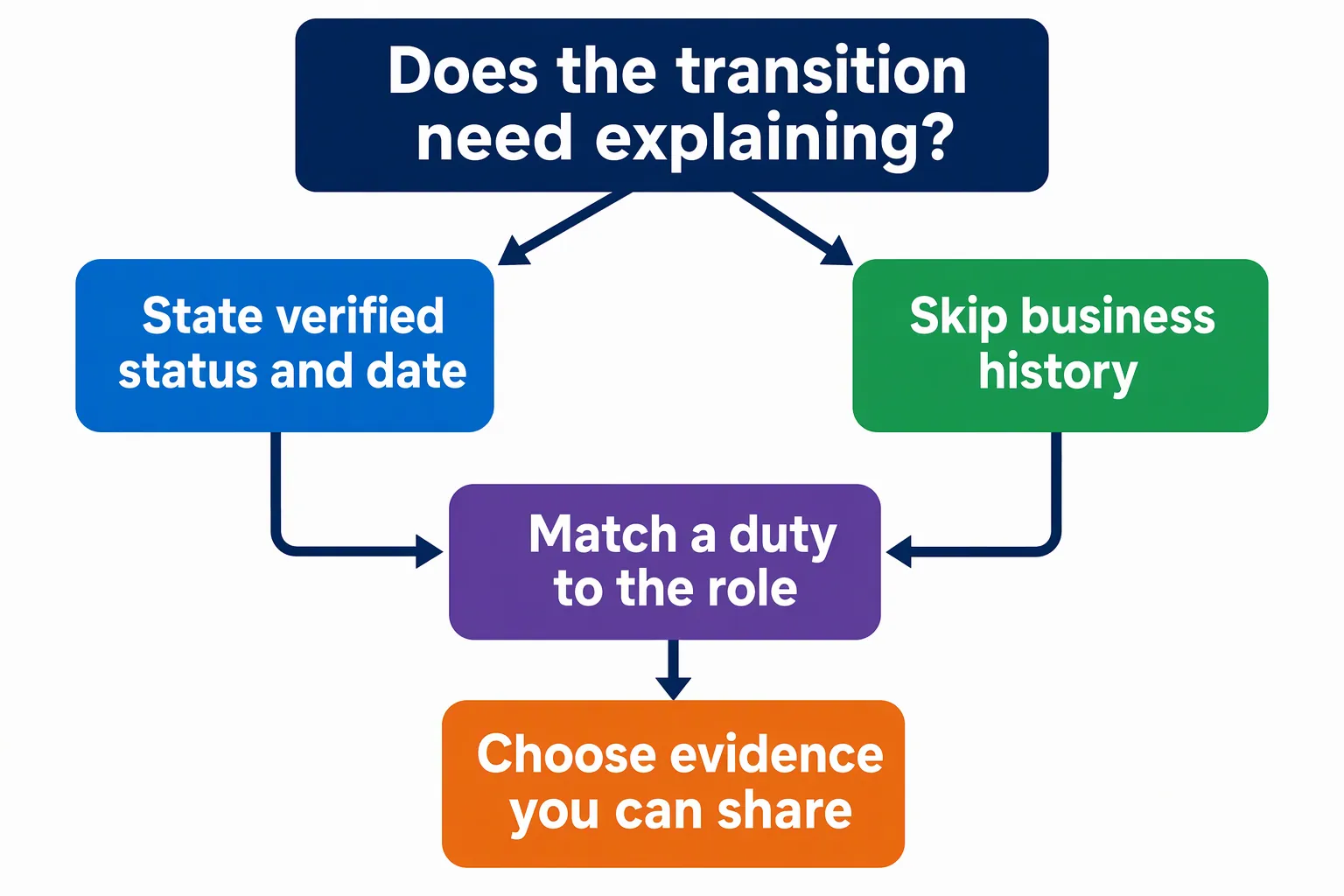
Structural approach: connect ownership to employee work
Keep the letter focused on the job rather than retelling the full history of the business. Choose evidence that helps the reader see how you would contribute within this role. If ownership is part of a broader career change, the transition still deserves an accurate explanation, but the letter should stay centered on the move from running a business to contributing in the advertised position.
A familiar cover letter structure can work, with each part doing a specific job: name the role, translate relevant owner work, explain the business transition only if useful, and show why the employee responsibilities fit. For guidance on how those parts work together, see this cover letter structure guide.
- 01
Select a specific job requirement
Choose a responsibility or skill from the posting that you can support with real experience. Do not lead with the size of your business or list everything you handled.
- 02
Translate one owner duty into evidence
Describe the task, your action, and a relevant result or reliable work practice. Explain the contribution in terms the employer can recognize, while keeping your former title accurate.
- 03
Clarify the transition when it matters
If a sale or closure explains why you are applying for employment, state what happened and when in one direct sentence. If the change is already clear and extra detail adds no useful context, do not force it into the letter.
- 04
Address role fit and team context
Connect your interest to this role's work, then give evidence that you can follow shared priorities, communicate progress, or respect decision boundaries. Explain why the employee responsibilities suit your plans without making promises about your future tenure.
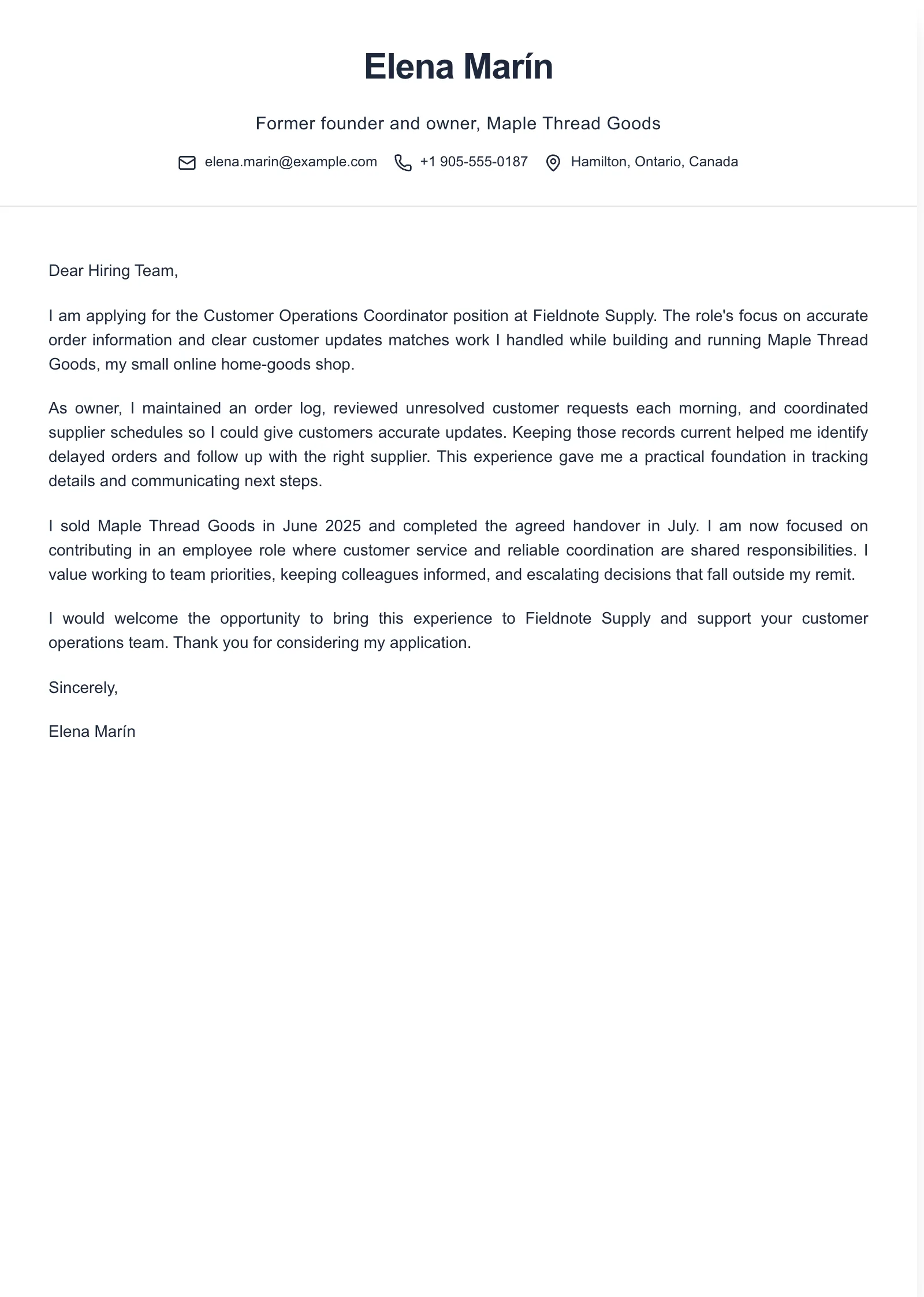
Former owner moving into an employee role
This fictional example connects relevant operating work to employee responsibilities and gives a concise, factual account of a completed business handover.
Example paragraphs
“As the [accurate title] of [Business Name], I [specific responsibility] by [action you took], which led to [factual result]. That experience relates to the [relevant requirement] in the [Job Title] role at [Company Name].”
“I [sold/closed] [Business Name] in [Month Year] and completed [factual handover detail, if relevant]. I am now focused on the [Job Title] position at [Company Name] because [specific reason this work and employee responsibilities fit your plans].”
“While running [Business Name], I [specific example of working to an agreed priority, sharing updates, or escalating a decision]. I would bring that approach to the [Job Title] role at [Company Name], where [specific responsibility from the posting] matters.”
Use these as separate paragraph models, not as a complete letter. Replace each bracket with a true detail, and choose only the examples that answer a real question about your transition. Keep the business status and dates consistent with your application materials. If a result is confidential or hard to verify, describe the work practice instead. Do not claim that ownership automatically prepared you for every part of the target role. A specific, modest example is more useful than a broad claim.
Common mistakes when moving from ownership to employment
Making the letter a business biography
- What goes wrong
- A long history of the business can crowd out the role's requirements and make it harder to see what you would contribute as an employee.
- Better approach
- Include only the business context needed to understand your evidence and transition. Focus on the specific work that matches the posting.
Using ownership as a substitute for proof
- What goes wrong
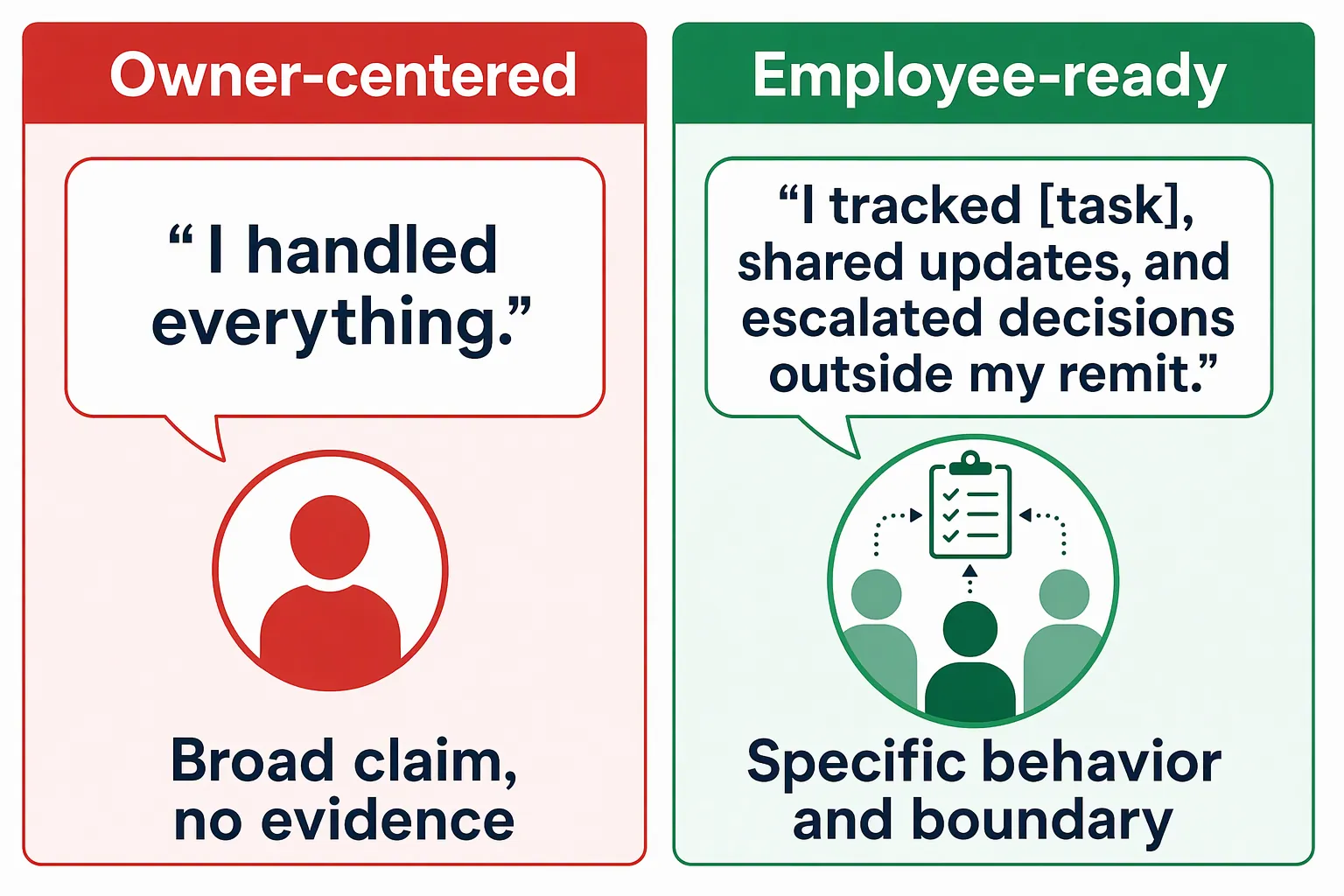
- Statements such as "I wore every hat" do not show which skills you used or how they relate to the job.
- Better approach
- Choose a real duty, explain your action, and connect it to a stated requirement. Be precise about which work you personally did.
Avoiding or dramatizing the sale or closure
- What goes wrong
- Leaving a relevant transition unexplained can create confusion, while giving a long personal defense can distract from your fit.
- Better approach
- State the verified status and timing briefly when it helps the reader understand the move. Do not invent a reason or include private details that do not help assess your application.
Making blanket promises about staying or taking direction
- What goes wrong
- A promise to stay indefinitely or accept any direction does not show how you will work with a manager or team, and it may sound less credible than a specific example.
- Better approach
- Explain why the role's work and responsibilities fit your plans. Describe a real time you followed a shared plan, reported progress, or respected a decision boundary.
Frequently asked questions
- Should I mention that I sold or closed my business?
- If the change explains why you are moving into employment or would otherwise leave your timeline unclear, state the sale or closure briefly and accurately. You do not need to share private financial details or give a long account of your reasons unless they are relevant to the role.
- How can I show I am comfortable taking direction?
- Give a specific example of following an agreed priority, coordinating with someone else, or escalating a decision outside your authority. Then explain why the role's responsibilities suit you. Avoid promising that you will never want autonomy or can predict exactly how long you will stay.
- Should I change my former business title to sound more like an employee role?
- Keep your historical title accurate. You can describe the work behind it in language that relates to the new role, but do not replace an owner or founder title with a job title you did not hold.
- Do I need to include business revenue or sale details?
- Include financial or sale information only when it is relevant, accurate, and yours to share. A concrete responsibility or result may show your fit without exposing confidential information.

Put this career change approach into practice
Choose sample data or build your own cover letter, then personalize it before you download.