
Introduction
A first management role can be a move into formal responsibility for people, not just a change in title. You may have led tasks, trained colleagues, or coordinated shared work without having authority over direct reports. Describe what you actually did, without presenting informal leadership as formal people management.
Choose one or two examples that relate to responsibilities in the [Job Title] posting. Explain your contribution, its scope, and an outcome you can support. This approach applies to external applications as well as internal ones, where the organization-specific context may also matter.
What to address directly
No formal manager title
- Hiring manager concern
- Your work history may not show a manager title, even if you have taken on leadership tasks relevant to the role.
- What your letter should prove
- Name the task, your actual scope, and what happened as a result. Training a colleague or coordinating a project can show preparation, but do not describe either as managing direct reports. If you cannot verify an outcome, explain the work completed instead of inventing one.
Peer support is not the same as formal authority
- Hiring manager concern
- Helping or guiding colleagues does not necessarily mean you set their priorities, assessed their performance, or made staffing decisions.
- What your letter should prove
- Show how you contributed while being precise about who made decisions. For example, explain how you shared information, organized a handover, or helped someone learn a process. If a lead set the priorities, say what you did within that direction rather than implying you owned it.
Readiness can sound like ambition alone
- Hiring manager concern
- Saying you are ready for a promotion does not explain how your experience relates to the work of leading a team.
- What your letter should prove
- Choose a specific responsibility from the posting and connect it to a real example. Briefly describe what you learned and how it prepares you to take on more accountability. Acknowledge that formal management involves responsibilities you have not yet held.
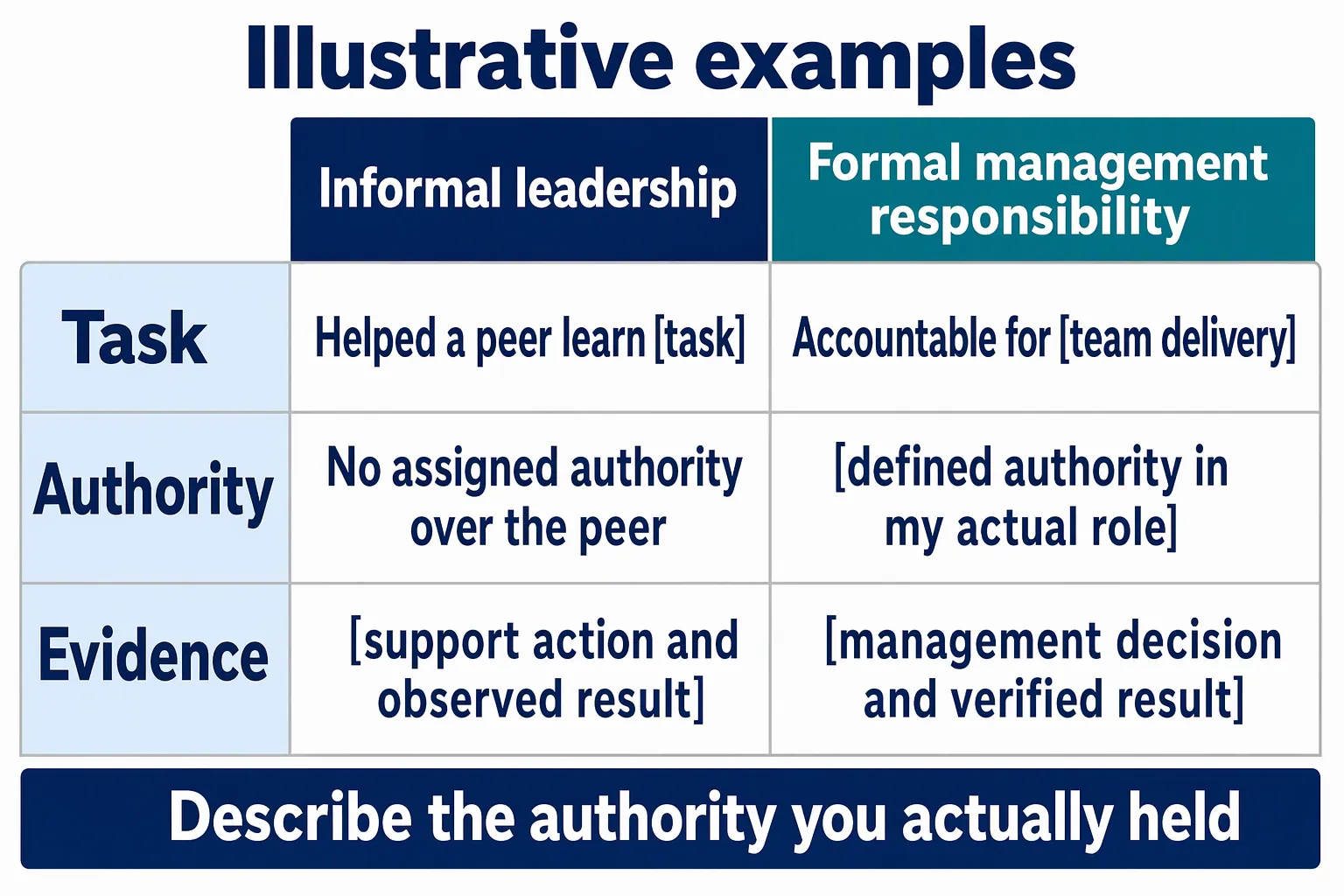
Structural approach: connect past leadership to the role
Focus the letter on the role's stated needs, not on proving that you deserve a promotion. Identify one or two responsibilities in the posting, then select evidence that shows preparation for them. For the general parts of a cover letter, see cover letter structure.
When you have not held a manager title, make the link between your earlier work and the target responsibility explicit. The guide to mapping transferable skills to a target role explains the broader approach; here, apply it to a first people-management role.
- 01
Choose a responsibility from the posting
Select one or two duties the employer actually lists, such as coaching, coordinating work, or communicating priorities. Do not assume that every manager role has the same scope.
- 02
Find a real example
Look for a time you trained someone, coordinated shared work, covered for a lead, or helped peers solve a work problem. State what you did and whether you acted independently or under someone else's direction.
- 03
Describe the result you can support
Name a specific outcome if you can verify it. If you do not have a number, describe a concrete change, such as a clearer handover or a colleague completing a process independently. Do not claim a result that you cannot substantiate.
- 04
Explain the next step
Connect the example to the responsibility you want to take on. Show that you are ready to learn the role's formal management duties; do not imply that a peer-support task already gave you that experience.
First-time manager cover letter example
This fictional example shows a move from coordination work into a first formal management role. Notice how it describes peer training and shared work without claiming direct-report experience.
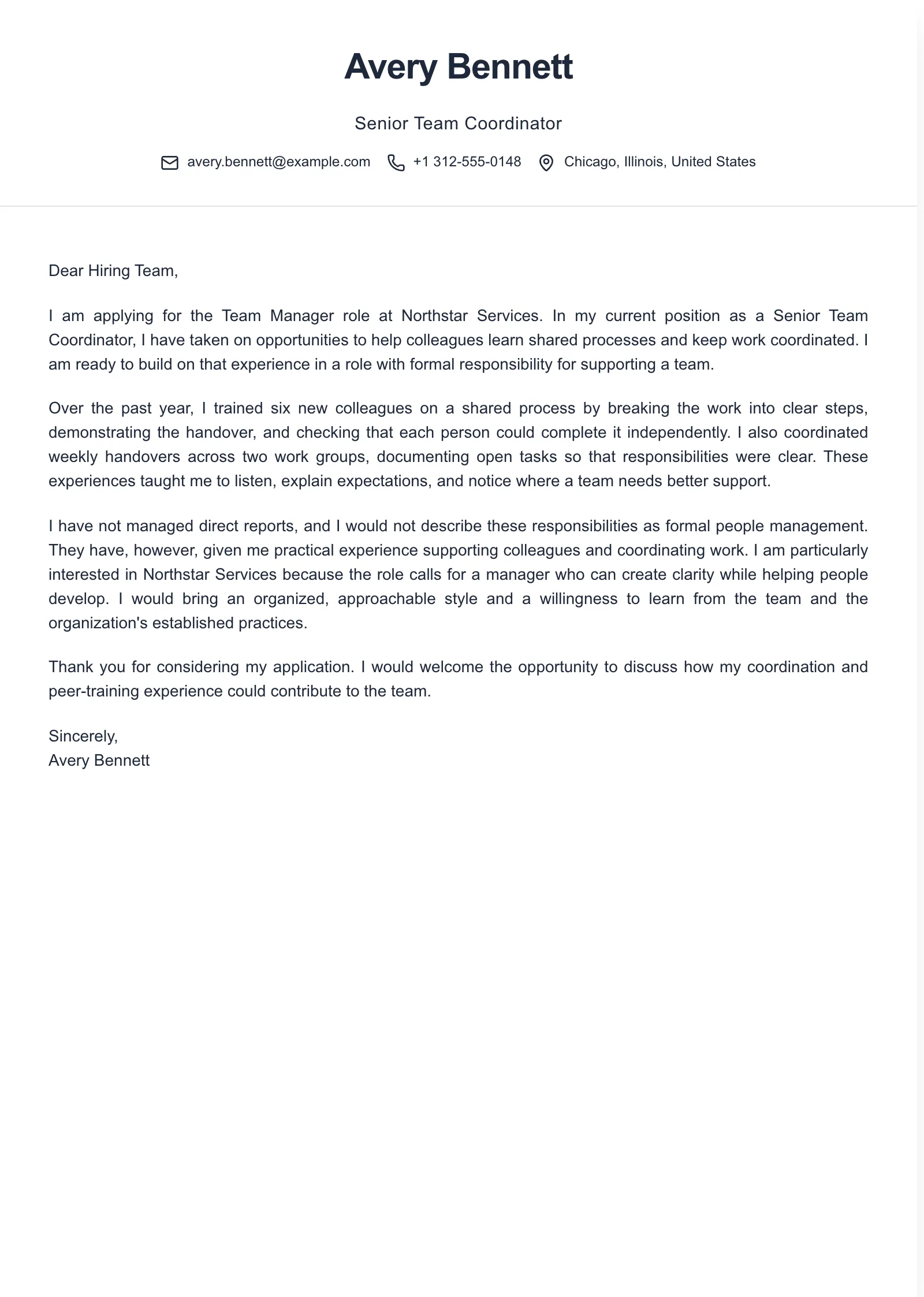
Example paragraphs
“I helped [colleague or group] learn [specific process] by [action you took], which led to [result you can support]. This experience relates to the [Job Title] role at [Company Name], particularly its focus on [relevant responsibility from the posting].”
“When [specific team need] required coordination, I [action you took] across [people or work areas], helping the group achieve [verifiable outcome]. I would draw on that experience in the [Job Title] role at [Company Name], where the posting describes responsibility for [related duty].”
“I have not held a formal manager title, but I have taken responsibility for [specific leadership task] by [action you took], with [result you can support]. I am interested in the [Job Title] role at [Company Name] because it would let me build on that experience while learning to take formal responsibility for a team.”
Use these as paragraph patterns, not claims to copy. Replace each bracket with accurate details and remove any example that does not fit your experience. Distinguish showing someone how to do a task from evaluating their performance. If you coordinated work, state whether you set priorities or followed a lead's direction. Keep your official title accurate and credit shared outcomes fairly.
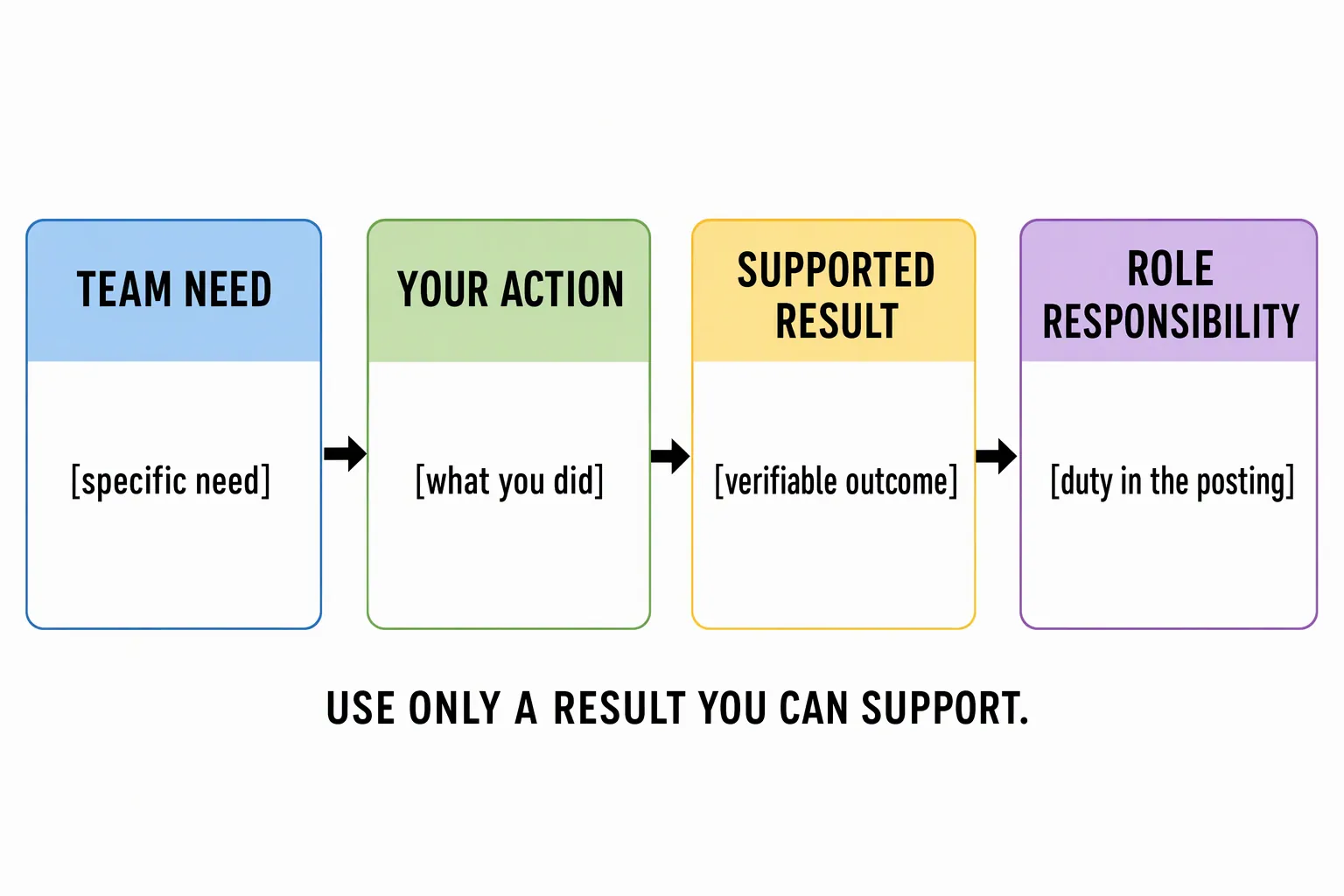
Common mistakes in a first management role cover letter
Calling informal leadership people management
- What goes wrong
- Saying you managed a team when you had no direct reports can misrepresent your responsibilities.
- Better approach
- Use an accurate description such as trained, coordinated, mentored, or covered for a lead. State who you supported and what authority you held.
Listing leadership traits without evidence
- What goes wrong
- Words such as confident or decisive do not explain how you supported people or work.
- Better approach
- Choose a real moment and describe your action, its scope, and its effect on a colleague, project, or shared task.
Focusing mainly on wanting a promotion
- What goes wrong
- A personal career goal alone does not show how your experience relates to this role.
- Better approach
- Connect your interest to a responsibility in the posting, then use relevant evidence to show how you are preparing to take it on.
Inflating your title or scope
- What goes wrong
- Changing a past title or implying that you owned decisions made by someone else makes your contribution unclear.
- Better approach
- Keep your title accurate and describe additional responsibilities separately. Be precise about your contribution and credit shared results fairly.
Frequently asked questions
- Can I apply for a manager role if I have never managed direct reports?
- You can explain why your experience is relevant without suggesting that informal leadership is the same as managing employees. Give a specific example of supporting colleagues, coordinating work, or taking responsibility, then connect it to a responsibility in the posting. Be clear that you are seeking your first formal people-management role.
- What leadership experience can I include if my title was not a manager?
- Use a real situation such as training a colleague, coordinating shared work, covering a lead's responsibilities, or helping peers solve a work problem. Explain your contribution, the scope you had, and a result you can support. Keep your official job title accurate.
- Should I say that this would be my first management job?
- You can say so briefly if it helps explain your transition. Pair it with relevant evidence and a reason tied to the role. Do not make the lack of a manager title the main point of the letter.
- How is this different from an internal-position cover letter?
- This page focuses on moving into formal people management and can apply to external or internal opportunities. An internal-position letter focuses on applying within your current organization and relevant internal context. If you are applying internally for your first management role, use the guidance that fits both parts of your situation.

Put this career change approach into practice
Choose sample data or build your own cover letter, then personalize it before you download.