
Introduction
A fellowship cover letter should connect the program’s stated aims with evidence from your work and the next step you hope to take. The emphasis depends on the application: it may ask about a project, professional development, or contribution to a cohort. Use the program description and prompts to decide which of these matter. This guide focuses on professional fellowship applications, not grant proposals.
Fellowship applications can overlap with internship applications in the information they request. The useful task here is to explain your fit for a particular professional fellowship, without assuming that every program has a cohort, offers mentorship, or supports a project. Programs may use labels such as “cover letter,” “motivation letter,” or “letter of interest”; do not infer a different format from the label alone. Follow the request itself. For more on these terms, see cover letter, motivation letter, or letter of interest.
What to address directly
“My project matters, but does it fit this program?”
- Hiring manager concern
- A project description can feel disconnected if the reader cannot see why it is relevant to this particular fellowship.
- What your letter should prove
- Choose a stated program aim and explain its connection to your project or next step. Be specific about what you hope to develop or learn. Do not claim the program offers resources, access, or mentorship unless its materials say so.
“Should I focus on my goals or what I can contribute?”
- Hiring manager concern
- A letter focused only on what you hope to gain may leave your contribution unclear. A list of past achievements alone may not explain why you are applying now.
- What your letter should prove
- Pair a goal with relevant evidence or a contribution you can genuinely bring. For example, connect a next step to experience, a perspective, or a practice you have used. Describe the contribution at the scale of your actual experience, not as a promise of results.
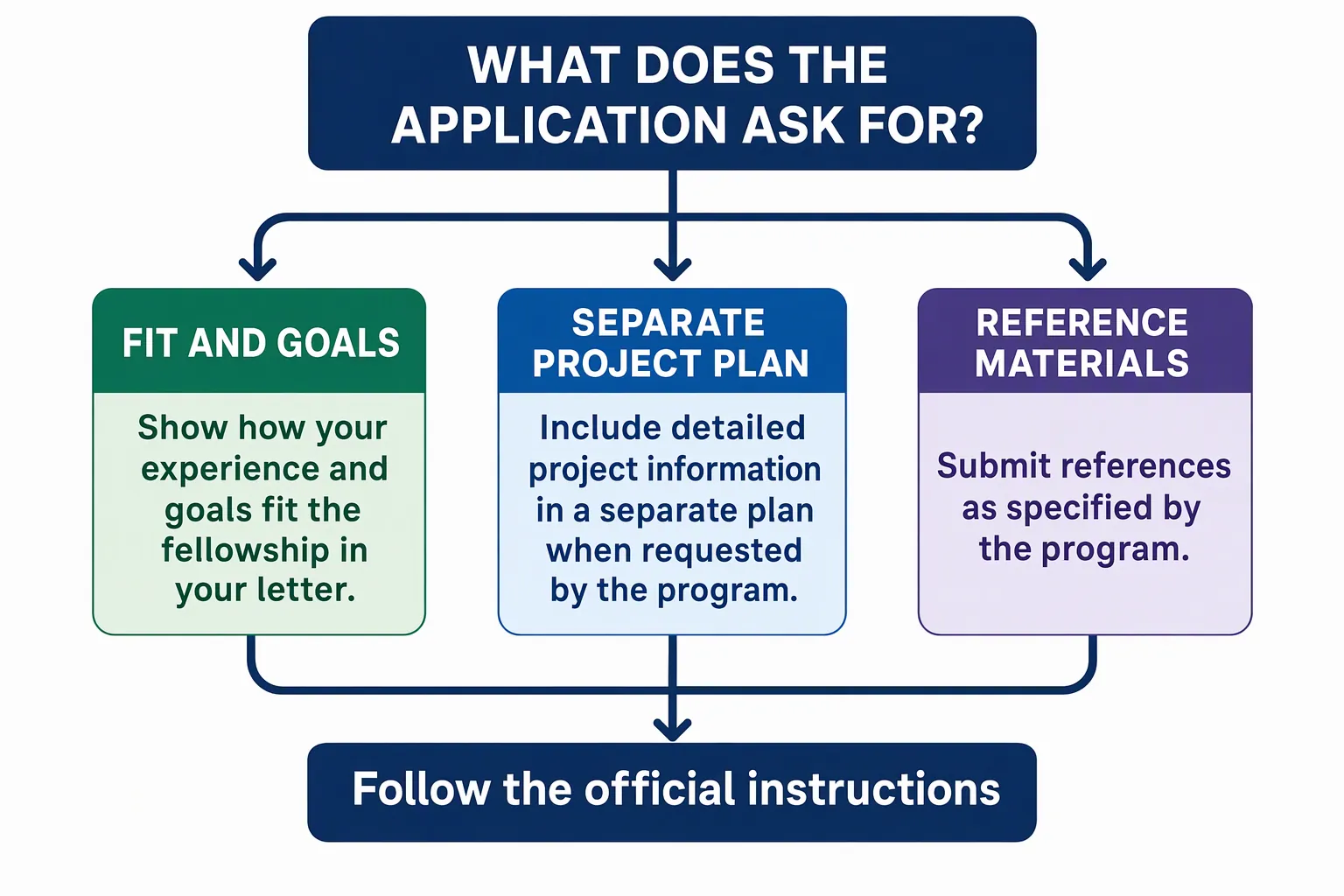
“What if references or project details have their own requirements?”
- Hiring manager concern
- An application may ask for reference materials, a project plan, or short answers separately. Repeating them in the letter can distract from its purpose.
- What your letter should prove
- Check the application instructions for each requested item. Use the letter to connect your evidence and goals to program fit, and provide other materials in the specified format. If a requirement is unclear, consult the program’s official guidance rather than guessing.
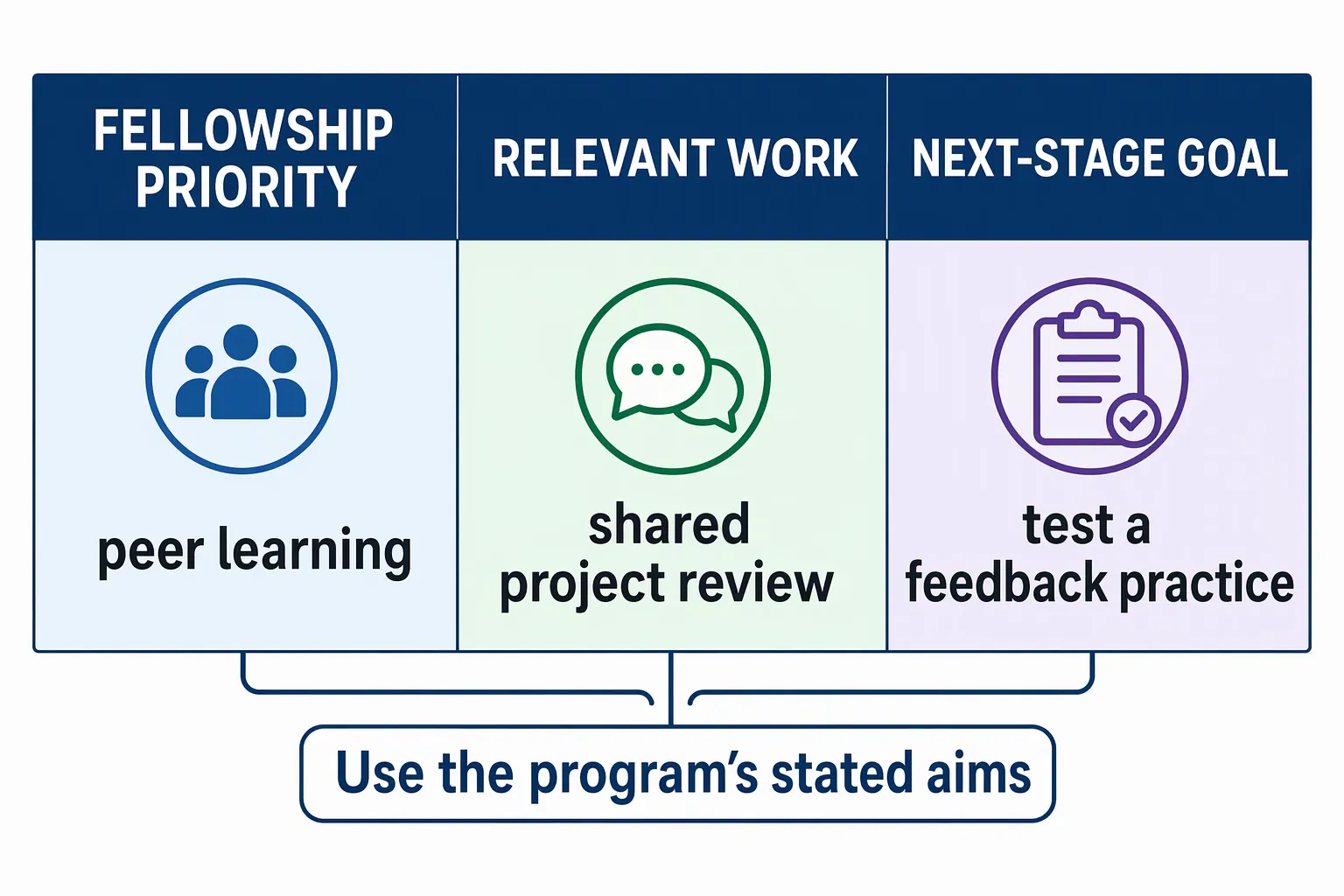
Structural approach: connect program fit, contribution, and next step
Read the fellowship description and application prompts together before drafting. Note the program’s stated purpose, what it asks applicants to demonstrate, and which materials it requests separately. If a project statement is required, orient the reader to your fit in the letter rather than reproducing the full plan. For a general paragraph sequence, see this cover letter structure guide; the fellowship’s own instructions take priority.
Build the letter around the application’s actual questions. The four moves below are options to adapt, not extra requirements. Use only the details that help make your case for this program.
- 01
Identify the program’s stated priorities
Choose one or two priorities from the fellowship’s own description, such as a learning focus, project area, or cohort activity if one is specified. Replace broad praise with a reason that shows fit. If the application asks a direct question, answer it clearly.
- 02
Select evidence that supports your fit
Choose an example of relevant work, judgment, or learning. State your role and a result or lesson you can verify. A project, collaboration, or responsibility may be useful evidence. Do not inflate your contribution or present an aspiration as an achievement.
- 03
Connect a goal to the program
Describe a realistic next step and connect it to a specific program feature that is actually described. If the fellowship includes a cohort, explain what you could contribute as well as what you hope to learn. Do not assume access, outcomes, or mentorship the program has not promised.
- 04
Close by respecting the application format
Briefly restate your interest and fit. Mention references only when useful to the application, and do not imply an endorsement that has not been agreed. Check the program name, requested length, and document requirements against the official instructions.
Fellowship application cover letter example
A fictional example connecting relevant work, a specific fellowship program, and a forward goal. Adapt it to the program’s instructions and your own verifiable experience.
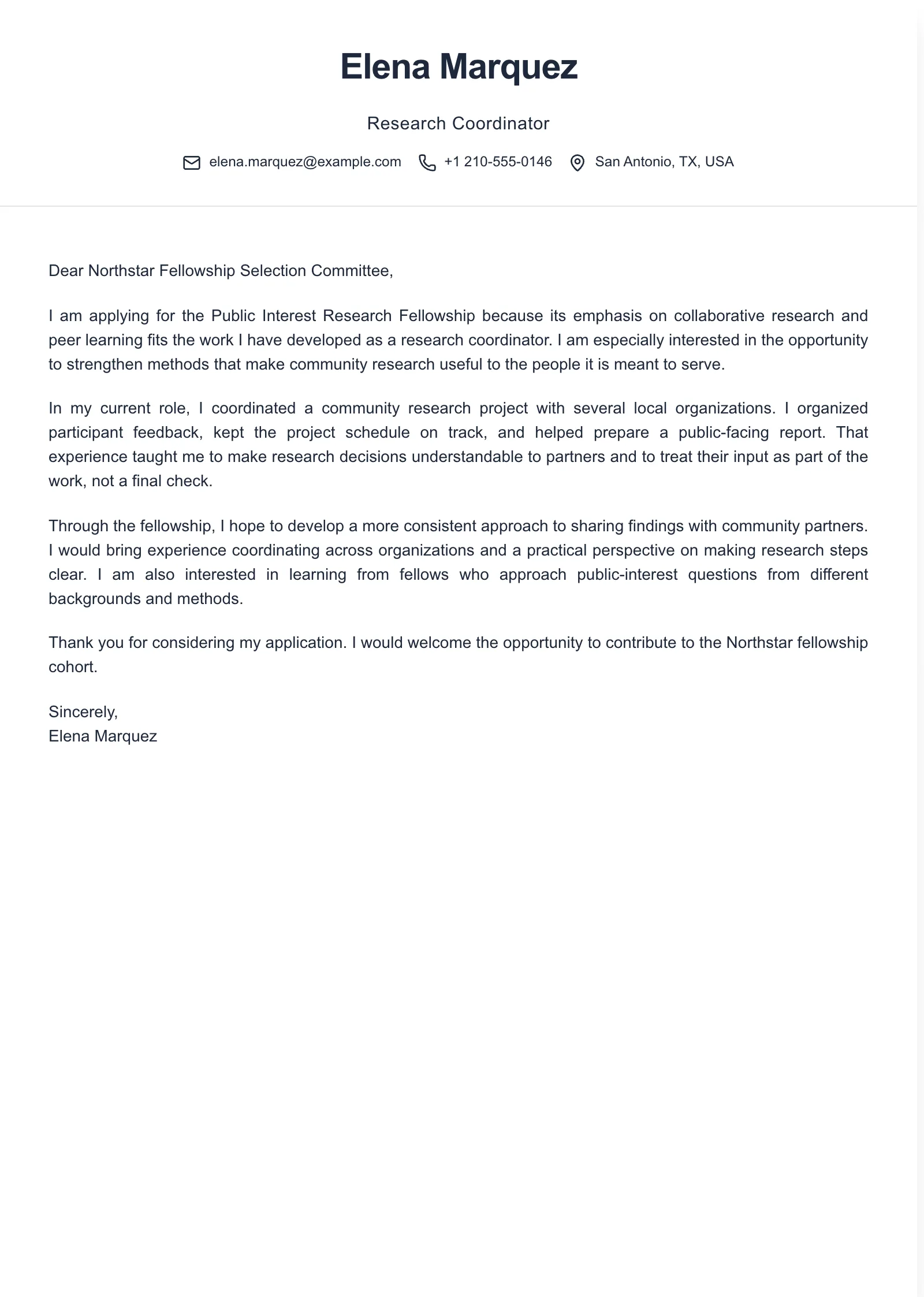
Example paragraphs
“I am applying for the [Fellowship Name] because its stated focus on [specific program priority] aligns with my goal of [factual next-step goal]. In my work on [factual project or responsibility], I learned [specific lesson relevant to that priority].”
“For the [Fellowship Name], I would bring experience from [factual project or activity], where I [specific action] and [verifiable result or learning]. I hope to use [named program feature] to develop [specific project question or next step], as described in the fellowship materials.”
“The [Fellowship Name] appeals to me because of its stated aim of [specific learning or cohort aim]. I could contribute [factual perspective or practice] from [relevant experience], and I hope to learn [specific skill or approach] that supports my next step in [factual area of work].”
These are adaptable paragraphs, not complete letters. Replace each bracket with a fact you can verify, and use the program’s name and description accurately. Keep detailed methods or timelines in a separate project document when the application requests one. Do not imply that a reference has committed, that the program guarantees an outcome, or that you have experience you have not gained.
Common mistakes in a fellowship cover letter
Writing general praise
- What goes wrong
- Calling the fellowship exciting or prestigious does not show how its aims connect to your work or goals.
- Better approach
- Name a specific priority from the program description and connect it to relevant evidence or a realistic goal.
Turning the letter into a project proposal
- What goes wrong
- A long methods section can distract from the application’s request and repeat a separately requested project document.
- Better approach
- Include only enough project context to explain your fit. Put detailed plans where the application asks for them.
Describing only what you hope to gain
- What goes wrong
- A list of hoped-for benefits may leave your relevant experience or contribution unclear.
- Better approach
- Pair an important goal with experience, a perspective, or a practice you can genuinely bring.
Repeating other application materials
- What goes wrong
- Duplicating reference details or a full project statement can make the letter unfocused and may not follow the form’s instructions.
- Better approach
- Check where each item is requested. Keep the letter focused on fit, evidence, and goals, and provide other materials in the specified format.
Frequently asked questions
- Is a fellowship cover letter the same as a grant proposal?
- Not necessarily. This guide focuses on explaining your fit for a professional fellowship. A program may request a separate project proposal, and a grant application may ask for a funding case. Follow the specific application instructions and provide each requested document in its designated format.
- Should I name my project in a fellowship cover letter?
- Name it when the prompt asks about a project or when it helps explain your fit. Briefly describe its purpose, your role, and the relevant next step. Keep detailed plans in a separate proposal if the application requests one.
- Should I include references in the letter?
- Follow the application instructions. If it requests reference letters or contact details in separate fields, provide them there rather than repeating them in the letter. Do not imply that someone has agreed to serve as a reference unless they have.
- How is a fellowship cover letter different from an internship cover letter?
- There is no single boundary in what applications ask applicants to discuss. Both may ask about relevant experience and learning goals. This guide focuses on the requested task of explaining fit for a professional fellowship, including project or cohort goals when they are relevant. Use the specific prompt to decide what belongs in your letter.

Put this career change approach into practice
Choose sample data or build your own cover letter, then personalize it before you download.