
Introduction
A senior executive cover letter should make the scale of your leadership legible without relying on title alone. Connect one or two priorities in the posting to verified outcomes, the scope you actually held, and the decisions you personally shaped. The goal is not to retell your career; it is to show why this specific mandate fits evidence from your work.
Directors and vice presidents can use the same approach. Adjust the scope of the evidence to the target role and your actual authority. For the basic paragraph sequence, see the cover letter structure guide; the guidance below applies that sequence to executive responsibilities.
What to address directly
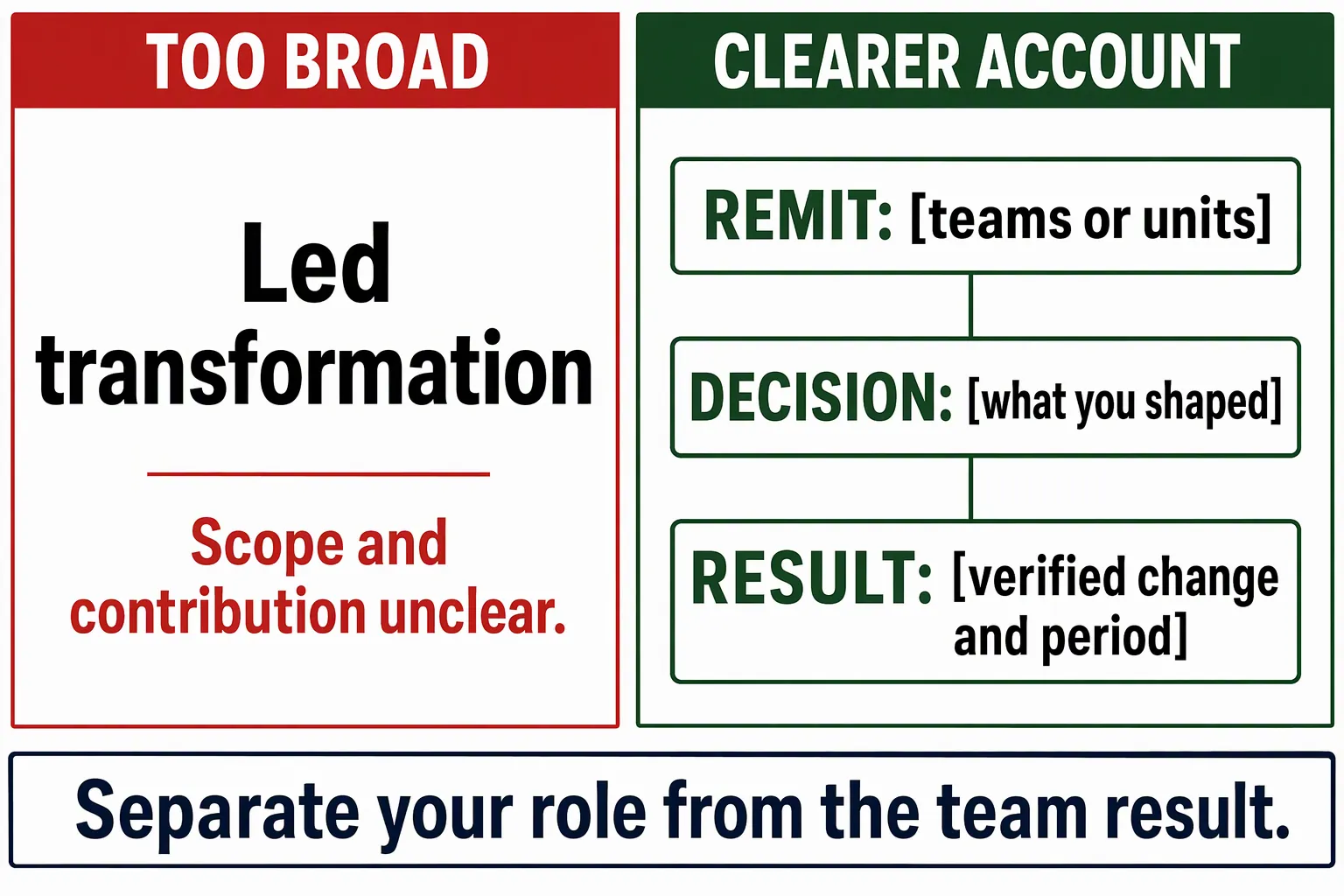
An outcome needs scope
- Hiring manager concern
- A result without context can leave the reader unsure how large the remit was, what changed, or what you contributed. A prominent number alone does not establish your leadership role.
- What your letter should prove
- Pair a relevant, verified outcome with the remit you held and the action you took. Add a time period or starting point when it clarifies the change and you can share it. Separate your contribution from work led by colleagues.
Governance language needs precision
- Hiring manager concern
- Terms such as “board-level” or “board-led” can blur whether you served on a board, advised it, prepared reporting, or carried out an approved decision.
- What your letter should prove
- Describe the relationship and your contribution in plain terms. Distinguish recommendations, reporting, approval, and implementation. Include board interaction only when it is relevant to the posting and accurately reflects your experience.
The mandate must be specific to the posting
- Hiring manager concern
- Broad claims about transformation or leadership may not show why your experience fits this organization's stated priorities. Assuming an undisclosed problem can also make the letter sound presumptuous.
- What your letter should prove
- Use the outcomes and responsibilities the employer actually names. Select evidence that connects to those priorities, and describe your current or past title accurately. Do not promise a result before you understand the organization's needs.
Structural approach: connect mandate, scope, and outcome
Build the letter around the role's stated priorities, not a summary of your entire career. Choose a small number of relevant examples that show what you were responsible for, how you exercised judgment, and what changed. Use details you can substantiate and are permitted to share.
A one-page draft can be a useful editing target, not a universal requirement. Give each paragraph a distinct job: establish fit, support it with leadership evidence, and connect that evidence to the work ahead. If an application requests a separate statement or more detail, follow its instructions rather than forcing everything into one page.
- 01
Identify the stated mandate
Note the few outcomes and responsibilities emphasized in the posting, such as growth, integration, or operating stability. Use the employer's stated priorities rather than guessing at a problem it has not described.
- 02
Choose relevant, verifiable evidence
Select one or two outcomes that connect to the mandate. Include a measure when it is accurate and shareable; explain the change and its scope. If a figure is restricted, describe the result truthfully without implying a number.
- 03
Define your leadership scope
Name the teams, functions, or regions within your remit and the decisions you shaped. Clarify shared responsibility. Describe board contact, if relevant, as reporting, advising, recommending, or another role that accurately fits.
- 04
Connect the evidence to the role
Explain why the example is relevant to the posting's priorities. End by expressing interest in discussing the mandate and how your experience may apply, rather than promising an outcome before you know the organization's needs.
Fictional executive cover letter example
This fictional example connects a defined operating remit to an organization-level change. Use it as a layout reference, not as a claim or achievement to copy.
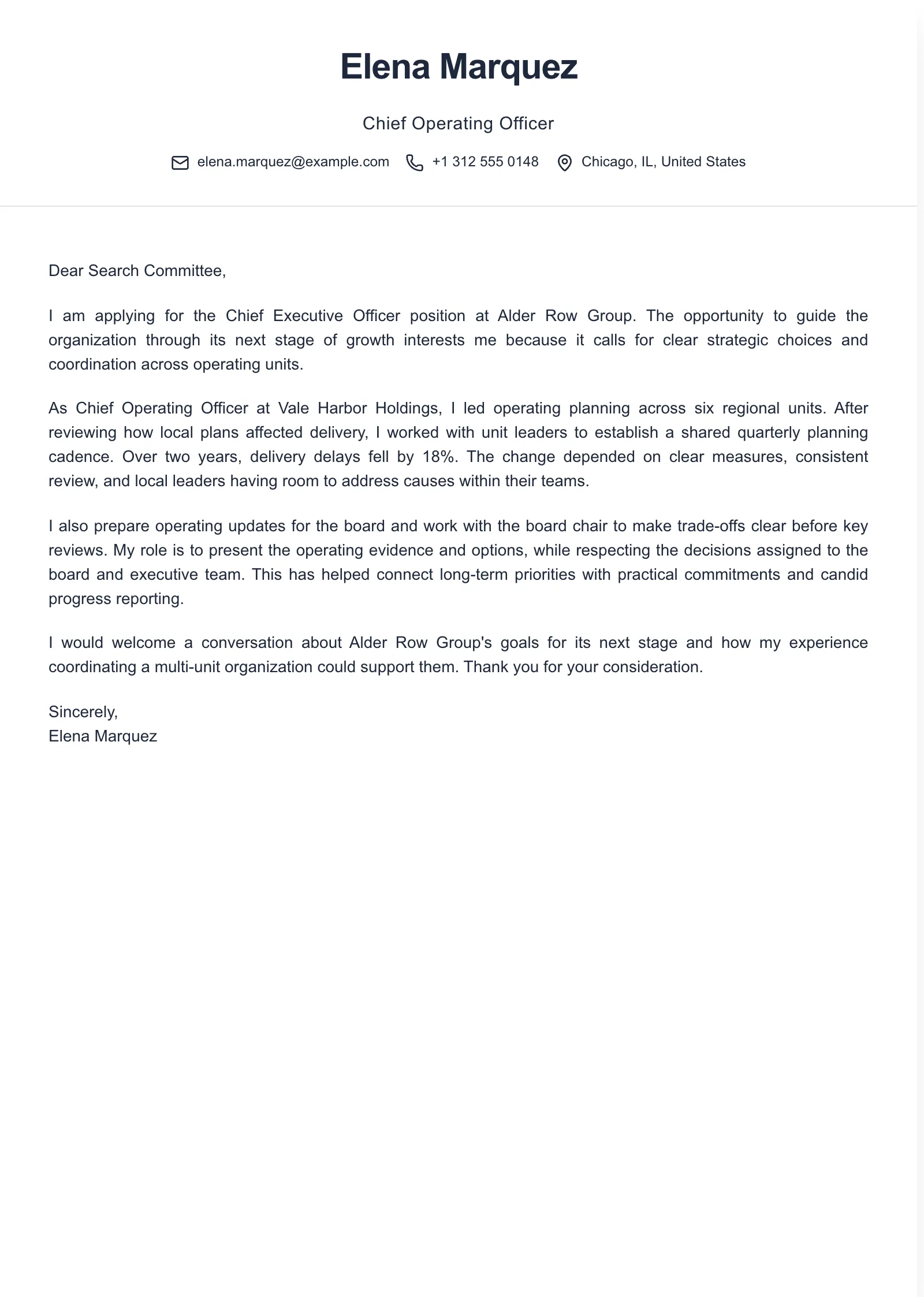
Example paragraphs
“I am applying for the [executive title] position at [organization] because its stated priority, [priority], aligns with my experience in [relevant scope]. In my [current or recent role], I was accountable for [verified remit], including [decision responsibility].”
“At [organization or business unit], I [recommended, approved, or delivered] [specific action] after reviewing [relevant evidence]. Within my responsibility for [team, function, or region], this contributed to [verified outcome] over [time period].”
“Across [functions or units], I [specific action] to support [shared priority]. The work led to [verified outcome]. My responsibility was [specific contribution], while [colleagues or other decision-makers] were responsible for [their role].”
Treat these as adaptable paragraphs, not a complete letter. Replace each bracket with accurate, shareable facts. If an outcome was collective, name your own contribution without taking credit for the whole result. If you cannot share a metric, describe the change and your remit without implying a figure.
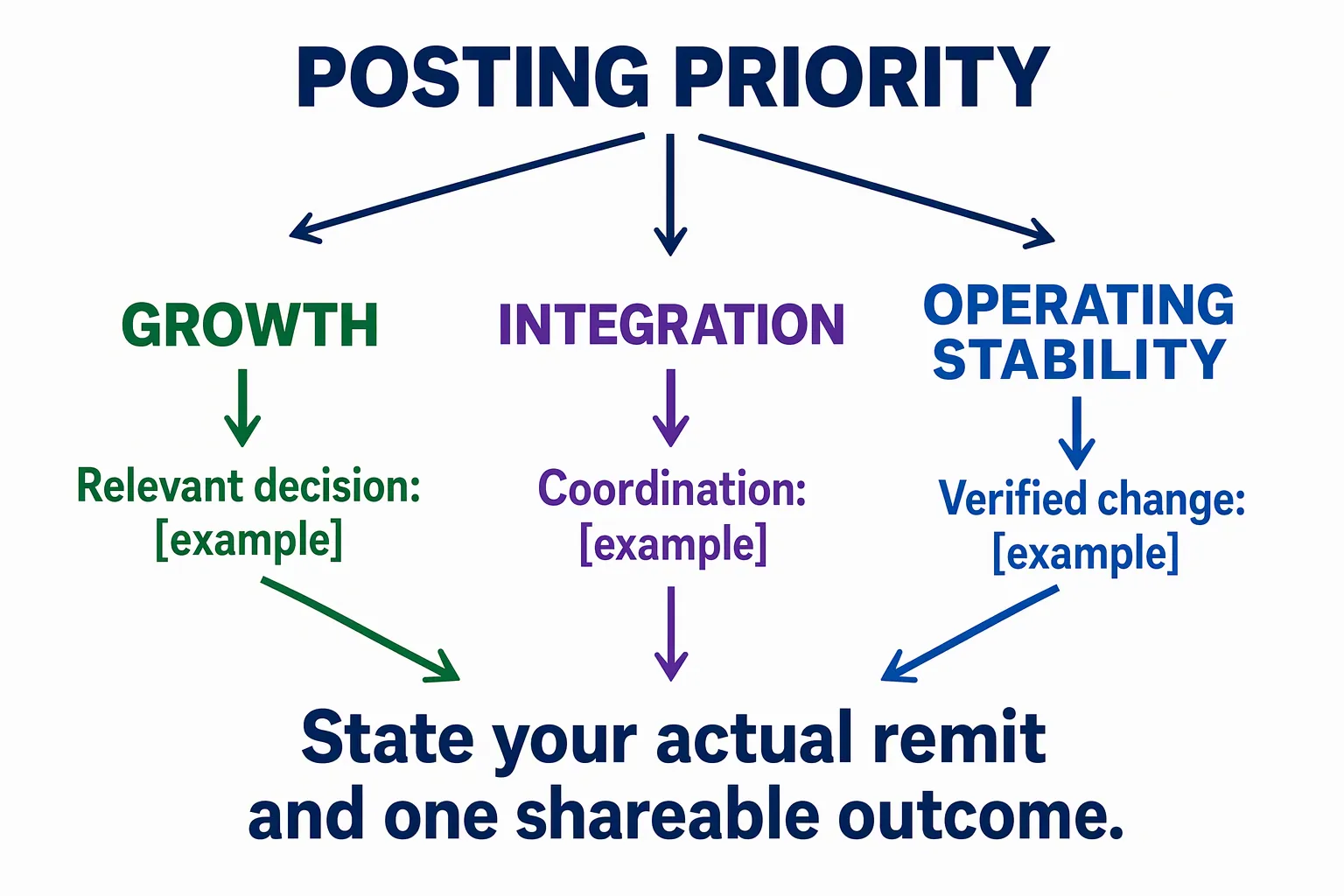
Common mistakes in an executive cover letter
Listing outcomes without your role
- What goes wrong
- A series of large results does not show whether you set direction, made a decision, or contributed to a broader effort.
- Better approach
- Choose fewer, more relevant outcomes and state your responsibility alongside each one. Give enough scope for the reader to understand what you led.
Using restricted figures as proof
- What goes wrong
- Sensitive financial, personnel, or organizational details may not be appropriate to disclose, even when they would make an outcome more concrete.
- Better approach
- Use a permitted measure or describe the change at a shareable level. Do not invent a rounded figure or disclose restricted information to strengthen the letter.
Implying authority you did not hold
- What goes wrong
- Phrases that imply board membership, approval, or sole ownership can misrepresent your contribution to a shared decision.
- Better approach
- Describe your relationship to the decision directly. Keep advising, reporting, recommending, approving, and implementing distinct where those distinctions reflect your actual role.
Changing your title to sound more senior
- What goes wrong
- A title that does not match your work history can make your actual scope harder to assess and create inconsistencies in the application.
- Better approach
- Keep your title accurate. Explain the scale of your remit, team, or decisions instead of using a title you did not hold.
Frequently asked questions
- Should an executive cover letter be one page?
- A one-page draft can be a useful editing target, not a universal requirement. Follow the employer's instructions, especially if the application requests additional statements or detail.
- Do I need board experience to apply for an executive role?
- Use the posting to determine whether board interaction is relevant. If you have relevant experience, describe your actual role, such as preparing updates, advising, or reporting. Do not imply board membership or decision authority you did not hold.
- How can I discuss results I cannot share in detail?
- Use a verified measure or describe the change at a level you are permitted to share. You can explain your remit and contribution without disclosing restricted information or inventing a substitute number.
- Should directors and vice presidents use different formats?
- There is no need to claim a distinct format. Keep the structure clear, and choose evidence whose scope and authority match both the target role and your actual experience.

Put this career change approach into practice
Choose sample data or build your own cover letter, then personalize it before you download.