
Introduction
A Europass cover letter is a letter created with the Europass format and tools. The official cover-letter editor lets you create or edit a letter, choose a template, and store or share the result through Europass. You still write the content and check the employer's application instructions. Using the editor does not itself submit your application.
Europass is not universally required by employers in the EU. Expectations depend on the employer, country, and application channel. Official German guidance, for example, says employers often appreciate individual applications, but that country-specific advice should not be treated as a rule across Europe. Consider the employer's instructions alongside guidance on Europass, national CVs, and other formats. The labels cover letter, motivation letter, and letter of interest can overlap; follow the vacancy's wording and purpose rather than assuming the labels always mean different documents.
What to address directly
Will an employer expect Europass?
- Hiring manager concern
- Seeing a familiar European format can make it seem compulsory, even when the vacancy does not ask for it.
- What your letter should prove
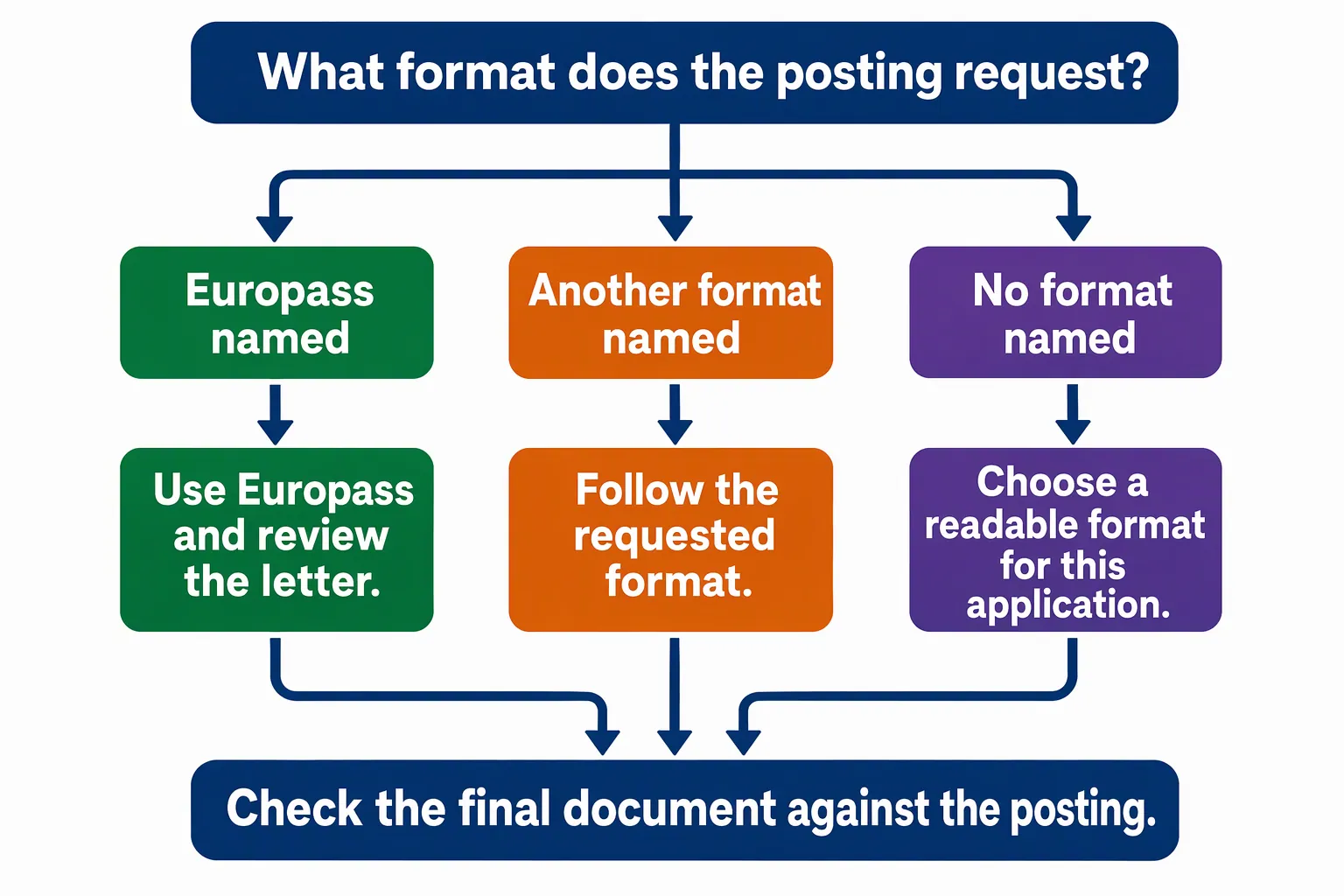
- Check the posting and application instructions first. If they name Europass, use it. If they specify another format, document, or route, follow that instruction. If no format is named, choose a readable format that suits the application. Do not describe Europass as mandatory across Europe.
Will using the editor make my letter specific?
- Hiring manager concern
- A formatted letter can still be generic if it repeats the CV or uses the same reason for applying to every employer.
- What your letter should prove
- Choose a specific reason connected to this vacancy and one relevant example you can verify. The editor is a way to create a letter, not a substitute for selecting evidence and checking that the content answers this employer's request.
Which personal details belong in the letter?
- Hiring manager concern
- Applying across borders can prompt applicants to guess which personal details are expected in a particular country.
- What your letter should prove
- Focus on the role, relevant evidence, and practical details the posting asks you to address. Do not assume you must include a photo, age, marital status, or nationality. Follow the employer's instructions and check requirements that apply to your own situation.
Structural approach: prepare the content before using the editor
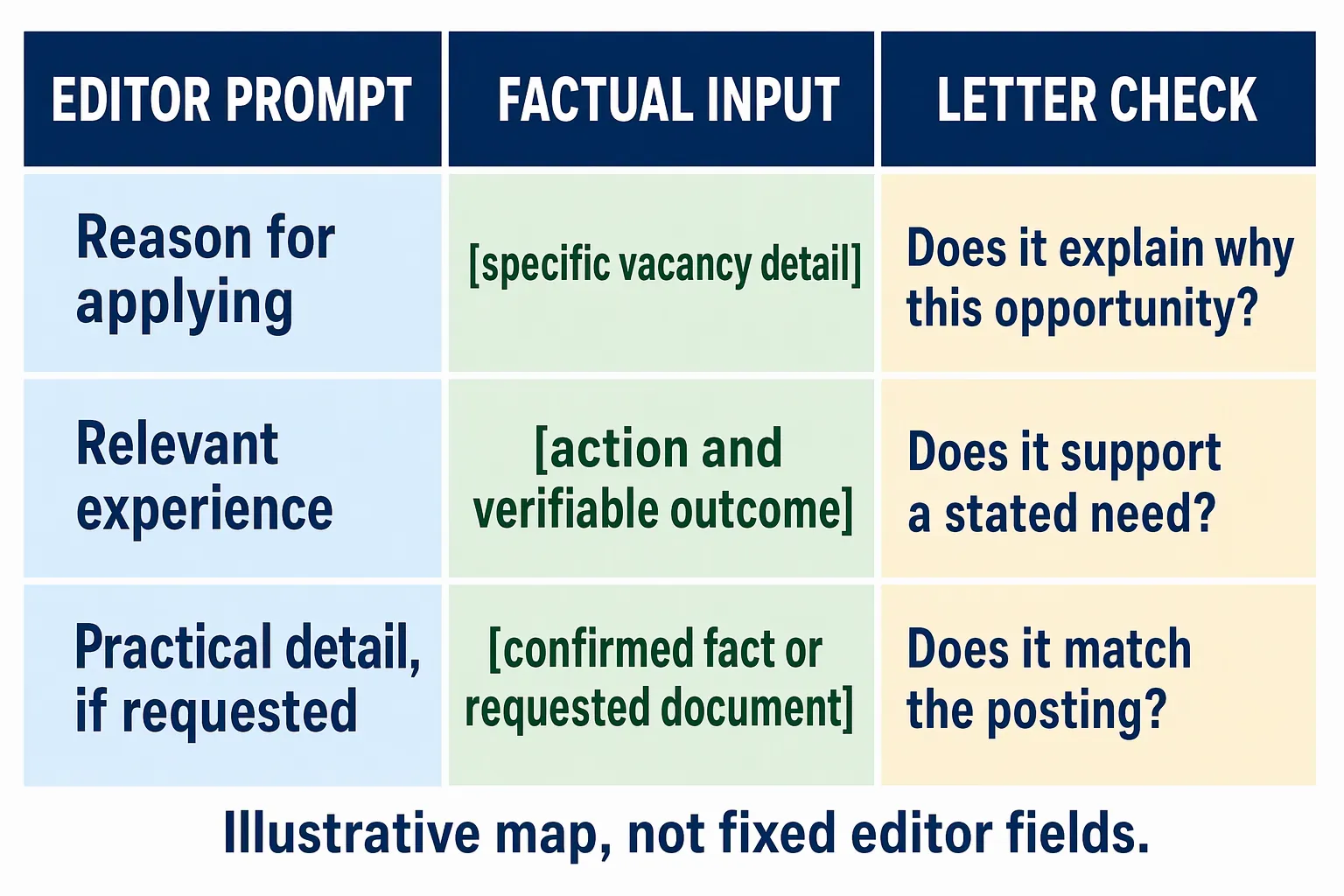
Prepare your contact details, the recipient's details where known, the vacancy or opportunity, and your message before using the editor. Europass recommends three main paragraphs: why you want the opportunity, what makes your experience relevant, and why this organization fits your direction. Add a greeting and close, then check the current editor's prompts and preview. These are writing roles for the paragraphs, not a substitute for any separate application questions.
Europass recommends a concise one-page letter, simple fonts, and short paragraphs. Follow any more specific instructions from the employer. In the motivation paragraph, name the actual opportunity and your reason. In the evidence paragraph, connect an example from your CV to a listed requirement. In the employer-fit paragraph, explain a verified detail about the organization that matters to you. Choose a template for readability, then review the completed document and export or share it as the employer requests.
- 01
Check the requested format
Read the vacancy and application instructions before opening the editor. Note whether Europass is explicitly requested, another format is named, or a separate form or document is required. If the employer specifies a different document or application route, do not replace it with a Europass letter.
- 02
Select relevant evidence
Choose one or two examples connected to the stated needs. Note what you actually did, the context, and an outcome you can verify. Use accurate, plain language. Do not add invented numbers or claim experience you cannot support.
- 03
Explain your reason for applying
Use a specific detail from the vacancy or reliable information about the organization to explain your interest. Connect that reason to the evidence you selected. Avoid a generic statement that could be sent unchanged to unrelated employers.
- 04
Review the finished letter
Check the letter you created for the correct employer and role, accurate names and dates, clear paragraphs, and a consistent signature. Make sure the final document is readable and matches the requested application materials. Send it through the channel specified by the employer.
Europass cover-letter example
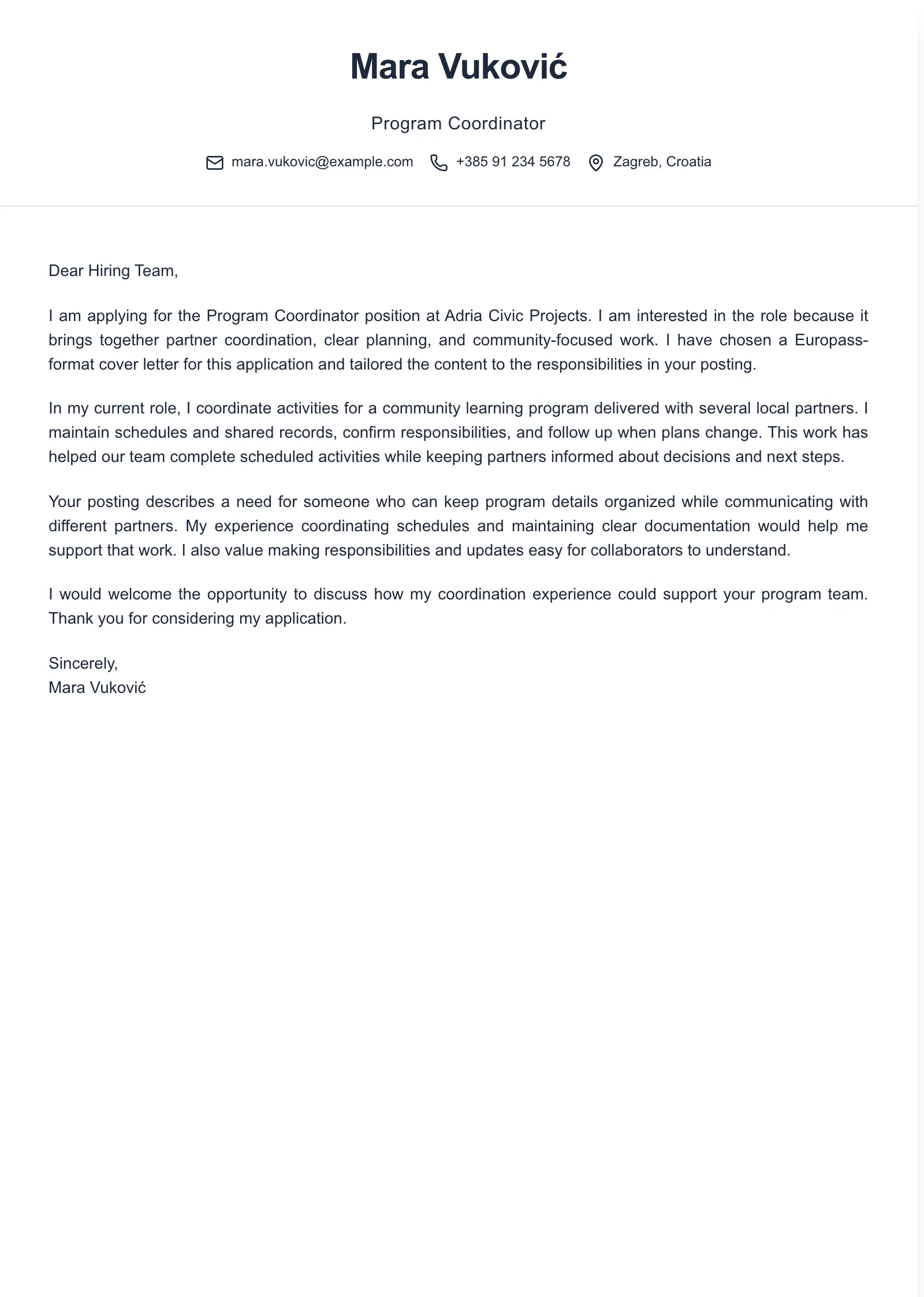
This fictional example demonstrates tailored content in a Europass-format application. It is not a claim that every employer requires Europass.
Example paragraphs
“I am applying for the [Job Title] position at [Company Name] because [specific feature of the role or organization] connects with my experience in [relevant area]. The posting's focus on [stated need] is relevant to [factual reason you are interested].”
“In [relevant situation], I [specific action you took] for [scope, team, or audience], which led to [verifiable outcome]. This experience relates to the [Job Title] position at [Company Name] because the posting asks for [specific requirement].”
“For the [Job Title] position at [Company Name], I can contribute [relevant skill], demonstrated through [factual example]. My confirmed [availability, location, or other relevant detail] is [specific fact]. I can provide [requested document] through the application channel named in the posting.”
Each paragraph should do one job: explain your interest, support your fit, or address a relevant practical point. Replace every bracket with accurate information and remove any sentence that does not help answer this employer's request. The Europass format does not make a generic claim more specific. If the posting requests another document, follow that instruction.
Common mistakes with a Europass cover letter
Assuming the format is compulsory
- What goes wrong
- Choosing Europass just because an employer is in Europe can overlook the actual instructions and local context.
- Better approach
- Use Europass when requested or when it is a suitable choice for the application. Otherwise follow the employer's stated format and submission route.
Treating formatting as tailoring
- What goes wrong
- A polished layout cannot make a letter specific if it says nothing about the vacancy or employer.
- Better approach
- Refer to a relevant need in the posting and connect it to a factual example from your experience.
Copying the CV into paragraphs
- What goes wrong
- Repeating duties and dates without explaining their relevance adds length but little useful context.
- Better approach
- Select a small number of relevant examples and explain how they connect to the employer's stated needs.
Sending without reviewing the result
- What goes wrong
- Names, dates, content, or formatting may be wrong even if the information was entered correctly at first.
- Better approach
- Review the finished letter. Confirm its accuracy, readability, and consistency with the employer's instructions before sending.
Frequently asked questions
- Do all employers in Europe require a Europass cover letter?
- No. Europass is not universally required by EU employers. Follow the vacancy's instructions and consider the employer's country and application process. Official German guidance says employers often appreciate individual applications, but that is not a rule for every employer in Europe.
- What does the Europass cover-letter editor produce?
- Europass provides an official online cover-letter editor. Use the current editor to create your letter, then review the result and check the employer's application instructions. Do not assume that using the editor submits an application or establishes which format the employer requires.
- Is a Europass cover letter different from a motivation letter or letter of interest?
- These labels can overlap in use, so do not assume each has one fixed meaning. Follow the vacancy's wording and purpose. If it is unclear, address the stated purpose directly or ask the employer which document is wanted.
- Can I reuse one Europass cover letter for different applications?
- You can reuse accurate background details, but adapt the reason for applying and the evidence to each vacancy. Before sending, check that the role, employer, examples, dates, and requested documents match that application.

Put this career change approach into practice
Choose sample data or build your own cover letter, then personalize it before you download.