
Introduction
An Erasmus+ internship cover letter should help a potential host understand why its opportunity fits you and what you hope to learn through the planned work. Make the practical details easy to discuss too, especially your proposed dates and any arrangements that are still being coordinated.
This is a focused application task, not a separate official letter format. It shares the basic purpose of a general internship letter, while giving particular attention to the planned learning program and coordination with your sending institution. Erasmus+ guidance describes the learning agreement as setting out that program, coordinated by the institution and host. A letter does not replace the agreement or establish that a placement or funding has been approved.
What to address directly
Can the host see why its work fits your aims?
- Hiring manager concern
- A general statement about wanting international experience does not show why you chose this host or how its work relates to what you want to learn.
- What your letter should prove
- Refer to a real activity or priority in the host's opportunity. Connect it to a specific learning aim, then support your fit with one accurate example from study, a project, volunteering, or work. Do not claim experience or results you cannot substantiate.
Are the learning aims and dates clear enough to discuss?
- Hiring manager concern
- A host may need to consider its activities and schedule alongside your proposed period and coordination with your sending institution.
- What your letter should prove
- Give the proposed start and end dates, or a clear date range, and label them as provisional if they are not settled. Explain how the proposed work could support your learning aims. The learning program and dates can then be coordinated with the host and your institution.
Is the funding statement accurate?
- Hiring manager concern
- Vague wording can make a pending application sound approved or leave the host unsure whether you expect it to provide support.
- What your letter should prove
- If funding affects planning, state only its verifiable status in a brief sentence. Do not imply that host interest confirms a grant or that a learning agreement guarantees funding. Check funding questions with your institution and current program guidance.
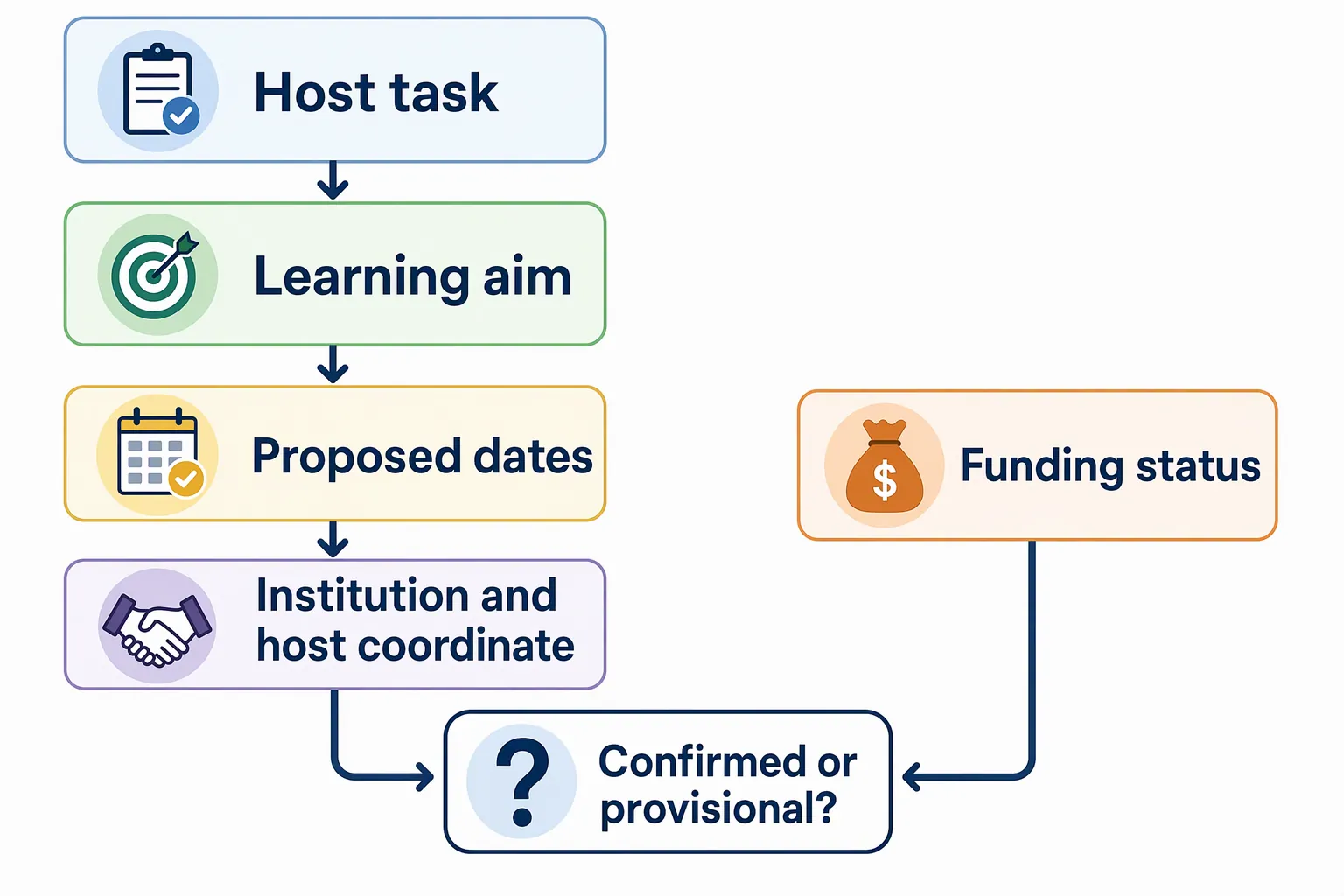
Structural approach for an Erasmus+ internship letter
Keep the letter centered on the host's opportunity. The Erasmus+ learning agreement sets out a planned learning program coordinated by the institution and host. Your letter can help them discuss how the proposed work relates to your aims; it does not replace the agreement or confirm its contents.
A practical sequence is to identify the opportunity, connect relevant preparation to a host activity, explain what you hope to learn, and state the proposed dates and funding status accurately. For a broader paragraph-by-paragraph overview, see the cover letter structure guide.
- 01
Identify the host opportunity
Name the host and the advertised [Job Title], if available. Refer to a specific task, project, or stated priority that genuinely interests you. Explain why that work relates to your current learning aims rather than relying on general praise of the organization.
- 02
Support your fit with real evidence
Choose one relevant example from study, a project, volunteering, or work. State what you actually did and what it demonstrates about your preparation. Then connect that evidence to a host activity. Do not invent responsibilities, qualifications, or outcomes.
- 03
Make your learning aims and dates discussable
Name a specific skill or area you hope to develop through the proposed work. Give your intended dates or a clear range, and say whether they are provisional. Explain that the planned learning program can be coordinated with your sending institution and the host.
- 04
State funding status separately
If funding affects the host's planning, state its current status plainly. Do not present an application as approved or imply that host interest guarantees selection or funding. Follow the host's instructions and confirm program-specific questions with your institution.
Fictional Erasmus+ internship cover letter example
Preview a fictional application connecting relevant preparation, learning aims, proposed dates, and coordination around a planned Erasmus+ traineeship.
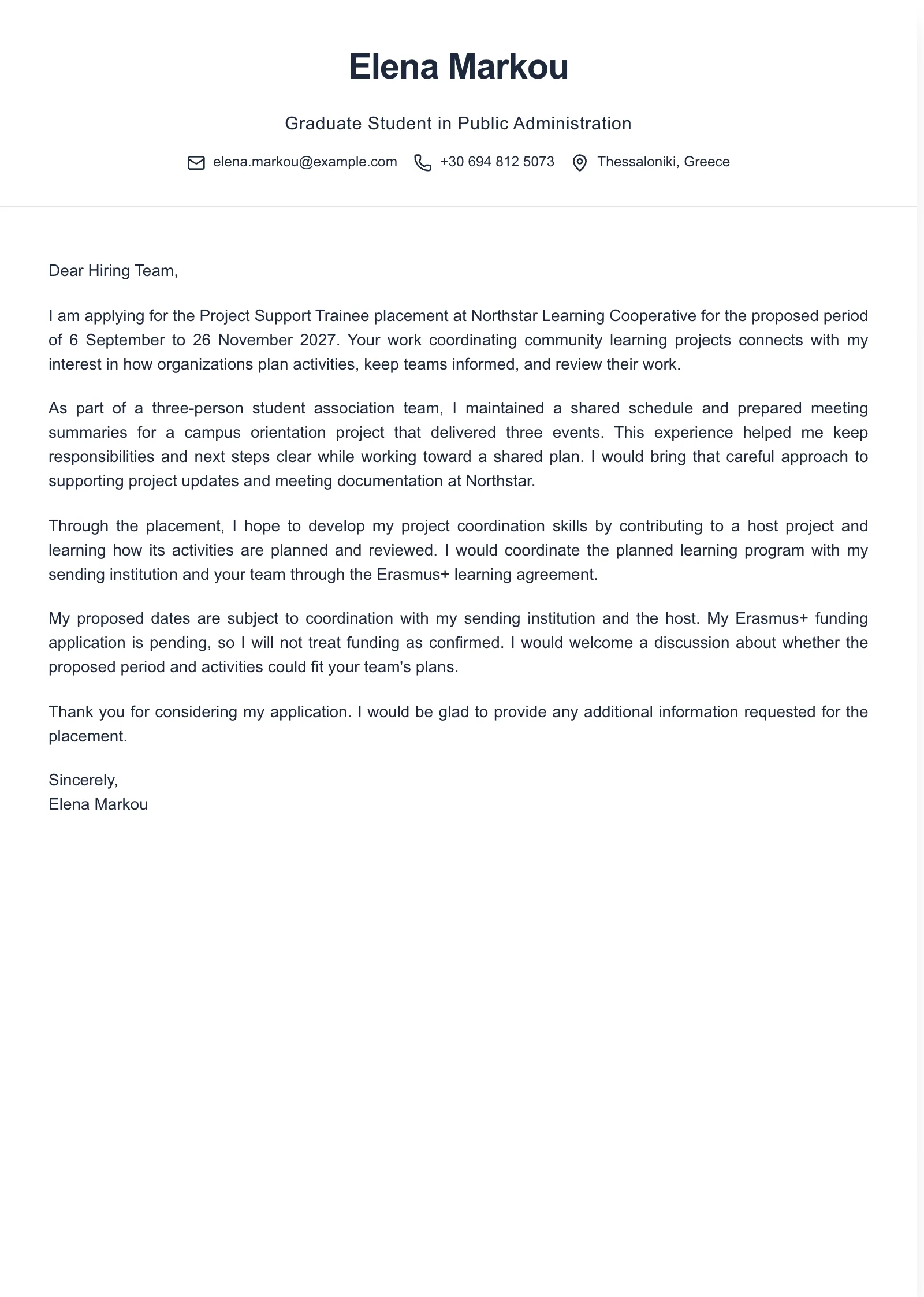
Example paragraphs
“I am applying for the [Job Title] placement at [Company Name] because its work on [specific host activity] connects with my learning aim of [accurate learning goal]. My experience with [relevant project or task] has prepared me to contribute while developing that skill.”
“In [course, project, or role], I [specific action] and [verifiable result or output]. During a placement at [Company Name], I hope to develop [specific skill] by contributing to [relevant host activity], with the planned learning program coordinated with my institution.”
“My proposed placement dates are [start date] to [end date], subject to [confirmation still needed]. My Erasmus+ funding status is [accurate status]. I would be glad to discuss coordinating the planned learning program with [Company Name] and my sending institution.”
Use these as paragraph models, not as a complete letter. Replace every placeholder with accurate details and follow the host's requested format. If dates or funding are unresolved, say so plainly. Treat the learning agreement as a way to set out the planned learning program, not as proof that the placement, its details, or funding have been approved.
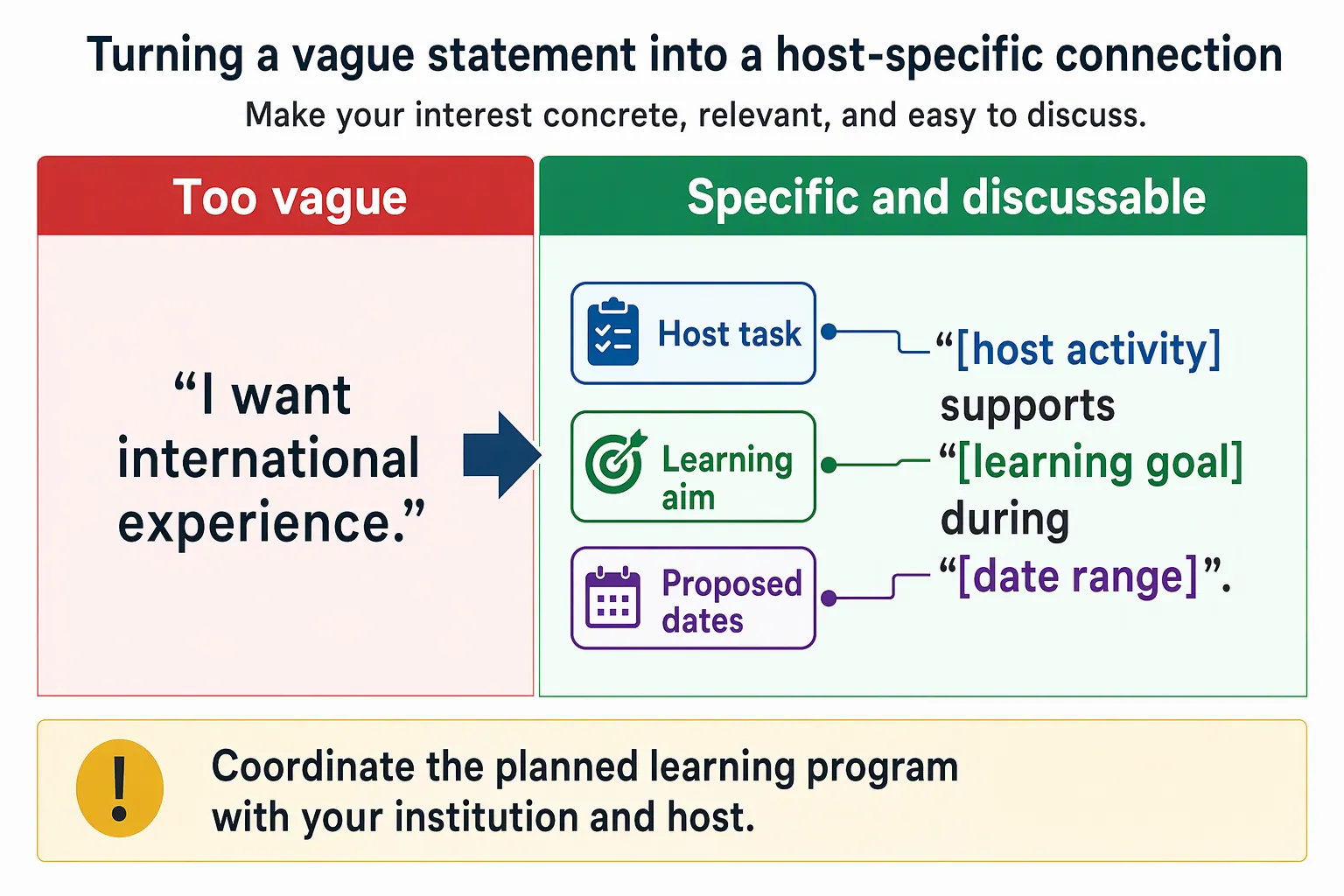
Scenario-specific mistakes in an Erasmus+ internship letter
Making pending funding sound confirmed
- What goes wrong
- Saying that an Erasmus+ grant will fund the placement can overstate a decision that is still pending.
- Better approach
- Use the status you can verify. If funding is not relevant to the host's planning, avoid adding an unnecessary claim.
Treating the learning agreement as an afterthought
- What goes wrong
- Describing the learning agreement only as paperwork can obscure the planned learning program and coordination with the institution and host.
- Better approach
- Connect a host activity to your learning aims, and explain that the plan can be coordinated with your sending institution and the host.
Focusing only on travel or personal growth
- What goes wrong
- Wanting an international experience does not explain your fit for this host or what you hope to learn through its work.
- Better approach
- Name a relevant host activity, connect it to a learning aim, and support your fit with a real example of your preparation.
Presenting provisional dates as settled
- What goes wrong
- Fixed-sounding dates can mislead the host when the proposed period still needs coordination or confirmation.
- Better approach
- Give the proposed period and identify what remains to be confirmed. Keep the dates consistent throughout your letter and application.
Frequently asked questions
- How is an Erasmus+ internship cover letter different from a general internship letter?
- The core task is similar: show why you fit the host's opportunity and support that fit with relevant evidence. This page focuses on making the proposed learning aims, dates, institutional coordination, and any funding status clear. There is no separate universal letter format.
- Should I mention Erasmus+ funding in the letter?
- Mention it if it affects the host's planning, and describe only the status you can verify. A pending application is not confirmed funding, and host interest does not guarantee selection or funding. Check with your sending institution if you are unsure what to say.
- Does a learning agreement guarantee funding?
- No. The learning agreement sets out a planned learning program coordinated by the institution and host. It does not, by itself, establish that funding or selection is confirmed. Check current program guidance with your institution.
- What if the host asks for a motivation letter instead?
- Follow the host's instructions and check what information it wants. The labels can overlap in use, so do not assume they require fundamentally different documents. Connect your relevant preparation to the host's planned work and explain your learning aims as requested.

Put this career change approach into practice
Choose sample data or build your own cover letter, then personalize it before you download.