
Introduction
A criminal record does not create one disclosure rule for every job application. An employer may ask a specific question on a form, request context later, or ask for an explanation in a letter. First identify what this employer is asking and where it asks you to respond.
Use the cover letter to show your fit for the work. If an explanation is requested, answer accurately and briefly in the requested place, then connect your qualifications to the position. Rules about criminal-record questions and hiring decisions vary by jurisdiction and situation. This is writing guidance, not legal advice.
What to address directly
A form question and a letter have different purposes
- Hiring manager concern
- Applicants may feel they should disclose a record in the letter to appear honest, even when the employer has not requested that information there.
- What your letter should prove
- Read the posting and application before drafting. If a form asks a question, check its wording and answer in the place the process specifies, as applicable. A letter is not a substitute for a separate form response. If the employer requests an explanation in the letter, keep it specific to that request. When the wording or your obligations are unclear, seek qualified local guidance.
Arrests and convictions are not interchangeable
- Hiring manager concern
- The broad phrase “criminal record” can hide important differences. An arrest is not the same as a conviction, and the exact wording of a question matters.
- What your letter should prove
- Do not label an arrest as a conviction or assume that every question covers the same information. In the United States, the EEOC discusses how arrest and conviction records may be considered under federal employment discrimination law. That guidance does not settle every state, local, or occupation-specific rule or determine an individual case.
The explanation should not replace your case for fit
- Hiring manager concern
- A long account can crowd out the qualifications an employer needs to assess. An answer that avoids a question the process asks may also leave it unanswered.
- What your letter should prove
- Keep the tasks distinct. Provide accurate information in the place and level of detail requested, as applicable. Use the rest of the letter for relevant skills, responsibilities, and evidence you can support. A fair-chance label does not tell you what a particular process requires or guarantee an outcome.
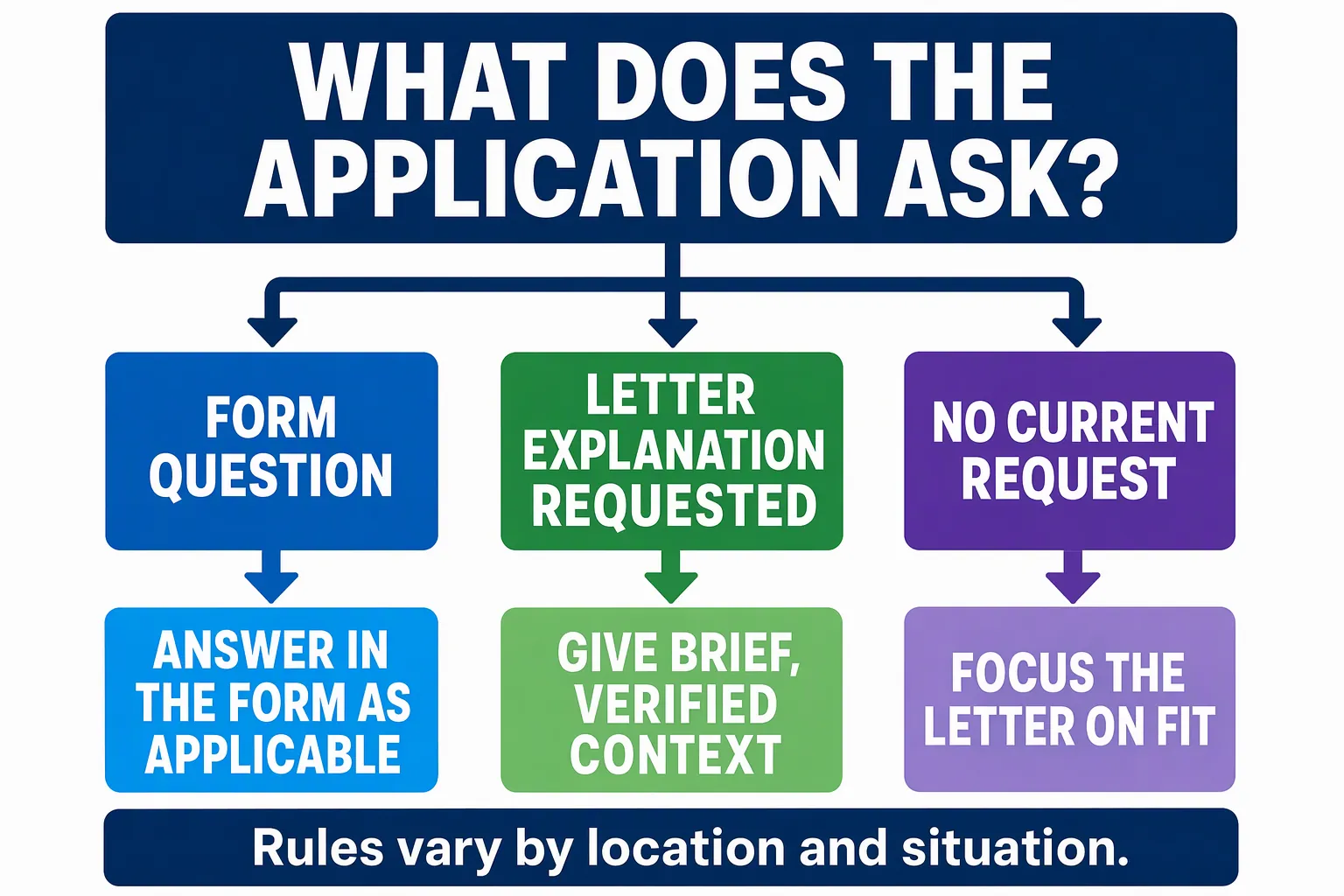
Structural approach: separate the answer from your case for fit
Build the letter around the employer's actual instructions. Put any response to a record-related question where the application requests it. Use the letter to explain your interest and show evidence that matches the position. If the employer specifically requests context in the letter, include a short factual statement rather than turning the whole letter into a defense.
Use this sequence to decide what belongs in each part:
- 01
Check the request
Review the posting and application for separate questions, requested documents, and instructions about where to provide context. Note whether the wording refers to arrests, convictions, or another defined scope. Do not assume similar wording means the same thing everywhere.
- 02
Choose the right place to respond
If a form asks for information, follow its instructions and answer accurately within the question's scope and applicable rules. Put a statement in the letter when requested or when you have a considered reason to address it. If you are uncertain about legal requirements, consult an appropriate local source.
- 03
Keep requested context factual
If asked for an explanation, use a few direct sentences. Include only relevant, verified facts and the outcome or completed steps that apply. Avoid minimizing the event, making excuses, sharing unrelated personal details, or promising an employer should overlook it.
- 04
Return to relevant evidence
Use the rest of the letter to address the position's stated needs. Choose a skill, responsibility, or result you can support. If the record relates to a duty in the job, do not make a broad claim that it is irrelevant. Address only what you can accurately explain, then show how your qualifications match the work.
Criminal record cover letter example
A fictional example of an applicant giving a brief, requested factual statement while keeping the letter focused on role-related evidence.
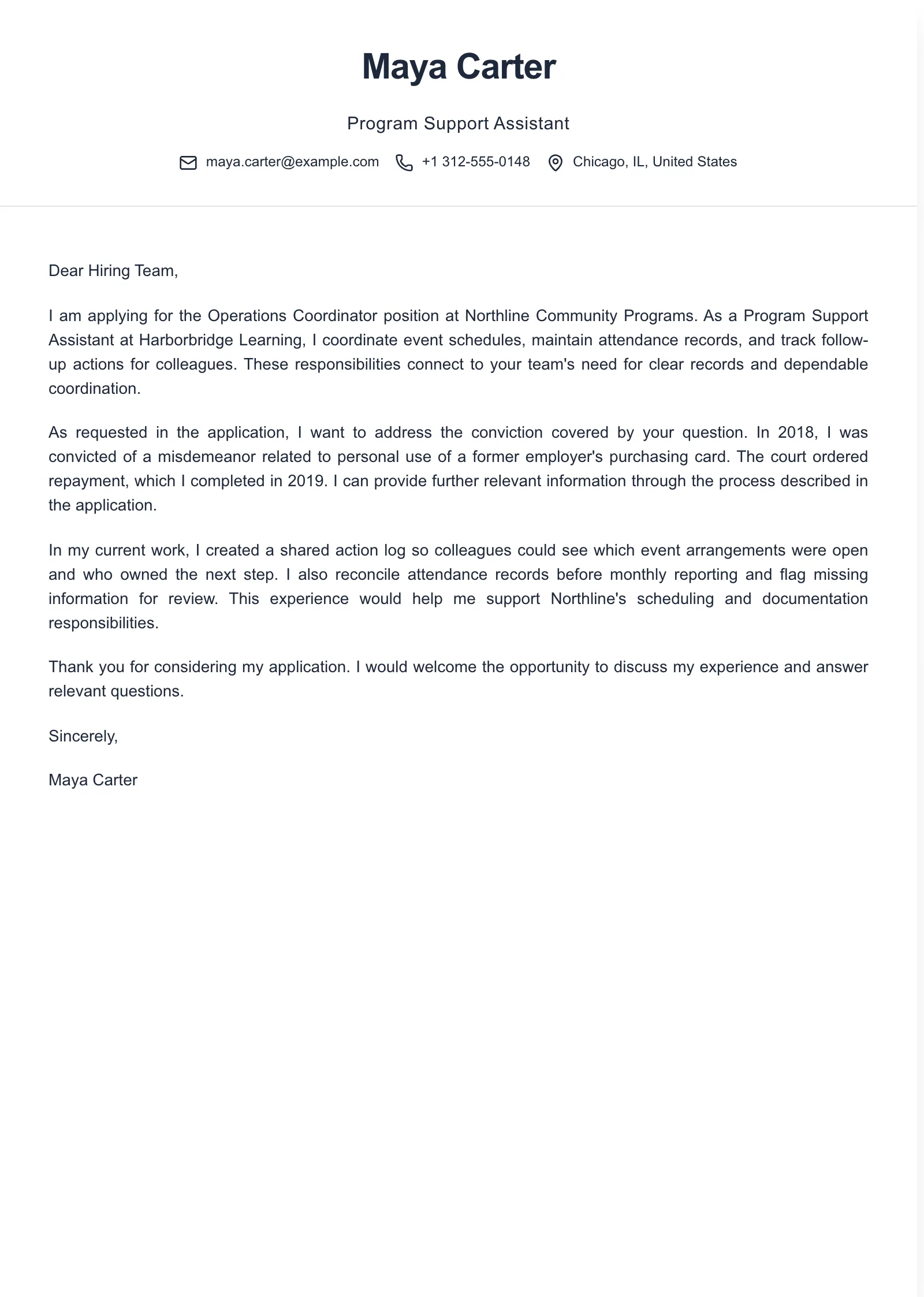
Example paragraphs
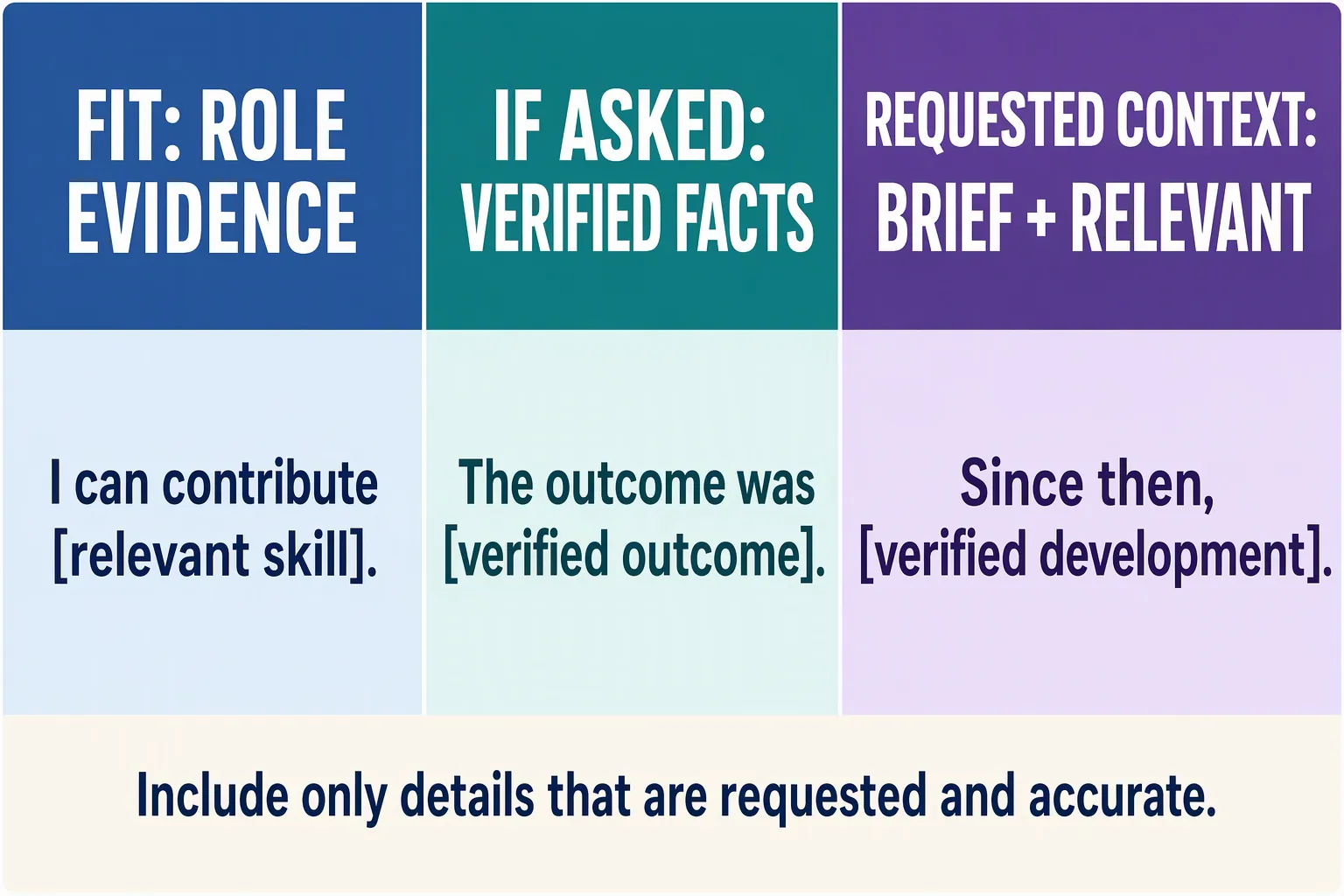
“I am applying for [Job Title] at [Company Name] because the position calls for [relevant skill]. My experience with [specific responsibility or verified result] shows how I could contribute to [stated need].”
“In response to the question about [the question's exact scope], I want to provide an accurate account: [brief factual description]. The outcome was [verified outcome], and I completed [applicable requirement or step] in [date or period]. I am applying for [Job Title] at [Company Name] with experience in [relevant skill or responsibility].”
“As requested, [brief, accurate statement about the relevant record and outcome]. Since then, [verifiable relevant development, if applicable]. For [Job Title] at [Company Name], I can point to [specific evidence] that matches [stated requirement].”
These are paragraph models, not facts to copy. Replace every placeholder only with information that is accurate and appropriate to the question. Leave out a development you cannot verify. Do not add details just to make an explanation sound more persuasive.
Scenario-specific mistakes to avoid in a criminal record cover letter
Disclosing by default
- What goes wrong
- Adding a record to the opening paragraph before checking the instructions can make the letter serve the wrong purpose.
- Better approach
- Review the request first. Put information where it is requested, as applicable, and use the letter for fit unless an explanation is requested or you have a considered reason to address it.
Answering a different question
- What goes wrong
- A vague statement may not answer a specific question. Calling an arrest a conviction is also inaccurate.
- Better approach
- Read the wording closely and respond truthfully within its scope. Distinguish the type of record, and seek qualified local guidance if you are unsure what applies.
Writing a defense instead of a concise explanation
- What goes wrong
- Long apologies, arguments about fairness, or unrelated personal details can obscure the requested facts and your qualifications.
- Better approach
- When context is requested, state relevant facts and the outcome briefly. Do not speculate about the employer's decision or promise that the record will never matter.
Assuming a fair-chance label guarantees an outcome
- What goes wrong
- A label does not establish that a record cannot be considered or that a particular applicant is eligible.
- Better approach
- Treat the label as context, not a guarantee. Check the employer's instructions and relevant official guidance for your jurisdiction and situation.
Frequently asked questions
- Do I have to mention a criminal record in my cover letter?
- Not automatically. Check the posting and application instructions for a question or a request to explain a record. If the employer asks for information in a separate form, respond there as applicable rather than assuming the cover letter is the right place. Rules vary by location and situation, so seek qualified local guidance if you are unsure what you must provide.
- What should I say if an application asks about a conviction?
- Read the question carefully, including its scope, and answer accurately under the applicable rules. If the process asks for context, keep it factual and brief: provide relevant information and the outcome, then return to evidence of your fit. Do not guess or add unrelated details.
- Should I explain an arrest the same way as a conviction?
- No. Arrests and convictions are different, and the question's wording matters. Rules about asking for or considering either can vary by jurisdiction and situation. Do not treat them as interchangeable; seek qualified local guidance if you are unsure how a question applies to you.
- Does a fair-chance employer have to ignore my record?
- A fair-chance label does not establish what a particular application asks, determine eligibility, or guarantee how a record will be considered. Review the employer's instructions and relevant official guidance for your location and situation.

Put this career change approach into practice
Choose sample data or build your own cover letter, then personalize it before you download.