
Introduction
A cover letter asking to move from contract or temporary work to a permanent role should connect what you have delivered for the client with the work you hope to do next. Your experience with the client gives you relevant context, but an assignment does not guarantee that a permanent position is available or that you will be selected.
Be accurate about who arranged your work, what you have done for the client, and what position you are asking about. The arrangement may involve a staffing partner or contracting company, and you may not be the client’s employee. State the relationship plainly, then keep the focus on your evidence and your request.
What to address directly
Will a request sound like an assumption?
- Hiring manager concern
- An assignment extension, positive feedback, or a busy team does not establish that a permanent position is available or that you are entitled to one.
- What your letter should prove
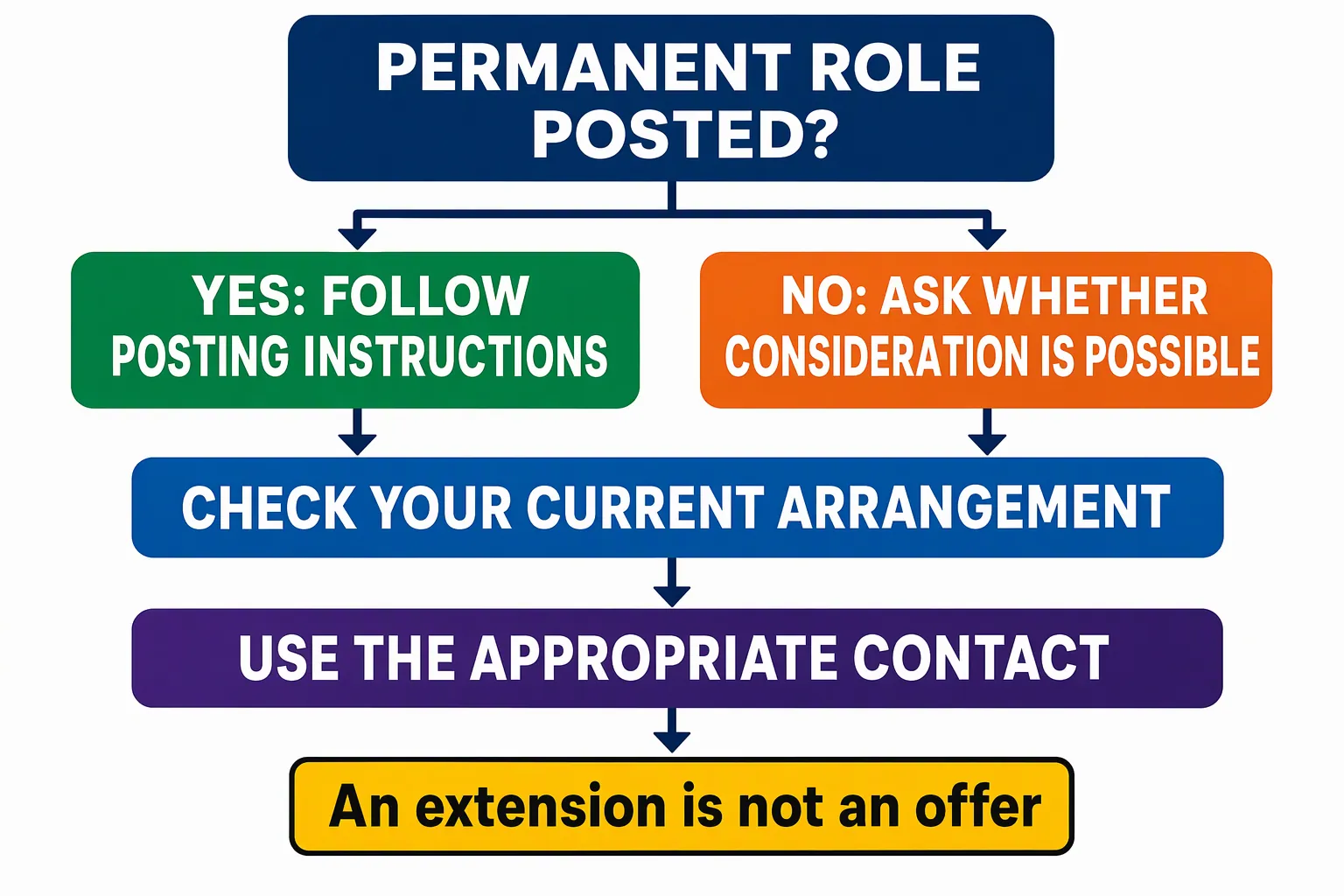
- Ask to be considered for a posted position, or ask whether a permanent opportunity may be discussed if no role is advertised. Keep your interest separate from any assumption about the outcome. If there is a formal posting, follow its application instructions.
How can you show your value without repeating your resume?
- Hiring manager concern
- A list of assigned tasks may explain what you did, but not what you contributed or why that experience connects to the permanent role.
- What your letter should prove
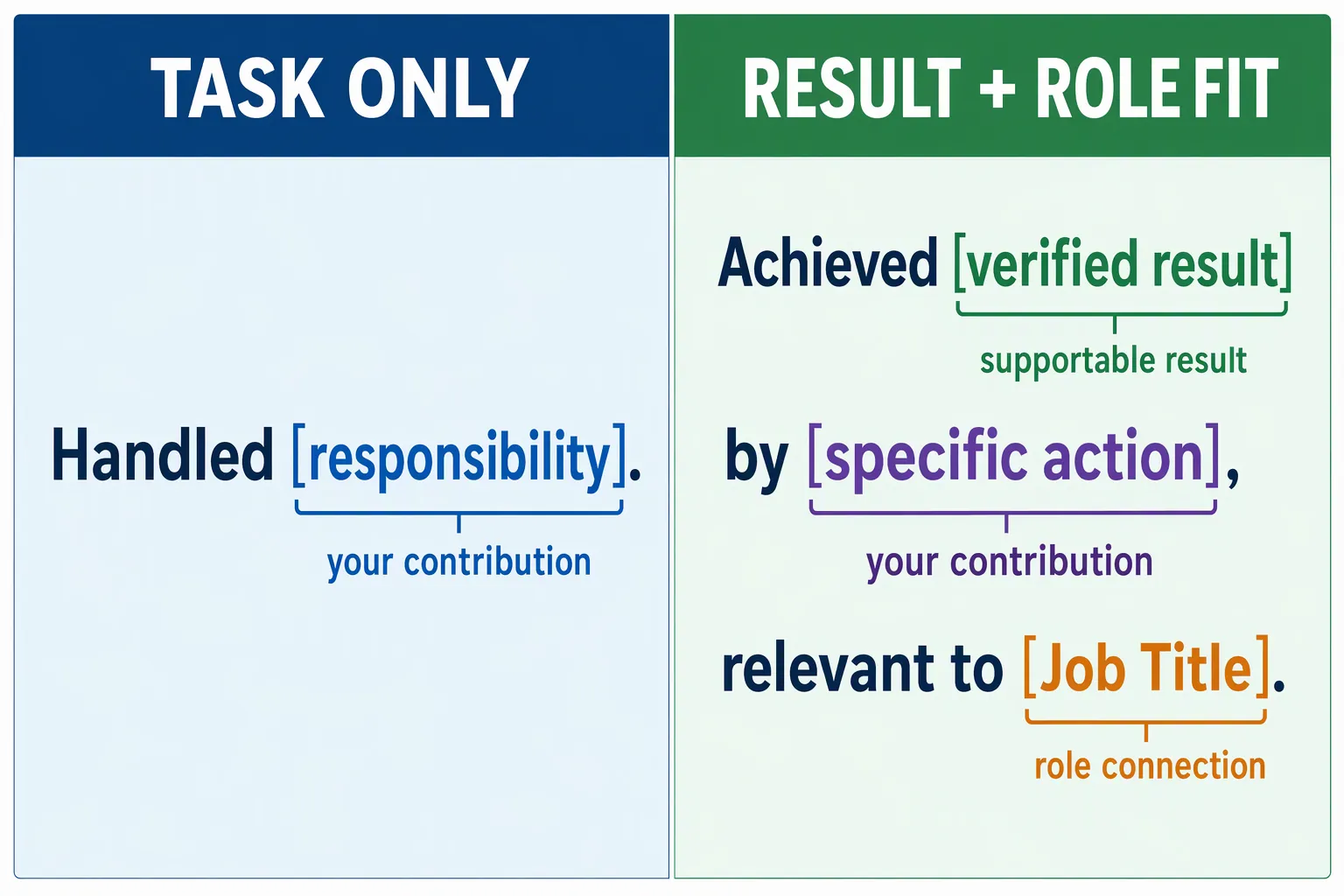
- Choose one or two verifiable outcomes. Describe your action and the result, then connect that evidence to a responsibility in the permanent role. Use figures only when you can explain how they were recorded and what part you played.
Who should receive the request?
- Hiring manager concern
- Your client contact, staffing partner, and contracting company may have different roles in discussing a possible move to permanent work.
- What your letter should prove
- Check the vacancy instructions and relevant terms of your arrangement. If the route is unclear, ask an appropriate contact who should receive your application before sending it. Do not suggest that anyone ignore an existing process or agreement.
Structural approach: connect your assignment to the permanent role
Use a short, tailored letter that names the permanent position and shows why your assignment experience is relevant. A standard cover letter structure can help organize the message. For this situation, make your current relationship with the client clear and include a direct request to be considered or to learn about the appropriate process.
Before drafting, compare the permanent role’s description with your assignment record. Separate work you completed from team outcomes, and leave out client information you are not permitted to share. If there is no posted opening, frame the letter as an inquiry about possible consideration, not as an application to a position you have not confirmed exists.
- 01
Name the role and your current arrangement
State the permanent [Job Title] you are asking about and identify your current temporary or contract assignment at [Company Name]. If a staffing partner arranged it, describe that relationship accurately. Avoid calling yourself an internal employee unless that description is correct.
- 02
Give evidence from the assignment
Choose one or two outcomes relevant to the permanent role. Explain what you did and what changed, using a concrete deliverable or documented result where possible. If the work was shared, say what you contributed rather than presenting the team’s entire result as your own.
- 03
Explain why continuing fits
Connect your assignment experience to a responsibility or priority stated in the permanent role description. Focus on the work you could take on next, not only praise for your past work. Do not imply you know the client’s future plans unless they have been shared with you.
- 04
Make a direct, process-aware request
Ask to be considered for the posted position or invite a discussion about the right way to express interest. Follow the posting instructions and check the appropriate route if you are unsure. Offer to discuss your experience and transition details without assuming an offer or promising a start date.
See a contract-to-permanent example
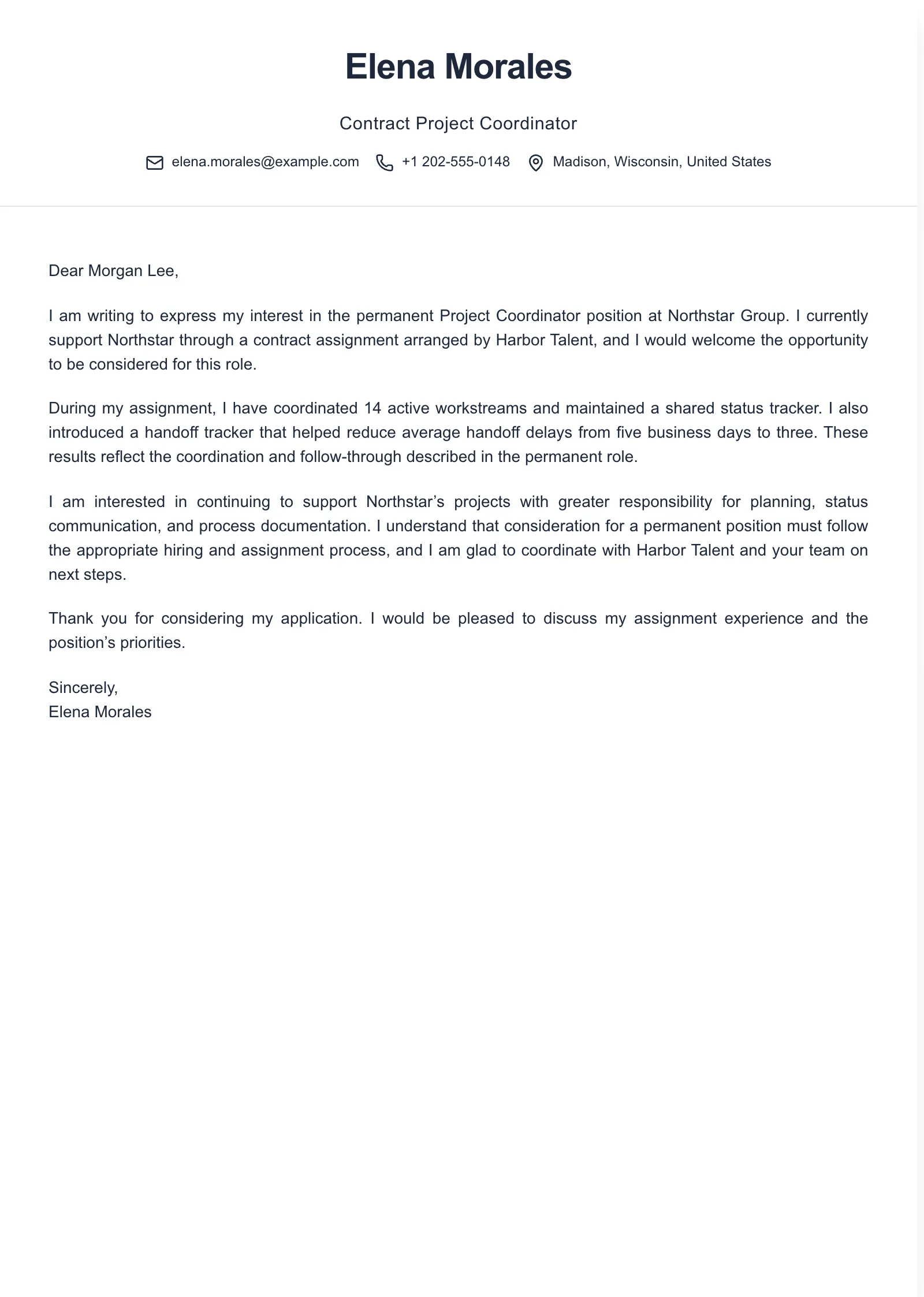
This fictional example connects an existing assignment, specific results, and a respectful request to be considered for a permanent role.
Example paragraphs
“During my assignment with [Company Name], I have supported [specific responsibility or deliverable]. I would welcome consideration for the permanent [Job Title] role because [factual reason the ongoing work fits my experience].”
“Since joining [Company Name] as a temporary or contract worker, I [verified result] by [specific action]. This experience would help me contribute to the permanent [Job Title] role, particularly with [priority named in the posting].”
“I would like to be considered for the permanent [Job Title] role at [Company Name]. I am available to discuss [relevant transition detail] and will follow [appropriate application or staffing process] for next steps.”
Replace every bracket with a fact you can support. If you do not have a measurable result, name a concrete deliverable or responsibility instead. Protect confidential client information, describe your contribution accurately, and make sure the letter reflects whether you are a contractor, agency worker, or temporary employee.
Scenario-specific mistakes
Treating an extension as a promise
- What goes wrong
- Writing as if a positive assignment or an extension means the client must offer you a permanent role can make your request sound presumptive.
- Better approach
- State your interest and ask to be considered. Refer to a posted opening when one exists, and do not present the outcome as decided.
Listing duties without outcomes
- What goes wrong
- Repeating a task list does not show what you contributed or how your experience relates to ongoing work.
- Better approach
- Choose a relevant result or deliverable, clarify your role in it, and connect it to a responsibility in the permanent position.
Using the wrong contact route
- What goes wrong
- Contacting someone who does not handle applications, or implying that a staffing arrangement should be ignored, can create confusion.
- Better approach
- Check the vacancy instructions and relevant terms of your arrangement. Ask an appropriate client contact or staffing partner about the correct route if it is unclear.
Overstating your contribution or availability
- What goes wrong
- Claiming team results as your own, sharing restricted details, or promising a start date without confirmation can undermine trust.
- Better approach
- Use facts you can support, protect confidential information, and offer to discuss transition details instead of making commitments you cannot confirm.
Frequently asked questions
- Should I wait for a permanent role to be posted?
- Check the client’s stated hiring process and the relevant terms of your current arrangement. If a role is posted, follow its instructions. If no role is posted, you can ask your client contact or staffing partner whether consideration may be possible and how to express interest. An informal conversation does not replace a formal application when one is required.
- Should I mention my staffing agency or contracting company?
- If a staffing partner or contracting company arranged your assignment, describe that arrangement accurately and use the appropriate contact route. If you are unsure how a possible move to a permanent role is handled, ask the relevant contact rather than assuming you can bypass the arrangement.
- What results should I include?
- Choose one or two specific results you can explain and support, such as a completed deliverable, a resolved process issue, or a documented improvement. Respect confidentiality, and distinguish your own contribution from the work of the wider team.
- Is this the same as applying for an internal position?
- Not necessarily. A temporary worker or contractor assigned to a client may not be that client’s employee. Describe your actual arrangement and follow the process that applies to it. An employee applying for another role inside their organization may face different eligibility and communication steps.

Put this career change approach into practice
Choose sample data or build your own cover letter, then personalize it before you download.