
Introduction
A cover letter for a contract job should help the reader assess two things: how your evidence relates to the stated work, and whether practical details you can confirm fit the posting. Start with the scope of this contract, not a generic claim that you are flexible or hardworking.
The word “contract” does not, by itself, explain every term or establish a worker's legal status. A posting may describe a fixed period, defined deliverables, or an arrangement that needs clarification. Use the employer's wording rather than assuming the role is freelance work.
The usual cover letter structure still applies. For this scenario, give particular attention to the stated scope, related evidence, and any availability or rate details the posting requests.
What to address directly
What scope and terms does the posting state?
- Hiring manager concern
- A contract label alone may leave important details unclear. Treating every contract as a freelance project, or assuming an unmentioned extension, can make your letter inaccurate.
- What your letter should prove
- Check the stated responsibilities, deliverables, duration, schedule, and application instructions. Use those details as your boundaries. Separate what the posting confirms from what you would need to ask about, and do not make claims about legal classification.
What evidence matches the work?
- Hiring manager concern
- A general statement about adaptability does not show which part of the contract's scope you can handle. The reader needs a relevant, supportable example.
- What your letter should prove
- Choose one or two examples tied to a task, workflow, or handoff in the posting. Describe what you did and the factual output. Include a result only if you can support it, and do not imply experience with a deliverable you have not completed.
What practical details can you confirm?
- Hiring manager concern
- Start dates, schedules, duration, and rates may affect fit, but a guess can create a commitment you cannot honor. Omitting a detail requested in the application can also leave it incomplete.
- What your letter should prove
- Answer requested questions directly and state only confirmed availability. Give a rate in the requested unit if asked. If the posting leaves an important term unclear, seek clarification through the appropriate channel instead of presenting an assumption as agreed.
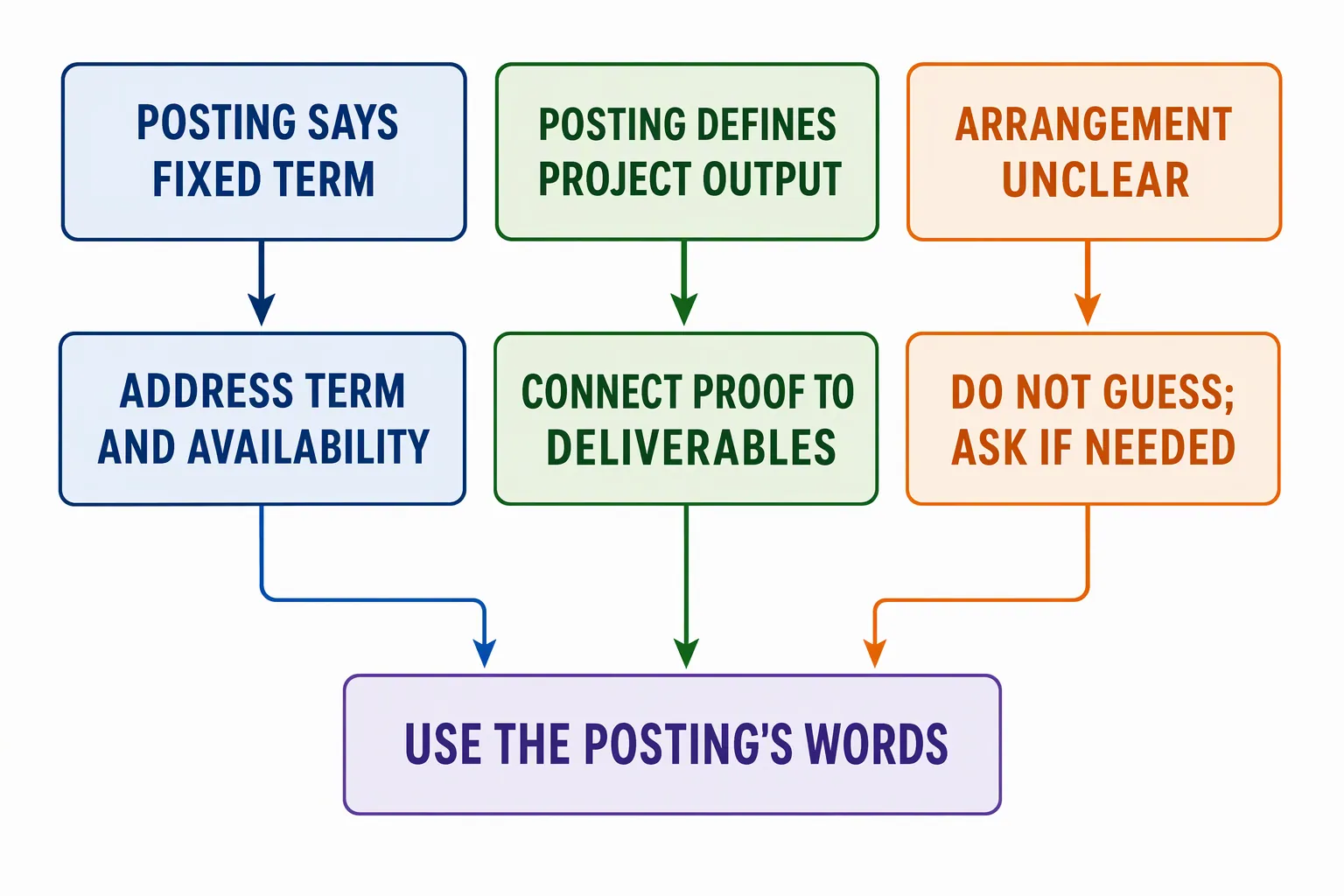
Structural approach: connect the stated scope to your evidence
Make the contract's boundaries easy to see. Identify the role and the work that interests you, connect relevant evidence to that work, then address the practical details the posting asks about. Each paragraph should help the reader assess this engagement, rather than make a broad case for your entire career.
Before drafting, sort details into two groups: what the posting states and what remains unknown. A listed duration is a stated term; an unmentioned extension is not. A requested rate is an application detail; an unrequested rate is not automatically useful. Apply this distinction throughout the letter. For a renewal, use the same approach with the next contract's stated scope and your current-term evidence.
- 01
Identify the stated scope
Note the main responsibilities, deliverables, duration, schedule, and application requirements. If the posting names a particular arrangement, use its wording. Do not substitute a freelance proposal or other work model unless the employer asks for one.
- 02
Choose relevant evidence
Select one or two truthful examples that show you can handle a related task or process. Name your action and the factual output. Keep the detail specific enough to show the connection, but leave out invented metrics or unsupported claims.
- 03
State confirmed availability
Give a start date or schedule when it is accurate and useful. If asked about a defined term, say whether you can commit to it. Do not promise an extension or availability beyond what you can confirm.
- 04
Address requested terms and close
If asked for a rate, use the requested unit and relate it to the scope you understand. If a necessary term is missing, ask through the appropriate channel. Close by restating your interest in the defined work, without adding conditions the posting does not support.
Contract Role Cover Letter Example
A fictional example connecting relevant work, a stated contract scope, and confirmed availability.
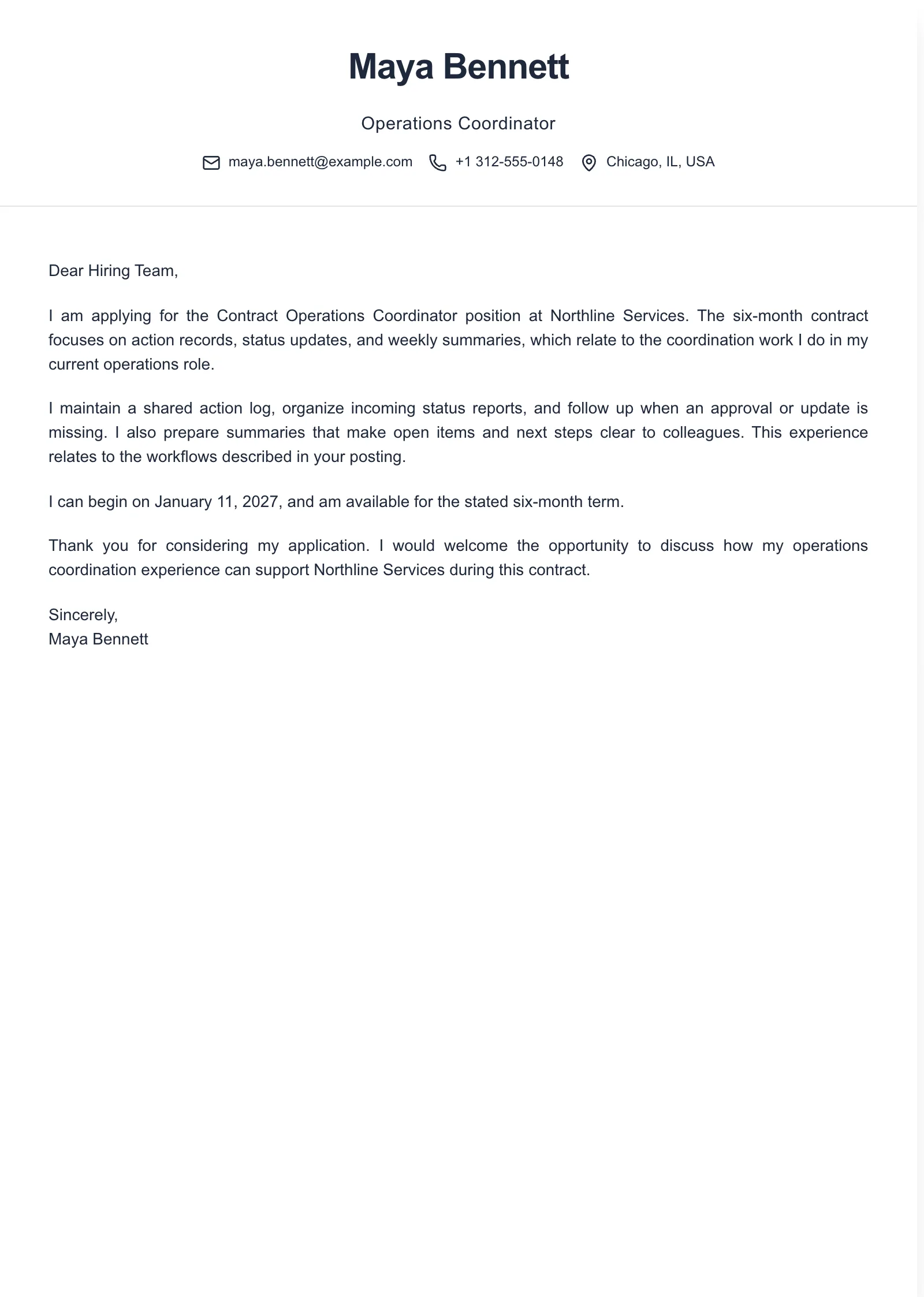
Example paragraphs
“I am applying for [Job Title] at [Company Name] because the contract focuses on [specific responsibility or deliverable from the posting]. In [relevant role or project], I [verifiable action] and produced [factual output], experience I can bring to this work.”
“For [related task], I [specific action] using [relevant process or tool], producing [factual outcome or completed deliverable]. That experience relates to [responsibility named in the posting] for the [Job Title] role at [Company Name].”
“I can begin on [confirmed date] and am available for [stated schedule or contract term]. As requested, my rate is [amount and unit] for [defined scope]. I would welcome the opportunity to discuss the [Job Title] contract with [Company Name].”
Use these as adaptable paragraphs, not as a complete letter. Replace each bracket with a fact from the posting or your own record, and remove anything that does not apply. An application letter and a cover letter can refer to the same task here: follow the employer's requested format. A contract role application is not automatically a freelance proposal. Do not add a bid, project plan, or rate unless the posting asks for it. If the employer requests separate answers or documents, provide them as instructed rather than assuming the letter replaces them.
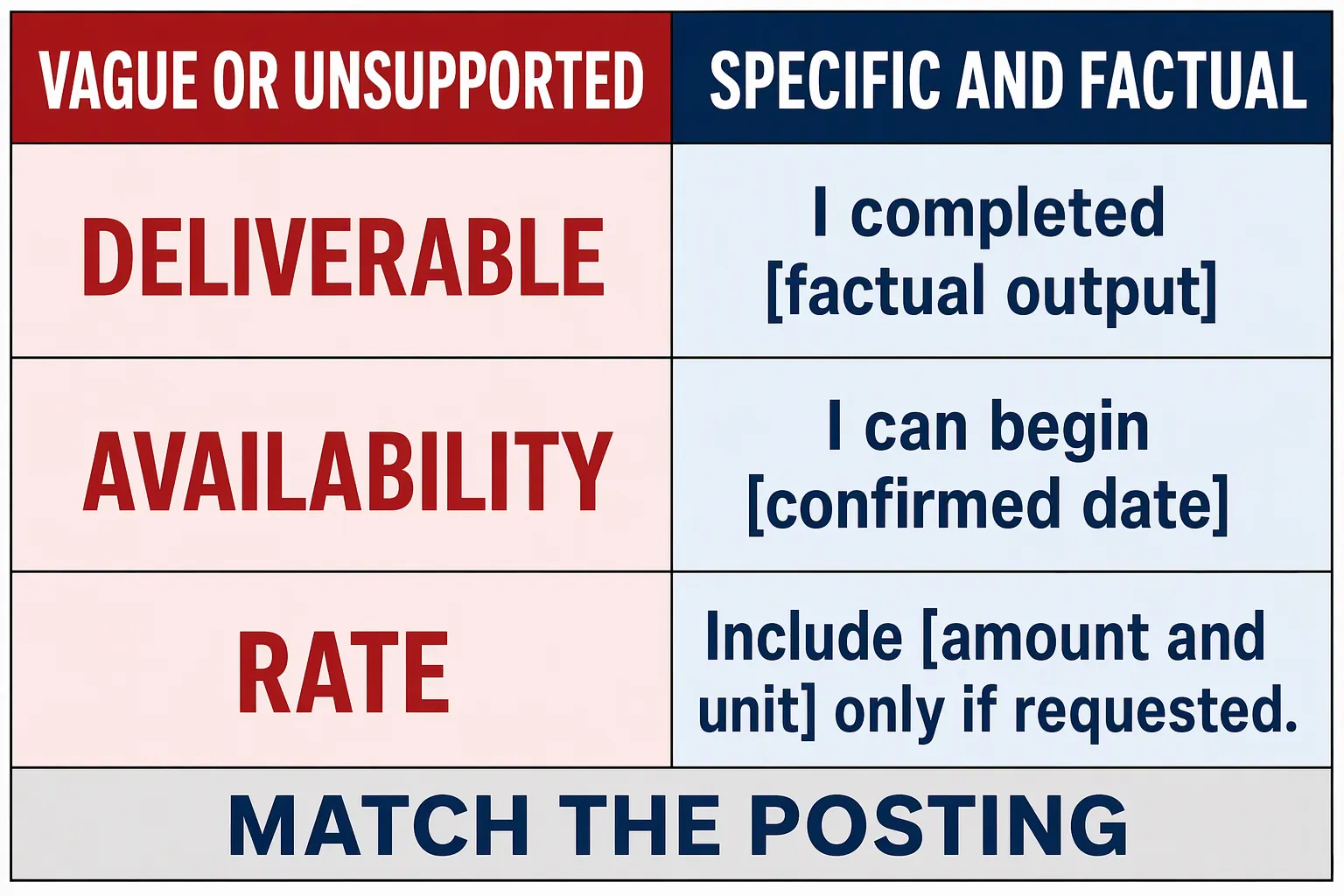
Common mistakes in a contract role cover letter
Treating every contract as a freelance bid
- What goes wrong
- A project quote or sales pitch may not fit a posting for a role with employer-defined responsibilities and a stated term.
- Better approach
- Follow the posting's description. Address its responsibilities and requested terms without assuming the role is freelance work.
Making broad claims without delivery evidence
- What goes wrong
- Saying you can hit the ground running or adapt quickly does not show why your experience fits the contract's scope.
- Better approach
- Describe a related task you completed, what you did, and the factual output. Keep the example connected to work named in the posting.
Promising dates or capacity you cannot confirm
- What goes wrong
- An unsupported start date, schedule, or promise to stay beyond the stated term can create a misleading expectation.
- Better approach
- State only confirmed availability. If you need clarification about a schedule or duration, ask rather than presenting an uncertain detail as a commitment.
Adding a rate before the scope is clear
- What goes wrong
- An unsolicited figure may distract from your fit or leave unclear whether it is hourly, daily, or for the whole project.
- Better approach
- Give a rate when requested, use the requested unit, and relate it to the scope you understand. Ask about missing details through the appropriate channel.
Frequently asked questions
- Is a contract role the same as freelance work?
- Not necessarily. A posting may describe a fixed-term role, work organized around deliverables, or another arrangement. Its label alone does not establish the legal classification or full terms. Follow the posting's wording and ask for clarification if an important detail is unclear.
- Should I state when I can start and when I can finish?
- Give dates or availability when they are accurate and relevant to the stated contract. If the posting asks whether you can commit to a defined term, answer directly. Do not promise a date, schedule, extension, or end date you cannot confirm.
- Should I include my rate in a contract job cover letter?
- Include a rate when the posting or application asks for one. Use the requested basis, such as hourly, daily, or project-based, and make sure it reflects the scope you understand. If the scope is unclear, ask through the appropriate application channel rather than guessing.
- Can I reuse the letter when applying for a contract renewal?
- Update it for the renewal decision. Point to relevant work completed during the current term, address the next contract's stated scope, and confirm your availability. Do not assume that the earlier duration, terms, or rate will continue.

Put this career change approach into practice
Choose sample data or build your own cover letter, then personalize it before you download.