
Introduction
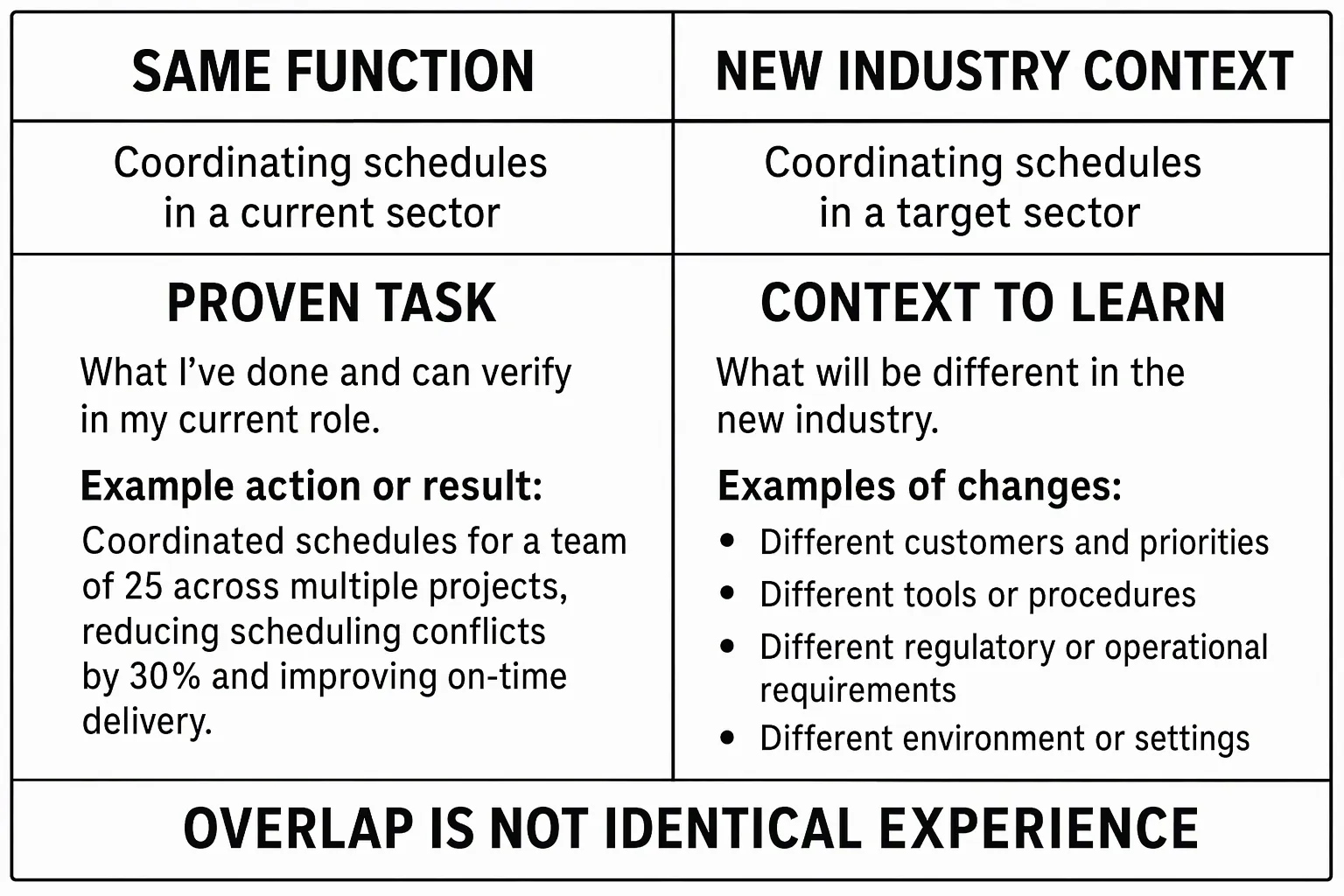
When you want to do similar work in a different industry, your cover letter needs to make two things clear: what experience carries over, and what you understand about the new setting. A list of transferable skills does not explain how your past work connects to this particular role.
Keep the overlap and the difference in view. You may have performed a similar function, while the customers, processes, and context are new to you. Explain what you can already do, then connect it to the employer's stated needs without suggesting that the industries are interchangeable. The terms career change and industry change can overlap; this guide focuses on a move where the function stays similar.
What to address directly
Will my experience look unrelated?
- Hiring manager concern
- Someone reviewing your application may not immediately see how a familiar role in a different sector connects to this opening. Broad claims such as being adaptable leave that connection unexplained.
- What your letter should prove
- Choose a task that matters in both settings. Describe what you did, its scope, and a result you can support, then connect it to a responsibility in the posting. Be precise about the overlap rather than suggesting the work is identical. This guide to mapping transferable skills to a target role can help you identify a relevant connection.
What do I know about the new sector?
- Hiring manager concern
- Experience in the same function does not, by itself, show that you understand the employer's services, customers, or operating context. General enthusiasm does not make that understanding specific.
- What your letter should prove
- Refer to one verified detail about the employer or sector and explain why it matters to the work in this role. You might draw on the posting, the organization's public information, or reliable sector research. Describe research as learning, not as a substitute for hands-on experience.
How do I avoid overstating my experience?
- Hiring manager concern
- Trying to sound like an insider can blur the difference between skills you have used and sector knowledge you are still developing.
- What your letter should prove
- Keep your past job titles and responsibilities accurate. Separate what you have done from what you have learned and what you would need to learn on the job. Support your fit with a specific example instead of claiming broad familiarity with the new sector.
Structural approach: connect familiar work to a new context
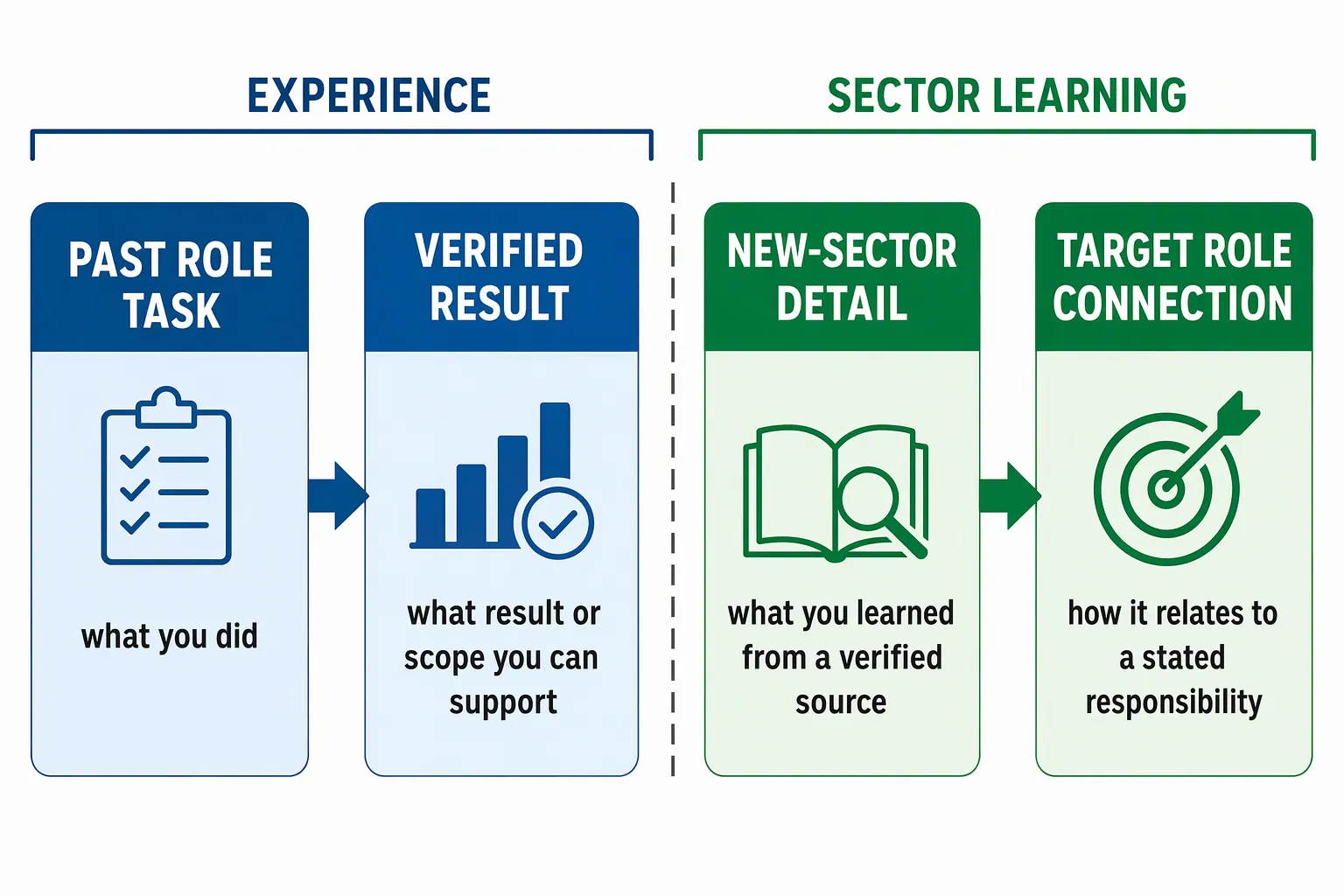
Build the letter around the actual transition: your function is familiar, but the setting is new. Start with a specific reason this employer or role interests you. Then give one relevant example of work you have done and explain how it connects to a responsibility in the posting.
Next, show what you have learned about the new sector and why that context matters to the role. Use the job description to identify relevant responsibilities and language. The cover letter structure guide offers general paragraph guidance; keep the evidence and sector connection specific to this transition.
- 01
Name the transition plainly
Say that you are moving from [Current Industry] into [Target Industry] while continuing in [Job Title] work. Give a truthful reason this employer or sector interests you. Avoid presenting the change as effortless or claiming that the industries are interchangeable.
- 02
Choose one comparable responsibility
Find a responsibility in the posting that resembles work you have actually done. Describe the task, what it supported, and a result or scope you can verify. If you do not have a reliable metric, explain the process or responsibility accurately rather than inventing a number.
- 03
Show what you have learned about the sector
Select one verified detail about the employer or target industry and explain why it matters to the role. Keep research, coursework, or personal exposure separate from professional experience. Do not claim a credential, work history, or sector knowledge you cannot support.
- 04
Connect your evidence to the opening
Explain how an established skill could help with a stated responsibility at [Company Name]. If you identify a new process or knowledge area to learn, name it only when it is relevant to the opening. Keep the connection realistic and based on the posting.
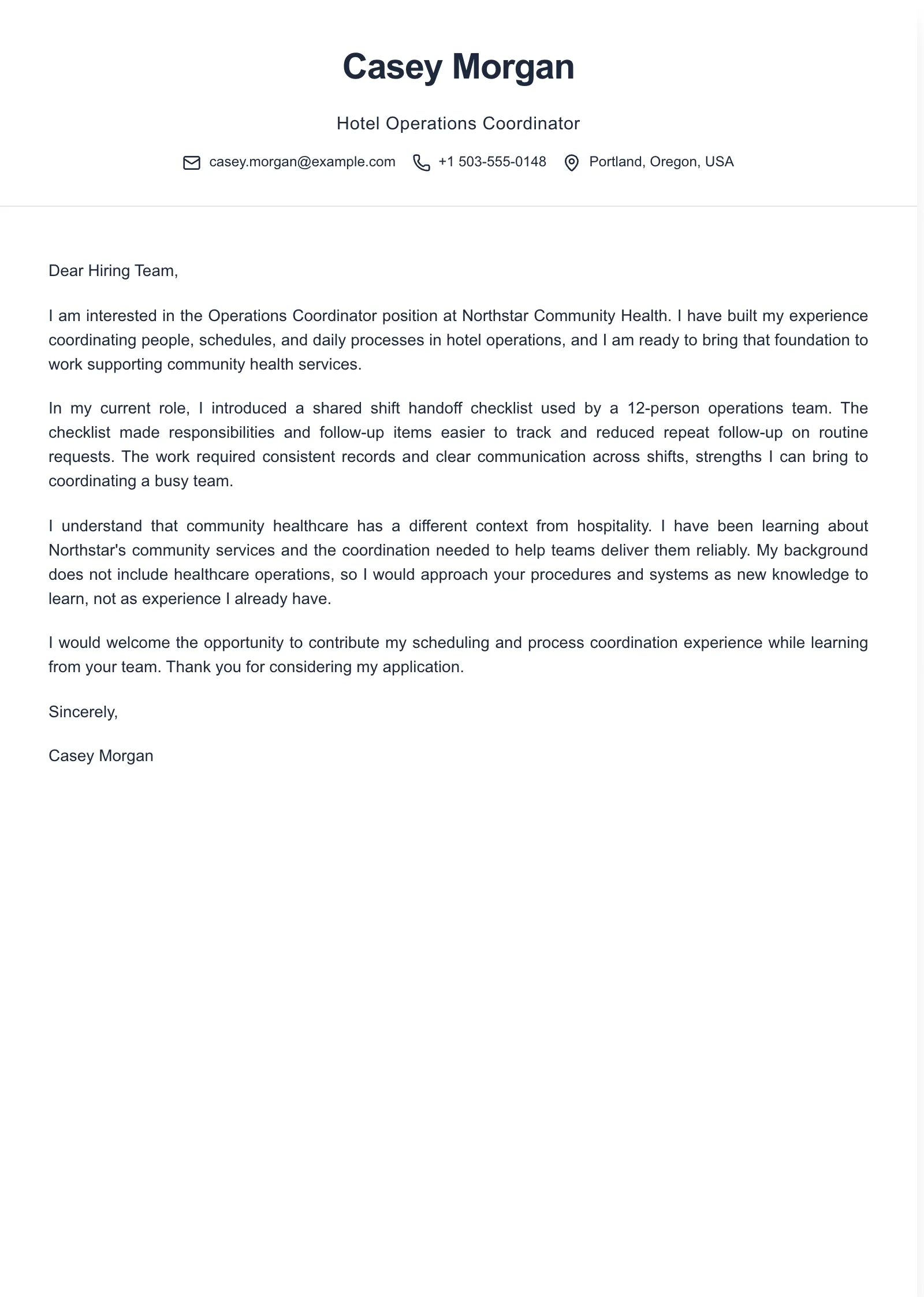
See a same-role industry transition
This fictional example follows an operations coordinator moving from hospitality into community healthcare. It separates prior coordination experience from healthcare knowledge the applicant is still building.
Example paragraphs
“I am applying for the [Job Title] role at [Company Name] because [specific, verified reason this employer or sector interests you]. My experience in [Current Industry] has centered on [relevant responsibility], and I am interested in applying that work in a setting shaped by [specific target-sector context].”
“In my [Current Industry] role, I [specific task] for [people, process, or service], using [relevant method or tool] to achieve [factual result or scope]. This connects to the [specific responsibility] in the [Job Title] posting because [explain the overlap]. I understand that the target sector has its own procedures and expectations.”
“I have been learning about [verified feature of the target sector or employer], especially how it affects [specific responsibility]. At [Company Name], I would bring my experience with [transferable skill] while learning [relevant sector-specific process or knowledge] from the appropriate team and guidance.”
Use these as paragraph patterns, not finished claims. Replace every bracket with information you can support, and remove anything that does not match your experience or the posting. Make the connection between your past work and this new setting explicit.
Common mistakes when changing industries
Using only transferable-skill labels
- What goes wrong
- Saying you are adaptable or organized does not show how your work connects to the target role.
- Better approach
- Describe a specific responsibility, your contribution, and a result or scope you can support. Then connect it to a responsibility in the new role.
Treating the industries as identical
- What goes wrong
- A similar task may involve different customers, procedures, or context in another sector.
- Better approach
- Explain the useful overlap, then acknowledge what is new. Show what you have learned without presenting research as work experience.
Overexplaining why you are leaving
- What goes wrong
- A long account of dissatisfaction with your current industry can distract from the fit between your experience and the new role.
- Better approach
- Give a concise, forward-looking reason for the move. Use the rest of the letter to connect your evidence and sector learning to the posting.
Changing titles or stretching sector experience
- What goes wrong
- Changing an original job title or implying that you have worked in the target industry can misrepresent your record.
- Better approach
- Keep titles and experience accurate. Explain the relevance in your own words, and distinguish proven skills from knowledge you are still developing.
Frequently asked questions
- How do I write a cover letter when changing industries but keeping the same role?
- Explain why the target employer or sector interests you, then connect a relevant responsibility from your current work to a responsibility in the posting. Add a specific, verified detail that shows what you have learned about the new context. Keep that learning distinct from hands-on experience.
- Should I say that I have no experience in the new industry?
- If your lack of experience in the sector is relevant, be clear about it without making it the focus of the whole letter. Pair that point with evidence of the function you have performed and an accurate example of how you are learning about the new context.
- Is changing industries the same as a career change?
- The terms can overlap in everyday use. This page focuses on the specific case where your function stays similar while the industry changes. A career change can also involve moving into a different function, which calls for different evidence.
- How can I show I understand the new industry without pretending to have worked in it?
- Use a specific detail you have verified about the employer, its services, customers, or stated priorities. Explain why it matters to the role, and describe it as research or learning rather than professional experience.

Put this career change approach into practice
Choose sample data or build your own cover letter, then personalize it before you download.