
Introduction
A career change cover letter can explain your move even when you have not held a role in the target field. The aim is not to disguise that gap. Explain why you are pursuing this work, what you have done to prepare, and how that evidence connects to [Job Title] at [Company Name].
This guide focuses on a career change with no direct experience in the new work. Build your case from relevant learning, projects, volunteering, or responsibilities from another setting. The guide to mapping transferable skills can help you identify useful connections; explain the evidence and its limits in your letter.
What to address directly
Your work history may not show the target work
- Hiring manager concern
- When your past roles differ from the advertised work, the connection may not be obvious. Saying only that you are passionate or a fast learner does not show what you have practiced.
- What your letter should prove
- Give a specific reason for the move, then describe a task you have practiced through a project, course, volunteer responsibility, or related work. Identify where the experience came from.
Learning alone may not show what you can do
- Hiring manager concern
- A course name or certificate shows what you studied, but may not tell the reader how you applied it.
- What your letter should prove
- Pair the learning with an action or output: a project you completed, a process you practiced, or a group you supported. Describe only work you actually did and can discuss.
Explaining the past can crowd out your preparation
- Hiring manager concern
- A long explanation of why you are leaving an old role, field, or employer can take attention away from the work you are moving toward.
- What your letter should prove
- Keep the explanation forward-looking. Connect a genuine interest in the new work to preparation you have already begun; you do not need to argue against your previous career.
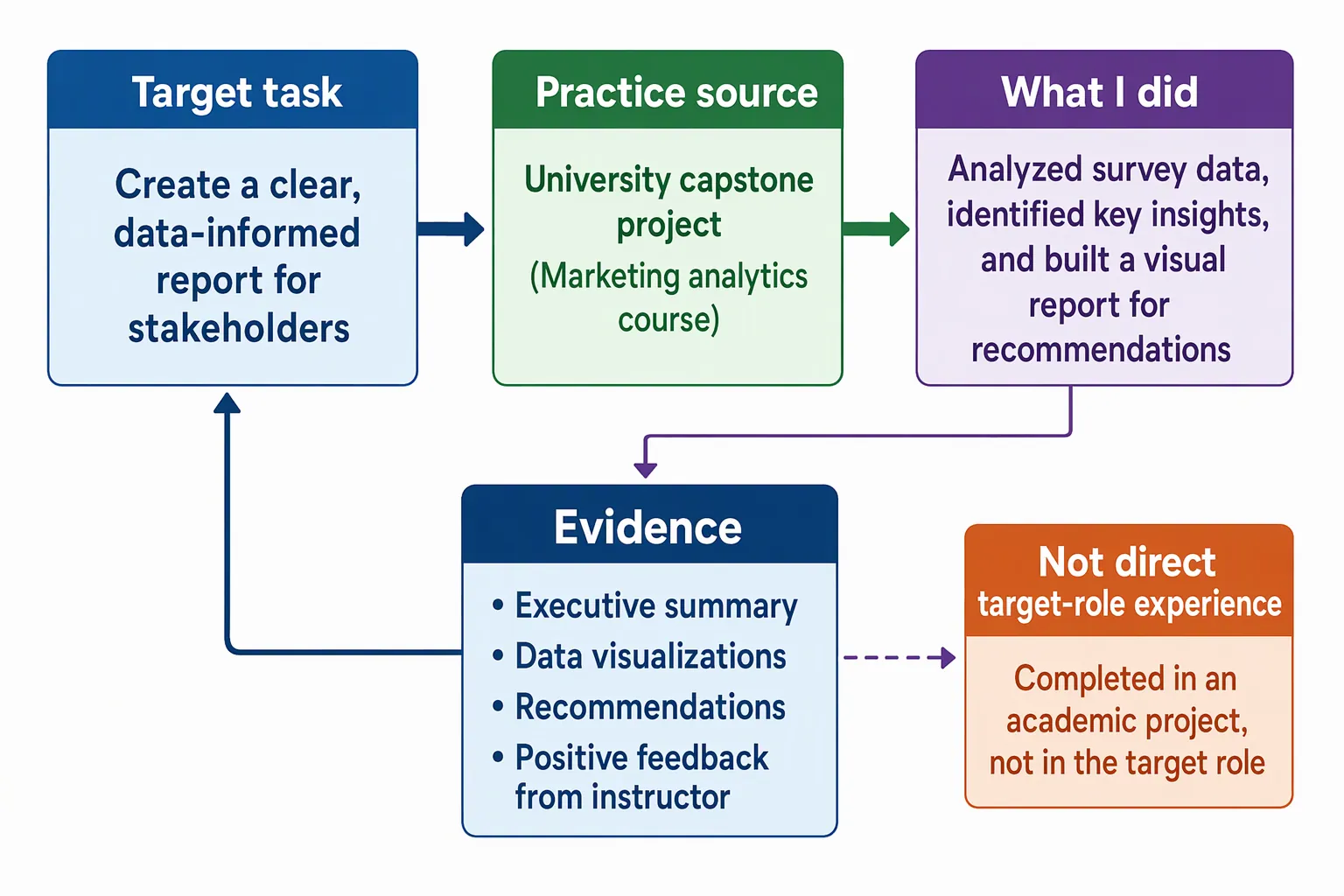
Structural approach for a career change with no direct experience
Build a clear chain of reasoning: name the work you are pursuing, show how you prepared, and connect that preparation to a task or priority in the posting. Make clear what you learned, what you practiced, and what you can contribute now. Do not describe a course project as professional experience or turn a volunteer responsibility into a job title.
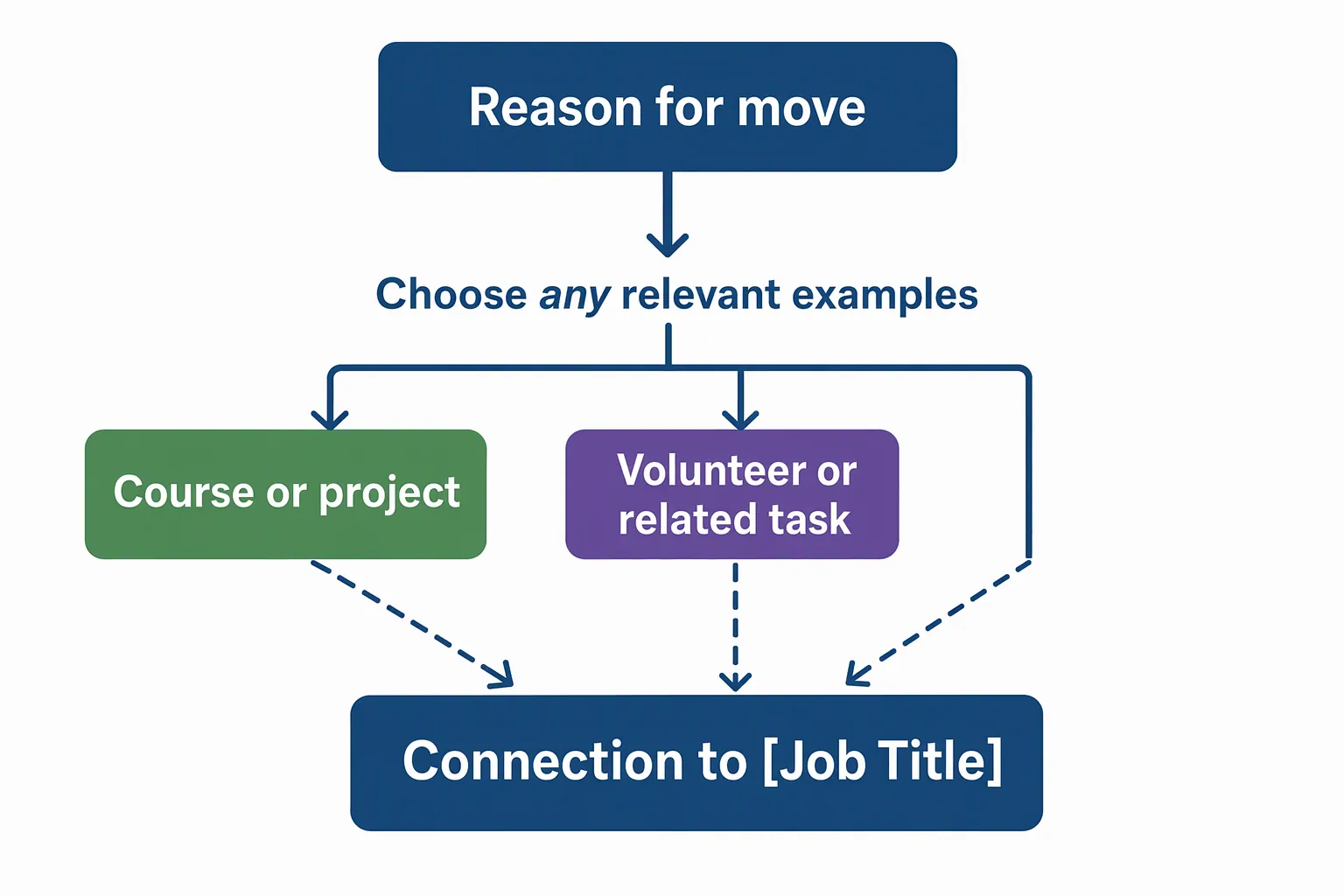
Give each paragraph a distinct purpose: explain why this work, show a relevant action you have taken, and connect it to this role. This keeps your evidence from getting lost in repeated claims about motivation or a list of skills without examples.
- 01
Choose a specific reason for the move
Review the actual duties and priorities in the posting. Choose one that genuinely interests you and explain how it connects to a decision, problem, or direction you have explored. If you mention wanting a new challenge, say what that challenge is.
- 02
Select evidence you can explain
Choose one or two examples from a course, personal project, volunteering, or past responsibilities. Note what you did, the skill or process involved, and an outcome or artifact you can describe. If you have no measured result, name the work you completed instead of inventing one.
- 03
Connect the evidence to the posting
Match each example to a real task or requirement in the posting. Explain the connection without claiming the example is equivalent to doing the target job. Organizing information for a class project, for instance, may show careful record keeping, but does not establish experience with a particular workplace system.
- 04
Close with a credible contribution
State what your evidence supports you bringing to the role and what you are ready to learn. Keep past and current job titles accurate. Show a prepared candidate making a transition, not a work history you do not have.
A career-change cover letter example
This fictional example connects a course project and volunteer practice to a target role without presenting either as paid experience.
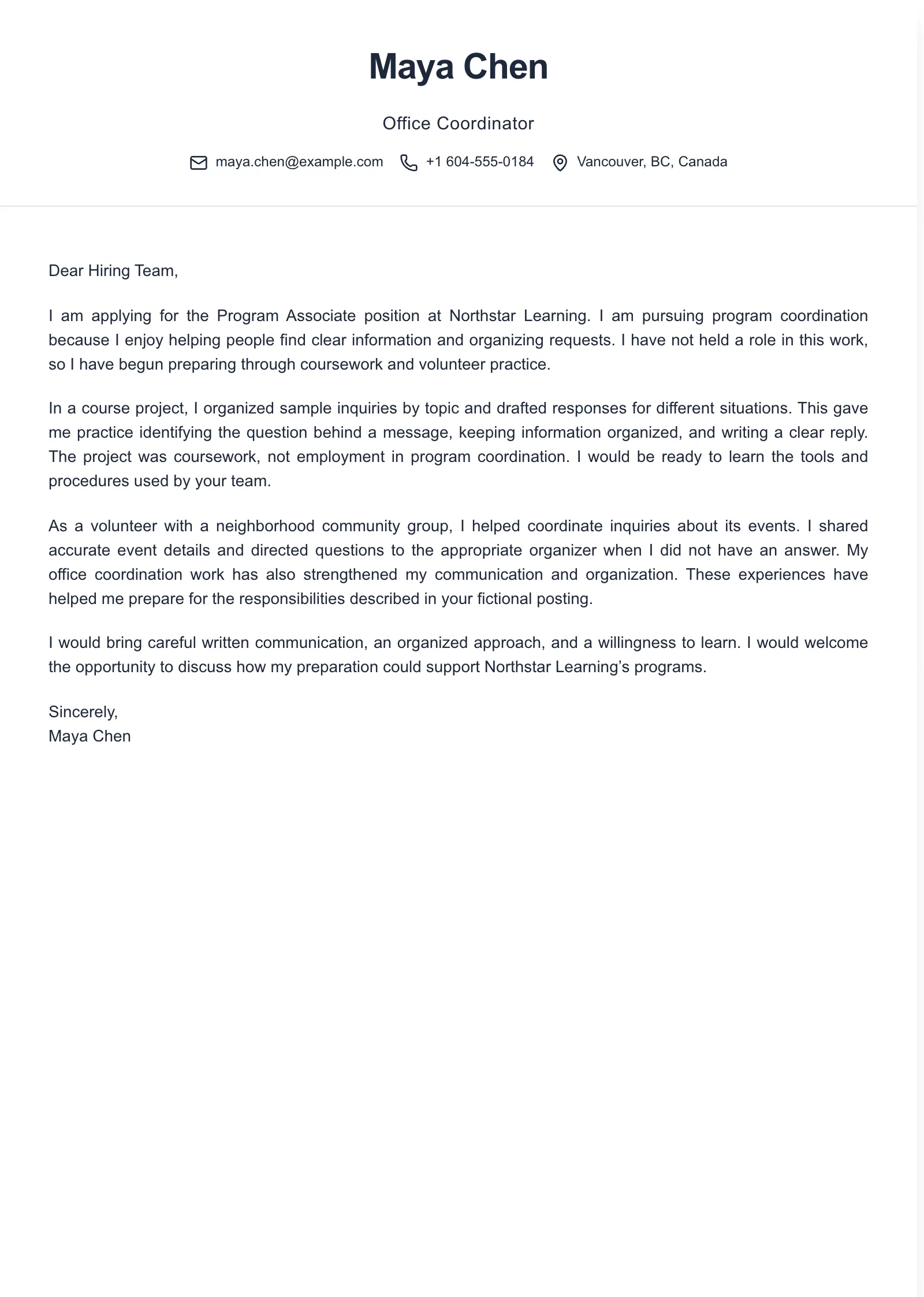
Example paragraphs
“I am applying for [Job Title] at [Company Name] because [specific aspect of the work] is the direction I have chosen to pursue. After [specific experience or observation], I began preparing through [course, project, or other action]. I am now seeking a role where I can apply that preparation.”
“In [course or project], I [specific task you completed] using [relevant method or tool]. The work resulted in [factual outcome or artifact] and gave me practice in [skill connected to a stated job requirement]. I would bring that foundation to [Job Title] at [Company Name] while learning your team’s approach.”
“While volunteering with [organization or group], I [specific responsibility] for [people, activity, or process]. This involved [relevant action] and led to [factual result, if known]. Although this was not work in [target field], it helped me practice [relevant capability] for [Job Title] at [Company Name].”
Use details you can verify and discuss. Replace each bracket with a concrete fact, not an assumption about what an employer will think. Name coursework and volunteering as such, and keep the source and scope of each example accurate.
Common mistakes in a no-experience career-change letter
Apologizing for the transition
- What goes wrong
- Repeatedly calling yourself inexperienced or asking the reader to overlook your background makes the gap the focus.
- Better approach
- If needed, acknowledge the relevant gap once, then move to preparation and specific evidence. Explain the transition without apologizing for it.
Listing courses without showing application
- What goes wrong
- Course titles alone do not show what you practiced or how it relates to the target work.
- Better approach
- Choose relevant learning and describe a task, output, or method from it. Identify whether it was coursework, independent practice, or a credential.
Calling practice direct experience
- What goes wrong
- Presenting a class exercise or volunteer task as equivalent to doing the target job can overstate your background.
- Better approach
- Name the real context and explain the specific skill or action that carries over, as well as what remains new for you to learn.
Criticizing the old career or changing a job title
- What goes wrong
- A negative explanation distracts from your reason for moving, while changing an official past title misrepresents your history.
- Better approach
- Keep titles factual and focus on your next direction. Describe relevant responsibilities accurately without relabeling your past role.
Frequently asked questions
- What counts as experience if I have never worked in the new field?
- A course project, independent practice, volunteer work, or a responsibility from another setting can provide evidence of relevant skills. Name the setting accurately. These activities may show what you have practiced, but they are not the same as paid work in the target field.
- Should I say I have no experience in my cover letter?
- If the gap is relevant, acknowledge it briefly and then give concrete evidence of how you have prepared. Avoid defining yourself only by what you have not done, and do not imply direct experience you do not have.
- How is this different from a general career-change cover letter?
- This is the same kind of career-change cover letter, focused on the case where you lack direct experience in the target work. It shows how to use learning, projects, volunteering, or related responsibilities as evidence without presenting them as target-field employment.
- Should I include every course or volunteer activity?
- No. Choose the items that best show a relevant task or skill. Explain what you did and any result you can state accurately. A list without a connection to the advertised work does not show how you have prepared.

Put this career change approach into practice
Choose sample data or build your own cover letter, then personalize it before you download.