
Introduction
A Canadian cover letter should connect your evidence to the specific opening, not follow an assumed national formula. Employers and application processes differ, so use the posting to determine the requested language, documents, and qualifications.
Use a readable layout with your contact details, the date, a recipient if one is provided, a greeting, focused paragraphs, and a sign-off. Keep the content relevant to the role. A concise, tailored letter is more useful than repeating your resume without explaining why the evidence fits this opening.
What to address directly
The posting asks for English, French, or both
- Hiring manager concern
- Language expectations depend on the role and employer. A job's location in Canada does not by itself mean applicants must submit a bilingual letter.
- What your letter should prove
- Follow the language instructions in the posting. If it explicitly asks for both languages, describe how you have used each and give a factual example. If it requests one language, use that language unless the employer says otherwise. Describe your ability at a level you can demonstrate.
The employer asks about work authorization
- Hiring manager concern
- A broad statement about permission to work can misrepresent your situation. Conditions depend on a person's current circumstances, and this guide cannot assess an individual's eligibility.
- What your letter should prove
- Answer only what the employer asks, using current information you have verified. Include relevant conditions or dates only when they are accurate and useful to the question. Do not promise eligibility or assume that a document name establishes what work it permits. For your own situation, consult official Canadian work-permit guidance.
You are unsure which format to use
- Hiring manager concern
- There is no single layout that guarantees a letter suits every Canadian employer. A template that overlooks the posting can miss its actual instructions or requested evidence.
- What your letter should prove
- Use a clear layout, then tailor the content to the opening. Canada's Job Bank recommends researching the employer and matching your application to the actual job; see its job application guidance. If the employer requests a separate response to selection criteria, provide it rather than replacing it with a paragraph in the letter. For paragraph planning, see our cover letter structure guide.
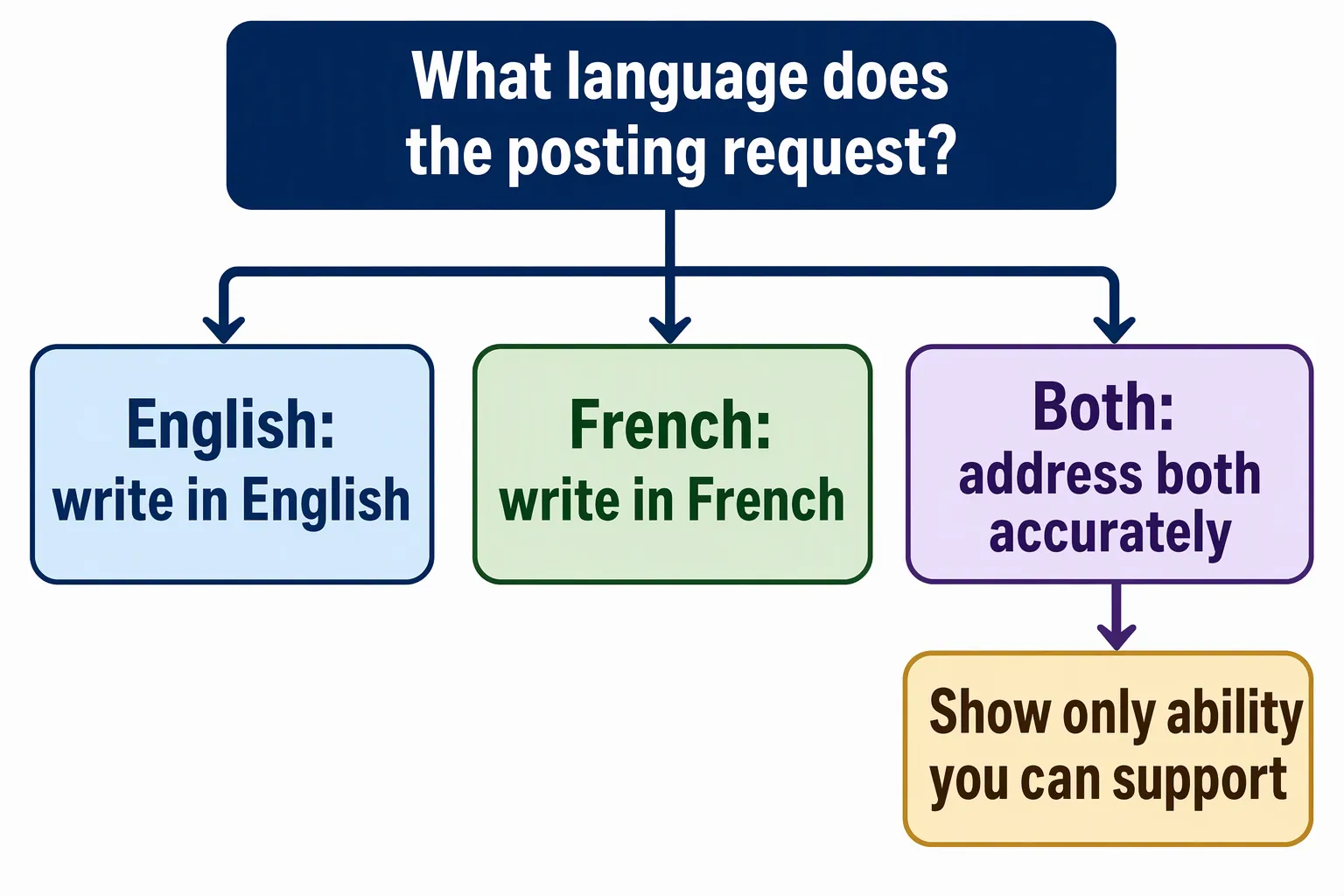
Structural approach: tailor the letter to the Canadian posting
Use these decisions as a practical method, not as rules that override the employer's instructions. Before drafting, separate what the posting asks for from assumptions you might make based on the job's location. Note the requested language, documents, qualifications, and any question about work authorization.
Choose evidence that matches the opening, state language ability precisely when it matters, and keep any authorization statement limited to verified facts. Before submitting, check that the letter and resume agree about your experience and that you have provided every document the employer requests.
- 01
Read the instructions
Mark the required language, recipient, documents, and questions about qualifications or work authorization. Check whether a cover letter is requested and whether selection criteria need a separate response. Follow the posting rather than a general template.
- 02
Select relevant evidence
Choose one or two real examples that demonstrate a skill the posting values. Explain what you did and the result without inventing numbers or overstating your responsibility. Research the employer so your reason for applying refers to something specific and relevant.
- 03
Describe language and authorization accurately
For a bilingual opening, describe each language at a level you can support with evidence. If asked about work authorization, use information you have verified and include only relevant conditions or dates. Check current official guidance if you are unsure what applies to you.
- 04
Format for the application
Keep contact details consistent, use a greeting suited to the information provided, and make paragraphs easy to scan. Submit the requested file type and review the document after export or upload to confirm the text is readable and complete.
Canadian Cover Letter Example
A fictional Canadian application showing tailored evidence and bilingual-language context; it does not imply one national format or immigration status.
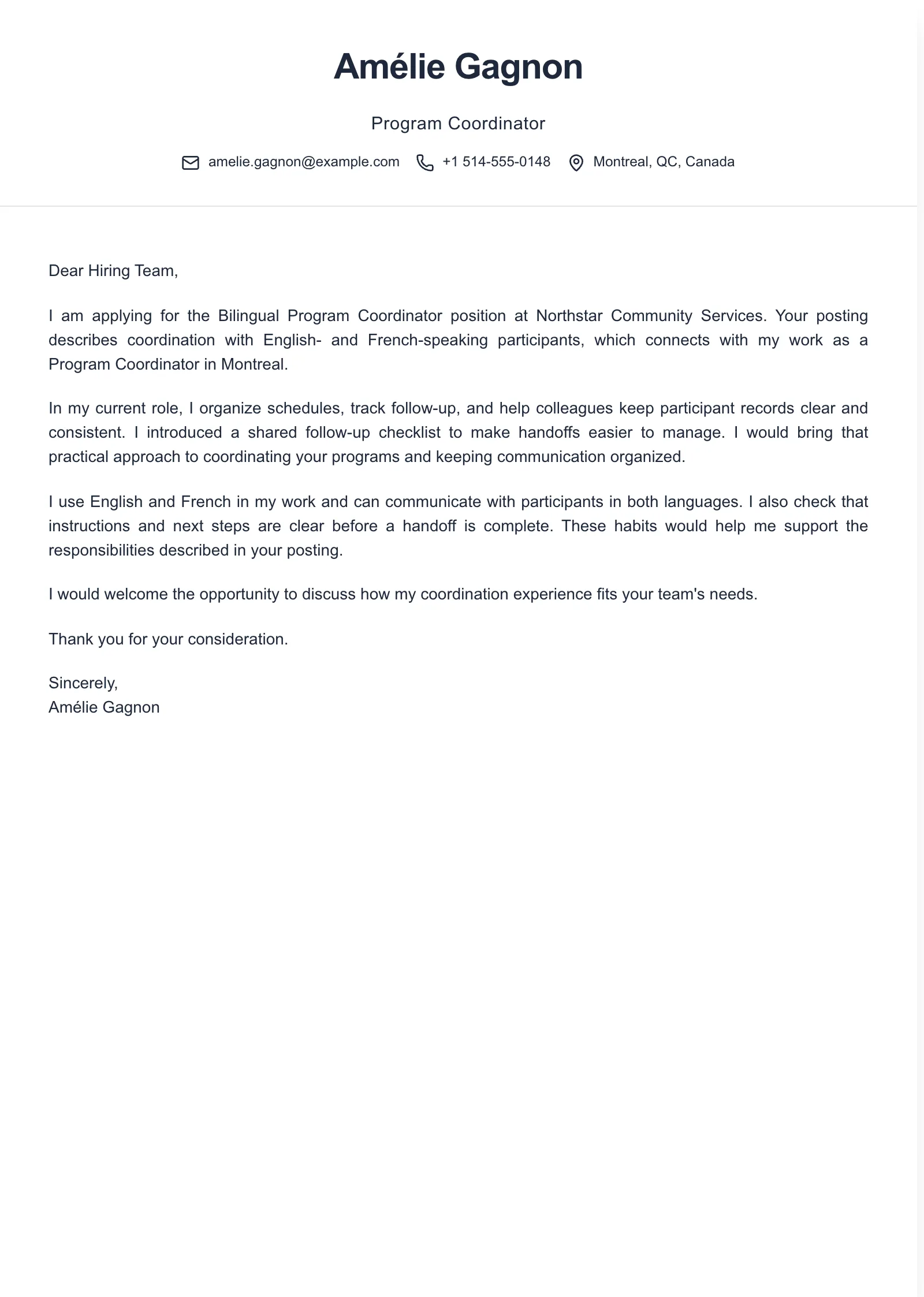
Example paragraphs
“I am applying for [Job Title] at [Company Name] because [specific detail from the posting or organization] connects with my experience in [relevant area]. In [factual situation], I [action you took], which led to [verifiable result relevant to the role].”
“Your posting asks for communication in [Language One] and [Language Two]. I have used [Language One] in [factual work, study, or service context] and [Language Two] in [factual context]. For example, I [specific communication task] while [brief outcome or responsibility].”
“As requested, my current work authorization is [exact status you have verified]. [If relevant and verified, state the applicable condition or date].”
Use each paragraph only when it fits the posting. Replace every bracketed prompt with a fact you can support. Include the authorization paragraph only if it accurately answers an employer's question; do not add a permit statement simply because the role is in Canada.
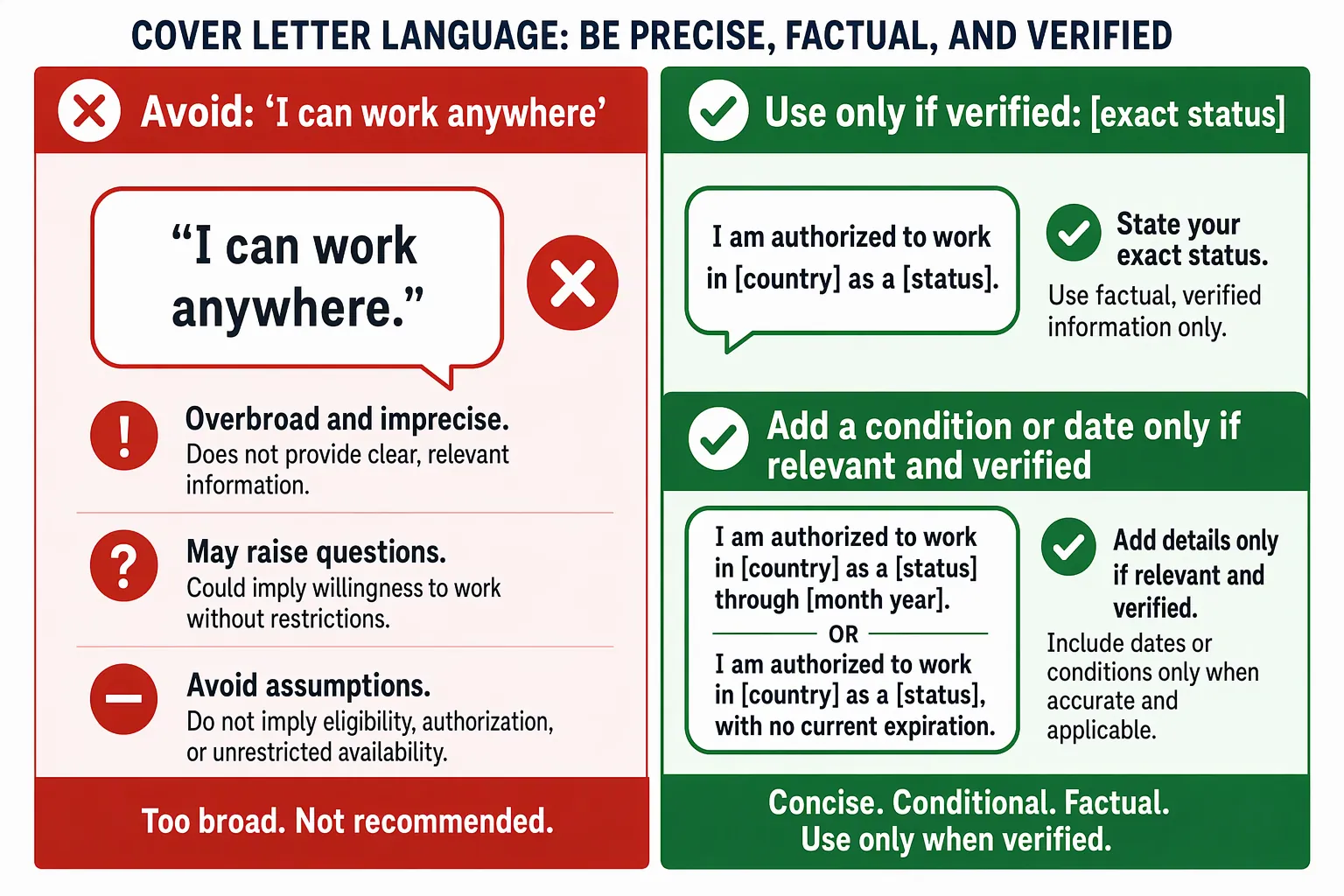
Scenario-specific mistakes
Assuming every Canadian role requires bilingual material
- What goes wrong
- Sending two versions or claiming language skills the posting does not request can distract from your evidence and overstate your ability.
- Better approach
- Use the language the employer specifies. For a bilingual opening, address both languages accurately and give evidence for the abilities you claim.
Making a broad authorization claim
- What goes wrong
- A phrase such as “I can work anywhere” does not explain your verified status and may suggest conditions you have not confirmed.
- Better approach
- Answer only what is asked. State verified information and relevant conditions or dates, and check official guidance if you are unsure what applies to you.
Sending the same letter to every employer
- What goes wrong
- A generic letter may not address the opening's actual language requirements, requested documents, or qualifications.
- Better approach
- Name the role, connect factual examples to its requirements, and give a specific reason for your interest in the employer or work.
Treating a layout as a national rule
- What goes wrong
- A fixed length, greeting, or format may not suit the employer's instructions or requested selection-criteria materials.
- Better approach
- Use a readable layout and follow the posting. Provide separate criteria responses when requested rather than folding them into the letter.
Frequently asked questions
- Is there one required Canadian cover letter format?
- Use the format requested in the posting. If none is specified, choose a clear, readable layout with focused paragraphs and relevant evidence. Keep the letter concise enough to explain your fit without repeating the resume; do not treat a preferred page length as a national requirement.
- Should I write my cover letter in English or French?
- Follow the language instructions in the posting. If it asks for both, describe your English and French ability accurately and give relevant evidence. The job's location in Canada alone does not mean you must submit a bilingual letter.
- Should I mention my work permit in a Canadian cover letter?
- Mention work authorization if the employer asks or a brief clarification is relevant. State only what you have verified about your current status and any relevant conditions or dates. Check current official guidance for questions about your own situation; this guide cannot assess eligibility.
- Do Canadian employers expect a photo or personal details?
- Use the cover letter to explain your fit. Follow the employer's document instructions and include personal information only when it is needed for the application. A template's photo space is not a reason to add one.

Put this career change approach into practice
Choose sample data or build your own cover letter, then personalize it before you download.