
Introduction
A bullet-point cover letter is a complete letter with a short list of selected evidence in its body. An opening gives the reader context, the bullets highlight relevant examples, and a closing connects those examples to the opportunity. The list supports your message; it does not replace it.
Bullets can help when several distinct examples are easier to scan separately. They are less useful when your reasoning depends on a sequence or explanation that would be chopped into fragments. Bullet-point and dot-point cover letter are two names for the same format.
This page focuses on using a list of proof points, not on making a letter short. A short cover letter can use paragraphs only, and a bullet-point letter can vary in length. For the broader paragraph order, see cover letter structure.
What to address directly
A bullet list may feel impersonal
- Hiring manager concern
- A letter made mostly of list items can read like notes rather than a response to a particular opportunity.
- What your letter should prove
- Use a short opening to identify the [Job Title] and [Company Name], then give a specific reason connected to the posting. Introduce the list by saying what the examples demonstrate. Close in your own voice, connecting the evidence to the opportunity. These parts show why the bullets belong together.
The bullets may repeat the resume
- Hiring manager concern
- Copying resume lines into a letter takes space without explaining why those details matter for this application.
- What your letter should prove
- Select evidence that adds a connection or useful context, rather than restating a responsibility. For each bullet, ask what the reader learns about your fit from seeing it here. Keep factual details consistent with your resume, but use the letter to explain the relevance of the selected points.
The list may make unsupported claims look polished
- Hiring manager concern
- A neat format cannot make a broad claim, estimated metric, or unclear contribution more credible.
- What your letter should prove
- Use details you can explain and support, such as the task, audience, scope, or verified outcome. Be precise about your own contribution. If you cannot verify a number, describe the work accurately without one. Do not add a point just to make the list look complete.
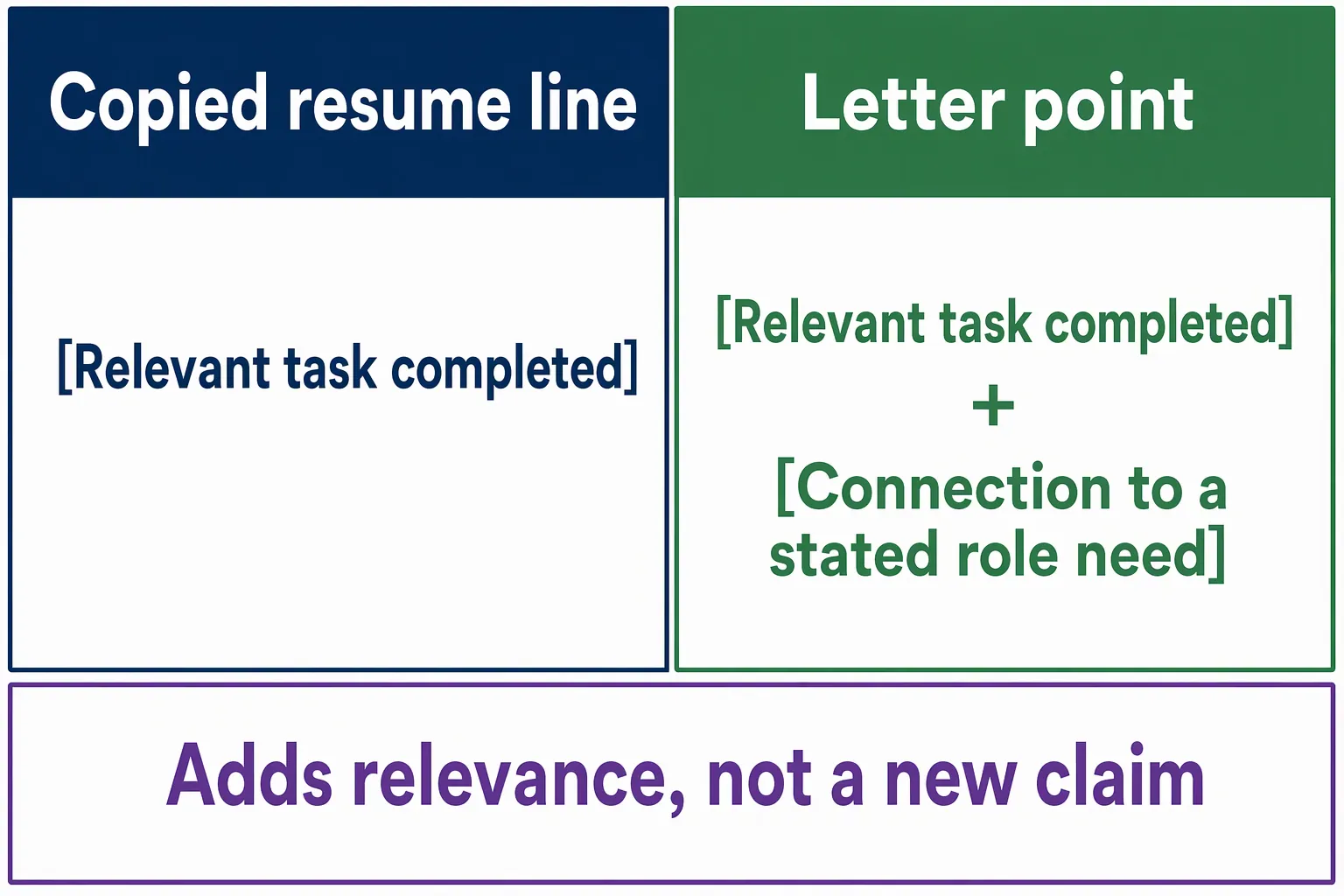
Structural approach: introduce, select, and connect
Keep the list inside a complete message. First give the reader the role and a reason for your interest. Then introduce the evidence and explain, through the selection of points, what it shows. Close by connecting that evidence to the opportunity. This is a useful structure, not a mandatory formula; follow the employer's instructions if they specify another format.
Before drafting, compare the posting with your experience and note the strongest relevant matches. A list works best when its points have a shared purpose but do not repeat one another. As a practical starting point, consider two or three bullets, then keep only the ones that add distinct evidence. The examples below are separate pieces to adapt, not a complete letter.
- 01
Decide what the list should show
Choose one purpose, such as showing related experience, a useful combination of skills, or evidence connected to a stated need in the posting. If your points do not support a clear idea together, use paragraphs or narrow the list.
- 02
Choose distinct, factual examples
Select examples that each add something different. State your part accurately, and include a number only if you can verify what it measures and explain your contribution. Do not create a metric or outcome to make a bullet sound stronger.
- 03
Give the list context
Open with the role and a specific reason for applying. Use a brief transition to tell the reader what the points demonstrate. Make each bullet understandable on its own, then use the closing to connect your evidence to the opportunity.
- 04
Check the letter in its final format
Read the opening, list, and closing as one message. Remove wording that simply duplicates the resume, and check that each bullet is easy to scan. If you paste the letter into a form or upload a document, inspect the preview for broken spacing, missing bullets, or hard-to-read text.
Bullet-Point Cover Letter Example
This fictional example shows a complete letter with a tailored opening, distinct evidence bullets, and a closing. Study the structure, not the claims as wording to copy.
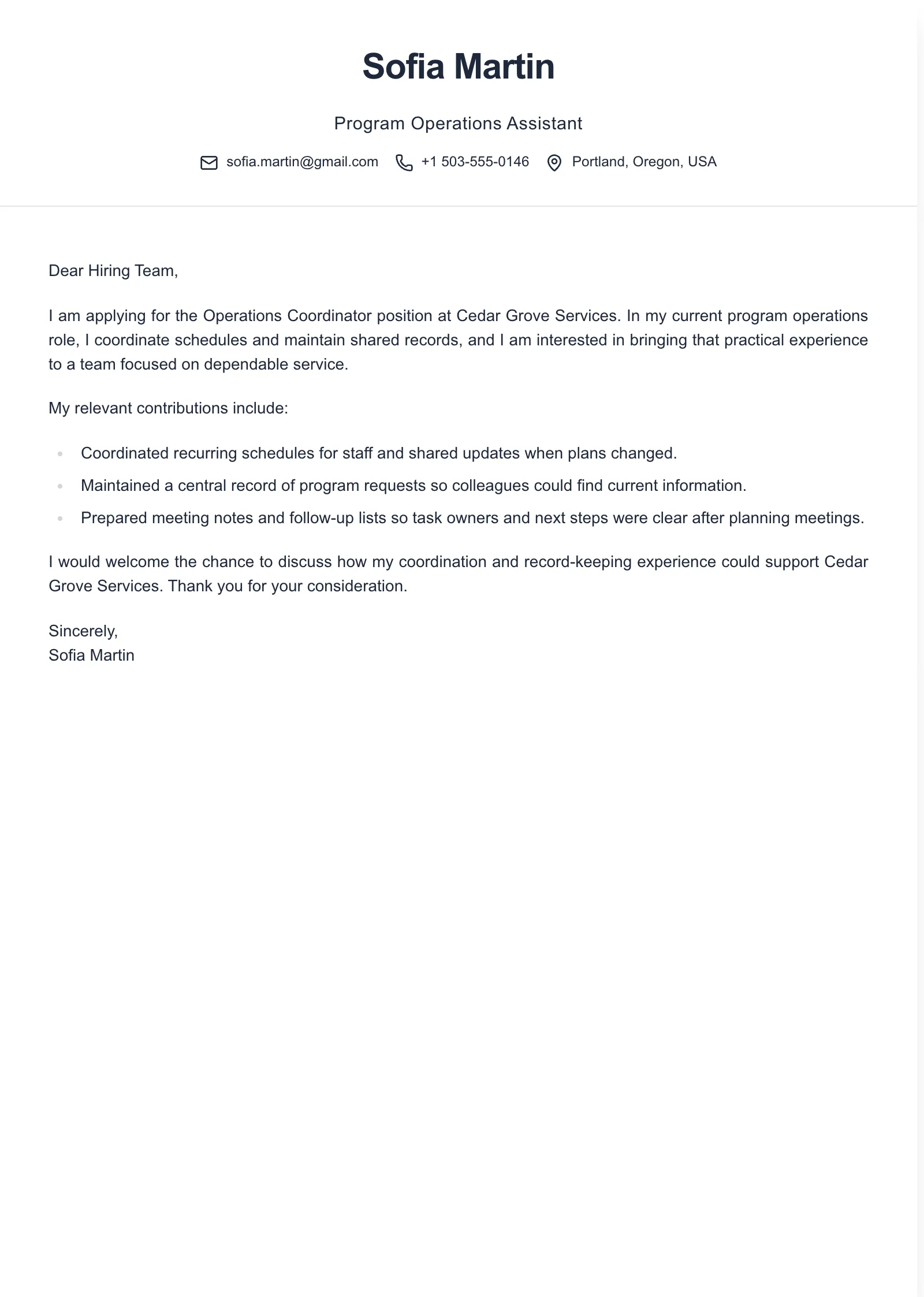
Example paragraphs
“I am applying for the [Job Title] position at [Company Name] because [specific reason connected to the posting]. My experience with [relevant responsibility] has prepared me to contribute to [factual need or priority from the posting].”
“My most relevant examples include: • [Completed a specific task for a defined audience, using a detail you can verify]. • [Used a relevant skill to address a real challenge, describing your part accurately]. • [Made a factual contribution that relates to the role and adds a different point of evidence].”
“These examples reflect how I approach [relevant responsibility]. I would welcome the opportunity to discuss how that experience could support [Company Name] in the [Job Title] role.”
Adapt each bracketed detail to evidence you can explain; the placeholders are not claims to copy. You do not need three bullets. Keep only points that are relevant, distinct, and accurate. If a point needs several lines of background to make sense, write it as a short paragraph or choose a clearer example. Check that the list adds context rather than introducing a claim that conflicts with your resume or other application materials.
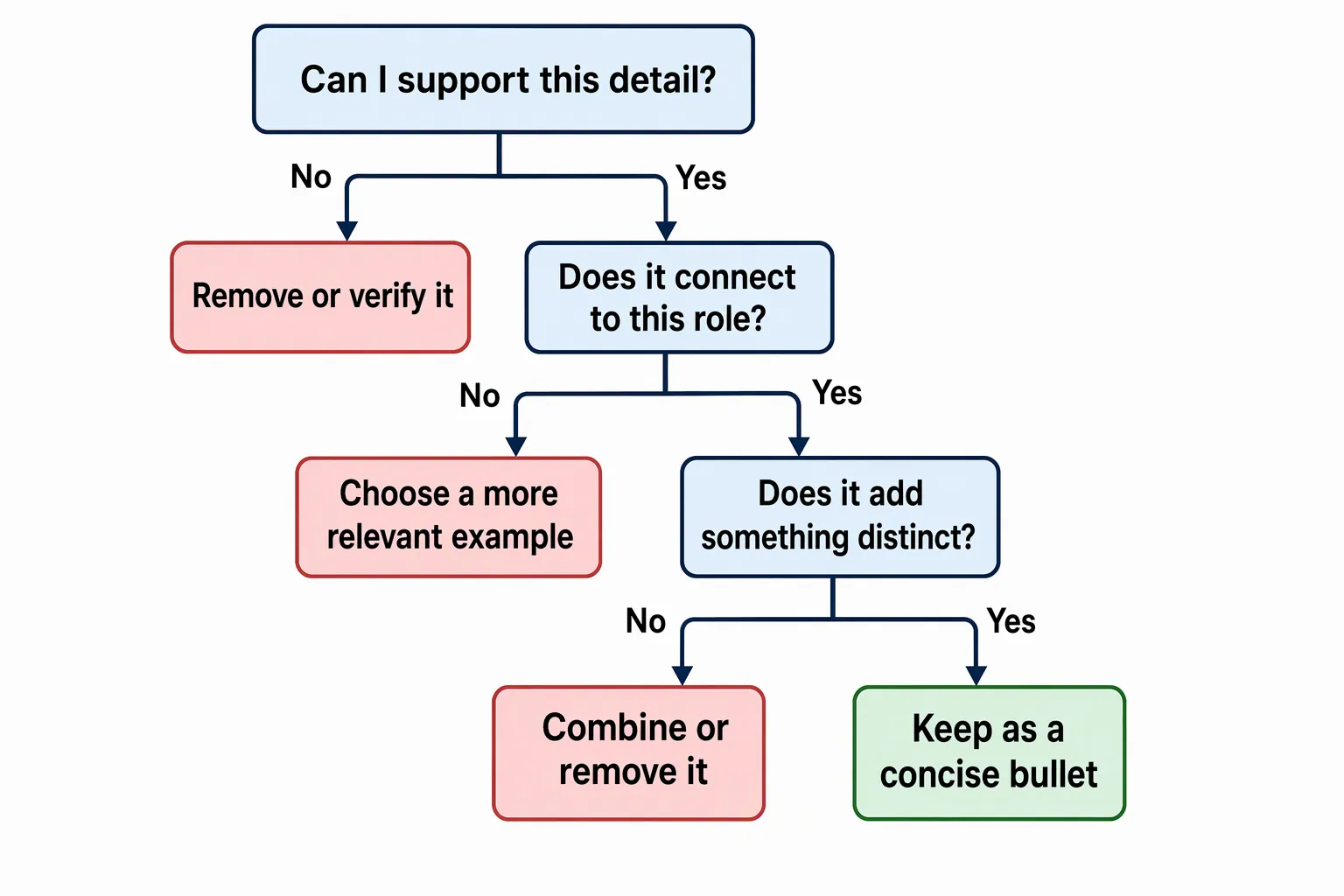
Common mistakes with bullet-point cover letters
Starting with bullets and no explanation
- What goes wrong
- The reader sees a list before learning which role you want or why the examples are relevant.
- Better approach
- Open with the role and a specific reason for applying, then add a transition that explains what the list demonstrates.
Repeating resume lines word for word
- What goes wrong
- The letter adds little context and gives the reader the same information twice.
- Better approach
- Use each selected point to explain a connection between your experience and this opportunity. Keep dates and factual details consistent with the resume.
Adding claims to fill out the list
- What goes wrong
- An estimated metric, vague strength, or inflated contribution can weaken trust instead of making the application more specific.
- Better approach
- Keep only claims you can support. Describe the work plainly when you cannot verify a number or outcome.
Letting the list take over the letter
- What goes wrong
- A long series of points can bury your reason for applying and make the letter feel like another resume.
- Better approach
- Keep a clear opening and closing around a focused list. Remove points that repeat one another or do not explain your relevance to the opportunity.
Frequently asked questions
- Are bullet points appropriate in a cover letter?
- They can help when a few distinct examples are easier to scan as separate points. Keep the list within a complete letter, and follow any instructions in the posting.
- How many bullets should a cover letter have?
- There is no required number. Two or three focused bullets can be a practical starting point, but keep only points that add distinct, relevant evidence.
- Should my whole cover letter be bullet points?
- Usually, use short paragraphs to introduce the role and close your message, with a small evidence list in between. The list needs context to show why the examples matter.
- Will a bullet-point cover letter work in an application form?
- It depends on the form and its preview. Check that the list remains readable after pasting or uploading, and simplify the formatting if the form changes it.

Put this career change approach into practice
Choose sample data or build your own cover letter, then personalize it before you download.