
Introduction
A cover letter for a board position should connect the board’s stated needs with the judgment and perspective you can contribute. Use its published priorities to choose evidence of how you have reviewed information, considered options, or worked with a group. Do not rely on general admiration for the organization.
This guide applies the general cover letter structure to a board application. The task here is to connect the board’s stated remit with relevant evidence, community knowledge, and your capacity to serve. First check whether the notice requests a letter and follow its process, especially for a school board or public body.
What to address directly
Showing relevant judgment
- Hiring manager concern
- A list of work duties does not explain how you would contribute to the board’s stated responsibilities.
- What your letter should prove
- Choose one example of reviewing information, weighing options, or raising a useful question. State what you did and connect it to a responsibility in the notice. Do not claim authority you did not have.
Describing a community connection accurately
- Hiring manager concern
- A personal or volunteer connection does not mean you speak for an entire community.
- What your letter should prove
- Name the connection you actually have, what it has helped you understand, and where your perspective is limited. Show how you would keep listening to people with different experiences.
Making your capacity credible
- Hiring manager concern
- Meeting attendance may not describe the full commitment, and the role’s terms may vary.
- What your letter should prove
- Use the notice’s stated schedule and duties. Say which parts you can meet, including preparation or committee work if specified. Mention unpaid service only when the notice states it, and ask about unclear expectations.
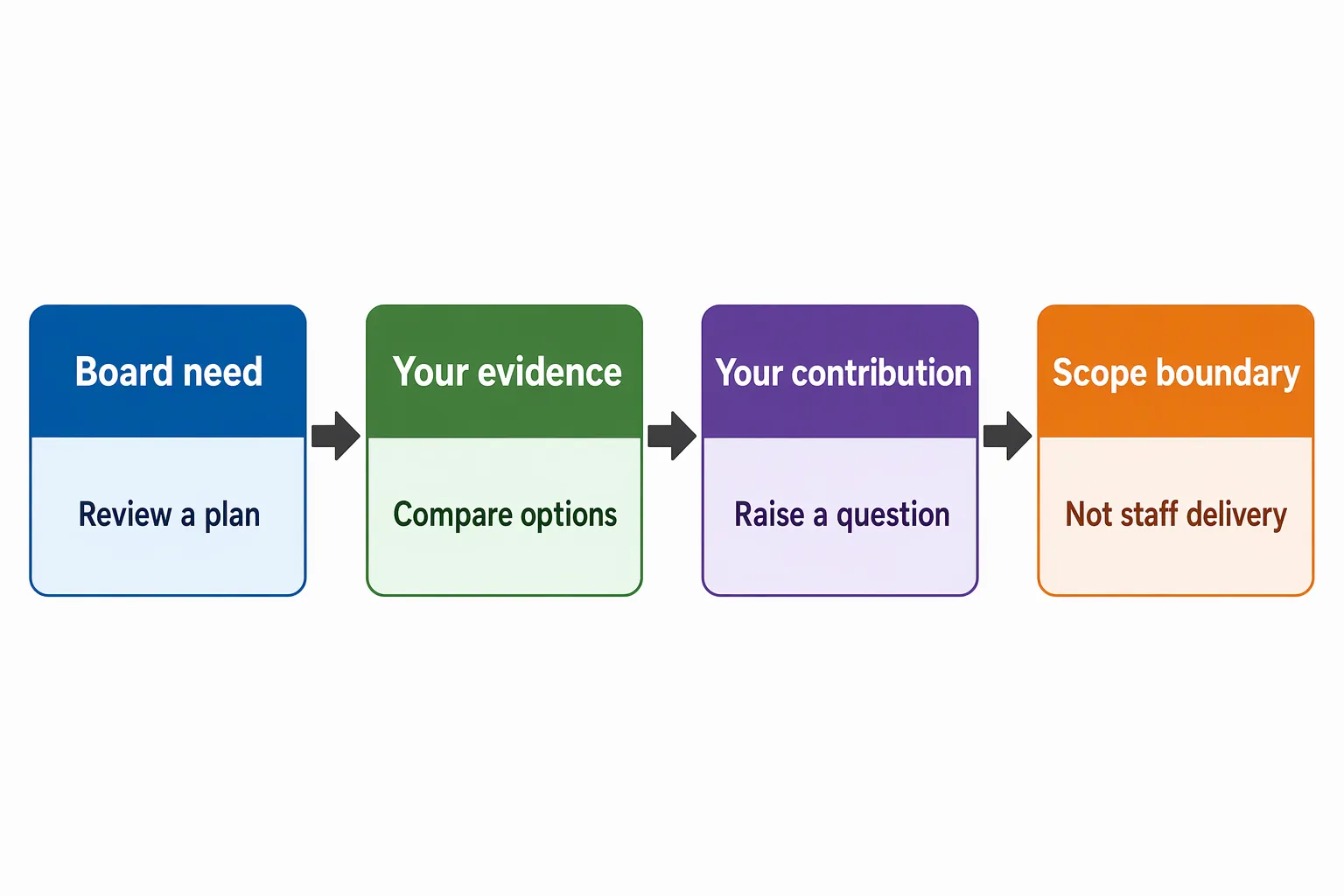
Structural approach: connect the board’s needs to your contribution
Build the letter around the board’s published remit, not assumptions about what every board member does. State why the particular opportunity interests you, give a relevant example of your judgment, then address your community connection and capacity. If the application asks for separate forms or criteria responses, follow those instructions rather than trying to replace them with a letter.
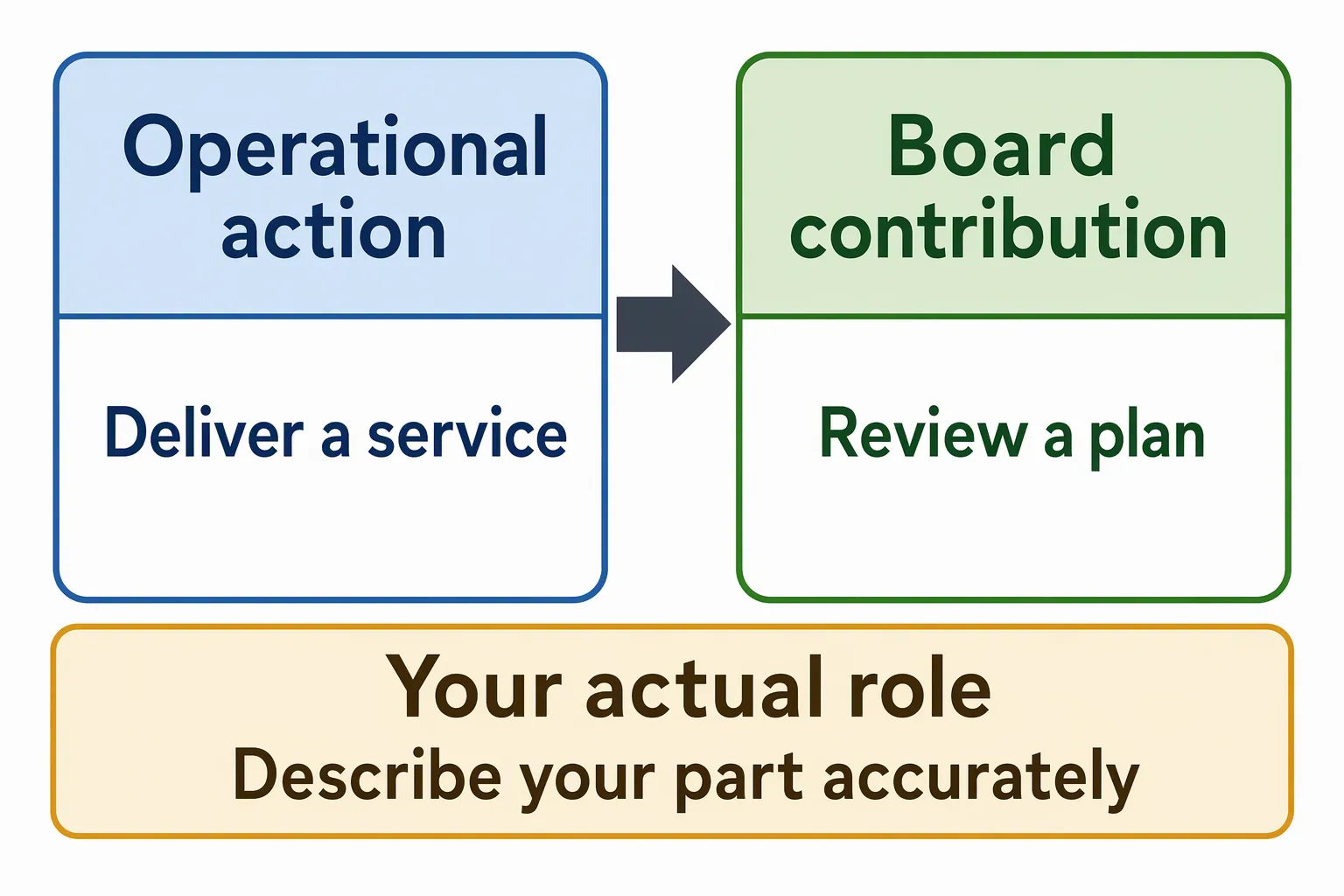
Be precise about your role in each example. If you reviewed or advised on a plan, do not imply that you set policy or managed staff. The board notice is the guide to the responsibilities relevant to this application.
- 01
Confirm the process and remit
Check that a letter is requested and identify the board’s stated responsibilities, priorities, and selection instructions. For school boards and public bodies, use the applicable authority’s current directions instead of assuming a standard job application process.
- 02
Choose evidence of judgment
Select one or two truthful examples that relate to the notice. You might describe reviewing a plan, serving on a committee, or helping a group compare options. Explain your own part and the reasoning involved. Include figures only when they are accurate and relevant.
- 03
Explain your connection
Describe a specific relationship to the organization’s work or the people it serves. Say what you learned without claiming to represent everyone. If your experience is limited, say so and show openness to other perspectives.
- 04
Address the stated commitment
Refer to the actual schedule and duties in the notice. Explain how you can meet them, including preparation or committee work if specified. If the position is described as unpaid, acknowledge that accurately. Ask the organization about unclear workload or expenses rather than guessing.
Board position cover letter example
A fictional example for a community learning organization connects committee experience, community knowledge, and the stated volunteer commitment.
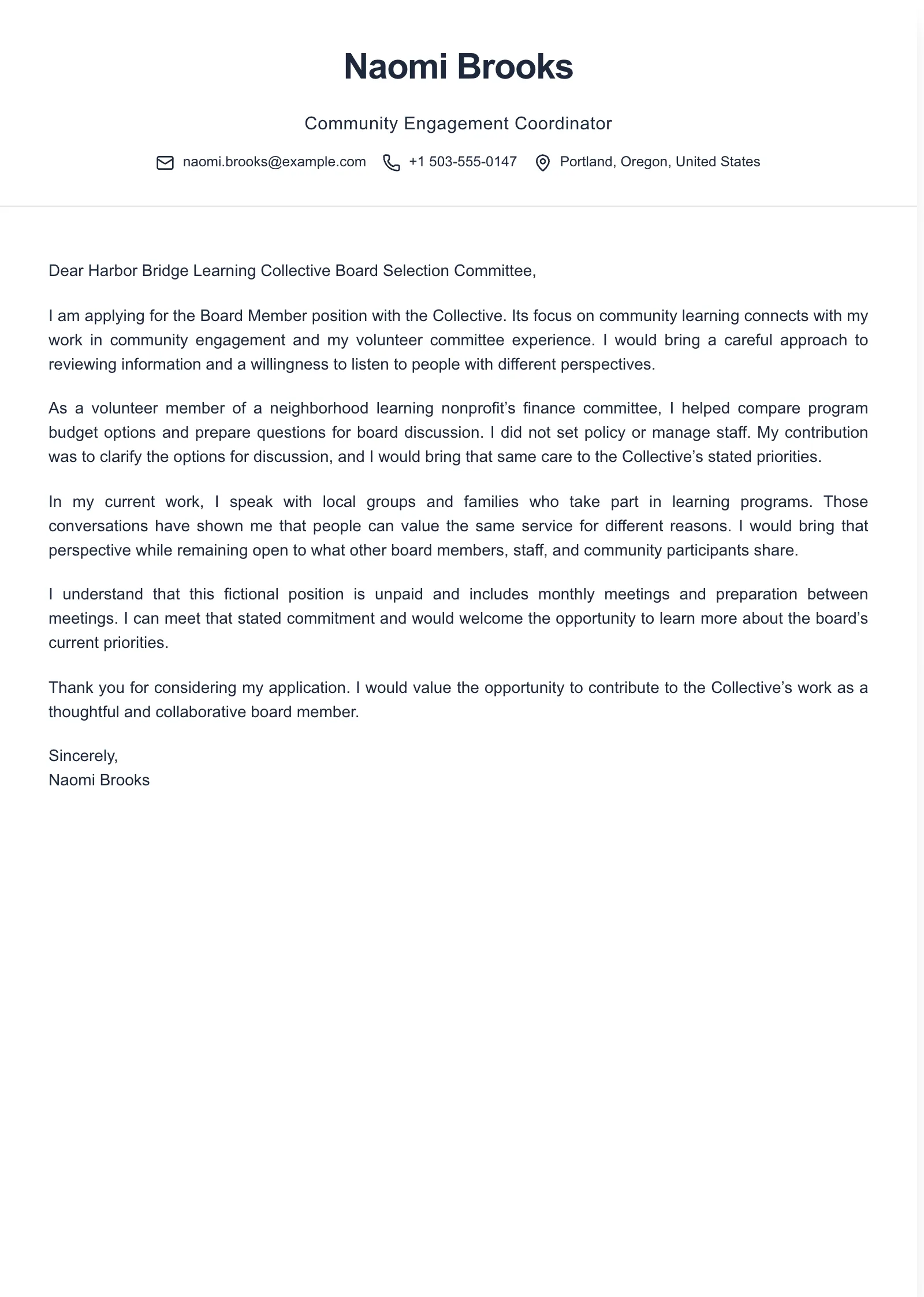
Example paragraphs
“I am applying for [board title] at [organization] because its stated priority of [published priority] connects with my experience in [relevant committee, service, or community activity]. I would bring [specific perspective or strength] to the board’s work on [stated responsibility].”
“In [committee or group], I [specific action, such as reviewing options or raising a question] when [factual situation]. This helped me develop [relevant judgment or practice], which relates to [responsibility in the notice]. My role was [accurate description], not [authority or operational duty you did not have].”
“Through [specific community connection], I have learned [relevant observation], while recognizing that people have varied perspectives. I can meet the stated commitment of [meetings, preparation, or committee work] and would welcome learning how the board gathers input from others.”
Treat these as paragraph patterns, not a letter to copy. Replace every bracket with a verifiable detail, keep role titles accurate, and use the board’s own instructions. If it requests separate materials, complete those as directed.
Common mistakes in a board position cover letter
Treating the seat as an honor
- What goes wrong
- Admiration for the organization does not show how you relate to the board’s stated work.
- Better approach
- Name a priority from the notice and connect it to evidence of your relevant judgment or experience.
Blurring oversight and operations
- What goes wrong
- Promising to run services or manage staff can misstate the board role and your authority.
- Better approach
- Describe your actual contribution and connect it to the remit in the notice. Do not claim powers or duties it does not state.
Claiming to represent a whole community
- What goes wrong
- One experience cannot establish what everyone in a community needs or thinks.
- Better approach
- Describe what you know, acknowledge the limits of your perspective, and explain how you listen to others.
Assuming unpaid service takes little time
- What goes wrong
- Calling the role an easy way to volunteer may overlook preparation or other stated duties.
- Better approach
- Address the actual commitment in the notice. Mention unpaid service only if stated, and ask the organization about unclear expectations or expenses.
Frequently asked questions
- What should a cover letter for a board position emphasize?
- Connect the board’s published priorities with relevant examples of your judgment, committee or community work, and ability to meet the stated commitment. Describe your own contribution accurately, including whether you advised, reviewed, or made a decision.
- Should I mention that a board position is unpaid?
- If the notice describes the position as unpaid, acknowledge that arrangement accurately and address the time commitment it states. Do not assume that unpaid service requires little preparation or that expenses are reimbursed. Ask the organization about unclear expectations.
- How is a school board application different?
- Use the selection process and application instructions published by the relevant school board or authority. Do not assume that a particular seat accepts a cover letter or uses the same process as a staff vacancy. Address only the priorities and criteria in the notice.
- Do I need previous board experience?
- Not unless the notice makes it a requirement. When direct board experience is not required or you do not have it, choose a truthful example of relevant review, committee work, community participation, or decision-making. Explain how it relates to the stated responsibilities without presenting it as board service.

Put this career change approach into practice
Choose sample data or build your own cover letter, then personalize it before you download.