
Introduction
An Australian cover letter should help the employer understand why you are applying and where to find relevant evidence. Start with the job advertisement and application instructions, not an assumed national formula. Employers and application processes differ, so use the requested documents and format to guide your choices.
One important decision is whether selection criteria belong in the letter or in a separate response. Australian JobAccess guidance notes that some employers request both a cover letter and separate selection-criteria responses. Treat them as distinct documents when the advertisement asks for both.
What to address directly
The advertisement may request more than a letter
- Hiring manager concern
- An Australian job advertisement may request a separate response to selection criteria. A cover letter is not automatically a substitute. Omitting the separate document or squeezing short answers into the letter may leave the employer without the information requested.
- What your letter should prove
- List every requested document before drafting. Note which criteria belong in the letter and which belong in a separate response. Use the letter to introduce your fit and point to relevant experience; answer each criterion in the requested location and format. Read the Australian JobAccess guidance on cover letters and selection criteria for further context.
A dot point is a format, not proof
- Hiring manager concern
- An advertisement may use the phrase “dot point” to describe a concise bullet. A bullet can make an answer easier to scan, but a list of broad claims does not show what you did or why the evidence relates to the criterion.
- What your letter should prove
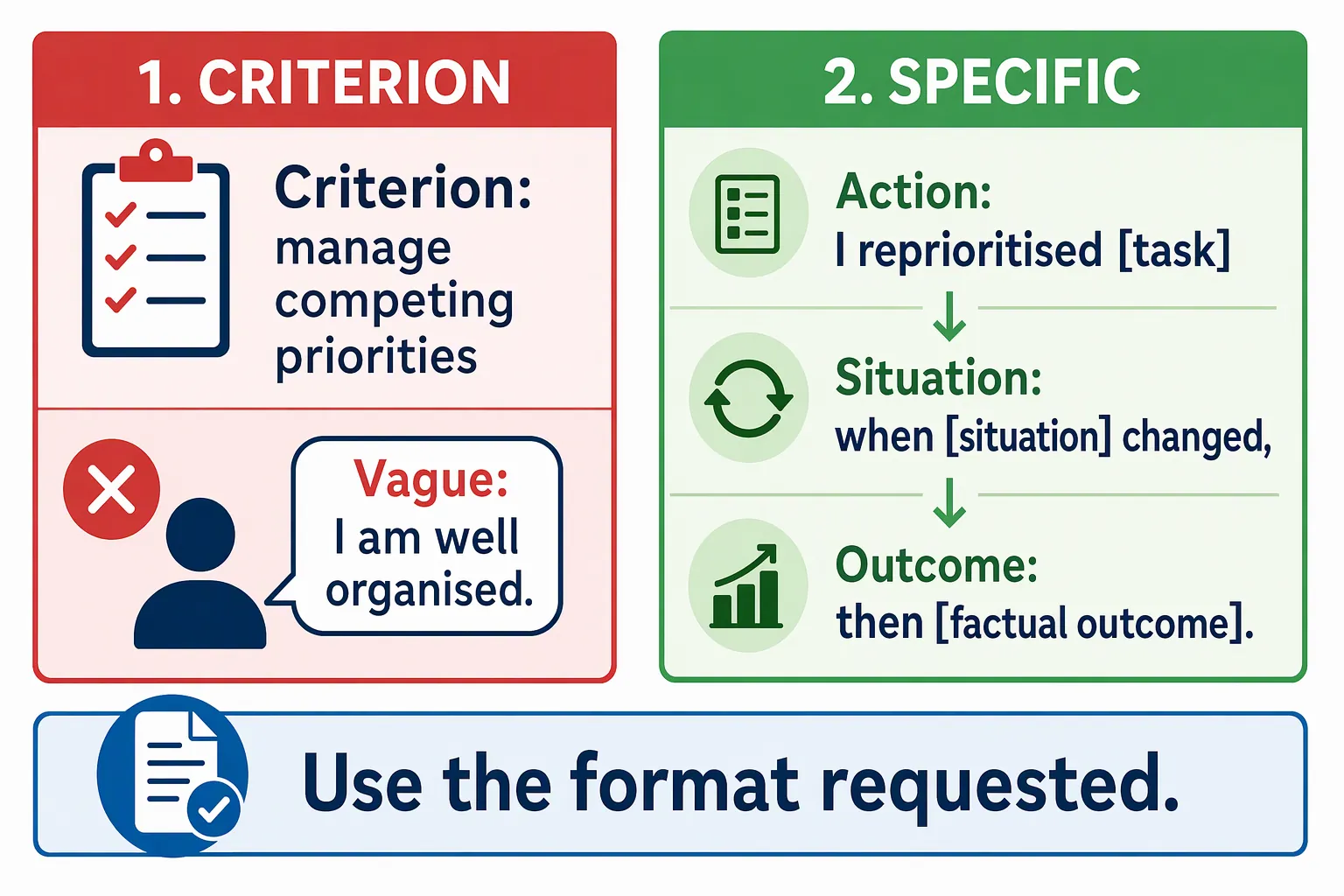
- For each requested criterion, identify a relevant task or situation, your action, and a factual outcome or responsibility. Use a short paragraph or dot points according to the instructions. Include enough context to make the example understandable, and do not add figures or achievements you cannot support.
Length and personal details are not a fixed checklist
- Hiring manager concern
- Advice about Australian applications can be mistaken for a universal page limit or a checklist of personal details. The role, employer instructions, and whether a separate criteria response is required all affect what belongs in the application.
- What your letter should prove
- Keep the letter concise and relevant, then let the instructions determine the format and any stated length. Do not add age, a photo, or other personal details just because they appear in a template. Use the space to explain evidence that helps show your fit.
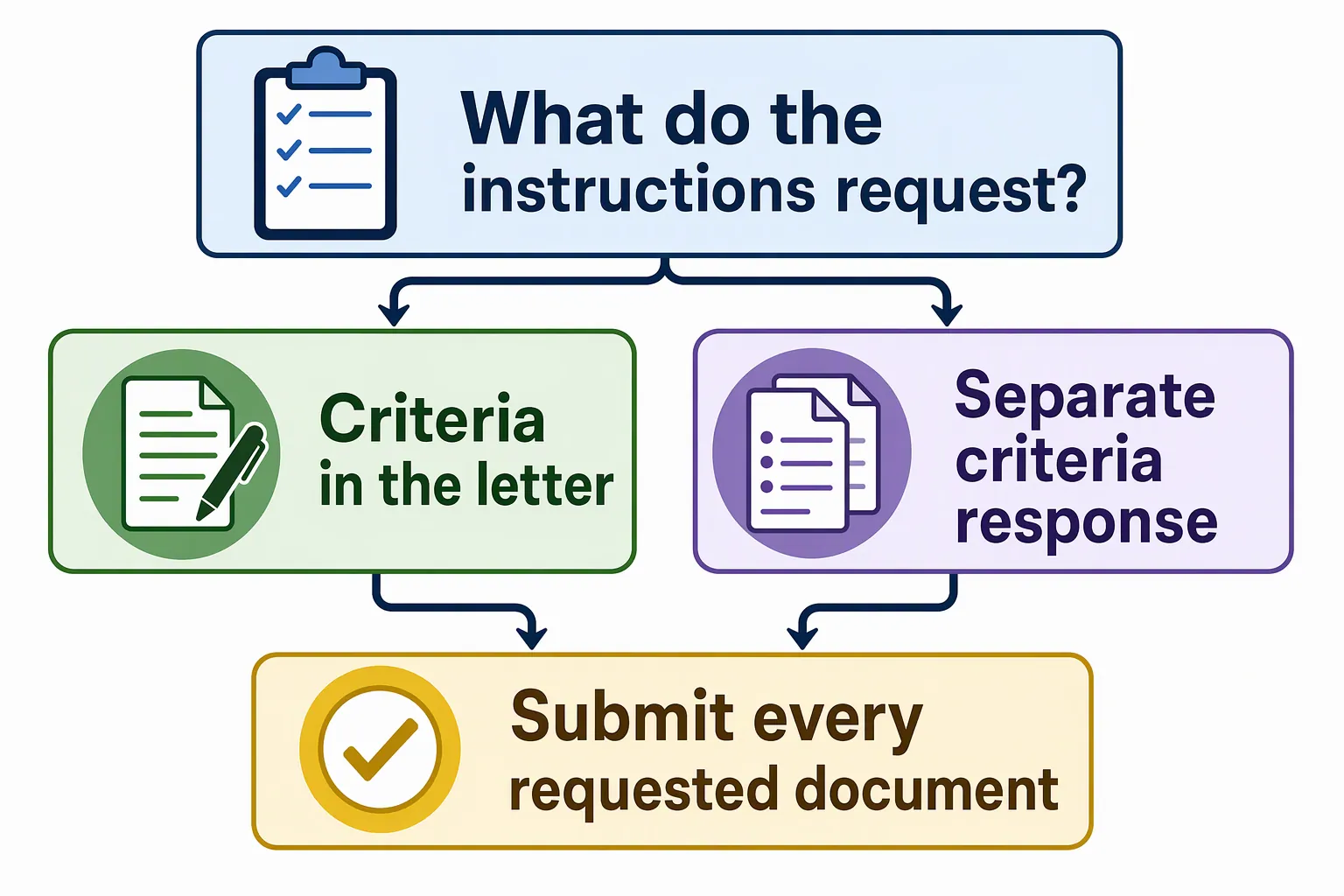
Structural approach: match each document to the advertisement
The letter should make its purpose easy to follow: identify the role, give a specific reason for applying, and connect relevant experience to the advertised needs. A separate criteria response should answer each requested criterion directly. For paragraph roles and order, see the guide to cover letter structure.
Use this sequence to keep the letter focused while still providing every selection-criteria response the employer requests.
- 01
Read the application instructions
Note the role title, requested documents, criteria, submission format, and any word or page guidance. Follow the advertisement if it differs from general advice.
- 02
Assign each point to a document
Mark what belongs in the cover letter, a separate selection-criteria response, or another requested document. Do not assume one document replaces another.
- 03
Choose evidence for each criterion
Select a relevant task, action, and factual outcome or responsibility for each criterion. Address any requested qualification or example directly, and keep every claim accurate.
- 04
Edit for length and clarity
Remove repeated resume details and general claims that do not support your fit. Check that the letter and any separate response use consistent role titles and do not contradict each other.
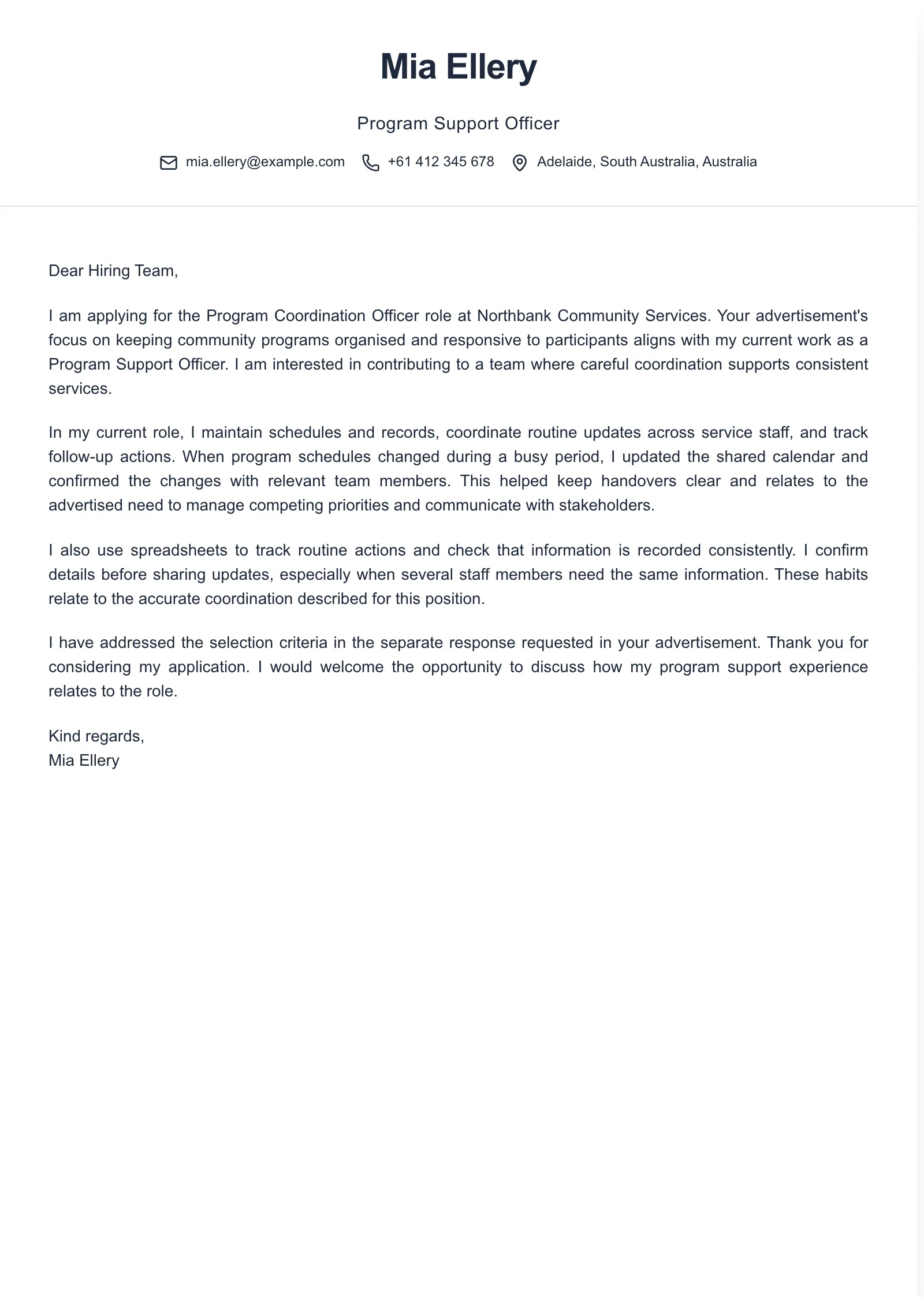
Australian Cover Letter Example
Preview a fictional Australian application letter that introduces the applicant's fit and refers to a separate selection-criteria response requested by the employer.
Example paragraphs
“I am applying for [Job Title] at [Company Name] because [specific feature of the role or organisation] connects with my experience in [relevant area]. My work on [factual task or responsibility] has given me experience relevant to [priority in the advertisement].”
“For the criterion on [criterion from the advertisement], I draw on my experience with [specific situation or task]. I [action you took], which led to [factual outcome or responsibility]. This example relates to [Job Title] at [Company Name] because [connection to the advertised role].”
“I have addressed the requested selection criteria in the separate response. My experience with [factual example] also relates to the needs of [Job Title] at [Company Name].”
Use these paragraphs as building blocks, not as a complete letter. Replace every bracket with a detail you can support and remove any sentence that does not match the advertisement. If the employer requests separate criteria answers, make sure the letter's brief signpost does not take the place of those answers.
Scenario-specific mistakes in Australian cover letters
Putting every criterion into the letter
- What goes wrong
- The advertisement requests a separate selection-criteria document, but the letter tries to answer everything instead.
- Better approach
- Submit the requested documents separately. Use the letter to introduce your fit and make sure the separate response answers each criterion.
Using dot points without evidence
- What goes wrong
- The response lists skills or personal qualities without explaining what the applicant did or what the example shows.
- Better approach
- Add a brief, factual example for each criterion. Use dot points only when they improve clarity or the employer requests them.
Repeating the resume without tailoring
- What goes wrong
- The letter restates responsibilities but does not connect them to the role or the employer's stated needs.
- Better approach
- Choose relevant responsibilities and explain their connection to the advertised role. Repeat resume details only when they add useful context.
Treating one length or layout as mandatory
- What goes wrong
- The applicant cuts useful information to meet an assumed page limit or uses a dot-point-only layout without checking the instructions.
- Better approach
- Keep the letter concise, follow any stated format and length, and reserve additional requested evidence for its designated response.
Frequently asked questions
- How long should an Australian cover letter be?
- There is no single page count that fits every application. Keep the letter concise, follow any length guidance in the advertisement, and put additional evidence in a separate selection-criteria response when the employer requests one.
- Should I answer selection criteria in my cover letter?
- Check the advertisement and application instructions. If they request separate responses, provide those as directed and use the letter to introduce your fit. If they ask for criteria to be addressed in the letter, answer the specified criteria there.
- Does an Australian cover letter need to use dot points?
- No single layout applies to every application. Use paragraphs for a readable letter. Use dot points when they make evidence easier to scan or when the employer requests that format, particularly for a separate selection-criteria response.
- Should I include personal details such as age or a photo?
- Do not assume these details are needed or requested. Follow the employer's stated requirements and include information relevant to the application. Focus the letter on your interest, evidence, and fit for the advertised role.

Put this career change approach into practice
Choose sample data or build your own cover letter, then personalize it before you download.