
Introduction
An apprenticeship cover letter should explain why you chose this training route and how you will approach learning. It does not need to suggest that you already have job-level experience. You may be new to paid work or changing direction as an adult, so choose evidence that reflects your actual experience.
Some postings use related training terms, and labels alone do not establish what a program involves or who qualifies. This guide focuses on the specific task of applying to an opportunity described as an apprenticeship, especially when you have no paid work history. Use the posting's own description rather than assuming all apprenticeships or internships follow the same model. A focused letter can help connect your resume to the opportunity.
What to address directly
No paid work history
- Hiring manager concern
- You may worry that a school or personal example will not count because it did not come from a job.
- What your letter should prove
- Choose a real commitment that shows how you act, such as a project, regular responsibility, or community activity. Briefly explain the setting, what you were responsible for, and what you did. Do not present unpaid responsibilities as paid employment or claim experience you do not have. If there was no measurable result, say what you completed or learned instead of inventing one.
Proving reliability
- Hiring manager concern
- Words such as “dependable” and “hardworking” can sound empty without an example.
- What your letter should prove
- Describe a specific responsibility, how you kept up with it, and what happened as a result. A small, clear example is more useful than a broad claim. If the posting names a relevant task or quality, connect your example to that detail without suggesting that one example proves more than it does.
Explaining why this route fits
- Hiring manager concern
- A general statement about wanting a job does not explain why this particular apprenticeship interests you.
- What your letter should prove
- Name a real detail about the work or training that interests you and say why. If you are changing careers, explain what you want to learn now and how a relevant part of your previous experience connects. Do not claim to know the day-to-day work, training arrangements, or outcomes unless the posting supports that description.
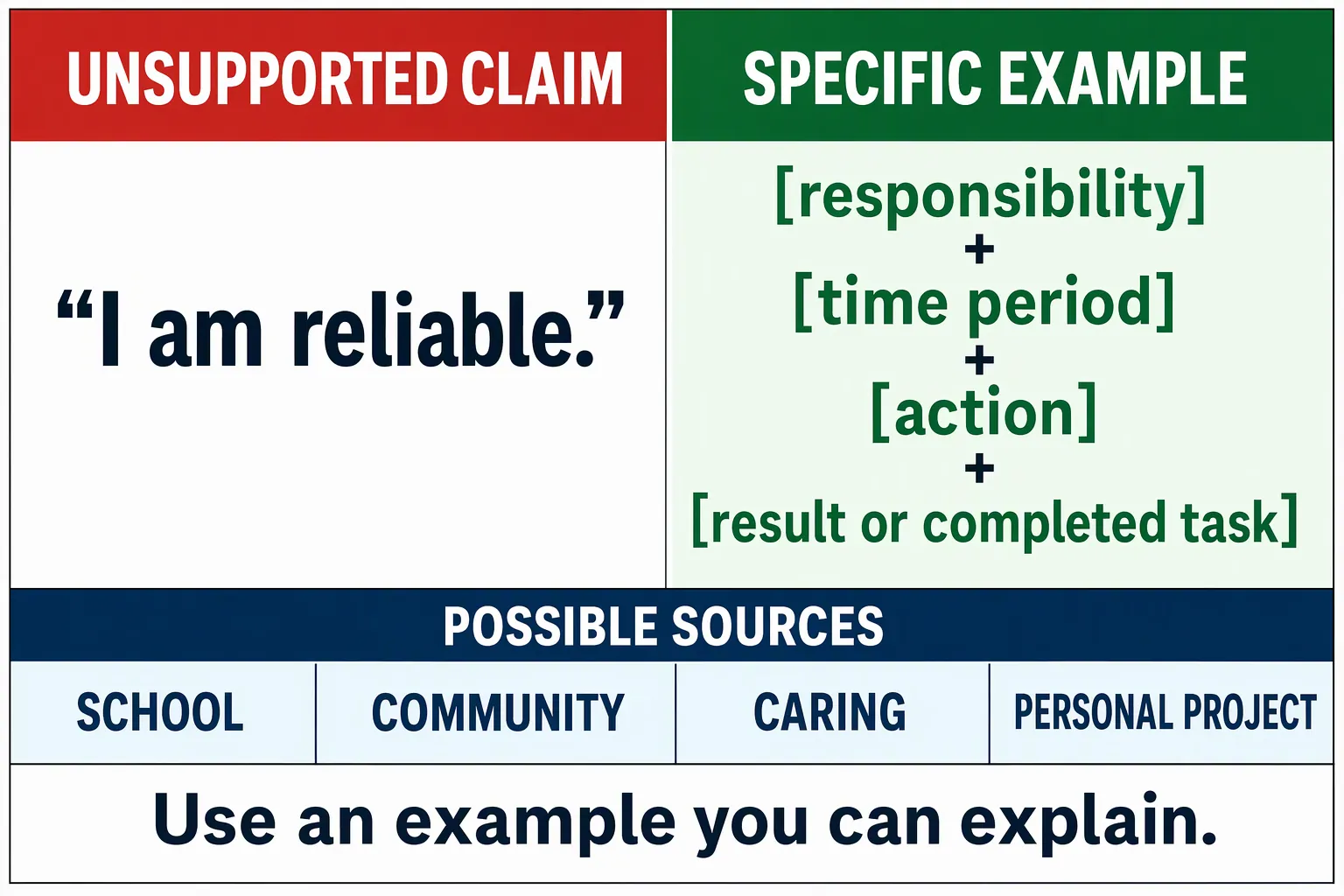
Structural approach: connect your interest to proof and learning
Build the letter around the employer's actual description, not assumptions about what every apprenticeship includes. Use a direct sequence: identify the opportunity, explain your reason for applying, show a relevant habit, and describe how you approach learning. For a broader paragraph-by-paragraph overview, see the cover letter structure guide.
Select evidence you can explain if asked about it. School leavers might use a class, club, project, or regular responsibility. Adults changing direction can use accurate examples from previous roles or another real setting. In either case, keep the source of the example clear and do not change a past job title to make it seem more relevant.
- 01
Name the opportunity
Use the job title and organization name shown in the posting. State what drew you to this specific apprenticeship, such as a described training feature or the kind of work it prepares you to learn.
- 02
Explain your reason
Give one honest reason for choosing this work or learning route. Connect it to a detail in the posting so your interest is specific, rather than relying only on a general desire for a new opportunity.
- 03
Show a reliable habit
Choose one true example and explain your responsibility and the action you took. Include an observable result if there was one; otherwise, say what you completed or learned. If it was not a job, identify the setting accurately.
- 04
Describe how you learn
Use a factual example of how you responded to instructions, feedback, or an unfamiliar task. Then name something you are ready to learn from the posting. Mention qualifications or availability only when accurate and relevant to its stated requirements.
Apprenticeship cover letter example
This fictional preview illustrates how an applicant might use a non-work example to explain readiness for training. The complete letter appears in the separate template preview.
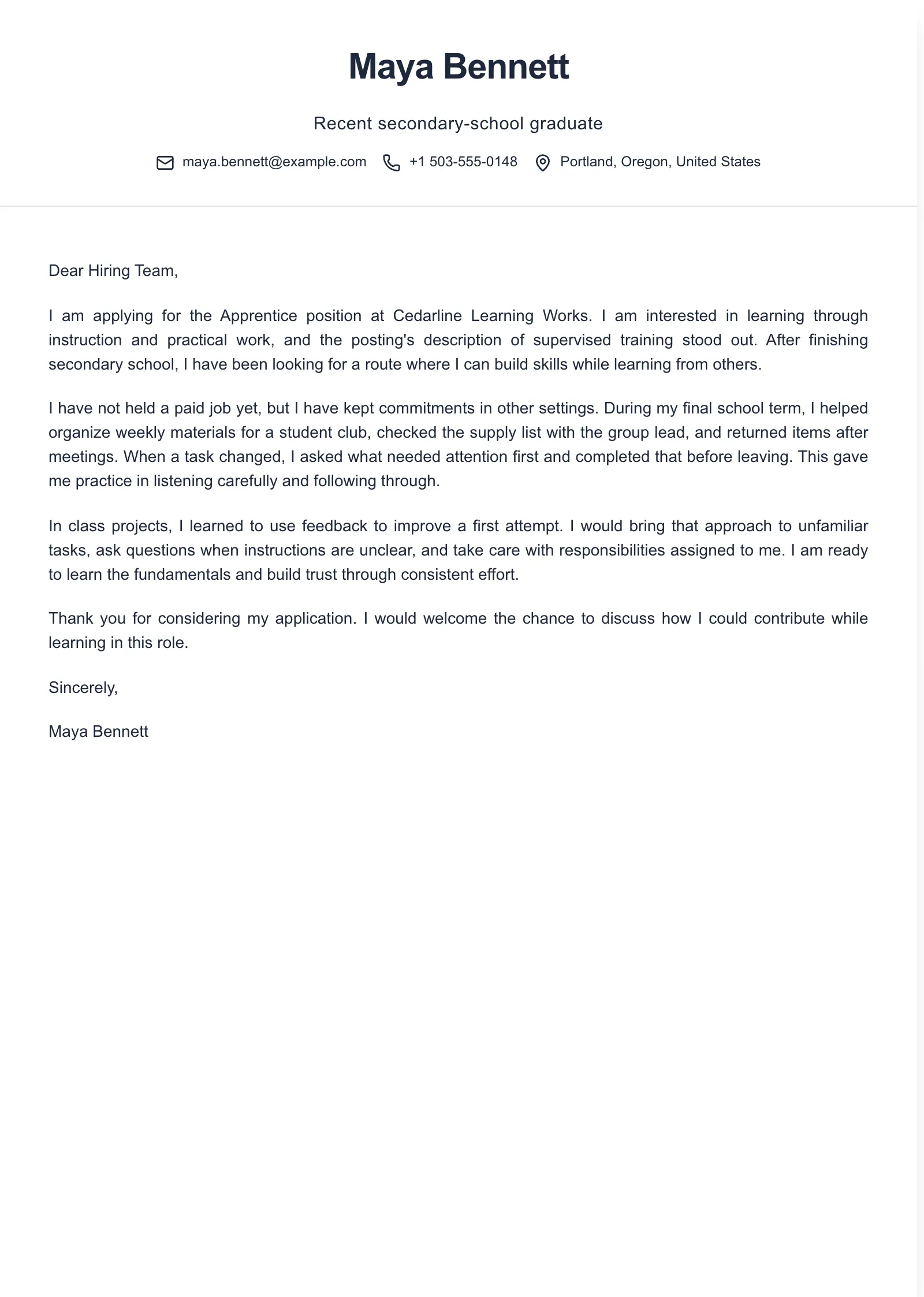
Example paragraphs
“I am applying for the [Job Title] apprenticeship at [Company Name] because [specific part of the work or training named in the posting] connects with my interest in [genuine reason]. [Factual detail about where that interest began] made me want to build my skills through structured learning.”
“Although my experience comes from [school, community, caring, or another real setting], I have shown follow-through by [specific commitment] over [time period]. I [specific action you took], which led to [observable result or completed task]. That example relates to [detail from the posting] for the [Job Title] at [Company Name].”
“I am ready to learn [specific skill or subject identified in the posting]. During [real project, course, or previous role], I responded to feedback by [specific action], then [observable change or what you learned]. I would bring the same openness to instruction to the [Job Title] apprenticeship at [Company Name].”
Adapt a paragraph to one real detail you can discuss. Replace every bracket with a fact, and remove any claim you cannot support. You may need only one or two of these paragraph ideas in your letter; do not stack examples that repeat the same strength.
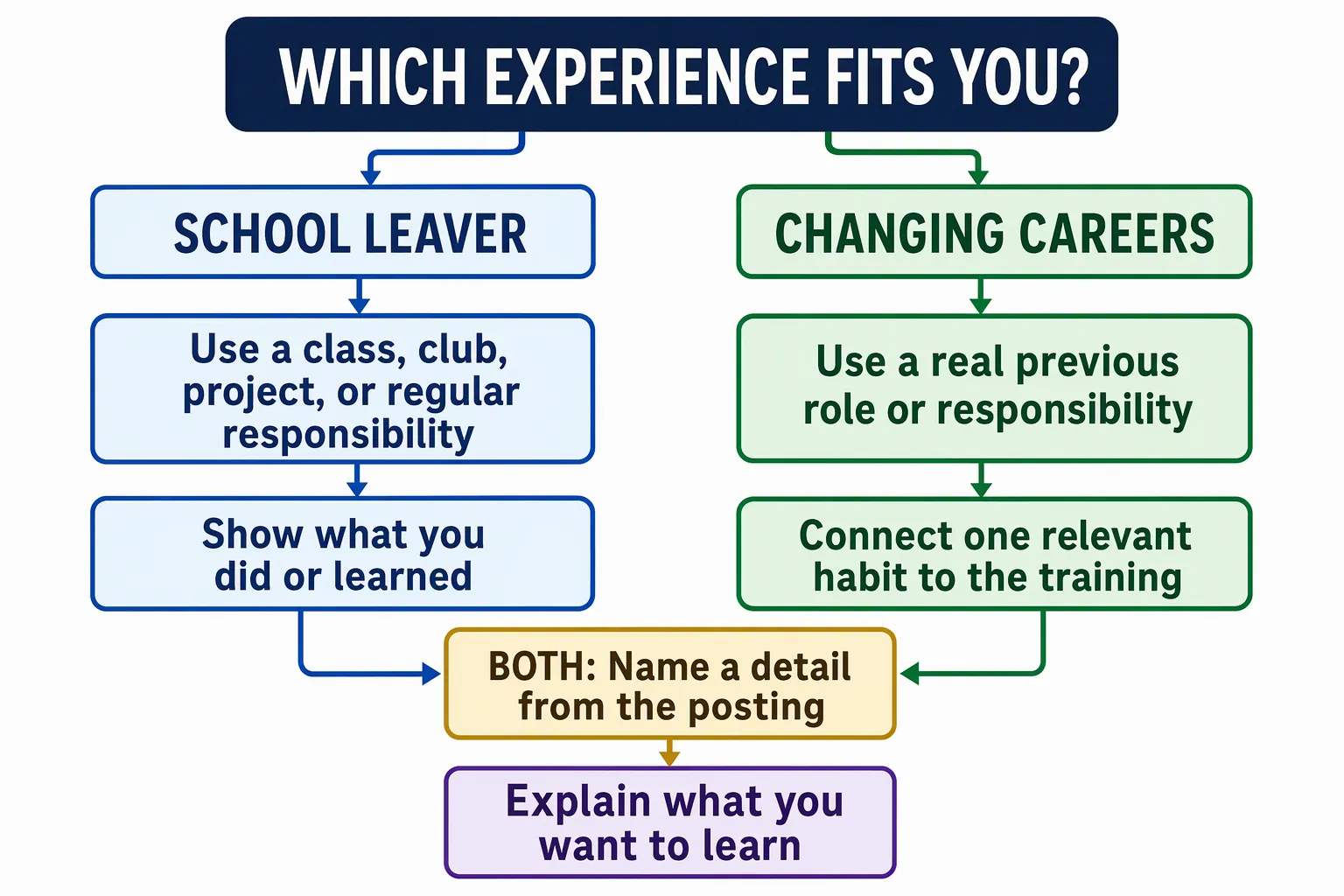
Common mistakes in an apprenticeship cover letter
Treating no paid work as no evidence
- What goes wrong
- A letter that only says you lack experience leaves the reader without an example of how you approach responsibility or learning.
- Better approach
- Choose a real responsibility from another setting and explain what you did. Be clear about where the example comes from and do not imply it was paid work.
Using a generic reason
- What goes wrong
- Saying you want a new career does not show why this particular opportunity interests you.
- Better approach
- Refer to a specific detail in the posting and connect it to an honest interest or learning goal. Leave out details you cannot verify.
Listing traits without support
- What goes wrong
- Calling yourself reliable or eager to learn does not show what those words mean in practice.
- Better approach
- Give one brief example of keeping a commitment or responding to feedback, and state the action you took. Do not add a result or metric that did not happen.
Changing facts to appear more suitable
- What goes wrong
- Inflating experience, changing a past job title, or claiming qualifications or availability you do not have makes the application inaccurate.
- Better approach
- Keep your history factual and check the employer's stated requirements. If an entry requirement or program detail is unclear, ask the employer or consult the relevant official program information.
Frequently asked questions
- Can I write an apprenticeship cover letter with no paid work experience?
- Yes. Paid work is not the only source of evidence. If you meet the posting's stated requirements, use a real example from school, a project, a community commitment, caring responsibilities, or another setting. Explain what you were responsible for, what you did, and what that shows about how you approach learning or follow-through.
- Should I say that I have no work experience?
- You can be direct if it helps explain your background, but do not make an apology the focus. Move quickly to evidence of reliability, learning, or follow-through from a setting you know well. Be clear about where that experience came from.
- Can an adult changing careers apply for an apprenticeship?
- Entry requirements depend on the particular posting and program, so do not assume every opportunity fits every applicant. Check the stated criteria. If the opportunity fits your circumstances, explain why you want this training route and connect a relevant, truthful example from your work or another setting. Keep previous job titles accurate.
- What if the application asks separate questions or criteria?
- Follow the employer's instructions. If the application asks for separate answers or supporting documents, provide them in the requested format rather than assuming the cover letter replaces them.

Put this career change approach into practice
Choose sample data or build your own cover letter, then personalize it before you download.