
Introduction
A cover letter after caregiving is for someone returning to paid work after time away to care for a family member. It is not an application for a caregiver job. If the time away needs context, name it briefly, then show why your experience and current evidence fit the role.
Care may have ended, or it may still affect your availability. The letter does not need to become an account of a relative's health or your private arrangements. Share only details you choose to include and that help explain your application.
This guide focuses on family care and the possibility that care duties continue. It does not assume you are a parent or that caregiving followed one timeline. For a resume timeline, see how to explain an employment gap; this page focuses on the cover letter.
What to address directly
You are unsure what to disclose
- Hiring manager concern
- A detailed account of a family member's needs can reveal private information without helping the reader assess your fit. Saying nothing may also leave a relevant change in your work timeline unexplained.
- What your letter should prove
- Use one plain sentence to give context for the time away. You can omit the person's identity, diagnosis, and day-to-day care details. Keep the focus on your application rather than defending the time away.
You are unsure how to show current skills
- Hiring manager concern
- Time away by itself does not show which skills you have kept current, and it does not erase relevant experience you already have. Broad claims give the reader little evidence to assess.
- What your letter should prove
- Select one or two role requirements and connect them to evidence you can explain. That might be earlier paid work or a more recent course, project, or volunteer activity. Describe the evidence accurately and do not imply that it is paid experience if it is not.
Care may still affect your availability
- Hiring manager concern
- You may want to show interest without committing to a schedule that is not workable. Sharing family logistics does not establish which hours you can reliably meet.
- What your letter should prove
- If the posting makes schedule relevant and you know what you can reliably work, state that clearly. Otherwise, leave the details out of the letter and avoid promising future changes to your care arrangements.
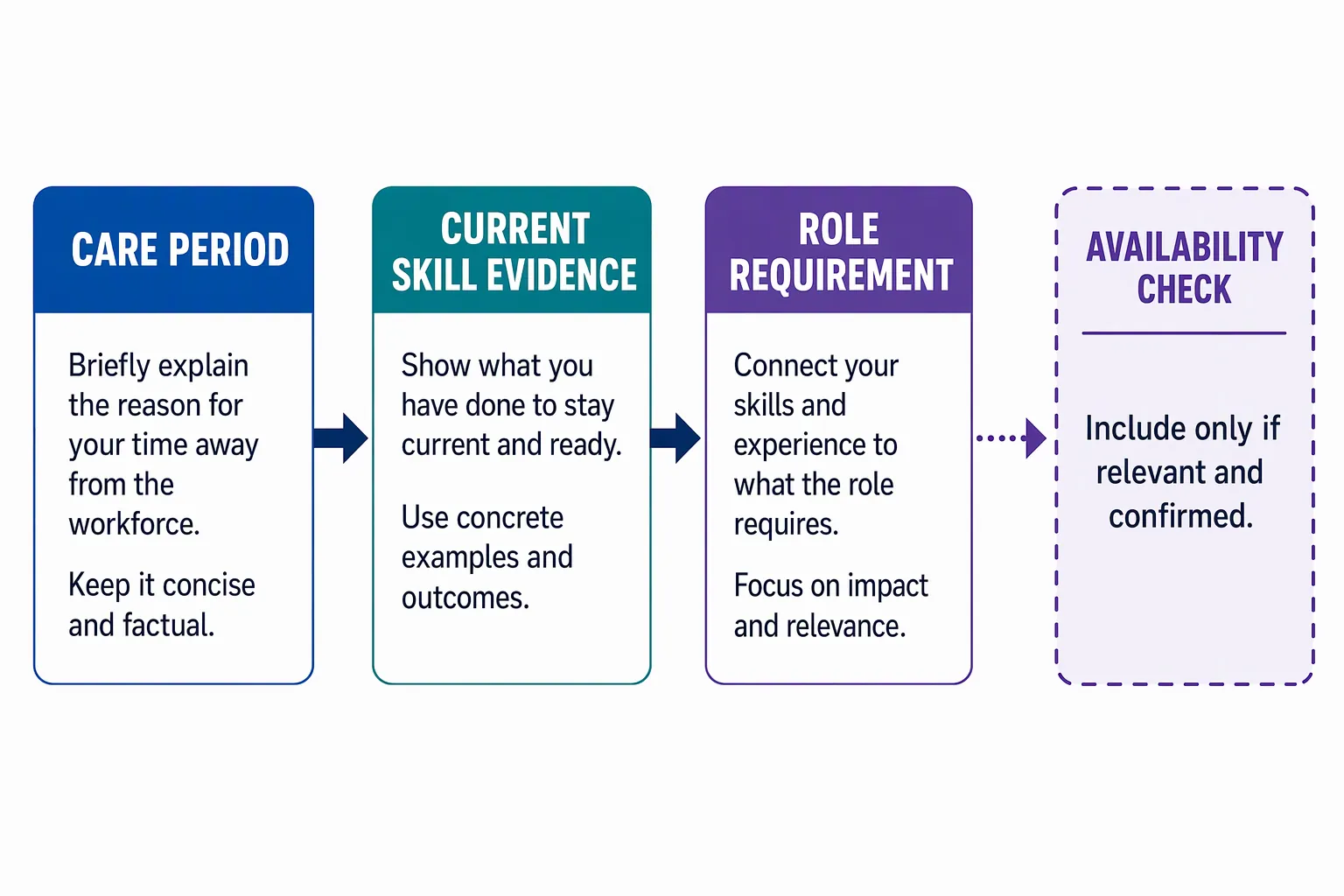
Structural approach: explain the transition, then show current fit
Keep the letter focused on the vacancy, not on defending your time away. A brief transition sentence gives context; the remaining space can connect your actual experience and current evidence to the work. See the cover letter structure guide for general paragraph roles. Here, the specific choice is how briefly to describe family care and whether availability belongs in the letter.
Use these steps to decide what to include. You do not need to mention caregiving in every paragraph or turn family responsibilities into work history. Keep dates and role titles consistent with the rest of your application.
- 01
Name the role and your reason for applying
Identify the [Job Title] and [Company Name]. Give one specific reason the position interests you, based on the posting or the organization's work. Do not open by apologizing for time away.
- 02
Explain the time away briefly
If it helps explain your timeline, say that you stepped away from paid work to care for a family member. Add dates only when accurate and useful. Do not invent a job title for family care or disclose details you prefer to keep private.
- 03
Connect evidence to the role
Choose a relevant capability and support it with an example you can stand behind. It may come from earlier paid work or a more recent activity that helped you keep a skill current. Identify what the evidence is; do not present a course or volunteer activity as paid experience.
- 04
Include availability only when relevant
If ongoing care affects your schedule and the posting makes availability important, state only what you can reliably meet. Otherwise, leave private logistics out. Do not promise a schedule you have not confirmed.
Fictional return-to-work example
This fictional example gives brief context for family care, then connects current evidence to a role. Its details are illustrative, not a history to copy.
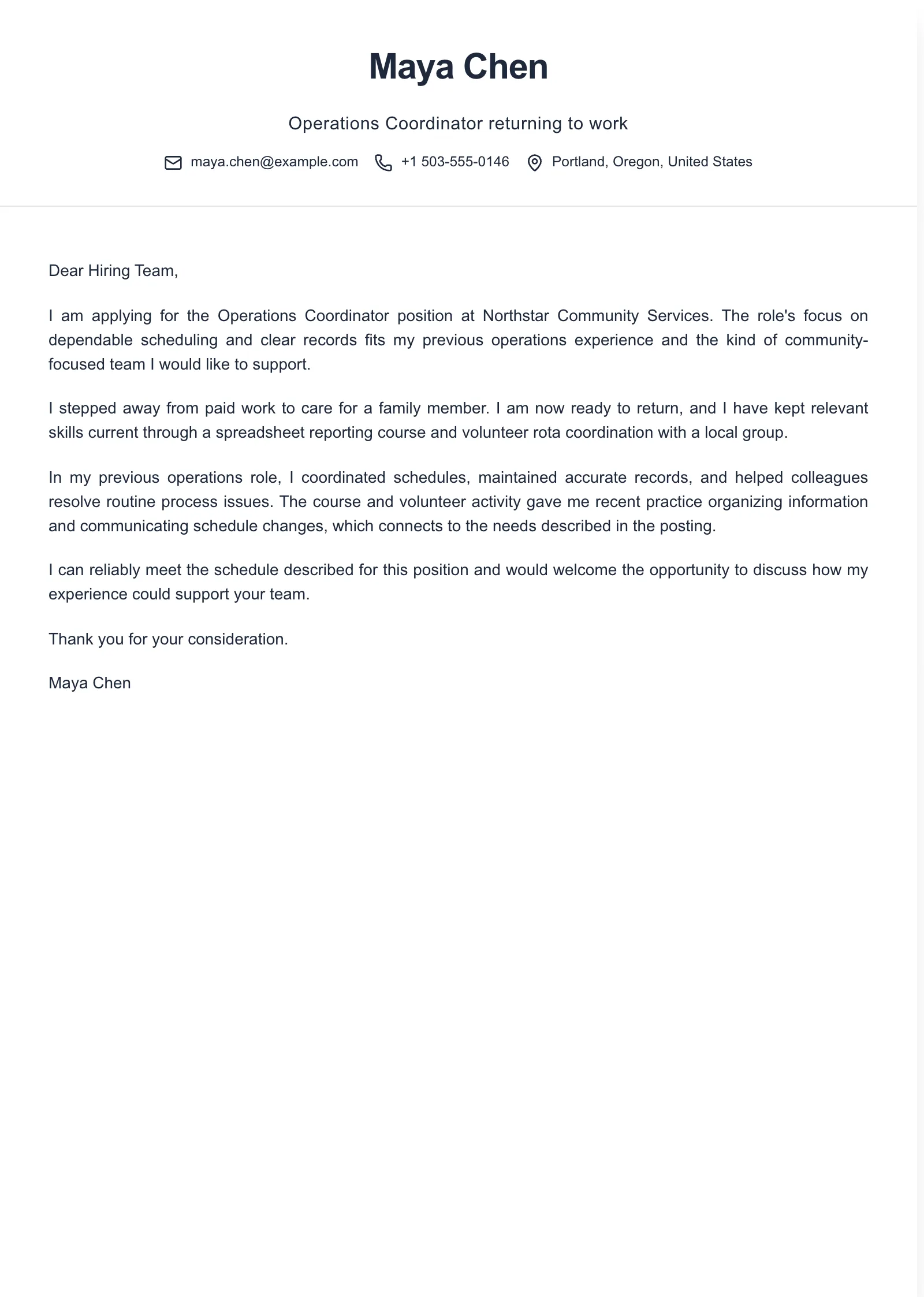
Example paragraphs
“I am applying for the [Job Title] position at [Company Name] because [specific reason drawn from the posting]. I stepped away from paid work from [accurate time period] to care for a family member, and I am now seeking to return to [relevant type of work].”
“Your posting calls for [relevant skill]. I have kept that skill current through [specific course, project, volunteer activity, or recent practice], where I [accurate action or result]. This gives me a recent example related to [relevant task].”
“The schedule described for the [Job Title] role is one I can reliably meet. I would welcome the opportunity to discuss how my experience in [relevant area] could support [Company Name].”
Use only details you can explain accurately, and replace every bracketed item with your own information. Include the availability paragraph only if schedule is relevant and you know what you can commit to. These are paragraph examples, not a full letter; follow any additional application instructions without repeating the caregiving explanation.
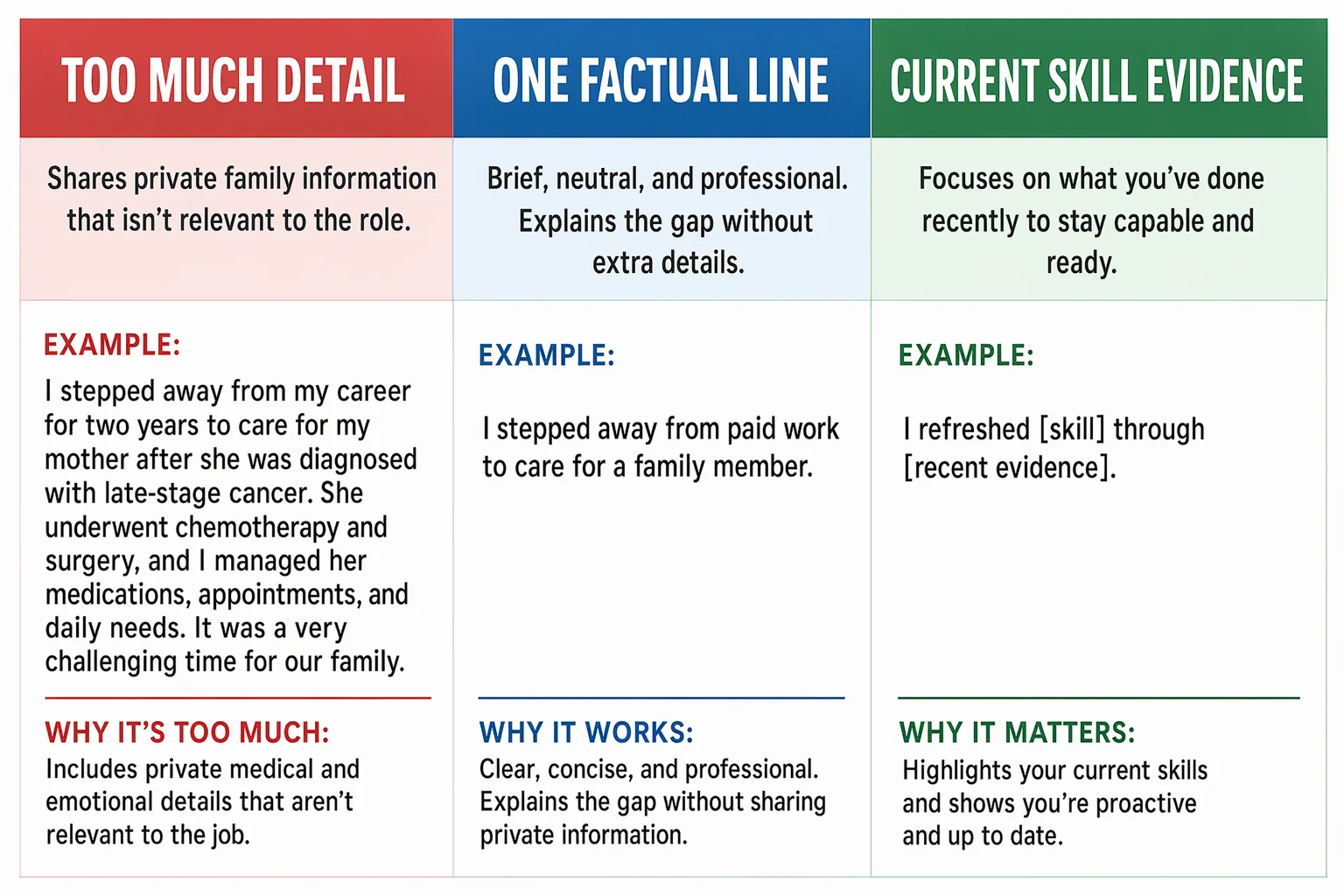
Common mistakes to avoid
Giving a detailed family account
- What goes wrong
- Describing a relative's condition or treatment can expose private information that does not help the reader assess your fit.
- Better approach
- Name the caregiving period simply. Leave personal details out unless you choose to share a specific fact for a clear reason.
Leaving the transition vague or apologizing
- What goes wrong
- An unclear explanation may leave the reader guessing why your work dates changed, while an apology frames caregiving as something you must excuse.
- Better approach
- Use one direct, neutral sentence if context is useful. Then move to your qualifications and reason for applying.
Treating family care as proof of every workplace skill
- What goes wrong
- Assuming that care responsibilities demonstrate a particular job skill can overstate your evidence.
- Better approach
- Make specific claims only when you have a relevant example. Describe a course or project accurately and distinguish it from paid work.
Promising a schedule that may not be workable
- What goes wrong
- A promise made to reassure the employer can create a mismatch if ongoing care affects the hours you can keep.
- Better approach
- State only availability you can reliably meet. Do not speculate about future changes to care arrangements.
Frequently asked questions
- How much should I say about caring for a family member?
- Use only the context you want to share. A short, truthful sentence can explain the time away without naming the person or describing their health. Include more only if it helps explain a relevant detail and you are comfortable sharing it.
- How can I show current skills after time away from work?
- Choose evidence you can describe accurately, such as a recent course, project, volunteer activity, or practice with a relevant tool. Connect it to a requirement in the posting. Do not present family care as paid work or claim it proves a skill without a specific example.
- What if caregiving still affects my schedule?
- Do not promise availability you cannot reliably meet. If the posting gives a schedule you can work, you can say so when it is relevant. Keep private care arrangements out of the letter unless you choose to share them, and answer specific availability questions accurately.
- Is this the same as a cover letter for a caregiver job?
- No. This page is for someone returning to work after caring for a family member. An application for a caregiver job is for a role providing care to others, so it should focus on the applicant's relevant experience and qualifications for that role.

Put this career change approach into practice
Choose sample data or build your own cover letter, then personalize it before you download.