
Introduction
Returning to work after burnout can raise two questions: whether to explain time away and how to show your present readiness. Your cover letter does not need to tell your health history. If context is useful, acknowledge the break briefly, choose a level of detail you are comfortable sharing, and bring the focus back to your fit for [Job Title] at [Company Name].
This scenario overlaps with explaining an employment gap, but adds decisions about privacy and readiness. For the general parts of a letter, see cover letter structure. Use this guide to decide what, if anything, to say about the break.
What to address directly
How much to disclose
- Hiring manager concern
- You may worry that a reader expects a medical explanation, or that a general description will invite follow-up questions.
- What your letter should prove
- You can refer to a planned break or time away without naming a diagnosis or describing treatment. A phrase such as “I took a planned break from work” may be enough when you want to acknowledge the timeline. There is no need to include details you do not want to discuss.
How to describe readiness
- Hiring manager concern
- Saying you are “fully recovered” may feel too personal or imply a guarantee about the future.
- What your letter should prove
- Describe your present decision and the work you are prepared to do, not a medical conclusion. You might state that you are ready to return to [Job Title] responsibilities and connect that to relevant experience or a current skill. Do not promise that you will never face difficulty.
Separate application questions
- Hiring manager concern
- A form or later conversation may ask something beyond the brief explanation in your letter.
- What your letter should prove
- Read the exact wording and follow the stated process; your cover letter is not a substitute for answering a separate question. If the answer could affect your rights or obligations, check official guidance for the relevant jurisdiction. In the United States, the EEOC's applicant guidance distinguishes requesting an adjustment to participate in recruitment from explaining qualifications. Its guidance concerns covered employers, and laws elsewhere differ.
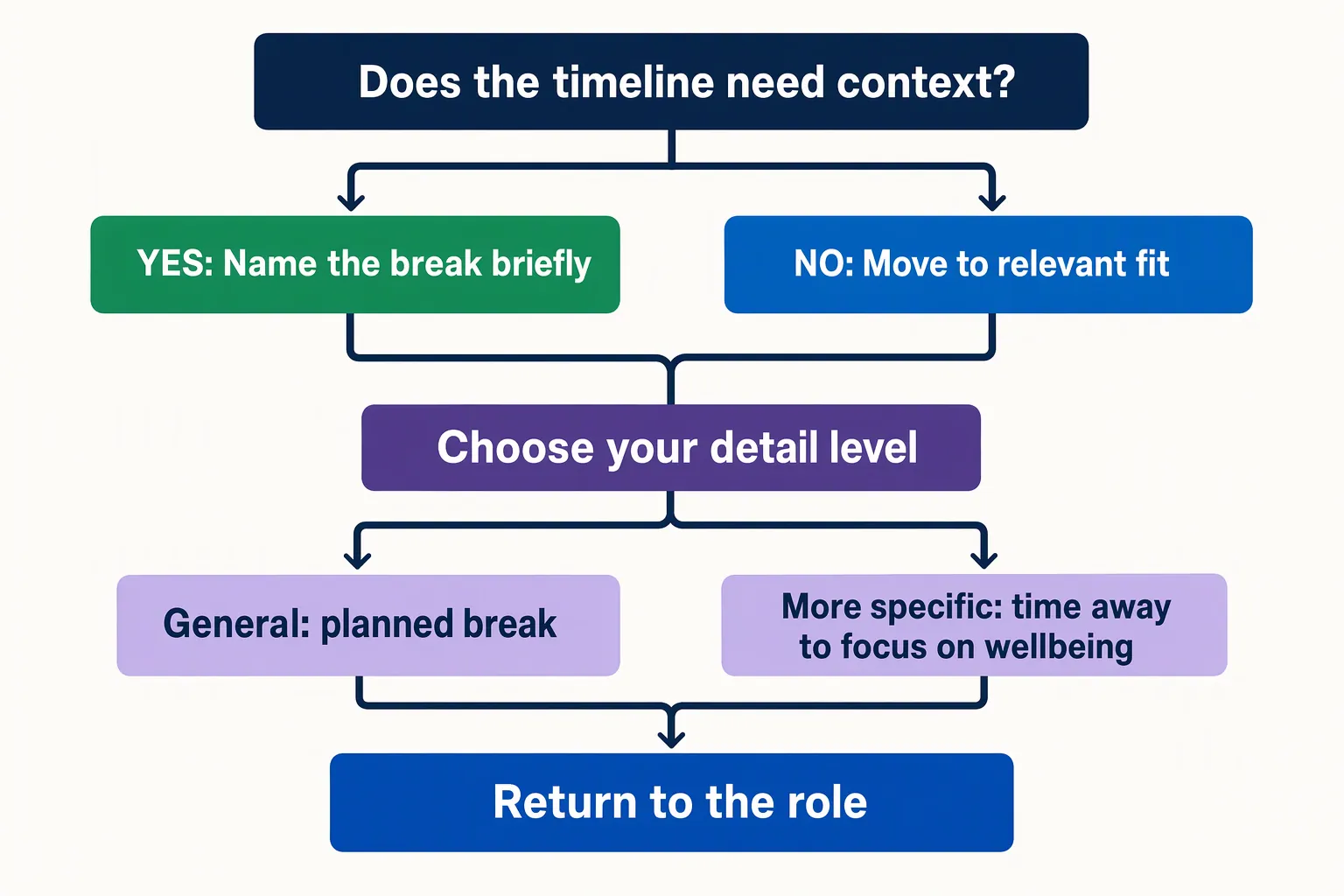
Structural approach: keep the break in context
If the break needs context, give it only the space needed to make your application clear. There is no universal word count for this explanation. Follow the employer's instructions, and do not let the break crowd out your relevant experience, interest in the opening, or evidence of fit.
A useful sequence is to acknowledge the break at your chosen level of detail, state your present readiness in work-related terms, connect relevant evidence to the position, and close with interest in discussing the match. Treat this as a flexible order, not a required script.
- 01
Choose your disclosure boundary
Decide whether to call it a planned break, a personal break, or time away from work. Leave out diagnosis, treatment, and other details that do not help explain your application. Use a description you are comfortable repeating.
- 02
Acknowledge the pause if useful
If the timeline would otherwise be unclear, name the break plainly. You can avoid apologizing or defending the decision. If it adds no useful context, you may choose not to foreground it.
- 03
Describe present readiness
State the responsibilities or work setting you are prepared to take on. If you have an accurate, relevant example, such as a project or refreshed skill, use it to support your work-related point. Do not present private recovery steps as job qualifications.
- 04
Return to the role
Connect a real accomplishment or skill to [Job Title] and explain your interest in [Company Name] using a specific, verified reason. This keeps the break in context and gives the reader relevant information about your application.
A concise return after a burnout break
This fictional example acknowledges a break, keeps personal details private, and connects present readiness to the role.
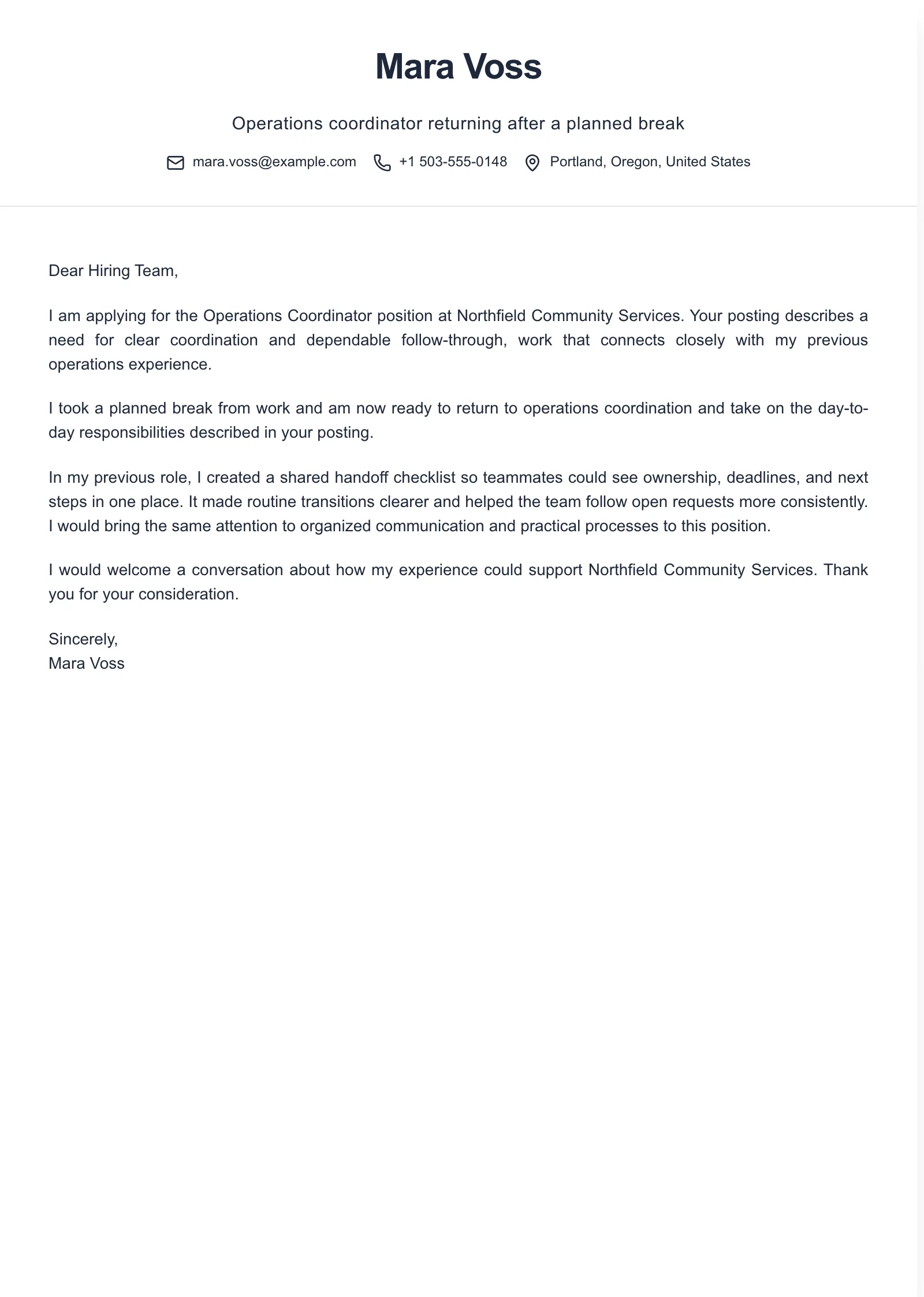
Example paragraphs
“I took a planned break from work. I am now ready to return to [Job Title] and am interested in [Company Name] because [specific, verified reason].”
“I am ready to return to [Job Title] responsibilities, including [relevant responsibility]. Recently, I [completed a relevant project, course, or activity], where I used [specific skill].”
“Before my break, I [specific, factual accomplishment]. That experience in [relevant skill or responsibility] connects to [specific requirement from the posting], and I would welcome the chance to contribute as [Job Title].”
Adapt these fragments only to facts you can discuss comfortably. They are alternatives, not three explanations to combine. If you mention the break, keep that acknowledgment proportionate and use the rest of the letter for role-specific fit.
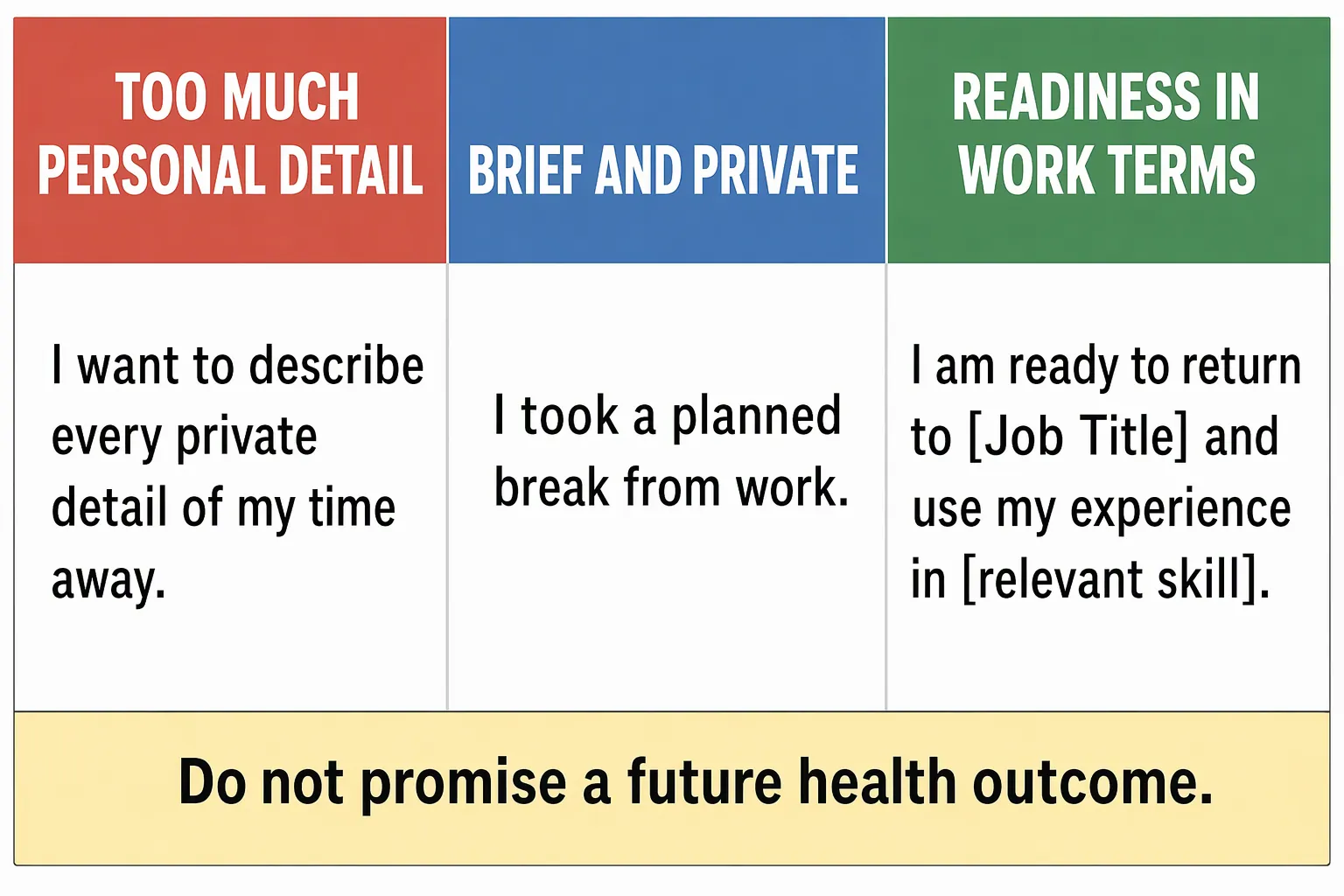
Scenario-specific mistakes
Sharing more health detail than you want to
- What goes wrong
- A detailed account of private circumstances can shift attention away from your fit and leave you sharing more than you intended.
- Better approach
- Choose a brief, truthful description of the break, or leave out its personal reason. Include private details only if you freely choose to share them and they serve a clear purpose.
Apologizing for taking time away
- What goes wrong
- Calling the break a failure or asking the employer to overlook it can make your application sound like it needs forgiveness.
- Better approach
- Describe the pause neutrally, if it needs mentioning, then move to present readiness and relevant experience.
Making absolute promises about future wellbeing
- What goes wrong
- A promise such as “I will never burn out again” makes a claim about the future without showing how your experience fits the position.
- Better approach
- Focus on the work you are ready to take on now and the relevant skills or evidence you bring. Do not promise a particular health outcome.
Letting the break replace evidence of fit
- What goes wrong
- A letter centered on explaining the absence can leave little room for your interest in the job or what you offer.
- Better approach
- Keep any explanation as brief as the application allows. Use the remaining space to connect a real accomplishment, skill, or relevant activity to the posting.
Frequently asked questions
- Do I need to use the word burnout?
- No. Naming burnout is a personal writing choice, not a requirement for explaining time away. You can describe it as a planned break or time away from work, then focus on your present readiness and fit.
- How much should I say about my health?
- You can keep the reason general and include personal details only if you choose to share them. For US applications, the EEOC says applicants generally need not disclose a disability in a cover letter, but that guidance applies to covered employers and does not determine whether an individual's experience meets a legal definition. Laws elsewhere differ.
- How can I show that I am ready to return?
- State your present decision to return in work-related terms and connect it to responsibilities you are prepared to take on. You can mention a relevant skill or activity if it is accurate and useful, but you do not need to make a claim about your future health.
- Is this different from explaining an employment gap?
- The two tasks overlap. An employment-gap explanation may focus on the timeline; this page gives particular attention to disclosure boundaries and how to describe present readiness after burnout. If your main question is how to address an employment gap, see the employment-gap cover letter guide.

Put this career change approach into practice
Choose sample data or build your own cover letter, then personalize it before you download.