
Introduction
An academic cover letter helps a search committee understand how your work fits a particular faculty appointment. Connect selected research, teaching, and service evidence to the role instead of listing every item in your CV. Choose details that show what you contributed and why that evidence matters to this search.
Start with the advertisement and application instructions. A search may request research or teaching statements, a service statement, or other materials, but requests vary. Use the letter to frame the most relevant parts of your record, not to repeat every document. For a general structure, see this guide to cover letter structure.
What to address directly
Connecting scholarship to this search
- Hiring manager concern
- A research summary can take over the letter, leaving the committee unsure why you chose this appointment. A broad claim that your interests align with the department does not explain the connection.
- What your letter should prove
- Name the research question, approach, or contribution most relevant to the role, then connect it to a priority stated in the advertisement. Be specific about the fit without claiming that your work matches every departmental interest.
Showing teaching evidence
- Hiring manager concern
- A course list or a general promise to teach a wide range of subjects gives little insight into your preparation. The letter also should not reproduce a full teaching statement when one is requested separately.
- What your letter should prove
- Choose one relevant teaching example. Identify the course or teaching context, the practice you used, and what it helped learners do. If a separate statement is requested, point to it for fuller detail.
Selecting service evidence
- Hiring manager concern
- Listing committees and activities without context can crowd out evidence more relevant to the appointment.
- What your letter should prove
- Select a contribution that connects to the role's stated needs. Describe your responsibility and the work it supported. Keep other service details in your CV unless the advertisement asks for them.
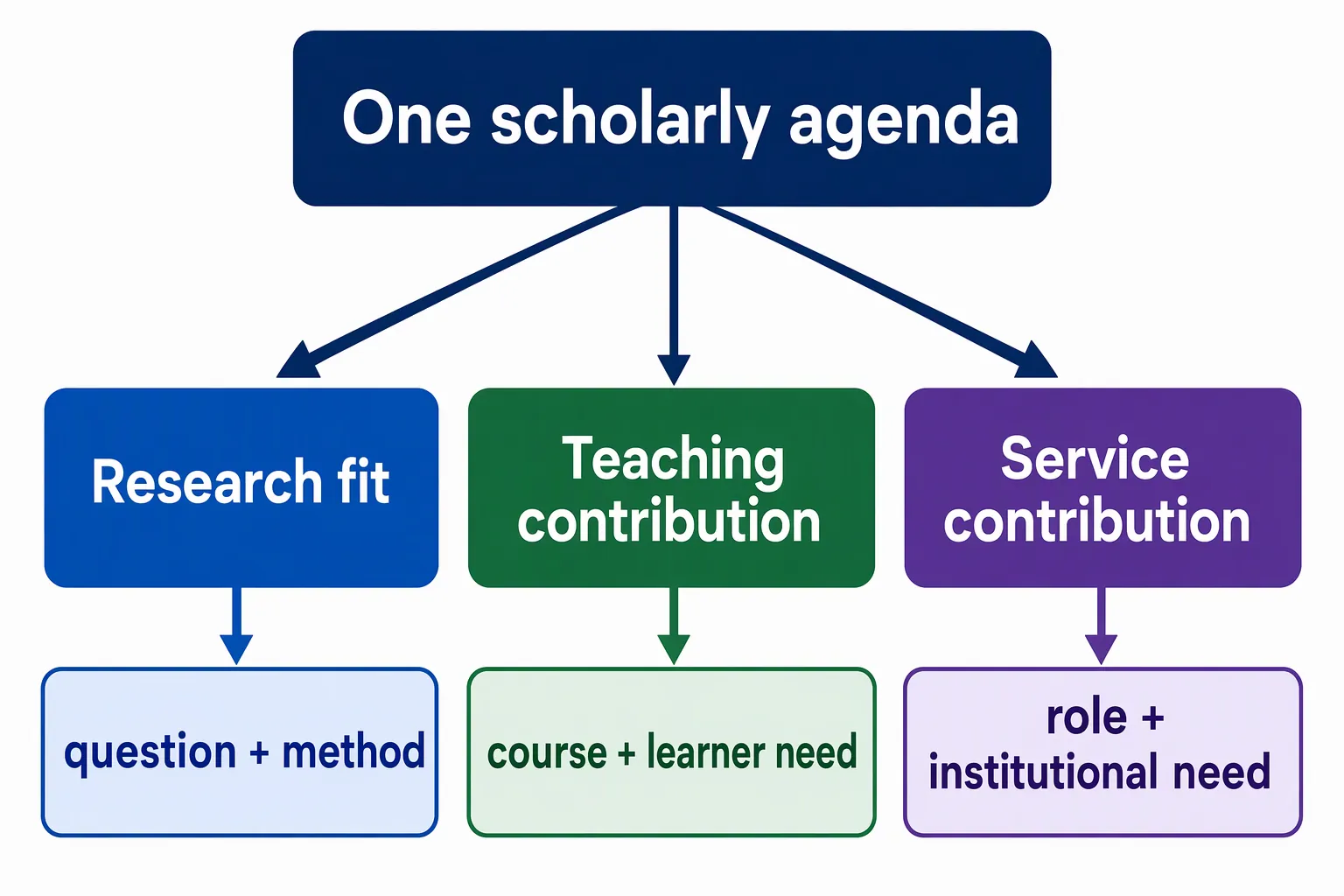
Structural approach: organize around the search criteria
Build the letter around the search criteria rather than giving research, teaching, and service equal space by default. Emphasize the areas the advertisement values. The letter should make the connection between your record and the appointment clear; keep fuller accounts of methods, courses, or committee work in requested supporting materials.
There is no universal academic cover letter page count. The space you need depends on the search instructions and the evidence relevant to the role. Follow any stated length or format requirements, and do not add material simply to reach a page target.
- 01
Extract the search criteria
Mark the appointment's research focus, teaching responsibilities, service expectations, and required materials. Separate explicit requirements from preferred qualifications. Use this list to choose evidence for this search rather than writing a general account of your career.
- 02
Select evidence for the priorities
Choose a small number of examples that address the criteria. For each, identify your role, the action or approach you took, and a verifiable result or contribution. Use a concrete output or observation when available; do not invent metrics or imply sole credit for collaborative work.
- 03
Explain the appointment fit
Connect each example to a detail in the advertisement, such as a research area, course need, or service responsibility. Explain what you could contribute without assuming unlisted resources or future outcomes. Avoid praise that could be sent unchanged to another institution.
- 04
Coordinate the application materials
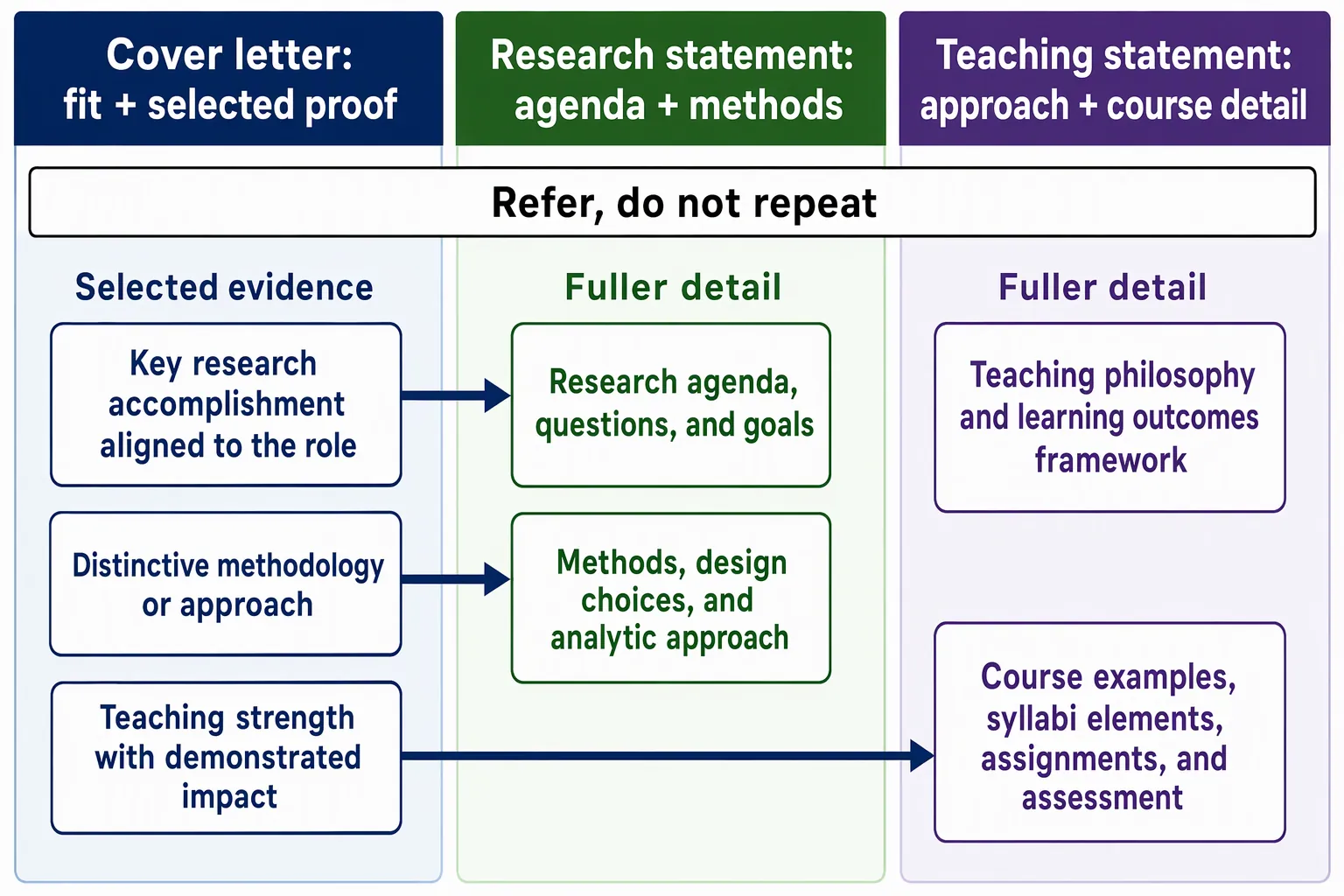
Check that the letter complements your CV and any requested statements. Use it to frame selected evidence; let a research or teaching statement provide fuller detail when requested. Before submitting, verify the institution and role names, document requests, and any length or format instructions.
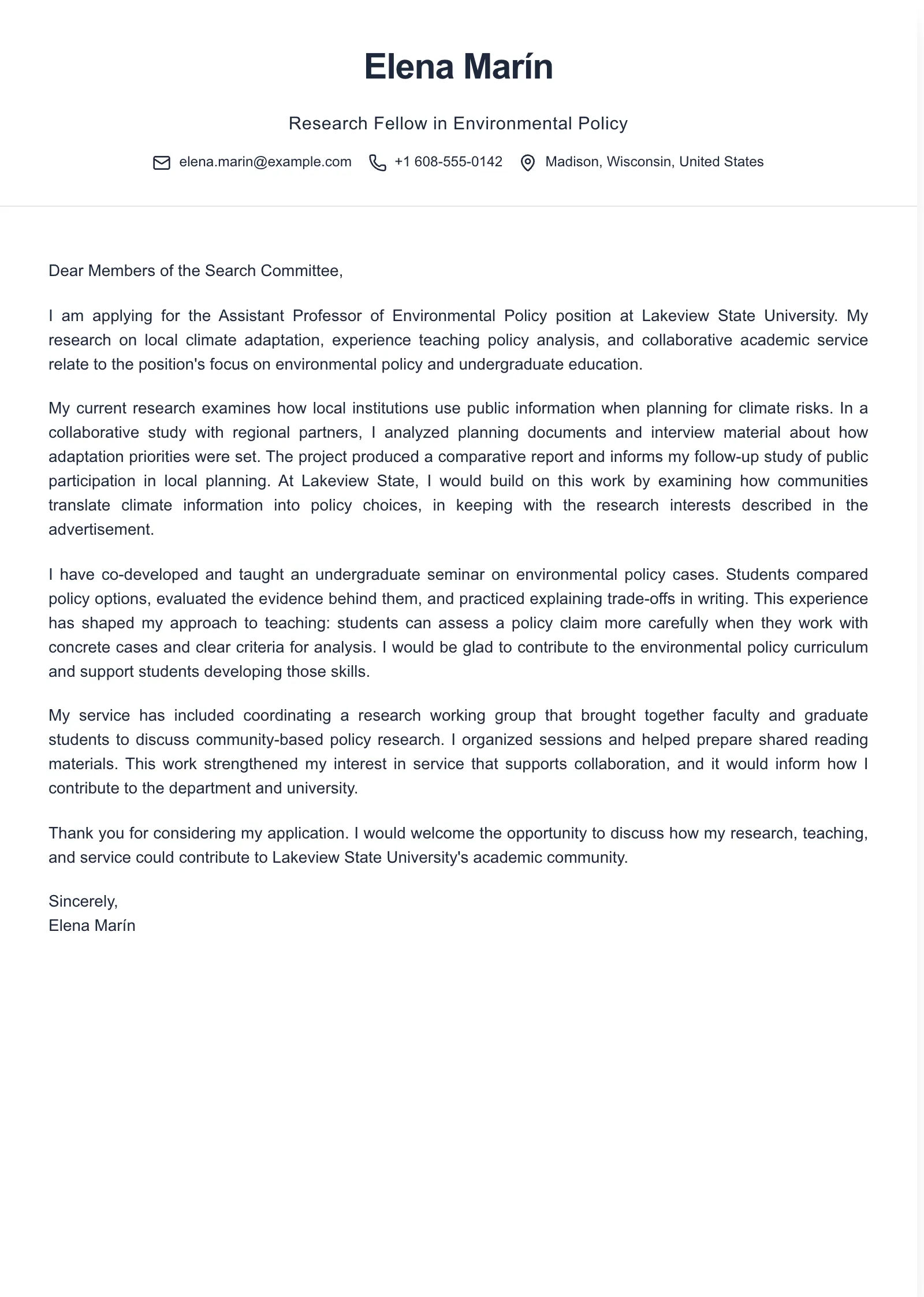
Academic job cover letter example
This fictional example connects selected research, teaching, and service evidence to one faculty appointment without repeating a full academic dossier.
Example paragraphs
“My work on [Research Area] examines [Research Question] through [Method or Approach]. This work has produced [Verifiable Finding or Output]. For the [Faculty Role] position at [Institution Name], I would bring this experience to [Specific Research Priority in the Advertisement].”
“In [Course or Teaching Context], I used [Teaching Practice] to help [Learner Group] work through [Specific Learning Challenge]. [Factual Evidence of Learning or Course Contribution] reflects what that approach supported. This experience is relevant to the [Teaching Need] described for the [Faculty Role] at [Institution Name].”
“As [Service Role], I contributed [Specific Work] in support of [Group or Institutional Need]. My responsibility was [Accurate Description of Your Contribution]. I would bring that experience to the [Faculty Role] at [Institution Name], particularly where it relates to [Stated Service Expectation].”
Use these as paragraph models, not claims to borrow. Replace each bracketed prompt with accurate details and remove anything you cannot support. The examples show how to connect an academic activity to a search criterion; they are not a full letter. Attribute collaboration, authorship, teaching responsibility, and results accurately.
Scenario-specific mistakes in an academic job cover letter
Summarizing the entire CV
- What goes wrong
- A chronological inventory of publications, courses, and committees repeats the dossier without helping the committee judge fit.
- Better approach
- Select evidence relevant to this appointment and leave the complete record in your CV.
Making research fit interchangeable
- What goes wrong
- Saying your interests align with the department, without naming the connection, could describe almost any search.
- Better approach
- Refer to a specific priority in the advertisement and explain its genuine connection to your work.
Repeating requested statements
- What goes wrong
- Copying long passages from a research or teaching statement can obscure what the letter adds.
- Better approach
- Summarize the relevant point, explain its fit, and leave fuller detail in the requested statement.
Assuming a fixed length
- What goes wrong
- Treating one page count as a rule can conflict with the search instructions or the amount of relevant evidence.
- Better approach
- Follow the application requirements and use the space needed to address the role clearly.
Frequently asked questions
- How long should an academic cover letter be?
- Follow the search instructions first. There is no universal page count for academic cover letters. The letter may need more room when the search asks you to address several areas, such as research and teaching, but include only the detail needed to show your fit.
- How is an academic cover letter different from a research statement?
- The letter connects selected parts of your record to the appointment. If requested, a research statement can explain your research agenda in greater depth. Use each document for its purpose rather than repeating the same material.
- Should every academic cover letter discuss teaching and service?
- Address the areas the advertisement emphasizes and the application requests. Include relevant teaching or service evidence when it helps show your fit; do not add vague claims just to cover every category.
- Can I reuse the same letter for different universities?
- You can reuse accurate descriptions of your work, but revise the fit and evidence for each search. Check that the institution, role, priorities, and requested materials are correct before submitting.

Put this career change approach into practice
Choose sample data or build your own cover letter, then personalize it before you download.