How Long Should a Cover Letter Be? A Practical Guide to Length, Structure, and When It Matters
A practical guide to cover letter length, structure, and when a shorter or longer letter makes the strongest impression.
How Long Should a Cover Letter Be? A Practical Guide to Length, Structure, and When It Matters
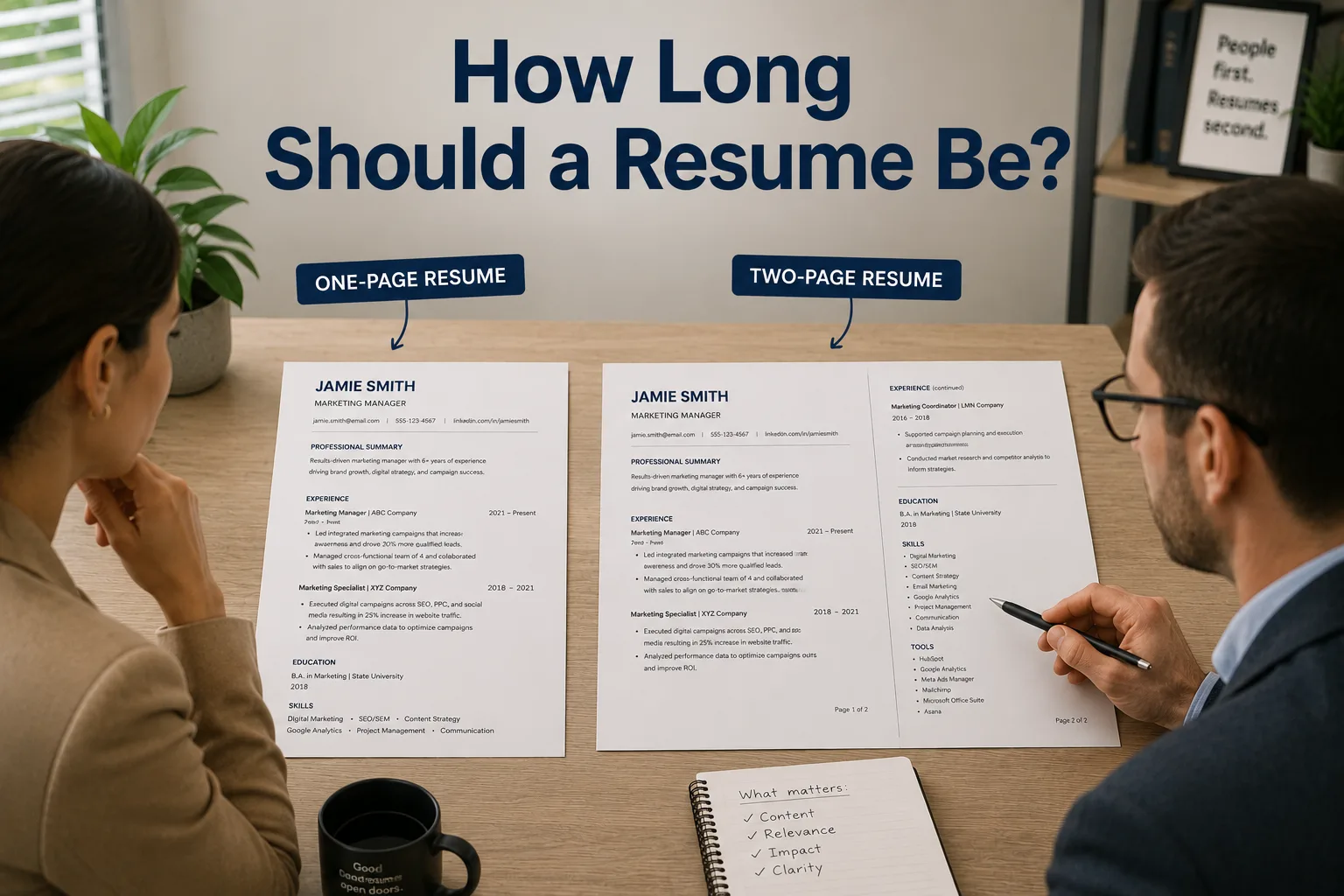
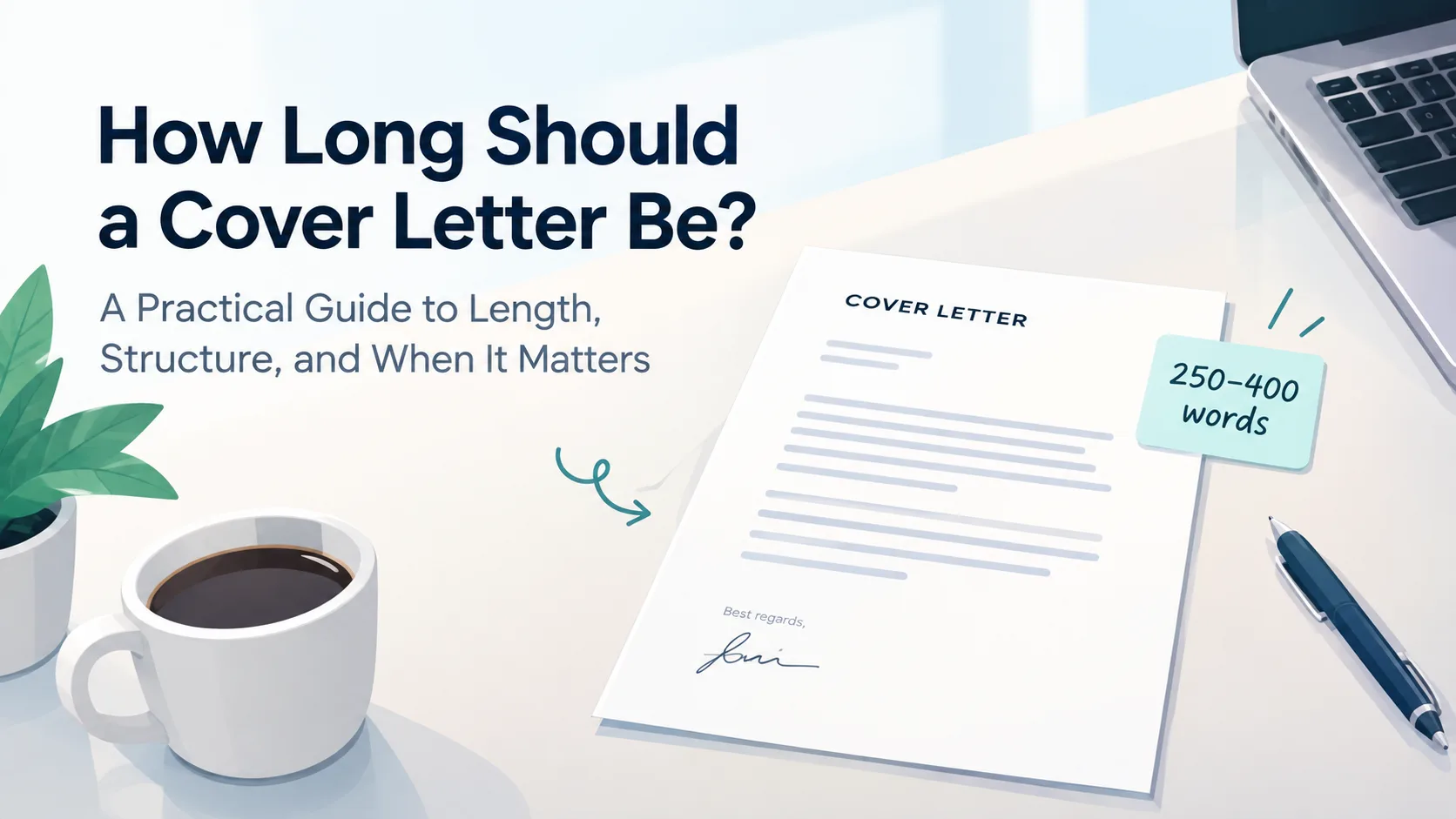
If you're wondering how long should a cover letter be, a good target for most jobs is 250–400 words, usually across 3–4 short paragraphs and almost always within one page.
The exact length depends on the role, application format, and how much context the employer needs. The goal isn't to reach a particular word count. It's to provide enough evidence of your fit and motivation without repeating your resume or filling the page with generic statements.
What’s the Ideal Cover Letter Length? Word Count, Page Length, and the Best Range for Most Jobs
For most professional applications, aim for 250–400 words and keep the letter to one page.
A useful rule is:
Write enough to show fit, motivation, and one or two strong proof points. Then stop.
A 300-word letter that connects your experience to the employer's needs is more useful than a 500-word letter that summarizes your entire career.
For example, if an application accepts a standard cover letter through Greenhouse or Workday, around 300 words is usually enough for:
A brief opening
One or two paragraphs showing relevant evidence
A concise closing
When a Cover Letter Matters, When It’s Optional, and When a Short-Answer Prompt Should Take Priority
If an employer requires a cover letter, submit one. If it's optional, ask whether it adds something your resume cannot communicate.
A cover letter can be particularly useful when you need to explain:
A career change
A relocation
A referral or personal connection
Unusual or transferable experience
Motivation for a communication-heavy role
If the application asks specific questions such as "Why this role?" or "Why our company?", answer those first. A 100–250-word response that directly addresses the employer's question is usually more valuable than adding a separate, generic letter.
Recommended Length by Scenario: Students, Career Changers, Mid-Level Applicants, and Senior Candidates
Your cover letter word count should reflect how much context the employer needs, not simply your seniority.
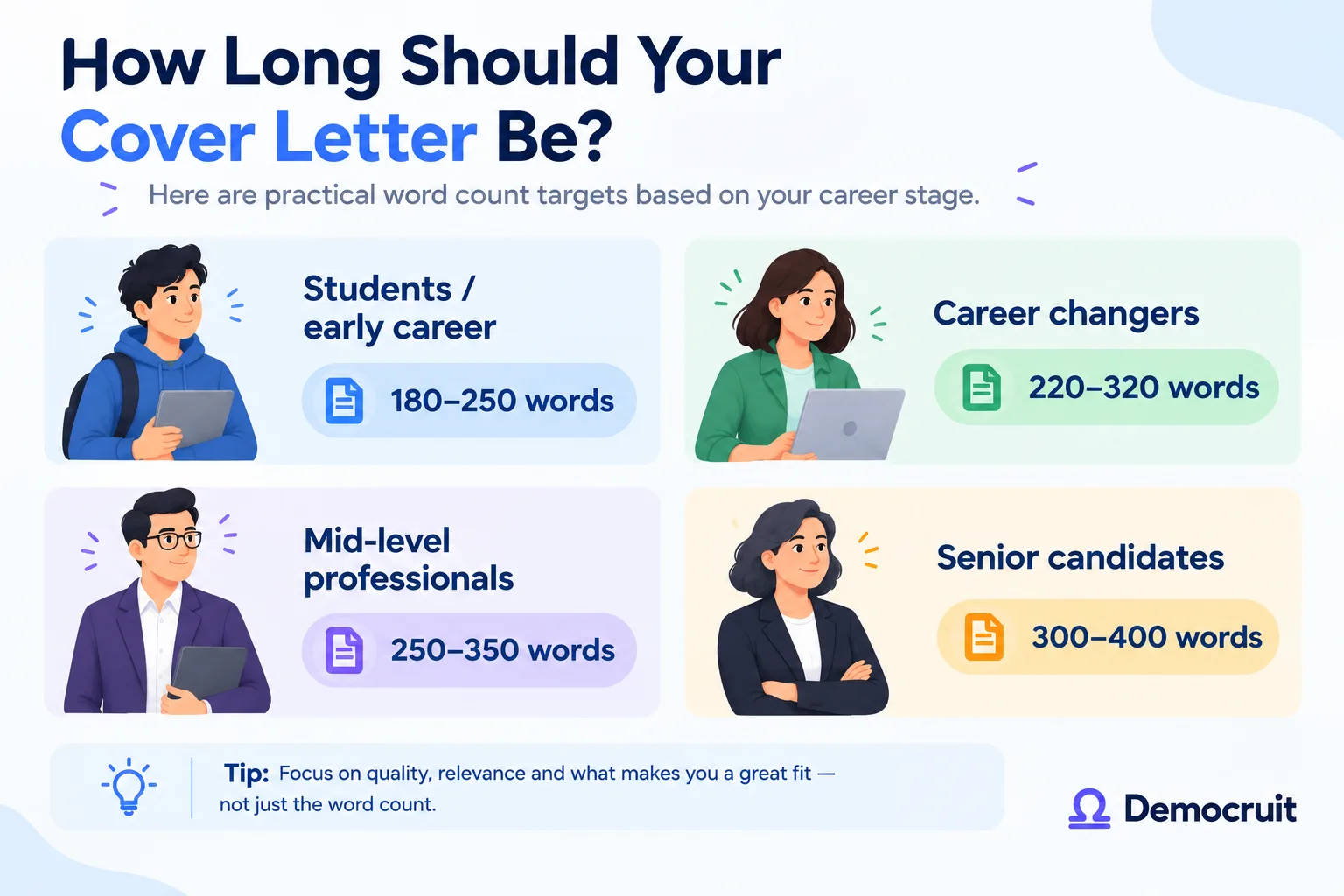
These are benchmarks, not rules. A career changer may need more explanation than a senior candidate whose resume already makes the fit obvious.
For students, focus on relevant coursework, projects, internships, or other evidence of potential.
For career changers, briefly explain the connection between your previous experience and the new role. For example, a teacher moving into customer success could connect communication, conflict resolution, and stakeholder management to the target position.
For experienced candidates, prioritize measurable impact, scope, leadership, and role-specific achievements.
How to Structure a Cover Letter So It Stays Concise and Easy to Read
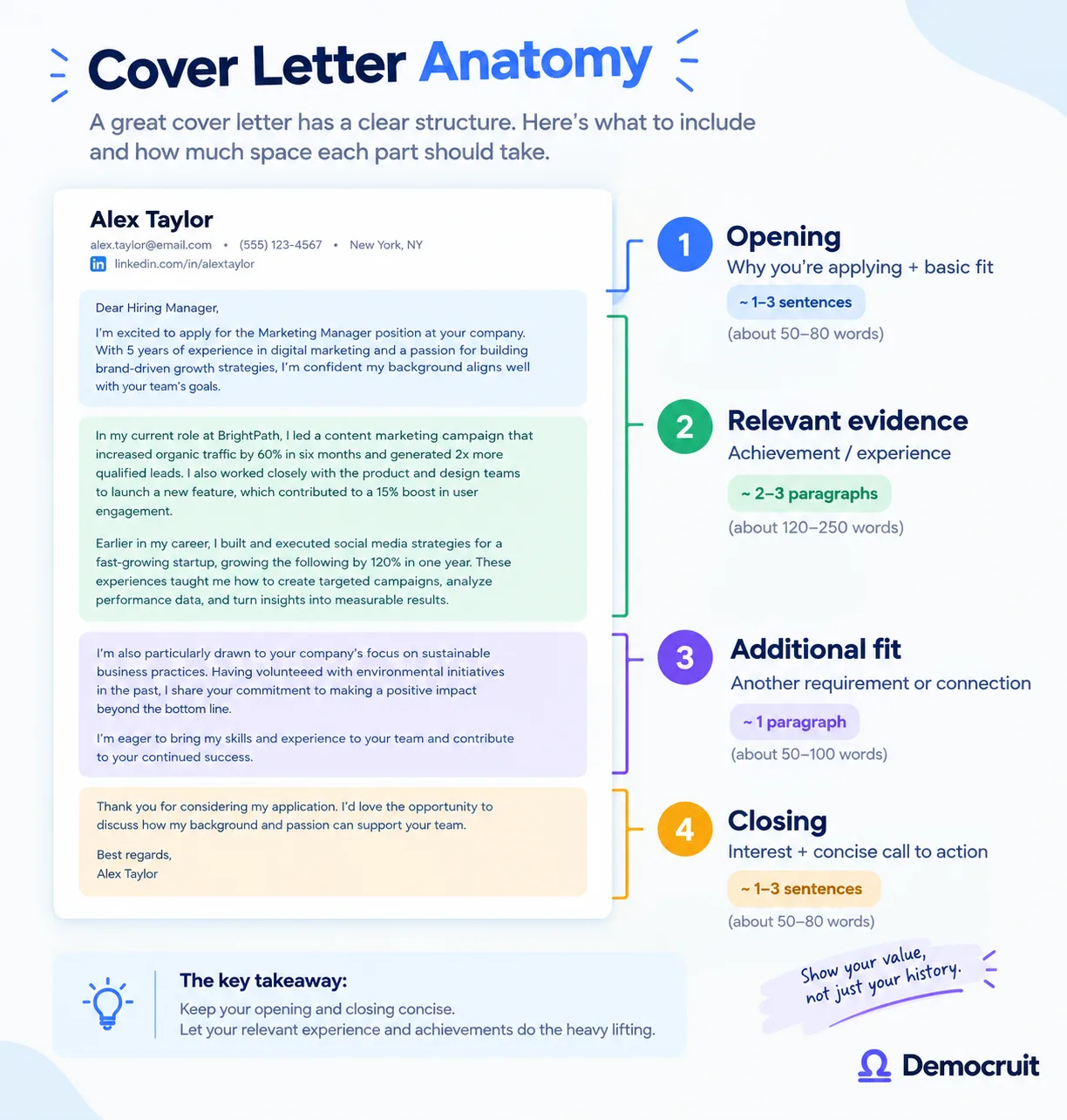
A strong cover letter usually has 3–4 paragraphs:
Opening: Name the role and establish your fit.
Evidence: Show one or two relevant achievements.
Additional fit: Connect another qualification to an important job requirement, if needed.
Closing: Express interest and make a clear final statement.
Give each paragraph one job. Avoid putting your motivation, skills, achievements, and career history into one large block.
For example, a marketing coordinator could use one paragraph to demonstrate campaign results and another to show relevant cross-functional experience.
Practical editing trick: after drafting, write a short label beside each paragraph describing its main point. If a sentence doesn't support that point, cut it or move it.
This simple test often reveals why a cover letter feels too long.
What to Include and What to Cut: Choosing Relevant Content Without Repeating Your Resume
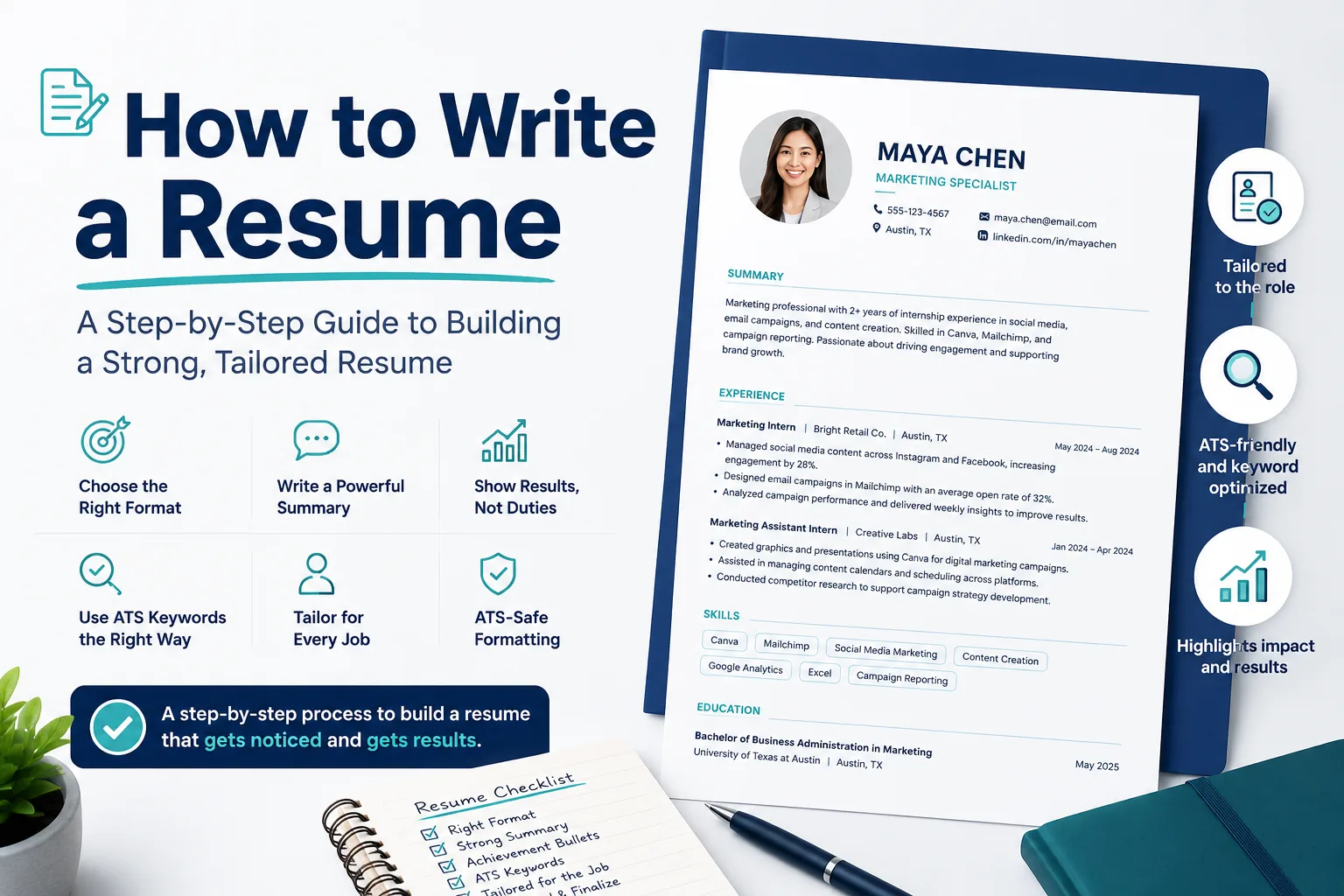
Choose 2–3 qualifications that clearly match the role. Your cover letter should add context, motivation, and evidence rather than repeat every bullet on your resume. If your resume itself needs work, see our guide on how to write a resume before using the cover letter to compensate for missing or unclear information.
Instead of:
- Responsible for managing social media accounts and creating reports.
Show relevance and results:
- Using HubSpot and GA4, I improved email click-through rates by 18% and built weekly reports that helped the sales team prioritize higher-converting leads.
The second version gives the employer something the resume might not: a direct connection between your experience and the value you could bring to the role.
Cut:
Generic praise about the company
Your complete work history
Responsibilities already explained clearly on your resume
Generic claims such as "I am a hard worker" or "I have excellent communication skills"
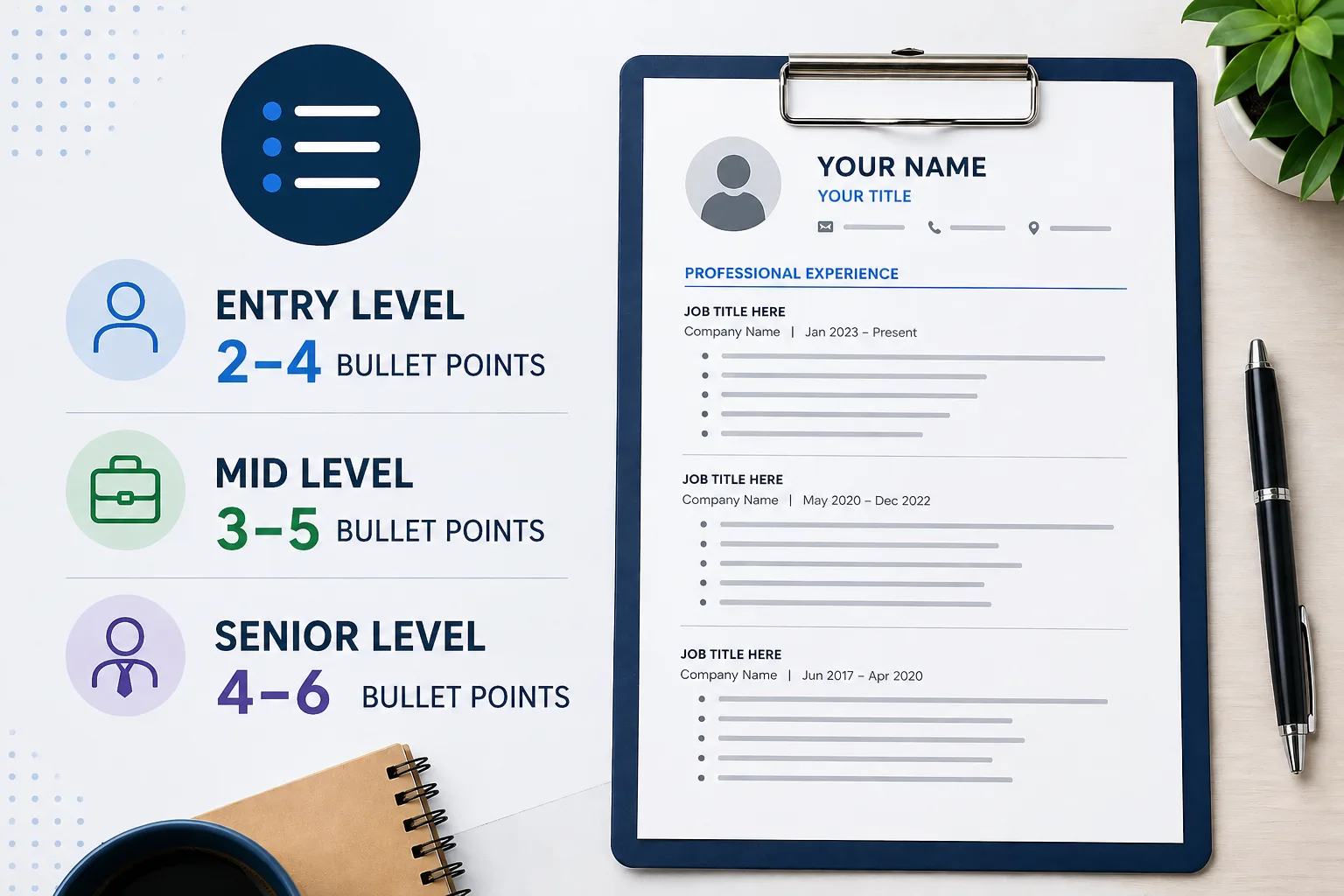
The same principle applies to your resume: resume length should be driven by relevant information rather than an arbitrary page count.
Weak vs. Strong Personalization: Employer Research, Salutations, and AI-Assisted Drafts
Personalization doesn't require hours of research. A quick review of the job description, company website, and relevant team information can give you enough context.
Compare:
- I am excited to apply for this role at your company.
With:
- I'm applying for the Email Marketing Specialist role because your focus on retention aligns with the lifecycle campaigns I built to lift repeat purchases by 18%.
The second version tells the employer why this role and provides evidence.
If you know the hiring manager's name, use it. Otherwise, "Dear Hiring Manager" or "Dear Marketing Team" works.
AI can help with drafting, but don't submit an AI-generated letter without editing it. Replace vague statements such as "I have strong communication skills" with specific evidence from your experience. If you use AI to create a first draft, focus on AI-assisted cover letter strategies that preserve personalization and give you something specific to edit rather than a generic letter.
Formatting for Readability: Font Size, Spacing, Paragraph Length, and Scannable Layout
Good formatting makes a short letter easier to read.
Use:
A standard font such as Arial, Calibri, or Times New Roman
11–12 pt font size
Left alignment
Comfortable margins and spacing
Short paragraphs of roughly 2–4 sentences
Avoid dense blocks of text. A 300-word letter can feel much longer when it's presented as one large paragraph.
ATS-Friendly Cover Letter Formatting: Headers, File Types, Layouts, and Do’s and Don’ts
If your cover letter will be processed by an ATS, keep the document simple and easy to parse.
Use:
A standard header with your name and contact information
A single-column layout
Standard fonts
Clear spacing
Selectable text
A simple filename such as Jane-Lee-Cover-Letter.docx
Avoid:
Text boxes
Tables
Multiple columns
Icons
Graphics
Decorative sidebars
Important information in headers or footers
A PDF is often appropriate when the application accepts it and the text remains selectable. If the application specifically requests or recommends DOCX, use that instead.
Practical check: copy the entire document into a plain-text editor. If the content remains in a sensible order, your formatting is less likely to create parsing problems.
How to Edit for Concision: A Simple Checklist to Cut 25% Without Losing Impact
Once your first draft is finished, edit it in passes.
1. Remove repetition.
Don't repeat resume information unless you add context or explain its relevance.
2. Replace vague phrases.
Instead of:
I am writing to express my interest in...
Write:
I'm applying for the product analyst role.
3. Remove unnecessary words.
"responsible for" → "led"
"in order to" → "to"
"due to the fact that" → "because"
4. Keep one strong example per major qualification.
5. Cut roughly 25% of the draft.
Remote Job Cover Letters: What to Emphasize and How Long They Should Be
For remote positions, 180–250 words is a practical target when a cover letter is requested.
Focus on evidence of:
Self-management
Written communication
Async collaboration
Working across time zones
Reliable execution without constant supervision
Instead of simply writing "I'm comfortable working remotely," show how you've done it.
For example:
In Asana and Slack, I coordinated a product launch across U.S. and U.K. teams, posted async updates, and kept deadlines on track without daily check-ins.
Career Change Cover Letters: How to Explain the Pivot Without Writing Too Much
For a career change, 220–300 words gives you enough room to explain the transition without letting it dominate the letter.
Use a simple sequence:
State the target role and briefly explain the pivot.
Connect two transferable strengths to the new role.
Provide evidence.
Add a credibility signal such as relevant coursework, certification, or hands-on experience.
For example, a project coordinator candidate could write:
In Asana, I managed cross-functional launch timelines for 12 product updates, which maps directly to project coordinator work.
Keep the actual explanation of why you're changing careers to a sentence or two. The employer ultimately needs to know what you can contribute in the new role.
Industry-Specific Guidance: When One Page Is Standard and When Exceptions Make Sense
For most private-sector positions, one page is the practical standard. But there are legitimate exceptions.
Academia: Teaching, research, and academic applications may require substantially more context.
Government: Some applications require detailed responses to qualifications or specialized experience.
Nonprofits: Mission alignment can require more explanation, although examples should remain selective.
Startups and tech: Shorter, direct letters often work better because the emphasis is usually on relevant skills and impact.
Creative roles: Format and voice can be more flexible, but clarity still matters.
The important distinction is between "longer because the application requires more evidence" and "longer because you couldn't decide what to remove."
For example, a government application may legitimately require details about compliance work or specific systems. Repeating your resume does not justify a second page.
Common Exceptions to the One-Page Rule and How to Handle Them Professionally
For most job seekers, one page is enough. Go beyond one page only when the role or application genuinely requires additional context.
If you need more space:
Add information that changes how the employer evaluates your qualifications.
Keep each paragraph focused on one requirement.
Avoid repeating resume bullets.
Follow any length or formatting instructions in the job posting.
Make the document easy to scan.
For example, a specialized government application may require detailed evidence of specific experience, certifications, or systems. That can justify additional length.
The test is simple: Does the extra information help the employer evaluate your fit? If not, cut it.
Ultimately, the best cover letter isn't the longest one. It's the one that gives the employer enough relevant evidence to understand your fit without making them work through unnecessary information.